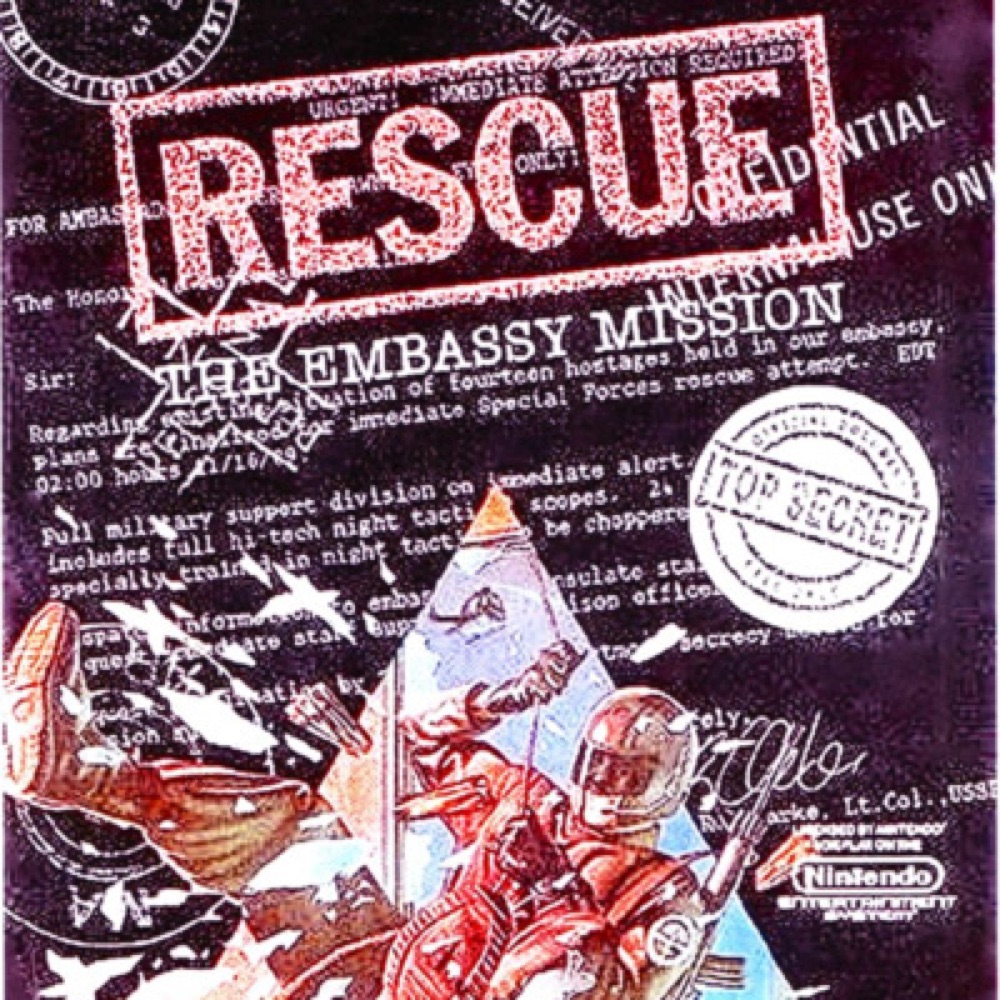
263 · Rescue: The Embassy Mission
Terrorists have overrun an embassy and hold the people inside as hostages. You control six counter-terrorists whose mission is to eliminate the terrorists. In the first part of the game, you have to bring three men into position so they can snipe the building. The second part involves entering the building with the other three men to kill the terrorists and rescue the hostages. Depending on how well you positioned your snipers, you can use them to assist you on that mission.
- Dig it!?
- NES Longplay
- Introductions
- Overview
- A terrorist group has overrun an embassy in Paris. The player takes control of a six-man GIGN team on a mission to free the hostages.
- In part 1 of the game you will set up your snipers around the building and in part 2 you will infiltrate the embassy and attempt to rescue the hostages with the assistance of the snipers you setup.
- Gameplay
- Rank and Mission affect difficulty
- Snipers - Part 1
- the player must bring three men into position so they can snipe the building
- While doing so, the men must avoid the searchlights by diving for cover in doorways, windows and behind fences as well as rolling, crawling and running.
- If the player is caught in a searchlight, the sniper is shot at and risks being gunned down.
- The Infiltration - Part 2
- The building must then be searched, shooting the terrorists and finding the hostages in the process. In some versions of the game, hostages must be taken to a safe room.
- This is like Rainbow Six before Rainbow Six
- Sequels and Spinoffs
- Hostages
- Hostage: Rescue Mission
- A sequel to Hostages, Alcatraz, was released by Infogrames for the Amiga, Atari ST, and MS-DOS in 1992
- EGL
- Next week - River City Ransom
- NEStalgia Byte - Captain Tsubasa II: Super Striker
Auto-generated transcript. Each paragraph starts with its timestamp. Speakers are not identified.
Rescue, the embassy mission. A diplomatic mission in a foreign city is seized by political fanatics.
And welcome to NEStalgia, a chronological exploration of every NES game released in North America. I'm Mike. I'm Sean. And I'm Joe. What a colorful way to describe terrorists. Political fanatics. I mean, you have to be politically correct about political fanatics. Yeah, they didn't want to piss off the terrorist audience, you know? They still wanted to get their money. And look, I know very little about the 1980s because I wasn't born then, so I don't care to read about what happened.
But I'm pretty sure that this was happening a lot in the 70s and 80s, right? Like, hostage situations with the Olympic Games in Helsinki and, you know, that's the best I've got for you, so I'm going to just roll with that one as an example. Sounds like you've been doing some research times before you. No, you know what? I know that one as a weird reason. I was watching a Steve Prefontaine movie. He's an amazing American track runner who died way too early.
And in the great movie that covered his life, as short as it was, that was like one of the things that happened was the hostage situation in Helsinki. Yeah, I mean, a lot of 80s movies would lead you to believe that this was happening a lot. I'm sure, like, it did happen a lot. I don't really know the variation from decade to decade because, you know, one of the most famous examples of it was actually in the 70s. But I'm sure, you know, every now and then there's some hostages that need to be taken.
It just makes you think about the situation in gaming then versus now, because if it really was like a more of a current events thing than ever, now look at, like, Nintendo won't even release Advanced Wars because it's kind of similar to the Russia-Ukraine conflict. So they're like, no, we can't even release that game. Meanwhile, Rescue the Embassy mission is like, it's happening all the time. Let's make a game about it.
Yeah, especially because this is back when I feel like the audience was more kids than it is today. Yeah, I mean, the game's mechanics lead you to believe it's for kids. The content, not so much. Yeah. Yeah, there's blood in this one. That's interesting, right? Oh, yeah. We don't usually see blood in Nintendo games. I thought it was more so you were sort of like tossing an apple into your enemy's chest area. It's open for interpretation.
Yeah. I don't remember apples as part of the weapon loadout, but, you know, this game, for what it's worth, is kind of like Rainbow Six before Rainbow Six. It's a game that sets out to do the job that it, you know, like the whole idea of being a six-man team and going around freeing these hosiers from this embassy. We have seen a few games lately where they don't quite understand the assignment and they focus on one thing in particular. Like the Infiltrator episode, we kept talking about how the helicopter thing was just way too detailed.
Genghis Khan, another one that like maybe didn't quite focus enough on what it was like to be Genghis Khan and take over the Mongol Empire and more just the same strategy game that we've seen before. Genghis Khan, the magic of Shahar Azad, you know, like came up with time travel but didn't really fully execute on it. This is a game that whether or not it's a good game or not, which is what we'll get into in this episode, it completely understands what kind of game it is. A terrorist group has overrun an embassy in Paris and now it's up to you to, in like three different parts of a mission, set up your snipers, infiltrate the base, and then free all the hostages. It's simple enough.
It completely stays grounded in that. It doesn't focus too much on like, okay, well, like, you know, here's how a sniper rifle behaves and like make sure you understand, you know, like make sure you get the timing exactly right. Or like here's how a rappelling down a building works and it's incredibly complicated to get inside the building.
It sticks to the assignment. Do you agree with that? Well, it's interesting because I agree that it feels that way more so than something like Infiltrator. It feels more cohesive and more like, okay, I understand the mission. But really when you break it down, it is very similar in the sense that like there's one gameplay part, there's one gameplay element, and then there's a totally new gameplay element that's introduced halfway through your mission or third of the way through your mission. And then you do that, and then there's another totally new thing.
There's three different gameplay elements that have like functionally very little to do with each other. Like story-wise, it's a progression, but it is like in the same way that Infiltrator is like first you're flying a helicopter and, you know,
talking to enemy helicopters and occasionally fighting with them. And then suddenly you're on the ground looking through buildings to try and find documents. That felt very disjointed. This is doing a similar thing, but I think it's doing it much better. Yeah, I mean, so I think what this game is, it's sort of like one of those funhouse games where it's a couple different mini games,
and it's masquerading as a tactics game. Like, Mike, you brought up the comparison of Rainbow Six because you're like a special tactics unit. In this case, I guess like Gigan or whatever, G-I-G-N, the French one. It's sort of using the language of like a tactics game where you have to do the setup and then you execute. The first one being sort of getting into position. The second one being getting your guys into the guys that are actually on the roof of the building into position. And then the snipers sort of taking their shots to prep for the actual extraction of hostages. But it's like it's always the same thing. Like you don't get to pick where your guys go.
So you have to go exactly where the game wants you to go. There's a little interplay between them. There is some, like if you take out a window with a sniper and you go to control one of the repellers, like that window will be broken. But it's not like the enemies inside are responding to it in any way.
So, yeah, I mean, those are my like first impressions of this, like after playing it for a little bit. Yeah, that's a good point, Sean, that it's not necessarily a lived in world or even a very interactive world. The parts as they're broken out, part one, setting up your snipers, is not something that you have really freedom to explore. You just have to complete that mission exactly as the game prescribes. And then you can move on to part two, repelling from the top of the building down into breaking into the windows to get inside. And then part three, taking out all of the terrorists in order to free the hostages.
Those things aren't like live switching between like move your sniper now to another location to get him around and free up another side of the building. And then like, OK, now live switch back. And I know that sounds crazy, right? But technically they are offering that experience of switching between people that are in the building and people that are outside of the building. It just doesn't really mean that much in the actual game because the game is very focused on only the rules that it's applied to it. It's not like the enemies inside the building are so dynamic and live that you have to focus on both elements.
Yeah, Sean, I like what you said, too, about it being like this funhouse game. Because I was thinking something similar to I felt like each of these sections, like I was playing three separate arcade style games that were like connected narratively.
You know, it's like avoid the lights. And that's like your game. And you've got the context of like, OK, I'm trying to sneak through, you know, enemy fire or whatever. And then, you know, the sniper thing is like kind of this search and hold your gun steady little game. And then the third one is kind of like a twitch reflex, like a like a zapperless wild gunman over and over again as you kind of go through this building. So it's like, yeah, three little mini games that really have no cohesion gameplay wise.
But they but narratively, that's what draws ties them together. But I do think that there's a case for saying that even with the recent streak of 1990s games being multi genre or at least, you know, switching up the control schemes enough to make the game feel different. This is still kind of surprising.
I do feel like not too long ago, the whole game would have been, yeah, terrorists have taken over this building. And now you're playing a top down action game where you just shoot at, you know, various enemies as you climb up the building to get to the top in like a diehard style video game where at the end, you know, like I'm on the 40th floor is the final boss. I think in an alternate universe, this game would have just been like navigating the building. There's a lot more assets.
It's probably the the deepest mechanically of the three phases or four phases, however you want to say it. And I mean, it there's enough to hear to say that the getting into position, the snipers and the repelling are kind of like tacked on to this. Like it's it's not the same kind of multi genre game that we've been seeing a lot of because those have like three or four, two or three phases that are not fleshed out at all. Whereas this has two or three phases that aren't fleshed out at all. And one phase that is just barely fleshed out.
Let's start where with where the game starts you off, which is well, the game really starts you off with choosing your rank and your mission, which affect the difficulty of the game. Rank being like how hard the game is and then mission being the time that you have. The game, though, starts you off in the snipers part of the game where you have to bring your three men into position so that they can snipe the building to do so. They have to avoid searchlights by diving into doorways or windows or getting on the ground low enough that the searchlights can't see them. You can roll, you can run, you can crawl. It's it's pretty it's pretty cool.
It's also very short and very limited in the actual experience. But if the player is caught in a searchlight, even not not necessarily like it's not an instant death. But if you're caught near the searchlight, then the snipers will shoot it. Not the snipers. Whoever's like artillery is watching you through the searchlights. They'll start firing at you. And there's a chance that it'll be a death or there's a chance that you'll narrowly escape if you like roll at the right time or everything. I think there's enough going on here that it's not like I don't know. It's not it's not a chore to put the snipers into the assigned positions or anything. You still have to be on it.
Yeah, I'd say it's like the least interesting part of the game, though, like just getting to where like you didn't have to walk down the street to get into these buildings. Like if this was actually like a tactics situation, you'd have different entrances and that aren't like right at where the enemy can shoot at you, which is also strange because in every other phase of the game, there doesn't seem to be that the enemies don't seem to be aware of anything outside of the building. So it's not cohesive in that way either.
But no, I wouldn't consider it a chore because moving around as these guys is surprisingly fun. It just seems unnecessary. Yeah, I mean, I actually found this part of the game pretty fun. Like compare like I don't know which which part I would say is my favorite. But like this was up there. I like this a lot. Granted, it's the first thing you play as before I even knew that there was going to be like other segments.
But, you know, like you said, you move in like a very fluid and like a fun way where you're diving through windows and rolling, you know, to try and avoid the spotlights and everything. It feels good. The only thing I'll say about it is that it it would get old really fast. I got to believe, you know, I only played so much of this game, but like it's not difficult, really. There's a couple of times you might be like, OK, yeah, this light might get me or whatever. What kind of once you get the hang of it or if you just decide to be super cautious, it's not difficult. I mean, the only downside to that is you're losing time, but it never it never felt like too much of a challenge.
So I do think if I like started playing this game a lot or went through all the missions, I'd be I would be tired of it after a while. But like in small doses, I thought it was very fun. The one thing that I did like about this segment, and it's it's a part of each of them aside from sniping, is that they're the one connective thread between all of these aside from the sort of plot contextual connections is that if you do die. And because it's a team of six, if you do die as one of them, like you just don't have access to that to that dude anymore.
So you'll have a shorthanded team or you'll only have as many snipers at your disposal once you get to the actual infiltration. And same goes for repelling. But that's a much more goofball way to lose somebody. But I did like that. Yeah, that is a cool persistent feature. And then the other persistent feature is that from the very start of the game, there is a time limit. And that is because you presumably only have a certain amount of time before these hostages are are executed. So you have to be quick. You can change that from anywhere to 20 minutes to 10 minutes. And so since the longest possible is 20 minutes, that also makes this a contender for one of the shortest NES games, right?
I guess so. Like the longest the game can be is 20 minutes, but technically there's a mode to beat it in 10. I mean, I guess some arcade games are sorry. Arcade games could be in the running for that, too. But those don't have some semblance of a story and plot. So maybe those aren't part of it. No, every time Donkey Kong falls and hits his head, he he does get back up and then just steal Pauline all over again to have you go back and start from level one again. That it's it's not like the story finished. You just are stuck in a time loop.
Are you? Oh, OK. You can't beat. Are there bathroom breaks? No. Donkey Kong. OK. Just checking. There's no bathroom breaks when you're trying to save the world, Sean. That's true. So why don't you put that on a poster?
Let's do it. Why not? March. Well, so our team here of six are trying to not necessarily save the world, but save these hostages. And after they move on from the sniper portion, you then have to repel down these buildings. And it's funny because this was the only instance I could think of where the controls weren't as intuitive as they should have been, because I did have to go look at the manual and be like, huh? Wait, what makes these guys go? Because if you go down, you just repel down to, you know, to your fall and then die.
You have to go down and then quickly tap the up button on the D-pad to then tap your feet against the wall of the buildings. This way you're actually repelling down, working with gravity. Yeah. I did gather that you had to go down and then up, but I didn't gather that that was trying to simulate the, like, hitting against the wall with your feet element. Yeah, I was also doing the, like, jump down, which I think you sort of jump down if you press left or left and A or something. And that made me feel much cooler because you usually see people jumping off of walls when they repel down and not just, like, slowly inching their way down. But that did take me a minute to figure out because I actually didn't look at the manual for this game at all.
So I was just button mashing for a while and I lost some guys. The guys that you lost, were they the normal named ones or the weirdly named ones? I think they're the normal ones. I think the weirdly named ones are the snipers. No, because there's Mike, Steve, and Jumbo are the snipers. And then Ron, Dick, and Kemco are the infiltrators. I was mistaking Jumbo as a not normal name. Sorry, Mike. I know your nickname was Jumbo. Uh-huh. Yes. And also I'm in this game, too, as Mike. So I get two appearances.
Are you guys grouping these abnormal names and normal names the way they are on screen? I feel like they're mixed up. Like, are you saying Ron is an abnormal name? I'm not saying that. Mike said it. I'm definitely not saying that. I feel like the only names that are not common that I see in here are Jumbo and Kemco. Yes, I'm in agreement. Okay, we all agree. But they're on two different teams. So equal distribution.
No, they're the specialists. Their stats are all, like, slightly boosted to make up for their weird names. Wait, they have stats? No, I'm joking. I'm saying that, like, because their parents were cruel to them, they had to, like, make up for it throughout most of their life. That's true. All right, so you're repelling. Kemco's a cool name. Jumbo, I probably wouldn't want to be called Jumbo. There you go. You're repelling down the building, and then you line up with the window, and then you just press the A button, and then you smash into the window.
Now you're there. You're on the third floor. You could have chose to go down to the second floor. I don't know. Can you go down all the way to the first floor? I don't remember. Yeah. Okay. They start the first. It's like, it's not the first floor, but it's because you don't have access to the ground floor. Right. It's the first floor of the three floors that you have access to in the game.
It's a very European way of thinking about things. There you go. You're inside the building now, and now you are switching to, like, a first person. Not really, though, right? Yeah, I guess most of the time it's first person. Yeah. It's first person. Yeah. It just looks weird sometimes in the rooms. Like, when you're inside the room, then you see yourself. Do you? Yeah, right?
I guess you do. Yeah, you're, like, over the shoulder in the rooms, and then in the hallway you just see your gun. Yeah, your proportion is very small, though. Like, it's very strange. When you're in the hallway, you're just the gun. Yes, and I'm not sure why the change for that at all, but, like, I guess, you know, they are, like, zoomed in more when it's just the gun, so maybe they thought in the room you had to, like, see more of the room, so they switched out to third person.
All that to say that, you know, if it didn't, if Sean didn't even notice, it's not really that jarring of a feature either. It's just changing the view mode for us rather than us controlling the camera. The one thing that you have to applaud this game for is that, yes, it is a first-person game where you have to actually, like,
press the left and right buttons just to turn your body, not even, like, turn to the next rooms or anything like that. You're just turning your body. There is a map in the left-hand side of the screen that really spells out for you with an arrow which way you're facing and the entire floor plan, so this way it's very clear where people could be, where you are, and where the rooms are. I really appreciated this, and I feel like all the other first-person games that we've played so far should have had this feature.
Yeah, it's also a very necessary feature with the way that they will spawn these guys. Like, when you're on the easier difficulties, they'll actually show on a mini-map where enemies are, but that'll also show you that the way that this game populates the map is very strange because you'll walk into a room and it'll look empty, but you know that there's a guy in there.
So you'll have to turn around entirely to realize that in that scene transition, you totally missed an enemy in the room. Because sometimes, yeah, you'll have to turn around and he'll be there. So when you're sort of combing through this place trying to find all the enemies, you have to make sure that you did a full sweep of each room. Yeah, and as far as I can tell, if the enemy is behind you or to your right and you haven't turned to see him, I don't think he'll shoot you, right?
I don't know. I don't think so. Unless I just never waited long enough, or maybe I just never played on a high enough difficulty. But there have been times where I'm like, okay, there's definitely a guy here, and I waited a significant amount of time, and then I turned and shot him. And I was like, I guess he can't see me unless I can see him or something.
Or they're just very polite. Maybe, yeah. It's dishonorable to shoot someone when their back is turned. Yeah, I'm fairly certain that they do have to be on the same screen as you, that they can't just shoot you from within the same room. But that is kind of funny to think that you entered a room, and you're just looking straight ahead, but this guy is looking straight ahead at a wall, not the door that you entered from. Realistically, if they're inside this building, they should only be looking for the doors, right?
Yeah. No one's coming in through the walls. What I think is really probably happening is that your character is wearing bulletproof armor all around his body except for his front. Yeah, that's what I would do. So they can only shoot at you if you're facing them. I mean, but we also have drawn the context that we have been shooting at this building from nearby buildings, so maybe they haven't heard you shooting up the third floor,
and they're still worried about the snipers across the street. And also, it just becomes a game of quick draw when you do see them. It's just make sure you shoot really fast the second you see anybody green on your screen because that's how you take care of enemies. If you stand too still or are surprised by the enemy, you'll get shot at, and that's no good for you. So just shoot as fast as you can. There's really not much else to the— there's not like an aiming component necessarily, right? Not at all. And, you know, I also felt— and granted, maybe I should have played some harder difficulties. I mean, I only played, like, the first two—I think the first two difficulties. But does it ever get hard?
I mean, it feels like— it feels like you have, like, a good two seconds to shoot before they shoot you. As soon as you see them, you just press the shoot button. You have plenty of time. It's not like— it's not like— I'm even thinking of, like, Wild Gunman or— what is the one where you're training for the FBI, whatever, the Zapper games where it's like,
there's things that make the twitch reflexes harder. There's things like, oh, don't shoot the innocent person. Or, like, something happens faster or something happens slower. But, like, it felt like it was always, like, you see someone. Now you have a couple seconds or at least a full second, maybe two, to just hit the shoot button and then you win. Yeah, well, on the harder difficulties, they get much faster.
One thing I noticed, though, is that you can't ever really shoot the hostages. Maybe they start killing them if you take too long. But then maybe—but I don't really—I don't know. Because that would make the timer kind of not fit with the story of the game. But I was never able to accidentally shoot a hostage. But I have been in situations in this game where I got shot or my guy got shot, so I'd have to use a new one.
So, yeah, it does change. It implies that the hostages won't die if you shoot your gun, but they will get injured. And I'm not sure if that affects your ending or not. Because there are other endings in this game. Yeah, I have gotten, like, the—
I did finish one of the harder difficulties with a death, and it said, like, yeah, the mission's over, but it wasn't the best success. Right. Okay, got it. Yeah. Because there's, like, there's success conditions for, like, if all the hostages are safe, but one of your soldiers died. There's obviously the opposite if all your soldiers survive, but you happen to also kill two hostages or injure two hostages, blah, blah, blah. That's not great. And then the last one is 100% success. No fatal deaths except for the terrorists, of course. And the terrorists are green and the hostages are blue. So it's not, like, too complicated, I suppose, especially because it's their entire bodies.
They're completely covered in either green or blue, and you're blue yourself. So it's not necessarily, like, the fast twitch reflexes of, like, Hogan's Alley where they had the cardboard come by, and you have to, like— You're like, I don't know which one's going to be the hostage and which one's going to be the killer. It's like you kind of—you see one or the other. You either see the hostage or you see the terrorist.
Yeah. And again, when you see a hostage, it's like, oh, okay, I'm glad you're here. Nothing can happen. Just like in real life. Yep. And so that's pretty much the game. Like I said, you can change the difficulty or change the amount of time,
but, you know, unless all six of your guys die or you run out of time, you will either win or lose the game based on those conditions. I don't think you can, like, win the game. Like, as soon as all three of your soldiers die, that's like it. You can't really do much from the sniping POV, correct? You couldn't win the game by taking out all the guys from the windows. No, you can just sort of thin the herd that way. Yeah, and I guess, again, this is an instance where it would probably feel different if I played on a higher difficulty, but it really just felt like the sniping minigame didn't really do that much because it was so easy to do everything else without the sniping. It felt like it took up time.
I mean, I could only ever find one guy in those windows anyways, so I shot that guy and I looked forever, couldn't find him. I was like, I'm just going to move on. I think you might have been dealing, though, Joe, just with the difficulty there, is there are less enemies, you know, so I think that you would have seen more in the windows potentially if you're playing on a higher difficulty. That makes sense. On the sequels and spinoff side, this game has a story behind it, but not necessarily an interesting one. It's just a bunch of name changes. So this game came out in arcades as hostages,
then came out on computers as hostage rescue mission, and then was changed for the NES, just the NES, keep in mind, to rescue the embassy mission. I kind of like hostage rescue mission, but then I start thinking about, like, you know, is it unclear? Like, are you one of the hostages now trying to rescue the other people that are being held hostage? Like, that's what hostage rescue mission read to me. Yeah, I guess if there's a colon after hostage, I could see that it should just be hostage rescue mission. Right, right, and there is a colon. That is a mission to rescue a hostage. I like that it just gets more and more specific
as the changes are made. Yes. One thing that I wanted to note just about the developer is I thought it was funny that, like, not funny, but interesting that we got, like, like, an Infogrames game,
because I only know them as, like, they're the ones that made Alone in the Dark, which sort of was the grandfather of all 3D survival horror games, and, like, really nothing else of note that they were always kind of like a middle-of-the-road developer, but French, which I guess explains, like, the Paris angle here. I just wanted to note that, which is, it just tickled me, I guess. Yeah, I never played Alone in the Dark, but, and I didn't know that they were responsible for it, but I know that logo.
It's, like, a weird, first off. Yeah, the loop-de-loops. Yeah, the loop-de-loops, but Infogrames, or Info, yeah, Grames, right? I don't know how to pronounce it. It's French. Infogrames, I don't know, that just, like, always looked, as a, you know, strictly American kid, it always looked like a spelling mistake for Infogames. The R just felt like it shouldn't have been there, but what about, you know, I wasn't worldly back then, so that's my experience with thinking about that developer. They would make a sequel called Alcatraz,
but it was mostly a sequel to the Arcade Hostages game, so I'm not sure, like, how much was changed or whatever, but it only ever came out on computers, like the Amiga and DOS systems and stuff like that, so would you play Alcatraz? Would you like to see what they update? Yeah, let's do it. Sure, let's just do it. Let's just start an Amiga podcast. I heard there's only, like, 3,000 games for the Amiga, so we can get started right away.
It says, The plot Alcatraz Island, once home to America's most undesirable criminals, lies empty and abandoned. Since its closure, it was used as a tourist destination. Now, it is used by the notorious criminal, Miguel Tardiez.
To use as the center of his distribution network for his drug and gun running and money laundering. How many things is he doing? He's doing a distribution network, a drug ring, a gun ring, and money laundering. So, learning that Tardiez is on American soil, the U.S. Navy SEALs dispatch their best operatives, Bird and Fist, their mission to covertly breach the disused prison, destroy the drug and weapons caches, and apprehend Tardiez.
I like it better just as, like, oh, there's somebody at the embassy, make it stop. Yeah, this feels much more involved. It doesn't even, I guess I must play similarly, but it feels like it has a lot more going on and probably has, like, you know, individual levels and stuff like that. Who could say? The only play is the two guys? Whatever. Yeah, just, yeah, exactly. We were playing a six in this one. That's a demake, in my opinion. And we have to give our opinion on one more thing, guys, and that is whether Rescue, the embassy mission, is on the Essential Games list.
I still think that there's a lot of neat stuff going on in this game. It is a fast game. It is something you could experience no matter what, so it is kind of just worth checking out. I guess I just wasn't expecting, you know, even if you look at, like, we didn't talk about this, but when you start up the game, if you just don't press anything, you're greeted to some pretty cool, like,
pixel art cut scenes and stuff like that. And even, like, when you're playing as the sniper and you're going for the guys in the window, like, it's not just some crosshairs view with a bunch of, you know, lines and you just shoot silhouettes. It has a nice, like, it gives a nice contextual to everything that's going on in the game, except for the idea that you can only see straight ahead in a room and that we all have to turn four ways to see everything inside of a room. I don't know about you guys, but I can see a little more than just straight ahead.
So all that to say that, like, while it's doing a lot of interesting things, and we've been seeing that a lot with 1990s NES games trying to shake things up, sometimes when you shake things up, it's not necessarily for the better. It's just to stand out a little bit. I think this is a game that I would have bought. It would have been, like, different and salesy enough with its, like, you know, rescue these hostages by being this elite team of six and you have both the snipers and the soldiers. Like, you know, I think there's a lot going on in this game. I just don't know if I would have actually been satisfied with my purchase
after finding out that that's all there is to the game. So for that reason, it's not on the essential games list, but I wouldn't say that I, you know, like, it's a lot of fun for the small amount of time that it is. So in today's day where you're just, like, downloading mobile games all the time and playing NES games on emulators, you'd really, like, you'd be fooling yourself if you didn't think it was worth checking out just because it's such a short experience to understand. Sean? Yeah, I kind of agree with you in that. I probably would have bought this game had I been around to do so because it sort of ticked it on the surface.
It looks to tick a lot of the boxes that I want. I think, though, one of its greatest sins is tricking me into thinking it's a different game than it is. Like, just a quick look at that map screen that's sort of showing the, like, where you are and it looks very tactical
while you're running up on the embassy and then when you're sort of deciding whether you're going to snipe or repel and you get to place guys where you want. None of those things really matter. Like, it doesn't matter where you place them. You're just going to go to the third, second, or first floor. It looks so much more like a procedural strategy game. Not procedural in the modern sense but, like, a systems-based strategy game where you can get creative with the way that you infiltrate and prepare in different ways. That's not what this is. This is three or four minigames one of which is a bit more robust than the others
with some cool art. I didn't hate it. I think that each of them, like, are good for what they do and how everything contextually fits together is nice. But I can't play this game without thinking about what I originally thought it was and that's a sin that I can't allow them to atone for. So, yeah, maybe play it and get tricked like I did but also not essential. Joe. I'd say it feels like, to me, this game succeeded in what it seems like it was trying to do.
And what I mean by that is that, like, it feels like it meant to be this short little experience with, like, these mini-game elements that tie together this mission that you're on. And I think that in 1990, I agree, this would have been an interesting, unique, fun experience. I feel like it would be, like, even in 1990, I feel like it would be, like, the equivalent of some quirky, weird, like,
one or two sitting Steam game or something, which, like, is fun. But, like, it never gets to a point where I'm like, oh, yeah. Even in 1990, I can't... I'm not sure I would tell people this is on my essential games list. I think I would say, yeah, it was a fun. It was a fun little experience. But essential back then, I'd probably say no, and now certainly not. So check it out. It's kind of cool, but definitely not essential. Next week, we'll be playing River City Ransom, a game that I'm sure everybody has at least heard. I've never actually played it, though. Guys, have you played it? I've played a game that... No, I've definitely heard of it. ...that, like, is named similarly,
but no, not this specific version. Right, not Street Gangs, right? Because that's just River City Ransom in Europe. I'll have to get back to you on that. That's just funny. No, I'm just joking. And then if you... You know, speaking of international games, if you want to join us for our Nostalgia Bites journey, you can join us at patreon.com slash nostalgia for that. And we'll be playing Captain Tsubasa 2. We never covered the first one, so we'll kind of just throw that in too, I suppose. Get it? 2, the number 2. They're actually using the Roman numeral 2 for this. It's Captain Tsubasa 2, Super Striker. It's a soccer game. It's apparently a big deal.
They've been making them all the way since the Famicom. I'm pretty sure one just came out for Switch last year. So maybe you played the Switch one, and you're like, huh, I wonder what the original's like. Well, join us on the Nostalgia Bites episode to find out. We've also got a bunch of other content on there and exclusive Discord and everything, but you've already heard all that stuff a hundred times because you're a devoted listener who listens to the ends of every episode. And so surely you could tweet at us and tell me what happened or what we said at the end of the Dr. Chaos episode because that was such a memorable episode that everybody listened to the end, right?
We'll see you next time.