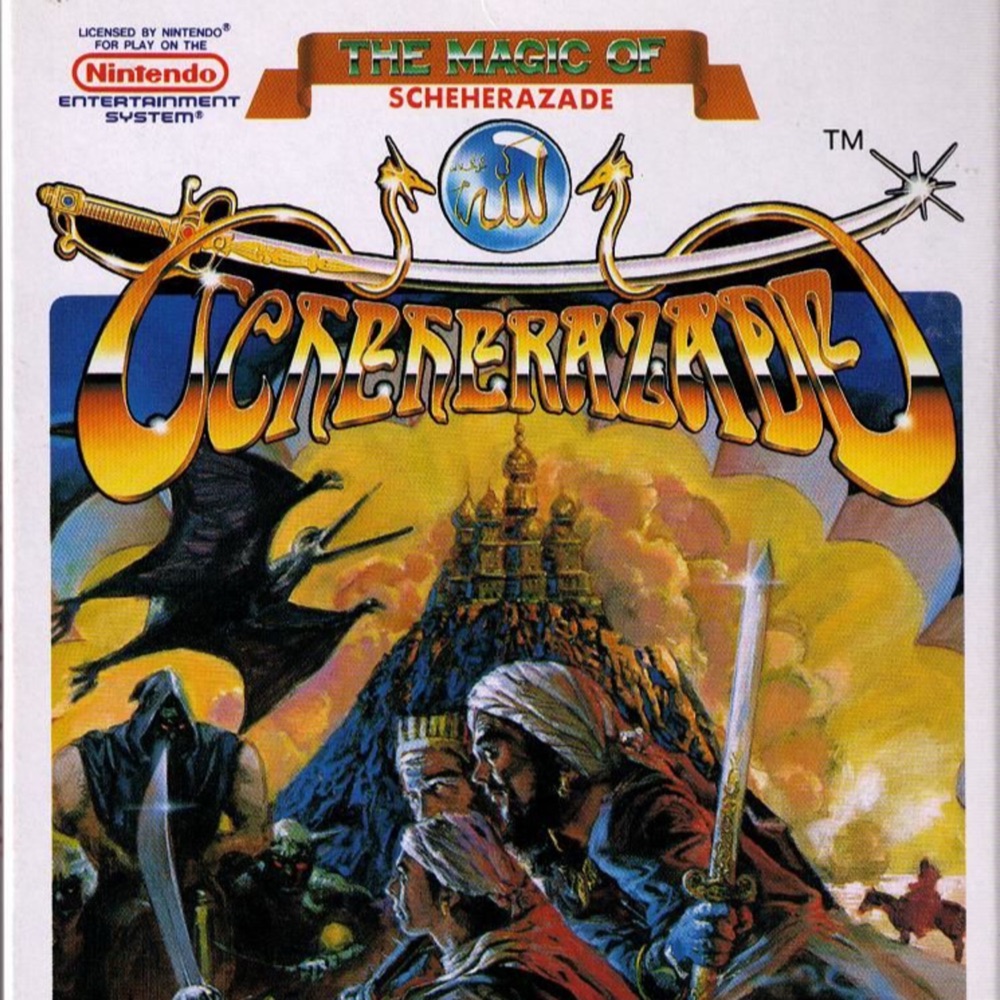
261 · The Magic of Scheherazade
The evil wizard Sabaron summoned a horde of demons to invade Arabia. One brave magician tried to fight Sabaron, but was trapped in the holes of time. This magician is you. Traveling through different time periods, you'll have to stop Sabaron's evil plans and to rescue the beautiful princess Scheherazade he kidnapped.
Culture Brain made and published this action RPG in 1990, loosely based on 1001 Nights. The box brags about five chapters and 750 screens. We liked how much it throws at you, then watched it go stale. Joe called it a jack of all trades, master of none.
What works
- The setting. An Arabian Nights world is a refreshing break from Tolkien and medieval Europe, and the music has a Middle Eastern twang. There are a lot of oak trees in this desert.
- Time gates. Plant a seed in the past and there is a tree in the present. A sunken city can be explored underwater as a city of mermaids.
- The cat. She points out where to use the reveal spell and tells you to talk to the townspeople. If she dies in battle the hints stop, and it is not a game over. Announcing the secret passage does defeat the point of having one.
- Town life. The casino's roulette dealer offers to fix the game for you, and shops give you a better price if you ask politely, but there is a risk: sometimes they get so angry they throw you out and take 10 rupees. A test in the game is almost insultingly simple: pick the right formation and you pass.
What doesn't
- Two battle systems, both unfinished. Random screen switches drop you into turn-based fights where you cannot pick a target. Enemies multiply if you let them live, battles drag with a dozen on screen, and the cramped layout looks like a spreadsheet. Several times a random battle ended a session because it wasn't worth dealing with.
- The real-time half. The controls are tight, but there is no knockback, and enemies do damage every second they touch you.
- Forced time travel. The NPCs all know about the gates and tell you when to use them. The past does not line up with the present, so it feels like a different map.
- It never goes anywhere. Town, enemy screens, next town, time gate. Only the random turn-based fights grow. It feels really long, and Sean figured you have mastered it mechanically after about five hours.
Worth knowing
Culture Brain teased a sequel, first for the NES, then the Super Nintendo, and was still mentioning it in 1996. It never came out.
The bottom line
Skip it. Nobody voted it onto the Essential Games List. The ideas are good, but they are not worth much if they do not work well. Joe called it a "play it" if you like this style, but not essential. Sean said if you are curious, go ahead: "You're not wasting your time. You're just, you know, kind of wasting your time."
Written from our conversation in this episode.
- Dig it!?
- NES Longplay
- Introductions
- I always think about Tales of the Arabian Nights Pinball Machine, but that came out later in 1996. Really one of the best pinball machines.
- Overview
- ARPG with some light turn based combat, recruitable party members, and time travel loosely based on the classic Middle Eastern folktales found in One Thousand and One Nights.
- Plot
- The player attempts to rescue Princess Scheherazade from the evil wizard Sabaron, who has summoned the demon Goragora to do his bidding.
- Why give choices if they aren’t accepted? A lot of times in the beginning of this game you can choose to say you don’t want to do this stuff and they just keep saying the same thing until you say yes.
- Gameplay
- Choose your class
- choose between three classes – Fighter, Magician, or Saint.
- Each class differs in weapon usage and certain abilities.
- For instance, a Fighter can use strong swords but is limited with the rod, a Magician is adept at using powerful rods but is restricted to a weak dagger instead of swords, and a Saint can exclusively utilize items like boots that prevent damage on hazardous floors.
- And you can and have to change classes
- Interesting to get this before Final Fantasy
- An RPG as a linear experience with Levels that are represented as Chapters.
- "Time Gates" that allow for time travel between the past, present, and future; they transport the player to the same location but in a different time and environment.
- Chrono Trigger anybody?
- The novelty isn’t as interesting with NPCs they seem to be aware of the time travel. Faruk was here 50 years ago, if you go there you’ll meet him
- Recruitable characters
- I don’t know why I mistakenly thought that Final Fantasy IV was the first to do this?
- Both real-time solo action on the overhead map and random, turn-based battles fought alongside befriended allies.
- The start of each turn based battle gives the player the option to fight, escape, or attempt to bribe enemies into leaving.
- Formations (learned for a fee at "Magic Universities" in certain towns) can also be created, which can grant the party added defense or enable them to cast powerful group magic spells
- EXP points have caps for each chapter, you can’t overgrind.
- The novelty of an Arabic video game even today is a little upsetting. We just don’t see this setting very much.
- Choose your class
- Sequels and Spinoffs
- A sequel by Culture Brain was teased for the NES, then the SNES, and even as far as 1996 it was still being mentioned, but it never happened.
- EGL
- Next week -
- NEStalgia Byte - Bio Miracle
Auto-generated transcript. Each paragraph starts with its timestamp. Speakers are not identified.
The Magic of Shaharazad, five chapters of magic and mystery over 750 dazzling screens.
And welcome to NEStalgia, a chronological exploration of every NES game released in North America. I'm Mike. I'm Sean. And I'm Joe. And I'm laughing a little bit through the intro there because I've never heard of a video game referring to how many screens of data they have. Like, just imagine like Super Mario Brothers, you know, they probably have called out the number of levels, but not like the amount of pixels across the game.
I'm like trying to imagine like the back flap of a book trying to rave about how many pages it is or paragraphs, I guess, if we're going to get into that with screens. Yeah. Paragraphs, I think, makes more like of a parallel because it's a, it's just so pages. I can at least be like, hey, here's 500 pages of wonder or whatever. Like kind of weird, but like you're getting so specific. Like here's 500 TV lengths of, of whatever they called it.
Sean, you just reminded me of the old Republic's marketing campaign where they were like, yeah, it's like 30,000 page script that like everybody read their lines and everything. And we've been working on this for years and it's like, sure. Like, that's really exciting that they recorded all that dialogue, but is it any good? Like, is it AI generated art? Yeah. It's, that's actually a pretty common marketing thing of just like, yeah, the scripts like 10, 100, 100,000 pages. Like I remember my, one of my games that I bring up every week, Disco Elysium is talked about how many pages that script is. But like it, the fact that several kinds of games of varying quality can have this talked about, it doesn't really indicate that quality.
When I hear the word Shahar Azad, I always think about the Tales of the Arabian Knights pinball machine. But that actually came out later. That came out in 1996, but they're the Tales of the Arabian Knights pinball machine, which is really one of the best pinball machines ever has you complete various quests from the 1001 Knights, you know, folk book that, and the magic of Shahar Azad is one of them. And this is also loosely based on the tale that's featured in the same book. But that book also has like Aladdin and other things in it too. So obviously it's like the Middle Eastern equivalent of like Grimm's fairy tales. Honestly, I didn't know that Shahar Azad was a part of it.
It was, because is it, I mean, I just read this because I don't really know much about any of this lore, but like, isn't it the case that this is like, like a lot of those stories sort of melded together? Yes. And that's why I said loosely based. Yeah. What are some other fun stories from the Book of Mormon?
Whoa. It's, the book is called 1001 Nights. Okay. And as far as I, you know, like I don't own a copy of the book or whatever, but I believe that is where, as I just said, like Aladdin, the story of Aladdin that Disney adapted is from that book. But if you wanted me to just cheat and go on Wikipedia, it's a very complicated page, but I'm sure that there's a story about a genie. I'm sure that there's a story about like nothing else that I can think of. Oh, the 40 thieves, right? Isn't that, isn't that the like Aladdin thing as well?
Are there, is there a part of Aladdin with 40 thieves? I'm sorry for getting you off track. No, that's okay. That's the third movie in the Aladdin series, the Aladdin trilogy. In the Disney Aladdin series. Yes. Wow. I didn't see that one. The books weren't written like trilogies. Sean, you shouldn't come to a 1001 Nights fight without being prepared. I just liked how Joe called it lore.
What's the definition of lore? What's lore? I don't know. When I think about lore, I consider it like stuff that doesn't exist, that hasn't existed for hundreds or thousands of years. So what about like lore that comes from folks? Well, that'd be folklore, but not lore. That's a type of lore, right? There's lore in like Skyrim. There's folklore in cultures. So lore has to be new and folklore is ancient. That's how I see it. Or old. Yeah. Interesting.
I don't know enough to argue. The Magic of Shaharazad is a action RPG with some surprising turn-based combat as well. They kind of had an identity crisis where for the most part, it's an action RPG similar to like Secret of Mana. But then as you're changing screens, sometimes it becomes a Final Fantasy style turn-based combat game with recruitable party members and also some chrono trigger time travel elements. You know, we're going to get all into this. So that was a really poor overview because basically this is a very large game broken up into the five chapters that I mentioned on the back of the box. And if you really want to get nitty gritty, 750 screens. But let's just start with the plot here.
You play as whatever you want your name to be. You put your name in. And you have lost the battle. Like that's how it starts. You've lost, but then you've also lost your memory. And it's unclear why you didn't just get killed if you lost. Like why you were spared. But you lost your memory. And now the Princess of Shaharazad has been captured by the evil wizard Saburon, who is about to summon the demon Gorogora to like destroy humanity. So not sure why the princess needs to be kidnapped in the same process as the demon killing everybody. But who knows what Saburon has for plans. So that's the plot in a nutshell. It definitely expands a lot. Like I said, there's recruitable party members. There's lots of NPCs and world building to this.
The actual layout of the world, rather linear and pretty rigid in the sense of like there was definitely not a lot of thought put into the map making. You just kind of go from one town, travel across a bunch of enemy screens, get to another town, learn some new stuff. But, you know, it's enough of, you know, kidnapping princesses. Seen it once. Seen it a dozen times.
Well, the one thing I don't really understand about the setup here is that, okay, so you've been defeated. And there's this demon that you got to defeat. And the world's at stake and your girlfriend's at stake or whatever. But like, why is the, why is there you forgetting everything part of the story? Like if you forgot everything, why, you wouldn't really care about this princess that you don't remember. Remember, and maybe somebody would tell you that the world's at stake. I thought that that was interesting too. I thought that the, like, to me it felt, I mean, maybe that's also part of the, the lore. I'm going to stick with lore of this.
But, but also like if, if I'm just thinking of it as like a writer wrote this for this game, I'm not sure if that's true or not. Yeah, it felt like it was just there for that, like that moment of like, do you remember? It's you. Like that twist, that plot twist five seconds into the game. But, um, yeah, it did feel like an unnecessary part of the plot, unless it is part of the lore. And in today's games, that would be saved for like the midpoint of the video game where it's revealed you've already lost, you know, here it's done right at the start.
And I agree, Sean, it's a little confusing because then you already know that you lost. So it's not a surprise to you, but the loss of your player's memory just makes it so that likely he, all the spells and stuff that he knew are forgotten, but more so so that he can have people explain the world to you because you don't know those parts. You just know that you lost. So now it's like a construct that way.
My biggest hang up though, and this is most egregious right at the beginning of the game is why give choices to the player character, you, if they aren't going to be accepted. A lot of times in the beginning of this game, you can choose to say that you don't want to do stuff. Yeah. And they just keep saying the same thing until you say yes. And this happened in Paper Mario, the Thousand Year Door, to me as like a kid, and I got hung up there. And I'm sure it happens in many other games, but it just feels so silly to give the option.
Yeah. It specifically happens a lot in Japanese games. For some reason, there's this trope in JRPGs or just story-based Japanese games where you have to be given the choice to do what the game is about. Let alone that you putting the cartridge or disc in your system and deciding to interact with the controller is you giving your consent for the game to happen to you. I feel like this is just like part of that hero's journey, the Japanese version, where it's just like, well, do you accept? You have to accept a call to action. Yeah. And I always found it funny. Like, I'll always say no just to see what happens. And some games will make you, like, replay the entire intro if you do.
But it was funny to see it here. Yeah. I mean, I guess I'd say it's, if for anything, I mean, I agree, but I guess they're doing it for immersion, hoping that you'll pick the, like, correct choice and then just always wonder what would have happened if you said no. So, like, I know some games, like, more, like, you know, not recent, but more recent than this. Like, I remember Final Fantasy VIII had a few times where that happened, but then it also had a lot of times where your choices did, I mean, not matter significantly to the story, but, like, change, like, what you were going to do next.
So, sometimes you're like, oh, I don't know. Maybe, like, maybe I shouldn't mess around and just say no just to be funny here because maybe it actually will change something. It doesn't feel like this game ever did this. It was just, like, right off the bat, yes, no. It's like, haha, funny joke. You're not far into the game anyways, so you can just restart if it does anything crazy. They do it twice in a row. Yeah.
And then following up on choices that seem like you have some agency over them but then don't really matter in the long run is choosing which class you want to be. You can actually choose between the fighter, the magician, or the saint, and that seems like it would carry some weight to it. I didn't actually think that we were going to see something like this before Final Fantasy, which is coming later this year.
But so, say you choose to be the fighter and you're like, all right, I'm the fighter. Yeah, you are the fighter at the start of the game, but later on you'll be able to switch classes. In fact, you need to switch classes at a certain point in this game to complete certain missions. So, missions, I guess, is what we're going to call them. But, you know, side quests. To progress in the plot, you have to change your class. So, it's not quite something that you have to, like, really think long and hard about.
Yeah, there's still enough changed, and I think that happens late enough in the game where it does have an effect on your play style. Like, I think if you're a fighter, your sword is longer, right? Isn't the swing a bit wider? Yeah, each class differs in the weapon that it uses, so the sword is a little better for the fighter, but also, like, the abilities you get, too. So, you know, even if you're not changing, I'm not pretending like you're just changing after each town or whatever. So, you are right that there is, at least it's a little bit more of an impactful decision than saying no to something that only allows yes.
Yeah. I think of it more in the sort of Soulsborne way of, like, the stats are so low, like, when you start, that deciding which class you're going to be is really only going to change your early game. Yeah, so the fighter, you know, has the longer sword, whereas the magician, I guess, uses a dagger, but then obviously the magician has access to more powerful rods that the fighter doesn't have access to. And the saint, since that's not a usual class that we see, I guess the saint equivalent, what would the saint equivalent be for, like, Final Fantasy games?
Well, what is the saint? I only played as the magician, so I'm not even sure what the difference is. They can exclusively utilize certain items, so they have, like, they have these boots that prevent damage when you're, like, walking on spikes and stuff like that, so... Yeah. You know, I guess that's, like, a cool feature, but it feels more like an item. Support class, yeah. Yeah, support class. I did appreciate the little taste of immersion, I guess, where if you do play as the saint, you are barred from gambling. Really? That's awesome. Because a saint wouldn't gamble.
But why would a magician be allowed to enter a casino? It's true. Magicians just win every time. Well, magicians are degenerates and have no morality, so I'm sure that, you know, most people in casinos fancy themselves magicians.
And this is an RPG where there are levels. They're represented as chapters, which is great for the, you know, 1001 Nights theme going around here. But they are pretty linear experiences where it's very defined onto what you have to do. And then once you clear that chapter, it's not like you get to go back to any of that stuff or revisit it in, like, a chapter-select thing.
This is very much the kind of experience that there are, you know, there's missable items, but not story-missable items, which is great because you don't, you know, we've played games where sometimes you find out 20 minutes later that you missed something that now you have to restart the game. This is just more like, uh, it's not the open, expansive world like Dragon Warrior or Final Fantasy will be. Yeah, and I think that works for a game like this, where it sort of branches out and then it'll branch back in before the next chapter so that it's just like a bunch of mini-worlds. So you still get this idea that you have the freedom to go whatever town in each world.
So it's not like you're always going to the right like in a, like a side-scroller or something, but they're able to guide you with a bit more heavy of a hand. Yeah, I think it's also significant based on something I'm sure we'll talk about at some point here, but there's this time travel element to each, well, I'm assuming to each world. I didn't, I didn't actually get to every world, but, um, there's this time door where you go to like some past version of the same world. And I think that that, first of all, adds a lot of like content without making like the map actually bigger and makes it like a little more enjoyable to re-explore the same place
at a different time period and like see the differences and what you can change and what's different, you know, it feels more like, um, it's designed to be these small experiences so then you can compare. Yeah. And the time gates as they're called, uh, it's pretty surprising to see. I thought like Chrono Trigger came up with that idea of like doing stuff in the past that affects the future and stuff. And like, you know, clearly that's just me being uneducated here, but, uh, I, I like that, you know, it's not just the past. You can go to the future too. I don't know if you knew that Joe.
Um, but what you do like, so for instance, the most apparent one is that because the game tells you about it the first time before you go to the past that if you plant a seed here, like they're mentioning in the present, like there's a way to plant the seed here. So when you go to the past, you go to the same screen, you plant the seed. When you come back to the present, now there's a tree there pretty cool.
Like, you know, good representation, very similar to Chrono Trigger where like, if you open a chest and then, um, and then go in, if you open a chest in the past and then go back to the present, like the chest is already open. So you kind of spoiled, uh, the reward cause it's already been opened. Whereas if you do it properly, you can open up the chest several times and get several different rewards. The novelty of the time travel though is a little less interesting here.
One, because it's, it's very forcibly done where you have to, in order to progress, you have to, um, like jump just to the past, do what you do in the past, go back to the present, so on and so forth. But also the NPCs kind of seem to be aware of the time gates and the ability of time travel and like explaining to, to the player, but also to you, the player very clearly what to do with time travel.
Like, um, the character, they're like Farouk was here 50 years ago. If you go there, you'll meet him. It's like, what the hell does that, like, you know, like if you knew about time travel, like why don't you go back in time and meet him? Like what is, what is that about? Yeah. I was very thrown off just by their use of there instead of like, yeah, if you were around back then, then you'd have seen him. Um, it, it very much like everyone here is in on it, but you, and why hasn't anybody else been time traveling? Like, it, it's weird.
Yeah. I mean, and the time travel is very, like you said, very like story driven. It's, it, it doesn't feel like it's a tool that you have that you can utilize in some unique and interesting way. It's like, no, this is when the story wants you to time travel. Like you do it then everything is in place the way that it's supposed to be. You change something that you're supposed to change and you leave.
Not that like I was expecting like, oh, an NES game is going to be like, I mean, even Chrono Trigger to some extent has a lot of that. And then it has some other stuff that like is a little more, um, you have a little more agency with, but like, yeah, I definitely wasn't expecting it to be more like that, but yeah, I just don't want anyone to think like, oh my God, you can go back and, you know, you can go back and kill the bad guy as a baby. No, you can't do shit like that.
And you only go like 500 years into the past. So why do the maps change so much, uh, between 500 years? Like I'm not talking about like the placement of towns or even just like enemy enemies or stuff. I'm talking about like the actual desert turning into a forest. Yeah. A desert turning into a forest, but also like not even, it's not one to one, the same screens. So it's not even like if you remember where you were in the present, when you go to the
past, it'll be like the same layout, but oh, these things have changed. You won't really notice. Like, it's not like the screen to your right from the time gate is exactly the same in the past or in the present. It's like even the world itself like has these life altering earthquakes that change the actual geography. Yeah. At least one is mentioned by like the townspeople, like in the first world, it's like, oh, you know, it's really too bad that that one city fell into the sea.
And like, so I guess you could imagine that some cataclysm struck and changed the geography and the environment. But, uh, for it to be like everywhere, uh, with this kind of change, it's, it's hard to, hard to believe. Yeah. And regardless of the story implications of that, it does feel like, uh, it's just such a missed opportunity because there's something really cool about revisiting the exact same landscape with new stuff in it. Like I know where I am, but now I want to see what it's like in the past. Like, oh, now I bet this guy's in this spot. But if it's not the same spot anymore, then it doesn't really feel like you've traveled to the past and you're looking at like a past version of it. It just feels like you're on a different map.
I thought that sometimes it did it okay. Like with that sinking city, you can go back to, I think it's roughly where that sinking city is in the past. When you go there in the present, you can like go underwater and it's like a city of mermaids. Yeah. Like that's cool. But yeah, it is, it is missing out on the opportunity to like make you go back in time or forward in time or whatever and be like, oh, I know this map.
I just don't know what I'm, what I'm going to run into now. Right. And it's a pretty, you know, we were saying that these are level based missions and stuff, but it's a pretty expansive game just in terms of what you'll do in the levels and what you'll find and what you need to be doing. So the manual is very surprising because it's actually, it's like 40 something pages and it's pretty in depth. It's not a strategy guide.
It doesn't give you like maps or tell you like starting the game, here's what you need to do and stuff. But it really is a good lay of the land in terms of everything that you can do in this game. I don't know if you guys looked at that or not. It really is just an actual manual, very similar to like board games that give instructions about like every single thing that you can do. And then you just like. You're like, well, maybe we need to play the game a little bit to understand the rules. That happens to me a lot in board games. It's very similar with this.
How did you guys make just getting around and figuring out what to do in the game? Was it, was it something where the NPCs were very helpful in giving fetch quests that were very obvious about your next steps? Or did you find any obtuseness to it?
I, I think so. So usually I will, I will read the manual before I play these games. It's, it's kind of rare when I don't do it. Um, this time I took a look at it, saw the length, skimmed the first few pages and it was just like, I, I can't, I'm just going to play the game. Um, and it actually turned out to be pretty easy, but not, not like easy at like the most extreme cases, but unlike a lot of games that we played, this one kind of holds your hand to some extent. And like you, you can just figure out what a lot of the mechanics of this game are just by playing it. And, um, like for example, when you enter a screen with a hidden door, your cat will just say like, Hey, use that thing and something will happen. And so you do when it does.
So it's not as obscure as I was expecting without any manual knowledge. Yeah. I noticed that too. I mean, I would say that it's, it is some, it does fall somewhere in the middle of like the best and worst cases of this that we've had so far where like there were times where I didn't know what to do. And then there were other times where I mean, gratefully, what was, you know, what was that cat lady's name?
Caronia or Caronia? Caronia. Um, she would like, when you go somewhere, she kind of like says, talk to the townspeople. Like she says like what you're supposed to do in that spot or like use your, uh, there's like a reveal spell. I don't remember what it is, but like use that here. I bet something's here.
And it's like, it felt like a solution to that whole thing of like, oh, there's like a random spot that we would never guess that you have to do one specific thing to open up a door. Like it felt like a solution to that. But also I noticed that if you let her as your companion die in battle, then you don't get those hints anymore. Oh, that kind of felt like a cool, like it made her more than just like, um, either a tutorial person or a companion that just fights in battles with you. Like it made it like, oh, she's, she's living and breathing in this world. And like, Hey, if she dies in a battle, she's not going to do the tutorial thing for you.
That's pretty cool. I actually didn't know that. Yeah. And it both like gave you a little bit of, um, agency, but also like agency to decide when you want your hand to be held or like decide how important that is to you when like
deciding when to use her or protect her. I do think that having the like, Hey, there's a, there's a hidden thing here. Better use that spell for finding hidden things. Or when you're like passing through the gates of a town, like, oh, you better talk to the townspeople here. I mean, I think that is going a little too far in the handholdiness, but I do appreciate that there is an effect, uh, to letting her die. And it's not like a game over.
I, I, yeah, I think my opinion would, it would probably meet you in the middle there where like, I think that saying, Hey, this screen, use that magic. That'll show you the secret passageway completely defeats the purpose of having a secret passageway because you might as well have it there. If you're just going to tell them how to do it immediately when you get on that screen. But I do like the, um, Hey, talk to the townspeople.
Like, I mean, then you're like, okay, that's how I figure out where to go next. You still got to talk to the townspeople and interpret their cryptic, uh, words to figure out where to go next. And Corona is one of your, uh, many allies that you can have in this game. Uh, those are the recruitable party members and they're only accessible during the turn-based combat during the action RPG combat.
It's just, uh, you, the player character, uh, on the screen and it top down legend of Zelda style. You swing your sword or use your rod and, um, fight these, uh, and fight the enemies on screen. They randomly spawn in on the, on the particular screen that you're on, or they don't, it's not guaranteed. So you can just kind of keep shuffling back and forth between. And then when you deal with all of them, they don't just continuously spawn. That's it for that. And then you have to continue to move on. Interestingly though, just for the like ARPG portion of the game, I found it to be like,
I don't want to say like too simple or whatever, but compared to the turn-based combat, which gives a lot more options. It has like formations and party members and, uh, supplies that you can give to, to your allies before the battle begins.
It just felt like really two separate experiences where the turn-based one maybe should have been saved for not just random screen switches and more for like big impactful battles and that the action role-playing probably could have just kept the majority of the game. Yeah, this is where my tone's going to shift because they have, they have designed two battle systems here, the active and the turn-based that both feel like afterthoughts. Like there's some interesting things going on in both. Like, um, in the turn-based, like you can hire mercenaries that sort of act as meat shields slash, uh, sort of auxiliary attackers. Uh, you have access to any arrangement of the, uh, companions that you've met across the way, each of which have different spells.
Um, but on the other hand, like the, the, the fighting is just, it's so simplistic and it's missing some very key features just to like make it make sense in any way. Like in the turn-based, uh, portion, you cannot select your target. Like it either, either the spell hits everyone or it hits one person. And then the next attack is going to hit the next person in line so that you'll end up just very lightly spreading around some damage. And there are enemies here that will multiply if you let them live. So it just becomes like a headache dealing with these things. And when it comes to the action RPG, uh, the action, uh, there, there are only so many different variety of different varieties of enemy, at least in terms of function.
Um, and while I think it's cool that, you know, even with your sword, if you time it right, you can like dodge projectiles, like there really isn't much going on there either.
So yeah, to me, bottom line, they both feel underdeveloped. Yeah. I mean, I felt almost exactly the same way that the, the, what you were just saying about the, um, turn-based having, lacking the option to choose your enemy just felt like it, it, a crazy oversight to me. I mean, I, it felt completely like unfinished in that sense. And then for the action part, to me, what, what really got me was I, which I do think that I think the action part was a little better developed, uh, than the, um, turn-based, but the fact that there's no knockback whatsoever really was bothering me.
Like, like enemies will come up to you and just like, they're just doing like damage per second as they're touching you. And like, it sounds like it'd be easy to get away, but there's like a lot of times where I'm like, I would like to just get a little feedback that I've been hit. And then like turn around and like run or whatever, like even Legend of Zelda is doing that. Um, I mean, I guess in Japan, these came around or this came out a lot closer to Legend of Zelda, but, um, than it did in the U S but, but still, I, I just felt that both of them, it felt like it was biting off more than it could chew.
And I, and I, you know, I'm interested in the idea. I'm not sure that I fully, uh, am behind the fact that like, that I could see this turn-based and action working together for me, but like, I'm interested in like a game really polishing both those things together. But this game particularly, I feel like would have just benefited from focusing on one. Yeah. I, I remember specifically during a couple of play sessions, like the action sequences are very simple, like we said, but at least it's, it's, it's fast paced and it's very fast to react to you. Like the, the controls are at least tight in these scenarios. And so you can sort of be in and out of an engagement in like 30 to 40 seconds.
But when you fall into these random encounter where you're going into the turn-based mode, they drag or they can drag because there could be like a dozen enemies on the screen. And I know that I think that there's a, uh, in the beginning of the game, you can select like slow, medium and fast. And I don't know if that affects the text generation or if it's just like the speed of the game in general.
Um, but you have to wait for each prompt to populate and then despawn and then the next turn starts. And like, it could be a very simple fight where you're just hitting attack over and over and over, but it can take forever. And there were several times where I was playing this game where when I just got into a random battle, it just ended my session because I did not feel like dealing with it.
Right. Yeah. The, the tech speed is what the, uh, slow, normal and fast is just so you know, it's not about like the game runs faster. Yeah. I figured that. Fidelity mode and performance mode. Right, right, right. Uh, but well, I don't want to like harp on the, uh, on the turn-based thing, but the other thing that I have to mention too is like just the way the information is presented on the screen is so not fun.
It's like, like your enemies are all just in a line at the top of the screen. And if there's a bunch of them, it gets a little, a little cluttered. And then you and your party are like crammed into like the right side of the screen. So you're not even across from the enemies. And then the text is like, it is like taking up that corner between you and like all of the like information as far as like your, your health and your magic and your, your bread and your, what's that? I forget what the other thing's called that you, your shuma or something like that. Yeah. Mushu. Yeah.
The mushroom. And like any, you can hire mercenaries. You get them to like, it's all like crammed into like, it almost like, it gives me like the vibe of like, I'm looking at like a spreadsheet of information or something. Like it's all just kind of clustered in one corner.
It's just like counterintuitive. Even I feel like even back then when you're like, when you might say like, well, there's not really a precedent for it, but like there's precedent for like a person facing off against another person and they're not kitty corner to each other. They're not like, like a right angle to each other. Like, I don't know, maybe that's a nitpick, but it just looked weird to me and it just made it. But I mean, I guess it drew even more attention to the fact that I'm not picking who I'm attacking because I have no idea like who I'm facing anyways.
Like at least I could see if I'm across from it. If you're like, no, the, you know, each character can only attack the person they're directly across from. Like not ideal, but at least it makes some sense. This I'm just like, okay, I guess I just select and he's going to attack one of these guys. Mm-hmm. The switch to between turn-based and real time. The interesting thing there is that the, just the whole like game is different in the sense that in the real time battles, it's only ever just you.
And it's kind of weird to think that like Corona or later on, like, you know, there's a genie, there's a flying monkey. There's all sorts of different allies that you can get, but they're never there to help you other than in the turn-based sections, which seems a little strange. But then there's also like magic that you can only use in the turn-based sections or
this, you know, the, the functions of the bread and the mushroom that we were talking about. Those are just items that automatically get used. You don't have to like use them. So if you have bread on you, when your HP finally like is at zero and you should be dead, you'll eat the bread and recover 50 health points. And I just wonder like, what does zero health points mean to this game? Why would you be able to eat bread and suddenly recover? What's in that bread? Yeah. I mean, again, that that's a part of management. You should have to use the bread when you see that you're getting low.
Otherwise there's no strategy to it. It's just an extension of your health bar. Yeah. And just, you know, the combined magic and stuff like that, like formations, it just feels like there's a lot going into the turn-based thing that I think it surprised a person at first. Like it definitely surprised me how like prevalent the turn-based combat was. I thought it was supposed to be some like neat little, like every now and again, it just switches to turn-based combat and it's a bigger fight. But then like I entered a cave and it just became like nonstop down in the caves, like turn-based combat.
And I just wasn't prepared for that. The game, obviously like it's an RPG, you gain experience points both in turn-based combat and in real-time combat, but it has a level cap too, so that you can't gain like more than five levels per chapter. So this way you're not like super strong or whatever, which I kind of admire, but not when like it's pretty much required to make sure you get all five levels before you move on because you don't want to be underleveled.
Yeah, I guess I didn't exactly notice that there was that cap, but it almost seems, I don't know, this game does hold your hand and it doesn't pose a lot of restrictions on you. I guess I wasn't expecting it to actually restrict its own systems. I was watching some people play the game and like they are just gaming the economy, so it's not like they've completely like solved it.
But yeah, I guess I just wasn't expecting there to be a level cap too. Well, so about that level cap though, is it, it sounds like from what you're saying, Mike, that it's, it's not at, in, in level one, you can, in world one, you can get to level five and in world two, you can only get to level 10. It's like, if you leave world one at level two, then in world two, you can only get to level seven. You know, I didn't get five per world. I didn't test that, but my understanding is the first option, Joe, that like, if you, if you got, if you somehow finished on just level two in, in chapter one, when you get to chapter two, you can get all the way up to 10, but not 11.
Okay. Well, that's not as bad then, because then you don't have to worry about locking, you know, like I can grind later if I need to. Yeah, but I'm just as in, like, you know, it's a, the turn-based combat in particular, because you can't choose which enemies you're fighting and your allies are computer controlled. So they're not, uh, sorry, not, are they computer controlled? I can't remember now. Yeah. No, you control them. Okay. Yeah. In the turn, but yeah. Right.
So yeah, you can do it. You know, there's just something about if you're not properly leveled for it, it's like, you know, depending on how many turn-based battles you run into, which again are random and stuff like that on top of the action combat, which is sharing the same health bar and everything, it's just, it's a lot, you know? You kind of do want to make sure, even though they're trying to not encourage grinding, you kind of do want to make sure that you have all five levels before you move on.
Yeah. I mean, I, I always go back and forth on that kind of thing where I like that it, I kind of like things like that sometimes because it, it gives you a reason not to grind further than that, it's like, it gives you a reason in this game, it probably doesn't apply because it's like the turn-based combat, like we've been saying, isn't particularly like something you're seeking out because you really want to play the turn-based combat, but, um, but
like it gives you enough incentive to do a bunch of, to partake in a bunch of battles without making you feel like, well, I should just keep going because I might as well get more powerful. Like it gives you also incentive to stop and continue with the rest of the game. I like that idea in a lot of other games, Chrono Cross being an example where it's like
after, after a boss battle, you kind of get like five level ups that come relatively quickly. It was basically like five battles or less. And then it's like, okay, so I can grind for the amount of time that's like to level up and then I can move on and not worry about like random encounters and stuff like that. It doesn't work as well here because the game's not designed around it like Chrono Cross is. Sean, you mentioned that you can gamble in some of the towns.
Uh, there's a lot that you can do in these towns other than just talk to the NPCs. Um, in the past, but not the present for some reason, there are universities that you can go to and learn, uh, take courses and some require you to even, um, answer like, you know, your understanding, uh, take a test. But for the most part, there are other ones that's just like probably more useful ones too, that you, um, select the course. And then at the end, they're just like, great, here's a powerful item, you know? And it's like, okay, thanks. Here's the scimitar.
Yeah. Why didn't I have to take a test for that? Yeah. The funniest one is like, you'll take a test in Cygnus and Cygnus is just a, an arrangement. I guess it's a four. Yeah. It's a formation for when you're fighting a specific group of enemies and, uh, why that's a thing. I don't know. But regardless, after you take that class, it will then give you a final exam.
Like, which, which was the name of the formation that I just taught you. And then you have to select from Cygnus and then like three Zodiac signs and you put, you select Cygnus and they're like, great, you passed. You are now an expert at this formation. It was, it's very weird. I don't know if it was supposed to be funny because there is some humor in this game, but it otherwise struck me as just odd and super like almost insultingly simple.
Yeah. It's, it's, there's not a lot of depth to it, but it's nice that like these towns aren't just, here's where you save, here's where you heal. Um, and then here's a bunch of NPCs walking throughout that have, uh, randomly nice information that will help you do the exact thing that you're looking to do. Like, I don't know about you guys, but like in my, in my daily life, random people don't necessarily help me get things done in my day to day.
Really? You know, sometimes when I was living in New York, I would stand on the corner of the street and be like, Hey, can you help me find a, I lost baseball cards scattered throughout the city. Everyone you bring to me, I'll give you a dollar. Right. I just, I just behave like an NPC. Yeah. I kind of want to just find like a, a fun fact to repeat to other people. Yeah. You know, the subway was founded between three different companies. It wasn't all one system. But it's gotta be something that you, it's gotta be something that you think will come in handy in their, in their day later. Like that they be like, you might need that information later. Well, I was thinking maybe I'd just be one of the lore guys. Oh, okay. Gotcha.
Well, it's real life though. So folklore. Well, it's a game clearly taking on like the MTA or something. Yes. You fight, you fight the MTA. Sean, you're like our degenerate gambler here. So how's the casino work in this game?
Um, it's roulette, uh, but they're crooked and the, uh, the dealer slash person that throws the ball around the circle will just offer to fix the game for you. So I don't really know like what, uh, how gambly it is. I didn't do it often because I was like, that's weird. Um, so I mean, if you know a, a dealer at a casino, maybe it's kind of like that. You know, there's a lot of that in this game though. Not just even the casino and not just the idea that like everybody can be bought, but everybody can at least be bartered with. Um, there's the shops that like, all you have to do is just ask the guy for a better price and he'll just give it to you. Oh, here you go. Yeah. I forgot about the discount button. You forget that you have to ask politely.
Yeah. But there is risk. There is risk that cause some, sometimes they just will not have it and they'll get so angry and throw you out and just take 10 rupees from you. Oh, so you abused it. No, I used it like, I mean, I used it at one place and then I went somewhere else and tried it one time. And on the first try, he's like, he just got mad. Wow. Yeah. I remember using RNG or I think I used it on the same shop and two different time periods. So maybe that has something to do with it, but maybe I also just got lucky with the RNG.
This conversation reminds me of the infiltrator. Show me your papers discussion we were having the other week where it's just like, who knows what, what upsets these guys, but also like, who knows, uh, in battle too, you can make peace with the, uh, with the enemies in the turn-based combat. At least you're able to, um, offer, uh, paying the money that, uh, you know, like a large sum of money and then they'll go away.
Uh, maybe if they, if they refuse the money, then you have to fight them. But I think it's funny that I don't know Middle Eastern culture or even just like what this game's getting at, but like everything has a price in this game. Everything can be bartered with, everything can be adjusted. There are spells to just cast that automatically refill all of your items and all of your wallet. It's like, what? Like a lot of this game can be broken if you just know, uh, the systems, I suppose. I also just like the idea that like a slug or something wants your money.
It's also tender in slug land. What do you guys think about the novelty of an Arabic video game? Uh, because even today, like we don't have that many Middle Eastern settings. Uh, you know, I think about like the first Assassin's Creed game kind of had, had that. And there's not like Persia Prince of Persia. Yeah. I mean like, you know, those games are always great too. Like we just talked about two great titles. Uh, I don't know how well the first Assassin's Creed game holds up today. I played it when it first came out, but there, you know, it's surprising that like, so many RPGs just have, um, I don't know, like, uh, Renaissance times.
That's standard Western European. Yeah. Medieval times. Right. Yeah, exactly. And, and so to see a different kind of, uh, you know, setting and just a different kind of culture, uh, did give this a bit of a unique feel to it because like we're, you know,
they probably should have embraced it maybe even a little more and make the classes like more distinct to the setting. But, uh, I, I, I wasn't expecting, uh, this game to be like so large in scope and size. I was, um, surprised too. And I, I thought it was a very, like, it was a refreshing change, you know? And I love that, like, uh, whatever, like that style that like medieval Europe based style that we see all the time or whatever, like, but, uh, but it was cool to see like this type of game in a different setting with like different, I mean, it's just a different aesthetic even.
Like, it was kind of neat. Yeah. I'm actually, I have never been a fan of, or I mean, like, it doesn't bother me when games are like it, but I've never been a huge fan of the standard fantasy setting. Like the, the, the Tolkien, uh, stand. Yeah. With orcs and goblins and elves and all that. But, uh, so yeah, any change in aesthetic I'm into.
And while it, I think it should have gone farther, like you said, Mike, uh, just having that as, uh, as the baseline was, that was a breath of breath of fresh air. Big. I think they could have done more, especially with the environments. I feel like there's more green space in this game than there is in the Arabian Peninsula.
Uh, but yeah, I agree. There's a lot of, there's a lot of oak trees in the desert. Yeah. And we only did like the surface level plot and everything like that. But do you guys have any thoughts on how the game evolved chapter over chapter? Uh, I, you know, I'm not interested in how far you got or anything, but just wondering like, is there a feeling of progression that is expected in RPG games? You know, you're supposed to be by the end of these games and Uber strong, like casting ridiculous magic spells and having a large party.
Like it is that experience found here? Well, I didn't get incredibly far in this game, but I, I did like that as you gather companions, when you're sort of traveling on the carpet, uh, there is banter and you like, you get this feeling that you have sort of, uh, created a team that has interaction with each other. Like they're in previous like RPGs that we played that have a party or early, they're not so much on this podcast, but early RPGs that have a party. Like it just seems like they go to work, they don't talk, they just fight together. And then you talk to the King and you take your next quest.
Whereas in this, it seemed like a group of people that were like teammates and, uh, actually had interpersonal relationships. So that was interesting to see. It was pretty much for me, at least, I only saw that when you're traveling between worlds, but it was cool to see regardless.
Yeah. Well, and also to build on it too, the, even though you don't see it other than traveling between worlds, most of the companions that you're getting are like, you're getting through some, they're part of the story before you get them in some small way. So they feel a little more like real, you know, than just like, yeah, here's your starting party or anything like that. Like, it's like, Oh, you got to go find, I forget a lot of the names, but like that, that first companion you find outside of, um, Corona, like a lot of people are talking about him for a while. You're like, I'm like looking for him. I need for him. I'm like, I know he's important.
Yes. Yeah. And then there's the girl, but I, uh, I think in the mermaid town where you just get like a hint right outside the door where you find her. Uh, like somebody says like, she's cool, but she's also kind of a square. And then when you walk in there, she'll just out of nowhere ask, Hey, would you ever ask a girl out at a hamburger shot? Yeah. And you have to say no, because you know that she doesn't know how to party.
Um, and then she'll come with you. So little things like that were cool. That's really not answering the question of like, Oh, was there like a feeling of progression? I guess I'm just talking about like how the game unfolds in a way. Yeah. I get it. And I would just say that, you know, to argue a little bit back on the progression thing, I actually think that the game doesn't really go anywhere.
And it's kind of surprising how much of this game. And it's mostly because of the ARPG side of things, the real time combat in the, in a game that like legend of Zelda, you really do gain new items that are very useful that make fighting newer enemies, more exciting and fun. And yes, the enemies are now harder, but you have new ways to deal with them. That doesn't quite happen in this game. You're just switching between projectiles and melee combat. And so are the enemies. Uh, it's, there's not really a lot to it. And that is a bulk part of this game. So it's kind of funny if you like, if you just jump through a long play, it's amazing how similar most of the game looks from beginning to end, but also the whole like layout of just
the way that the world is built, where you start in a town, talk to everybody in that town, Corona will still remind you even towards like the final chapter, like Corona will continue to remind you, talk to everybody in this town. You do all that. You explore a little bit, probably find some secrets along the way or whatever, but then you're just in the next town and you do the next thing and then go through the time gate.
It's not as they built a lot of systems in this game. And I know this feels more like my vote, but I guess I'm just saying like, it never really evolved past what you experience in not necessarily just the first chapter, but maybe like in the first hour of your game. Yeah, no, it all is, it's kind of a, what's the word I'm looking for?
Recursive. Like if you zoom out and you zoom in, it all looks the same because you're, you're kind of doing the same routine everywhere you go. Yeah, I can see that. I mean, as far as like your character's abilities, I feel, and again, I also didn't get, usually a game like this, I mean, I, I get a lot further than I did this time. I think this is a game just feels really long because, because of the, I mean, we haven't had a lot with the turn-based battles and they take so long in this game. I know like a full playthrough, uh, like, like a perfect playthrough is like almost five hours, uh, on YouTube.
Uh, so just saying like, I didn't get too, as far as I'm going to be done, I think it's like the third, third chapter, but, but I was feeling like my abilities were evolving somewhat, you know, a noticeable amount, even like the rod.
I don't remember getting these upgrades, but I feel like the rod became like fireball instead at some point. And then it became like starlight or something. I'm getting this totally wrong, but like, I kept looking at my inventory and be like, oh, the rod has been replaced with this other thing that like apparently is more powerful. They kind of sneak them in there. And the spells you get, yeah, the spells you get do, um, like, I know like later on there's one that's like a dragon spell or something. And it like, it like the whole screen flashes with like fire and ice and like, it, it, it, it tries to give you that like, oh, you're getting more powerful feel at least.
Yeah. And I think that's you, that's mostly done in the turn-based combat where, you know, most of your options fill out. You know, you have a lot of magic choices, the, the formation stuff, uh, things that we can't really like break down in this podcast, but it is funny how the turn-based thing, the thing that happens randomly and not on every, you know, like not, not predetermined is the thing that grows, but the act, the real-time combat is the thing that kind of like, yeah, the, the sprite changes and it does more damage and stuff, but the actual experience of it,
uh, me personally, I didn't feel like it was evolving. No. On the sequels and spinoff side, it looked like we were going to have one, but I'm pretty sure this game never came out. You see, there was a sequel, uh, that Culture Brain, the developer teased for first the NES
and years went by and then it randomly showed up again as a listing for the Super Nintendo. And even as far as 1996, it was still being mentioned as like, you know, right. Not even like, you know, Oh, 1996, like, okay, we're going to rework it for the N64 or whatever. It was like still being like, no, it's going to be a late Super Nintendo game. It's going to have all these awesome features, but it never came out.
Wow. I wonder what did, what did it in? That's a shame. Yeah. Because think about like everything they could have expanded upon. And especially if they were still working on the game by 96, they would have seen like, what Final Fantasy and Dragon Quest and Chrono Trigger were able to do. And they could have taken all of those awesome systems, but worked them into this unfamiliar setting. Well, maybe that's what happened. Like they saw what those games could do and they saw what they're working on. And they were like, Oh, well, that could be, uh, maybe we shouldn't.
Yeah. I mean, I would have loved to see a Super Nintendo sequel to this if they could have pulled it off though, because I, I do feel I love this type of game. I mean, it's no secret, but I feel this is more just from like cultural awareness than necessarily all my personal experience, but some personal experience that the Super Nintendo really perfected this thing that I love about these, especially based on like what we've played
in these early games, uh, on the Nintendo, like I would love to see what this could do on a Super Nintendo where there are other games like Secret of Mana and, and Chrono Trigger and everything like that, where I'm like, like those feel like they've polished this formula that I already love so much that I would, I, in a way that like in a type with a type of polish that I think that this series, uh, would definitely could benefit from.
Interestingly enough to the game was going to be called the, uh, the magic of Shaharazad the prelude. So I wonder if you would have played the story before you get to the point where you lose and maybe like, you know, the end of the game is like you use the time gates to appropriately win that time instead of losing and setting up the, the sequel. So it's kind of like, uh, erasing the events of the first game by doing it right the first time. That could be really cool. I like that plot element.
I totally just came up with that based on the title, but I will take my money culture brain. If you're out there, let's, uh, let's make something happen. Well, we have to make one more thing happen on this episode. And, um, I don't think it's, uh, it's still, you know, it's still a toss up. I don't think it's been decided, even though I said I kind of gave my vote, but what we are voting on is something we call the essential games list.
So I was talking mostly about the progression, but I do want to say in regards to the whole game, it's another one of those games. That's very impressive for all of the things that it offers it. We, we talked about them and we only like got to like the surface level of things. Like I feel, I feel that the game is owed a, uh, at least a test because I've, this is the kind of game that is either like a hidden gem that not many people talk about and, uh, you'll think it's great.
Or there's a reason why nobody's talking about it. And, uh, the magic of Shaharazad was definitely not a game I have heard much about, but when I was playing it at first, I was kind of like blown away and I was taping up notes for the episode and I was like, Hey, you get to, you know, choose your class and you have recruitable party members and you can, uh, you could travel through time and there's two different types
of combat, but the more and more you go through the game, like I was talking about in the progression section, that's where it starts to actually become less impressive. And you start realizing like, yeah, those are really neat ideas and features, but they're not worth much if they're not working well. And for me, they weren't working well.
And I don't think that this is a, like, it's not a terribly long game, not a terribly hard game, but it does make you, you know, with the limited time you have in today's world to play video games, it does make you question if you want to keep going on. And that's not something that I like to experience in games. I don't like to experience the, uh, you know, start, stop, start, stop, start, stop that comes with a game like the magic of Shaharazad, not because of it changing systems, but just because it really started to get stale. The longer I realized that this was the game and that the, the world wasn't going to get more interesting and that the combat wasn't going to become more exciting or change up, you know, very much.
They're offering a lot of great ideas here, but when they're not executing them, well, it's not worth much. So no, it's not on the essential games list for me. What about you, Sean? Yeah. I like, like you said, this is, uh, very similar to Infiltrator, um, in that they're giving you a lot to play with. Um, but there's a problem with how much those, those things are developed.
And I think that this is actually a pretty well polished game in terms of just a, like a cosmetic and game feel sense. Um, it, it, it obviously had a lot of thought put into it in, uh, in a lot of senses, but there just isn't enough complexity in the things that are supposed to be complex and there isn't enough change. Like there isn't enough to build off of, to make the, the systems that it's introduced still interesting five hours into the game. Uh, you will, you'll pretty much master this game after that amount of time, at least mechanically.
Uh, that said, like the aesthetic is super cool. Uh, the music is pretty good and different from what we're used to hearing with that Middle Eastern twang. There's a lot aesthetically that I like, but there's a lot systems wise that I don't. And I think that it's just, there's not enough here to recommend it be put on the essential games list. But if you, if it sounds curious enough for you to try it, then by all means, go ahead. You're not, you're not wasting your time. You're just, you know, kind of wasting your time.
Joe, what about you? Uh, I'll definitely throw out the term hidden gem. I, I think that this was a very fun, but very flawed experience. Like that, and I think that's the best way that I, that I could put it. Like I, you know, it, it does a lot, right. But I, I think that it, what it boils down to me to, to me is that it's a jack of all trades, master of none. And that master of none part really, uh, stands out to me because for everything it does, that's cool. And for every system that's in it, it leaves something to be desired. I mean, the turn base, uh, you can't choose the enemy, a very, very simple, like thing that we've taken for granted in every other game that you select the enemy you're going to attack isn't there.
Um, you know, that there's not a lot of like feedback in the action RPG part. There's just, there's just, it feels like at the time of developing this on the NES, they bit off more than they could chew. And, and that shows that being said, I mean, if you're like me and you like this style of game a lot, I say it's a play it. Uh, it's, it's not essential. I mean, I think that we've, we've already, there's already so many other games like this that, uh, that don't have those flaws that, uh,
that keep it off the essential games list for me, but fun time. So it's not on the essential games list and, um, that's fine, right? No, one's going to send us angry mail about that because we have other games that are on the essential games list, like just a couple episodes ago, Double Dragon 2, The Revenge, and really they're very similar games. So you could understand why we would not be able to put both of them on the essential games list. Right. They both leave something to be desired.
Yeah. So according to Joe, at least who did not vote Double Dragon 2 or Double Dragon 1, but maybe Double Dragon 3. I think I did vote Double Dragon 1, but I tried to take it off. Oh, okay. So I just, yeah, now I'm just slandering your opinion. Yeah. Wow. More slander.
Yes. Uh, next week we're all going to learn how to play piano. Uh, even you, the listener, I'd suggest just like, you know, hire a tutor or something, play piano at your local community center. Um, do whatever it takes because we're going to be playing the miracle piano teaching system, which is something I never thought we'd have to do for in, uh, for like an NES, uh, podcast, but I'm down to learn the piano. Um, do you guys have a keyboard or have any kind of keyboards in your life? I mean, yeah, none of them interface with the NES. Uh, so I hope you're providing the piano, Mike. Yeah. Well, just break on over to the other side. I have no keyboard, so I don't know what I'm going to do. I might have to pull a, uh,
aerobics or whatever it was that I did with the dance pad where I was on like a blanket. Yeah. Use the blanket. I'll have to draw keys on like a piece of paper or something. And then like, just make the notes with my mouth as I'm hitting them.
Interestingly, the miracle piano teaching system, which we will get into more next week, uh, to the best of my knowledge, cannot be emulated either. So you can't just like, even if you had the keyboard, I don't think that there's an emulator that's capable of like registering that you press the right key. Uh, it requires like an NES hookup. Wow. Good luck though. So that'll be, yeah. If we don't do it, that'll be the end of the podcast. And thanks so much for joining us for the last four years, uh, five years. Has it been five years?
Something like that, man. We passed our five year anniversary, but we can't celebrate everything. We celebrate all the time. We're celebrating this episode guys. Can you believe it? It's our 261st episode extravaganza. Wow. Well, you know, the numerology behind two six one. Yeah. Yeah, of course there's no need to explain it. Yeah. We all know. Yeah.