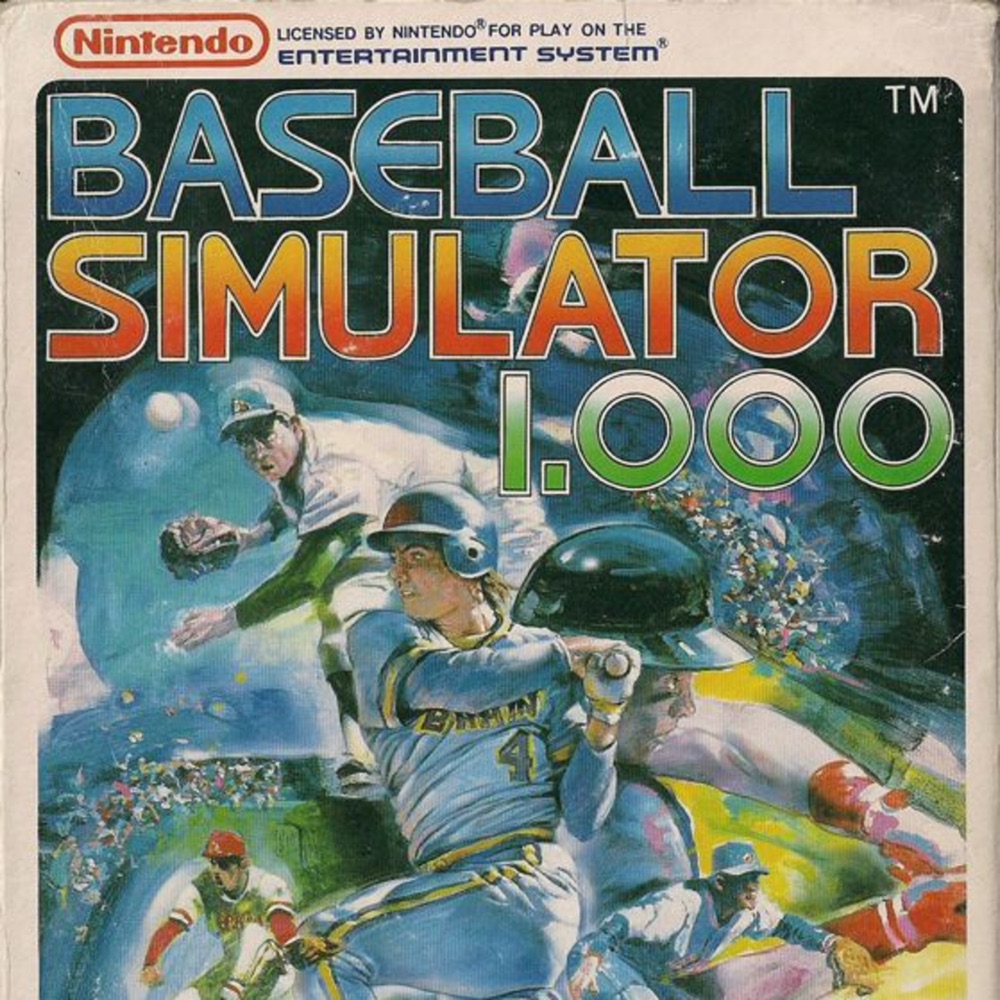
280 · Baseball Simulator 1.000
In Baseball Simulator 1.000 you can choose from four different leagues; three with six preset teams each and one where you can build the teams yourself from scratch. Face the computer or challenge a friend to compete in a 5, 30, 60, or 165 game season. Games take place in six stadiums.
- Precise Pitching, Bullseye Batting, and Far Out Fielding!
- NES Longplay
- Manual
- The 1.000 not exactly 1,000. More for a perfect average which would be batting 1.000
- Aside from SNK’s Baseball Stars, Baseball Simulator 1.000 was the
- only baseball game for the NES that allowed you to create your own team from
- scratch, naming players and giving them statistics that would be followed in
- gameplay. In addition, Baseball Simulator 1.000 allowed you to run a full
- season within a six-team league of your choice, from 5 to 165 games in length,
- and kept track of detailed player and team statistics through battery backup.
- When the ball is hit, it is automatically sent into a fixed camera posisition
- "Ultra Plays." These plays included pitches that would snake left and right as they
- went to the plate, hits that would explode whenever they were caught, and
- fielders who could leap thirty feet in the air to rob batters of home runs,
- among others.
- if both teams are set to AUTO, you will be given the
- option to either WATCH the game, or SKIP it and have the computer simulate it.
- However, computer simulations still take 6-10 minutes, while watching a game
- takes about 25-30 minutes, so either way you’d better go make yourself a
- sandwich or something. (And if you choose to skip the game, you’re forced to
- look at the Sports News screen, and anchor, the whole time, while the box score
- sloooooooowly gets posted.) Also, if both teams are set to AUTO, and twenty
- seconds goes by on the pre-game screen without anything happening, the computer
- will automatically start the game in WATCH mode.
- The Stats
- It's really hard to determine how good a pitcher is, because all you get to see is his ERA, even when he comes in the game.
- Rich Statistics with silly powers and locations
- Playing NES Baseball Games
- Sequels and Spinoffs
- Super Baseball Simulator 1.000 (1991, Super NES), also known as Super Ultra Baseball
- Ultra Baseball Jitsumeiban (1992, SNES), NPB licensed.
- Super Ultra Baseball 2 (1994, SNES)
- Ultra Baseball Jitsumeiban 2 (1994, SNES), NPB licensed.
- Ultra Baseball Jitsumeiban 3 (1995, SNES), NPB licensed.
- EGL
- Next week - Baseball Simulator 1.000
- NEStalgia Byte - Downtown Special: It's Kunio-kun's Period Drama, Gather Everyone!
Auto-generated transcript. Each paragraph starts with its timestamp. Speakers are not identified.
Baseball Simulator 1000, precise pitching, bullseye batting, and far out fielding.
And welcome to NEStalgia, a chronological exploration of every NES game released in North America. I'm Mike. I'm Sean. And I'm Joe. And I was on the fence about 1000 or 1.000 because that has like a computer connotation to it, which would be fun with the simulator. So jury's out on which one it is, but obviously the 1000 is reference to batting 1000 for a perfect average. Nah, it's baseball simulator 1.0. See, that sounds good too, right? And then they would just release 1.0.1.
1.0, like three, uh, alpha, um, you know, just make it a patch note. What's kind of funny because, you know, occasionally we don't have access to all the games. We have to emulate games from time to time. And I'm sure you guys have noticed that sometimes you're stuck with the dilemma of, do I play, um, this version of the game or do I play the rev a version of the game? Kind of like a fixed version that would must've been like stealth released to Toys R Us after the fact because they noticed there was a glitch in it. Just curious. What do you guys do in that situation? Do you play the 1.000 or do you play the 1.1?
You know, it's only just now that, uh, I'm realizing that just, that just means like, uh, revision a, I didn't actually, I just played the blank one. The one with just the name. For the purest experience. Yeah. That's, I, I feel like, cause that's the one that was released at this time in North America, right? Like the revision was released later. Yeah. We weren't having day one patches back then. Right. And aside from SNK's baseball stars game, baseball simulator is, um, one of the only, the only baseball game so far that we've played that allows you to create your own team from scratch. You can name players, give them statistics, uh, that will, uh, show up in the game play and kind of determine their stats a little bit.
Um, do you know, we've kind of praised that feature in baseball stars as being like the whole cool thing of a career mode thing. Do we want to, do we want to also praise it here? Or is it kind of like, um, at this point, eh, baseball stars did it. And I'm kind of like looking for something different in my baseball simulator. Well, let me ask you guys, if you remember, I mean, was baseball stars, did they like, was it this level of control over like statistics in the creation? No, it was, it was more, if it was more about like building a team in this very basic, like
manager way. Yeah. This is like a simulator in the sense where I feel like you could say like, oh, I wonder what would happen if I put like these players with these stats up against each other all on a team together or whatever. Like you really are like building every stat of every player. Right. To, to Sean's point, like in baseball stars, you were the manager of a team in this game. You're like the baseball God who like determines who, you know, or the commissioner, right? Like who determines like what the league even looks like. The God or commissioner. Yeah. They're pretty much the same thing, even in a major league baseball and baseball simulator also allows you to run a full season.
Um, in, uh, baseball stars, it was kind of this like weird grid format where there, it would show you like every possible team who would play every other team and what the results were all on like one neat screen. But in this one you can choose between five and 165 games in length, which is really strange because there aren't 165 games in a major league baseball. Maybe that's like the Japan league, but I feel like that's not true. I feel like they play even less games. So to go 165. It sounds completely arbitrary. Um, and that's cool. Like I appreciate that you can do that, but, um, if you're trying to go for, uh, this authenticity, then you gotta have some kind of playoff, right?
But there is a playoffs. No, no. After the season ends, the season ends, the champion is crowned by who gets the most wins, right? Wow. I mean, no, I believe you. Cause I didn't, you know, I, I didn't play through a full season, but like, that seems crazy, right? Like, isn't the point of the season to determine who goes to the championship game?
Like not just like after five games, like, up, this guy had the most wins. So he's the champion. I mean, I'm getting, I'm getting the feeling that playoffs in general are a mostly American thing. And maybe they don't do that in the Japan league. I wouldn't know. But if I'm, if, uh, you know, soccer is anything to go by. And like the English leagues or the just European leagues in general, it just, whoever wins the table wins, you know?
Hmm. I guess if I had bought this, then as a fan in 1990 in America, I would have been disappointed when I got to the end. I would have felt like, wait a minute. Like I just played through this whole season and I don't get the playoffs. Like, unless it's like made clear in the manual, but I wouldn't have read that deeply into it. I would have just assumed, I guess, you know, back then also, I wouldn't have really thought of the fact that like most of these games are coming from Japan first.
And I'll confirm that Sean is correct. There is no playoffs. Not that he needed the confirmation, but just to throw it out there. And what's funny is, you know why I wouldn't be able to find out something like that? Uh, because true to the name of baseball simulator, it takes way too long to simulate all these freaking games.
So, um, you know, before we talk about the actual batting, you know, uh, gameplay experience, I just wanted to talk about like the simulation aspects because yeah, there's a lot of cool feature rich statistics and you can track a bunch of stats along the way. But I guess it really is using all of the NES power to, uh, save constantly and track these stats for you because it must be really simulating these games. Uh, just to, uh, skip a game, not even watch it is anywhere from like, I don't know, five to 10 minutes to get through the computer's simulation. And you are just watching to skip the game, to skip that particular game. You have to, you have to, unfortunately, like it shows just a scoreboard, right?
So it has like, you know, you're in the top of the first and it's zero, zero. And then you're like, am I doing something wrong? Like, why isn't it moving? You're pushing the buttons. Buttons don't matter. Button inputs aren't doing anything. Instead, I suppose in the background, the game is running the actual game just like a bit faster because it's not showing it to you, but it's generating everybody's results. You know, what, what the count was, what they, where, what happened as the result, who caught it, blah, blah, blah. Cause they have to keep track of all those stats.
However, that again, that means that it's going to take about five to 10 minutes just to, uh, skip through the simulation. But if you choose to watch the game instead, a game that you're not even, your team isn't playing in, then you're looking at about, you know, 30 to an hour to watch these games. Wow. So either way, uh, you know, you better get comfy whether you choose to simulate it or watch it. But the worst feature of all is that if both teams are set to computer teams and you're not in there and you are running the simulation and then the following matchup is again, two computers and you went to go make a sandwich, let's say.
They only give you 20 seconds to decide before they decide that you automatically want to watch the game. So you are stuck into the 30 to 60 minute thing. If you're not there for the brief 20 seconds where it's asking you again, what would you like to do for these other two computer teams?
I'll just say real quick that I didn't do too much exploration to the other game modes. I'm more so played this game to experience what it was like in the game. So forgive this question, but if you were to pick 165 game season, does that mean that it is simulating every game in that same way? Every game for every team. So this, oh my God, that's like six, how many, that's hundreds of games that you have to sit there. Yeah, you were, I think you were going to say 600 and you're pretty much spot on because there's six teams in every league. So yes, six times, well, three times 165.
Wow. And what is the save mechanic? Like I, how did this, how did this cartridge run? There is a battery in it. There is a battery. Okay. So at least you can save it so you can let it play itself again later.
And they have the, you know, for the simulation part, they have a news screen with like a sportscaster and like they have the scoreboard up, but the sportscaster's not even saying anything like really that, you know, it should be giving play-by-play commentary then if it's going to take this long, right? If you're going to take the time to really make it feel like I watched a whole inning where I was just staring at the scoreboard. And I'm not joking, it really does take that long sometimes, especially if they score multiple runs in the inning. Because keep in mind that it has to keep running some kind of RNG to determine the results.
I wish that at least the anchor could like jazz up that screen a little bit and like announce runs being scored and stuff. But well, think of all the things it's doing. Like it, it doesn't have the, it doesn't have the capability. It doesn't have any leftover processes to do that, Mike. Yeah. It sounds like your NES would get really hot during these simulations.
I mean, there is something, I guess, theoretically cool about the fact that like, while you, you play this game, it also is actually like a simulation machine. Like not like, that's not just like a fancy word to be like, oh, you're kind of playing basically like it's actually simulating these games. That's neat in theory. I don't think that would ever be fun to try and simulate a whole season on the NES in the way you're describing in practice.
Getting to that simulator bit though. I think it's really funny that, I mean, up until something as preposterous as like goat simulator, this is probably the most cartoonish simulator I've ever played. Uh, especially when you get to like these ultimate teams. Well, that's just how baseball works, right? The ultimate teams. The ultra teams really boggle my mind a little bit because that feels like a different game,
right? I think it is. Yeah. They're focusing all on these stats and, and, uh, you know, simulate seasons and, uh, you know, watch your team grow and blah, blah, blah. And then also if you don't want to do that, we also created these ultra teams where you play on the moon and they can, uh, you know, jump up really high and rob people of home runs by taking advantage of gravity. And then this other guy, he, uh, you know, he turns into like a hurricane, a tornado while he swings the bat.
It's almost as if like NFL blitz or NHL hits or any of these was just like a difficulty setting in the official game. Yeah. Like if you didn't read the manual and you're just like, Oh, there's three leagues and you just pick this ultra league. Oh, that sounds like the best league. And then you're like, suddenly like the ball is on fire creating earthquakes with the bat and stuff. And there's some great, there's some great features in the ultra one, like some great ideas. Uh, Joe, I actually don't know if the fire thing's real, but there's other ones.
Like you hit the ball and it creates like six shadows around it. So you're not sure like where it's going to land. If it's a, you know, if it's a fly ball or, um, it creates an earthquake and every, the whole screen like shakes a little bit. Uh, it's, you can turn the ball into a bomb and then it will literally explode on contact with the fielder.
I do like that. There's different like categories. Like the pitchers have these special moves too. Like there's one that will just always break your bat and you need to use your own special move to counter that. And, uh, that it's not just like very, because I would imagine in some situations it would just be very hitter centric. Um, but you can also just pause the ball in midair or make a clone of the ball when you're pitching. Uh, there's, there's a lot of fun ideas going on here.
But when it comes to the stats that are presented in the game, uh, you know, especially early on, if you're just getting familiar with the system, it's really hard to determine how good a player is just by the, uh, brief stats that they provide before you get to the more feature rich details later on. So like when you start a season, um, consider this a nitpick. Uh, I'm mostly just pointing out a flaw of the game here. It's the pitcher is presented. You're given five choices, but you don't get to go to like their core stats screen. You just get to see their ERA.
And so you would just assume, of course, like, let me pick the, um, the guy with the lowest ERA. He must be our best player. But like, you don't know if he's got like, you know, really fast, you know, like a really fast, fast ball, or if he's got a great breaking ball or, you know, like you won't find that stuff out until you get to really know the team. So, so wait, see, when you do the create a team, cause this is another thing I didn't do. Are you, are you setting stats that you won't see ever again? No, no, no. Okay. You're, you're setting their statistics.
They're like ERA. Yeah. Stuff like that. Yep. Mm-hmm. Their average, their, their batting average. Yep. And the game is sort of extrapolating that to, to, to inform how well they're going to be as players. Yeah. Essentially like, you know, um, you know, uh, giving them a lot of power or great contact or, you know, et cetera.
Yeah. That was, I wasn't sure about that either. I wasn't sure if it was like, oh, I'm just deciding for lore purposes, what their batting average is before the season starts, or if their batting average actually affects it. And I think that's, that's neat. Yeah. Maybe I should have spent some time and create a team.
Well, because it goes two ways though, too, right? Like, so to create a team as your, as the very first thing you do, I don't know if like, that would be the best approach of like how to learn this game because you might make a really unbalanced, poor team. You know, like you might want to play a, it sounds like you did some exhibition matches, like get a feel for the teams and the players. And like, you know, you, if you really want to will it, you can bring the ultra teams into a regular league, right? And have them just play and be the dominant team through everybody. Right. Like, or you could challenge yourself.
Yeah. That was how I learned that there is a mercy rule in this game. Um, I would think of us playing as the home run team against Philly and, uh, they really are power hitters on that team. Yeah. I think there's something that could be fun or funny too about like, yeah, like setting up a game where you're just, you know, the Yankees playing against like the superhero team. He was like, all right, you got to like actually beat these super humans with just regular baseball.
Confirming again, just because it feels like we need to do this since it is a very feature rich game and everybody's experiences are different. Confirming that, yes, the stats that you assign when you edit any player, keep in mind, you can edit any player in this game. Um, those are like extrapolated to like their skills feature. So if you gave somebody a high home run count, they would be considered a power hitter by the game. Wow. That's cool. Yeah. It's nice that it kind of translates it into something that like, you know, it's not, it's not like a Sims, like arbitrary, uh, like, yeah, I've got a poetry skill of nine.
Yeah. No, you know, it's like, yeah, it's not just a random number. It's like, oh, if you know baseball, you have some understanding of like what this number means to this player. And then the game figures out the rest.
And yet the game is not out of the park baseball 2024 or whatever version we're on right now. Uh, the famous computer simulation franchise that has been around for a while now, but essentially that is the one where like sabermetrics fans like get involved and really like you can, you can run true simulations of anything you can think of. You could bring in past players all, you know, from any league you can have the, um, you can have international teams get involved. Like this isn't that deep of a game, but it is surprisingly, I think it is surprisingly
feature rich for a game on the NES compared to other baseball games we have played on the system. I agree. Like, yeah, the, the fact that it's trying to appeal to these two audiences of, of what at the time would have been probably the most stat forward game, um, with also these sort of arcade mechanics just kind of speaks to the, uh, the wide variety of things that can do.
Yeah. It's funny that in, even in the same league, you can have, you know, uh, uh, the town is the name of the stadium, right? And it's just what you would expect. Yeah. Stadium inside a town and things are normal. The at a home run, there's fireworks that go off. And then the same town, it's like, we're going to the moon on this next one. All right. And, uh, there's, uh, zero gravity stands in the background. Like I, I didn't quite understand that. They're like, they're like in chunks in, in square blocks away. And it's like, is, is that how the moon works?
Yeah. But did they carve out pieces of the moon? I don't think, I think you're assigning the moon to the stadium. I think it's just, where else in space are they? Where else? They're just floating in space. Oh, the stadium is just floating in the, in space. Yeah. You can see like a, you can tell it's all stars behind you and everything. Yeah. But then also like if someone hits a home run, there is like, yeah, there's a space station. Like floating around outside there. I get it. I guess I was assuming that because the stadium, the, the, the bleacher blocks were like these gray things and the moon is gray.
But very loud and clear. That does raise a question though, because I don't see any like bubble for an atmosphere. So it seems like maybe this game is featuring cyborgs that they're not even wearing a astronaut helmet. Yeah, exactly. So I'm thinking you're always playing as robots. You see, I had to distinguish astronaut helmets there because they are wearing helmets, just not the kind you need to survive in the space.
All right. So let's talk about baseball games on the NES. All right. And we don't need to go over every name or everything, but for the most part, playing NES baseball games.
Isn't the most enjoyable experience for someone like me, who's now more familiar with like MLB, the show and a 3d baseball game since the end 64. Like there's just something about the, um, the camera position. I, and you know, and trust me, we've had a bunch of games, try a bunch of different ways to like fix the camera. If you remember famously bases loaded, we applauded for it's like a television presentation, but it still was like the switch between that and contact and everything of the ball and like just controlling your fielders, something you can't even do on NES baseball.
One of the original black box games. There's just a lot of things about NES baseball that just leave a lot to, um, wishful thinking. Like you wish that it controlled a certain way and it never quite gets there. I will say, uh, not to just rag on baseball simulators, gameplay the whole time when the ball is hit, this is one of the few, if the only example I can think of where after the ball is hit, it shows a top down view of the pretty much the entire field and it's kept in a fixed position. So this way you can track your fielder to the shadow of the ball rather than it tracking the ball. And then you see your fielder only when it gets so close. Um, it may, it made the, it made the fielding aspect a lot easier.
Yeah. The, um, the, yeah, definitely the fielding. But one thing I would say about this is it also, and maybe this is just a feeling that I had, I don't really have any quantitative, uh, proof here, but this game, it seemed to have more end states. Like it seemed in a lot of the older baseball games that we played that it was sort of picking between cards of where the ball could, could be going.
And there were like, yeah, it could go down the seam or it could go foul in this direction or it could be a home run at this specific angle. Whereas it seemed like in this game, there, there were more situations that could happen. Did you kind of get what I'm saying? Absolutely. Like the ball can travel. Yeah. It felt a little bit like it was closer to like, like the game was using physics rather than the game was picking between, you know, 25 possible directions the ball can go. Yeah. So I felt that. And I think that that combined with the fielding, uh, allowed for just more things to happen. Like, and the fact that these fielders seem to be more prone to error, uh, just made it a lot more fun just to see like how this might shake out.
Yeah. But it also kind of felt, you know, I understand the errors thing, but it also kind of felt realistic as it should to the simulator name of if you're not in a, if you're not playing against the ultra teams or not in a crazy, uh, stadium that if you hit the ball into the outfield and the guy doesn't catch it, it's not like, unless you have crazy speed, it's not a triple, you know, it's, it's, it's a double and, uh, a ball hit to third base.
When you have a runner on first is nine times out of 10, going to be a double play. Like most situations just feel like they play out the way that you would expect them to not the, um, you know, like, Oh, well this guy has, you know, has incredible stats or this, uh, a throw from third to first takes a while. So technically for, you know, as long as the guy's got good stats, he'll make it to first base. Like no, most times in baseball, like the guy's just going to be out if it's in the infield and he's running to first base.
Like there's a reason why that happens. But what do you think about that statement about, uh, playing NES baseball games as opposed to, and maybe NES is even just a little harsh, but just like going from 2d to 3d and, uh, and then coming back.
What do you think about that statement? Is there something that these games will just lack because they're in 2d that like other genres, it's actually sometimes better that they're 2d.
Uh, absolutely. I think we've talked about, um, how much value we put into again, authenticity of the, of the sport at simulating and all of the sort of soft factors that go into a sports game where like that stuff's really important to me. One of my favorite sports games of all time is NFL 2k5 specifically ESPN NFL 2k5 because it pretty much does its best, not just to simulate the sport, but to simulate the presentation of the sport. And I think that these 2d games can be fun and can be fun distractions, but I'm not going to, I'm not going to do a season in baseball simulator. 1000 point zero.
Um, because it doesn't have what I'm actually going for. I've done a season in, and it will be the show because I really liked the way that those games are presented in addition to really enjoying the mechanics of the sport. Yeah. I mean, I haven't really played enough. I mean, I can't remember the last time I played a 3d baseball game. It would have been when I was a kid growing up because my brother was playing it, but like not in the last 15 years at least or longer have I played one of these.
So it's really hard for me to sort of quantify it, but I do feel this is like a weird little analogy doesn't add up exactly, but I, these 2d NES baseball games always feel a little bit like those, like, like those little, like NES sort of, uh, I don't know, you wouldn't call it a board game, but like those sort of, uh, one of those things like the physical, uh, baseball, not NES baseball, like, like an LCD display thing. No, not even that. I guess that's probably actually closer, but, but like talking about this, like actual, like a physical game. I don't even remember like the mechanics of like a bubble hockey equivalent.
Oh, with the, it was like pinball almost like where. Sort of. Yeah. I mean, I guess the, just like, just in, just in spirit, it gives me that. Cause like, even like when the runners, like when you, you watch them go, it's like they go like in chunks. It's like, Oh, they're one third of the way to first base. Now they're two thirds of the way to first base. Now they're on first base. You know, it feels like a lot of little, like, like little gears moving rather than like real time. It's a flea circus. 3d baseball. Yeah, exactly.
Uh, I, you know, all of this that I'm saying is just coming from like this subconscious connection I'm making. Like I, I'm not claiming that like, this is just like that pinball esque, uh, baseball game. And obviously like, this is true of any game that is a 2d instead of 3d, but I feel like specifically in baseball, uh, we're missing a lot in the batting and the pitching because of the 2d space. Uh, there's just a little less control that you have over the pitching and certainly over the batting. Like, it's kind of weird that every baseball game for the most part that we played on the NES allows you to like, just slide your batter around the box.
Right. And, uh, theoretically like that would mean a lot more, but not really like it. You can't really like, you're not changing the way they swing the bat or the way they hold the bat even, you know, like in baseball, like some guys put it over their shoulders. Other guys hold it, you know, um, uh, like with two hand grip, uh, on, you know, not between their legs, but you know, perpendicular to them, I guess is what I'm trying to say. Right. Like there's like a curve to the bat from perpendicular to over your shoulders. And that has effect on the game too.
And it's something that 3d baseball games would go on to do. But like here, I just feel like we're not getting, we're getting the option to choose our pitch. Right. And we're getting the option to choose where we want to be in the box, but it's not quite
the level, um, that it needs to be, uh, compared to where we are now with baseball games. So I guess that's my gripe with NES baseball game, not specifically baseball simulator. Yeah. I mean, I would say that the other limitation that I, I don't remember specifically all the other ones. I know we've had a lot of different camera angles, but in this one, I noticed because we're behind the plate as the, as the player, we're behind the plate as the viewer rather.
Um, and we're sort of at this like higher angle. So it is sort of hard to tell if the ball is low or hot, you know, it's like your eye just doesn't have enough time to tell like the height of the ball. So it's like easy to tell if it's in, if it's in the, if it's in the box, like left and right. But like, if it, if it's like a, if it's like a low ball, it takes, it takes a lot more of like brain processing very quickly to, to see that and to like decide it's going to be a ball. Yeah.
Especially with like all of the weird things going on in this game specifically where the ball can just sort of stop or, uh, pitches can be incredibly slow. Um, it, a lot of the, like the rhythm based stuff that you might use to, uh, determine if, since you don't have that, uh, that, that parallax or that, that depth perception you might use, you might depend on that to know when something might be low or super high. Um, all these other, uh, all these other weird things that can happen are not making it any easier. Yeah.
I mean, like I'm looking at a still right now cause I paused the footage I'm watching and the ball is almost to the plate. And yes, there's like a little bit of, there's a shadow below it, which is, I guess how you're supposed to determine if it's higher or lower. But like, I'm trying to think if I were to take this ball right now and move it lower towards the plate, it would be fundamentally the same as me moving it closer to the plate because it's all two dimensional. Yeah.
And it's all information that the computer has available to it too. So that doesn't help, you know, like the computer will be able to read and know what's worth hitting versus you.
On the sequels and spinoff side, uh, we have quite a few here, but unfortunately a lot of them are Japanese only. And, uh, in Japan, the series was ultra baseball. And so, uh, on the super Nintendo, they wound up getting, uh, looks like five, uh, ultra baseball games on the super Nintendo. It seems like a yearly iteration thing from 1991 until 1995, but we would get two of those,
uh, super baseball simulator in 1991 on the super Nintendo and super ultra baseball too. Um, on the, uh, super Nintendo as well in 1994. Now kind of funny that they went back on the super baseball simulator and super ultra baseball too. And, you know, it's like, it's hard to tell. Like, did we ever play super ultra baseball one? Like, I guess not until you open the game and realize it's another baseball simulator entry. Would you get that?
All these super mega ultras are making the name completely meaningless too. So I can't even really follow you. Right. Cause ultra was supposed to be reserved for the N64 games. That was, uh, originally called the ultra 64 and they were all going to get ultra in their titles instead of super to differentiate.
Now who would we be up to now by the switch? I mean, like what is, yeah, what is, what is like four iterations beyond ultra? Yeah. Atomic super Mario brothers. And who designated what, like, why is super just basically like the basic extra, you know? Like why isn't it like ultra mega super? Well, it starts with super because of super Nintendo, right? Yeah. But why was super the next step is what he's asking instead of ultra being the next step. Like it did. Cause that just seems like a linguistic like rule. Like if it's, if it's super super, then it's just ultra. They should have gone the pokey NES, the great NES, the ultra NES and the master NES. Yes. And then been done. Retired. And then the midnight NES.
And speaking of that, you wouldn't know that these were baseball simulator games unless you played them to realize that they were the thing. You might also find out right away from all the branding in the game because culture brain, the makers of baseball simulator definitely want you to know that they made the game because they are on the, they're on the stadium designs. The other games that they've made or features as advertisements on the scoreboards.
We didn't really talk about, I mean, we talked about the silliness of the locations, but not necessarily like the flair that each of them bring. I'm fine with putting your games on the scoreboard and stuff like that. Like, you know, better than putting Coca-Cola on the scoreboard, right? Like that feels like forced advertising. At least this is like, oh, from the makers of baseball simulator, it's Kung Fu Heroes. You didn't like going to KFC and Crazy Taxi? I didn't like driving my car exclusively with Valvoline either.
They're no longer a sponsor of the show. Never were actually. Well, I mean, now we can't say that they were after what happened. And we can't say if baseball simulator 1000 is on the essential games list or not until we do that segment. So what do you say we do it right now on the essential games list?
All right. So, you know, I gave that whole speech about how I feel about playing NES baseball games. You can kind of imagine where the vote's going to go here. But I'll start by saying that baseball simulator 1000 surprised me because I thought this was just going to be a very like technical game where gameplay was almost put second. And it was more about, you know, like really thinking about the statistics and building the team and being the manager and other like fun things could work off of that. But instead, it is a game that is mostly about the baseball at these long games that you're going to play for as many as 165 games in a single season.
And then like, yeah, what you do kind of influences the statistics and build out that, you know, like the team grows from there. So that's cool and all. Like I actually feel like for an NES baseball game where you're mostly going to want to be playing baseball. This isn't out of the park baseball where you're mostly going to be like adjusting your lineups and making sure that your pitchers aren't tired and stuff like that and having a full featured rotation and trading players like that's what those simulator games are for.
But this is really like baseball simulator junior, right? Like it's giving you just what you need to feel like you're doing more than just playing games of baseball on pre-assigned teams and you just happen to pick the most op team. Like, no, you can build your team and see where it takes you. But mostly you're playing 165 games of baseball or just five or maybe just one exhibition game and realizing it's not for you.
And I'm not I don't fall into that last category. I played more than one, but I still don't feel like baseball simulator is taking baseball up a level even on the NES. So no, not on the essential games list for me. Joe. Yeah, it's really cool to me that the level of simulation and I say that it's cool to me knowing this. It's not for me personally, but it's cool that like someone who really is into baseball can make their little league team if they know all their statistics and play through a game. Like that's that's a great feature.
And, you know, like you said that they didn't just go that route. They also went the route of like, hey, if you just want to have fun and like mess around, here's this ultra these ultra league that like you can, yeah, become a tornado or you can do all this like crazy goofy stuff while playing it to really give it a little extra life. But it does definitely does not like tip the scales of a baseball game or a sports game on the NES that like to that extreme high quality. We always talk about what you would need out of something like this to put it on the essential games list. So for me, I'm also not going to vote it essential.
Sean. I would I would describe this not so much as baseball simulator junior, but more baseball sandbox because it calling it a simulator is kind of disingenuous, I think, because of how wacky things can get. But I also really like the concept of this game. I like what it brought to 2D baseball.
I think that I still prefer baseball stars just because it seemed more what you were kind of making your own felt a bit more not realistic, but. Uh. Not as much like just plugging numbers in like you kind of grew attached to your characters, whereas in this one, you're just sort of making a simulacrum of whatever you whatever you want that there's there's less constraints. So I think that this is still really fun. I think there's a lot of especially in like the arcade aspects and the the goofy powers and
making an earthquake or making a field or blow up. Those are really cool. But I'm also going to not put this on the essential games list. Sean, you bring up a great point there at the end about the difference between it and baseball stars. It's like baseball stars is the baseball RPG, you know, like because even the stats that you're editing in that one aren't statistics, right? Like you're assigning actual like attributes like you would in a RPG. So I I like that it does differentiate them. You know, I would have to go back and play baseball stars. I do remember that being more exciting even from a gameplay point of view, like if the action felt really good and yet the fielding was still responsive.
So I'm not sure, you know, where I would land on that. But all said, competent baseball game we've got here, which is not something you could say every time you play an NES baseball game. That's true. You know, it's funny. So not last week's episode, but the week before that, I said I was starting this new thing where we were just going to end by like asking a question. And then I didn't do it last week. So people must have been like, wow, that segment died really fast.
But no, I'm back with a question for you guys. And my question this time is, other than, you know, recent recent releases, how do you guys determine what you're going to play next on your backlog? So other than like something new just coming out, how do you determine when retro games or when games that you've always wanted to play come up and become the next thing you
play? Honestly, I don't know if I have like a specific system. It's actually a bit of a problem for me because the time that the times that I really want to play like backlogged games or like, you know, like PlayStation one games that I never got around to playing or PS2 games or whatever is always when I'm when I'm like sick, because I think it just reminds me of when I was a kid and was sick and got to stay home from school.
So whenever that happens, granted, now, obviously, I still have to work when I'm sick. But like whenever that happens, I'm just itching to play one of those games. And I always like look at it. And I always will just spend so much time trying to decide which game to play next that I end up playing none of them.
So recently, I started making just a list of like, here are the JRPGs I want to play. Here are some platformers I want to play. And next time I'm sick, I'll just look at that list. And I'm going to just pick one of these things. And I'm just going to play it. And that's it. Like if I if I let myself if I let myself fathom the endless possibilities, I'll just do that for all of my free time until there's no time left to play any of the games. Yeah, I don't really have a system.
And sometimes that causes me to just not play anything for a long time. But usually, whatever I'm playing, or maybe it's whatever I'm watching or whatever I've been reading about recently will trigger like, like I got into Rome for a while, just the concept of Roman history. So I was like, Oh, there are any good Rome games that aren't just Total War. So that led me to Expeditions Rome. And that kind of got me back into tactics games. So that then I started to play, I revisited XCOM. And then I was sort of into sci fi stuff. So it's just sort of like a really chaotic web of interests and comparable, either themes or comparable mechanics.
And yeah, there's there's no method to the madness. And there doesn't have to be right. I think a lot of people suffer from that same decision paralysis of, you know, I have so many games on my backlog, that I just won't play any of them. And I'm certainly guilty of just adding things to my backlog. But I feel like there's, I have two lists, I have like, the immediate like what I want to be playing soon.
And then just like the whenever I see a game that just interests me, even the slightest bit, I just like jot it down in my notes, in Apple notes, not like I don't have like a notebook of games I want to play. That does sound like a fun idea, though. So I know IGN came out with like IGN's playlist where you can like add games to a backlog there. I'm not really a fan of like organizing my video game playtime. I'm sure there was a time in my life where I was like trying to track exactly how many hours it was taking me to beat games on like howlongtobeat.com. Also not interested in that anymore.
I guess like the more tools you add to like finding games to play, the longer it takes you to actually play any of those games. So Joe, I'm with you that like, I definitely have a long list somewhere of every JRPG I want to play, but I probably haven't touched any of them. I'm better off just looking at like one JRPG I want to play, writing that down and like making that my fortune for the year. Like you will play this game by the end of the year or something like that. Yeah. All right. So how do we end it after I ask the question?
I think just awkwardly fade into silence. Sounds great. Before I fade off into silence, well, maybe we'll fade off into music instead. But just a reminder that, you know, there's a whole backlog of nostalgia episodes. So if you're just tuning in, let's say you've only listened to the last two, three,
hundred episodes. You can also go back and listen to the other episodes because we're almost at 300 and we're going to celebrate that. And we have a bunch of unnumbered episodes. There's some weird ones in there. If you really scroll through the feed, got to figure out a better way to get people to find out like specific game episodes that they want to get access to. Can't be efficient to be scrolling to find the one you want. You let us know. So Twitter.com, that's their website. Our handle on that is at NostalgiaCast or go to NostalgiaCast.com and hit that contact button. We've had people contact us, believe it or not. It's not just that page isn't non-existent. That page gets some action and you could be the next person to show it some love.