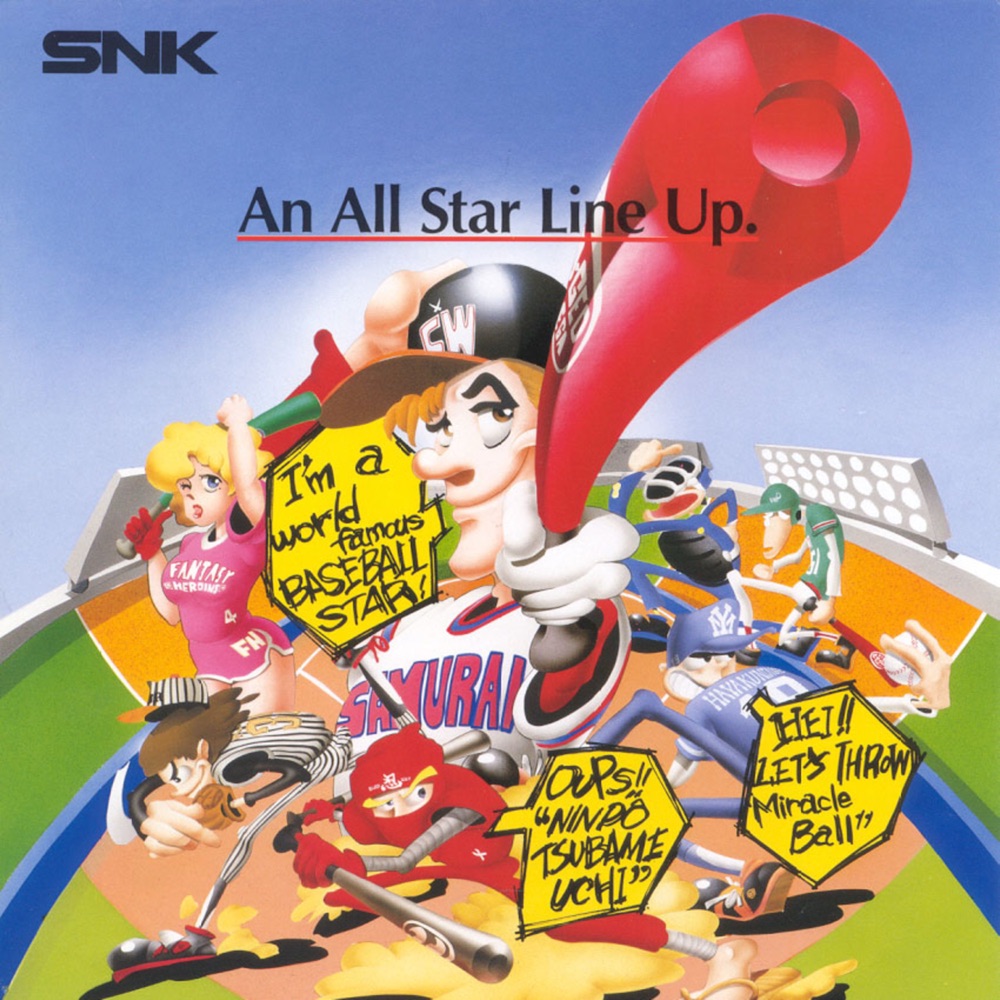
197 · Baseball Stars
Player, manager, owner... You can do it all in Baseball Stars! Make your own team and leagues; hire, fire, and trade players: develop your players from inexperienced rookies into veteran pitchers and hitters. Play against a friend or challenge the computer - you'll never have to worry about being rained out again!
Show Notes
Baseball Stars Longplay
Baseball Stars 2 Arcade
- Player, Manager, Owner...You can do it all in Baseball Stars
- NES Longplay
- Introductions
- Baseball Season just ended but lucky us, there’s always a baseball game around the corner on NES.
- Gameplay
- Presentation
- We’ve seen better
- Why is the player in a zoomed in box?
- Why is the stadium so bare
- Teams feel unique
- Stats are actually wild
- Offense
- Batter movement. I don’t like when it’s this free roam
- Worth taking some pitches
- Defense
- Hard to catch because there’s barely a visual cue
- Pickles are actually challenging
- Climbing the wall
- Different types of pitching - Overhand vs sidearm
- Creating a team
- HIRING, FIRING, AND TRADING PLAYERS
- Building player stats
- Training players aka spending cash
- Earning Money
- Called Game
- If, at the end of an inning, one team has a leading margin of ten points, the game will be called. Victory goes to the team with the greater points.
- Presentation
- Sequels and Spinoffs
- Baseball Stars 2
- Baseball Stars on Neo Geo CD
- EGL
- Next week -
Auto-generated transcript. Each paragraph starts with its timestamp. Speakers are not identified.
Baseball Stars. Player? Manager? Owner? You can do it all in Baseball Stars.
And welcome to NEStalgia, a chronological exploration of every NES game released in North America. I'm Mike. I'm Sean. And I'm Joe. So guys, you know, earlier this month, maybe, maybe the previous month now, I don't know when this is going to exactly post baseball basically just ended is the point I'm trying to make. And, you know, while that's sad, it's lucky enough for us that there's always a baseball game right around the corner when you're on the NES, right? Like this is, this has gotta be, we get sports games all the time, but the amount of baseball games we have that don't have sequels, we're just keep getting like every developers like,
you know, Hey, are you working on that platformer? Yep. You're working on that shmup. Yep. You're working on that baseball game. Yeah. Baseball is so hot right now. Right. Baseball is so hot. I don't know. What is it? What makes, what makes baseball, you know, that's America's game, right? Yeah. It's also like Japan's game. So, I mean, it makes sense like, you know, like, Oh, it's, it's popular here and it's popular in the other big market. Like this is a slam dunk. Yeah. I'm sorry. This is a home run. Right. Home run. Yeah. Makes you wonder why there's no stock market game on the NES.
Yeah. They both, they both love the stock market too. That's true. Couldn't you, couldn't you play the stock market in like Ghostbusters or something? Okay. No. You could play it in, you could play it in Nobunaga's Ampestation. Yeah. You had to play the gas market. Yeah. It was just the, the gas commodities market. Right. That's true. And Ghostbusters. Oh, wow. Thank you for that flashback. Uh, both of you for remembering all that stuff.
Anyway, do you remember, you remember all that stuff, but do you remember other baseball games? Yeah. Um, there's the ones that look like cartoons and then there's the ones that look like real life. Um, and some of them have better fielding than the others. Um, but they all kind of blur together in one way or the other. Yeah. There's the ones where you, the camera is behind the pitcher no matter what. And there's the ones where the camera is behind the batter no matter what. And there's the ones where there's both. I guess what we're saying is that there is sort of a formula coalescing in the genre.
Or that you have to pick a side that really it's either, like you said, cartoon or realistic camera behind the pitcher for the broadcast aspect or camera behind the batter for like probably the more gameplay friendly aspect. Um, these are all interesting things to consider and I'm glad that we managed to, uh, neatly wrap up the history of NES baseball games so quickly so that we can move on to what I was surprised to find out is a, um, another pretty in depth, but for entirely different reasons version of a baseball game on the NES, which is baseball stars.
Sean, don't give me the whole game or anything like that, but just your initial takeaway from baseball stars and what you think set it apart from the other ones. Well, this is sort of like the baseball game of the time that would have been made for me. Like this is a game in which it doesn't have any of the licenses. Um, but it has like the first instance of a create a team, the first instance of like a create a player, the first instance of a create a league.
Um, and it basically it's a baseball playground, um, a stats playground. Um, you can, uh, you can make all the teams in the league. You can use the presets. You can fiddle with stats. You can hire and fire. Like this is all about like, uh, customization. Um, not so much in the visual aspect of it, but at least in the, uh, actual like management of baseball. Um, it, it's a lot, like it's infinitely like replayable. If you just want to play baseball, uh, and see like the lifetime of a team. Um, Joe, anything you want to add other than customization?
I mean, like stood out to you. That summed it up pretty well. I mean, I'll say that the, um, the back of the box really, uh, really kind of nails it. Cause what does it say? Uh, play baseball player, manager, owner, like that, the, those are kind of the things that you're doing in this. And you can just, you can, I like that you can just like play a game of baseball. And I do think that it, um, it seems to control.
Again, this is just like last week. This is another instance where we've had so many of these where like, I'm trying to remember like if there was one that I liked the controls better, but I really liked the way that this controls in the actual gameplay and, you know, not to repeat Sean, but I do also love the fact that, that you can, that you can really play as, you know, you play as the team, you, you, you, you hire and fire and you try and, you try and build your team as well as actually play these games.
Absolutely. And you know, one of the most interesting things about, uh, this particular version of baseball star, uh, baseball games on the NES is that while it's not licensed, right? So you're not playing as the New York Mets or the St. Louis Cardinals. You have such a wide array of teams that are just like, it's not like, you know, okay, this team's really good at base running. This team's really good at hitting home runs and stuff like that. Not in that kind of array, but more like the entire, no, no one team is perfect.
Some teams, um, you know, vary so much in skill level that like, because these are all no names, it almost adds a little bit of personality to every, to every batter in this game that if you played it long enough, you would develop like more feelings for these players because they're not just, you know, based on their, right.
Yeah. They're not based on their stats in, in the game, right? Like Mark McGuire is not going to like have an insane power stat just because he hit a bunch of home runs in real life. In this game, these characters just, they, they are, they're given the stats they're given and like, yes, you, you can improve upon them and trade them and, and do what you will. But there's also just the ability to play as these other prebuilt teams that have their own like strengths and weaknesses. And I think that's really interesting that there's no, like, there's no perfect team. There's no easy win.
There's no like super strong lineup. You know, you're going to have, you're going to have like a, a, a good time dealing with the balance of playing across the league when you make your own league. Yeah. And to sort of build on that, you can, you know, to build on that feeling that, you know, that attachment you would have to these players, like you can, you can like purchase quote unquote, like upgrades for them or, you know, by winning games, you make money and you can, I guess, train your players and make them, make them better. So now like that you've actually invested time and, and your virtual money into a player, you're going to feel a real connection to that player.
Yeah. Since the, the customization seems to be the big new hot feature, the one that really sells on this game. Let's start there before we just talk about the, you know, the similarities in how the baseball game controls compared to other baseball games.
When you create a team, you know, you, you have a lot of, you have a lot of different kind of ownership over the team in the sense of like, you can, you can stick with the team that you're like given, right? Which is a bunch of no name, like guys that mostly suck, or you can like fire some people, look at the contracts, look at rookies, veterans, or superstars. Although I don't know if you have the cash for any of them offhand at the beginning of your, your newly formed team. But there's a lot of like decisions just to make from the get go that I really liked that. I liked that. It's not just like, here's your crappy team. Yeah. Win some games, make some cash and then like progress. You, you kind of have free reign right from the very beginning.
Yeah, it was pretty, it took a long time for me to get from, uh, the start menu to actual baseball playing because I was just having so much fun, like fiddling with my created team. Um, and yeah, like finding some veterans that maybe like, they seem to just be randomly generated, like just finding the, the, the best combination of stats for what I can afford at this time. Um, uh, it, for, for menu divers like me that like love franchise modes, like this is really, uh, where it really shines.
Yeah. And it also sort of like kind of solves the, the problem. Not that it was necessarily like a big problem if you're into baseball games, but, but it takes away any like element of like, okay, this game is just like a pick up and play game. You get, you might get bored of it after a while, or if you're not like just that,
super in like, it's weird because I feel like this is obviously made for people who are really into baseball. But I also think that if you're not super into baseball, you play, you play a regular baseball NES game a couple of times and you're like, you're kind of bored of it. Cause you're like, okay, I get it. It's the same thing over and over again. It's not a game that I love, but then now adding this to it will give you like, it gives you more reason to, to keep going. It makes it feel like a, like a progression. It makes it feel like, like a continuous journey that you're on. And you know, it feels like you're actually playing through like a, you know, a season of baseball.
Especially because you make money through the, through playing games. So there's always like a, a benefit to, to playing a game regardless because you'll, you'll come out a better team as a result of it. So there, there is a sort of incentive to keep chugging along. Losses shouldn't be like, okay, I'm just done for, I'm just done. Cause I'm angry about this loss.
It's like, you're going to get something out of it. So you may as well finish the game. Right. And I, I guess to sum up what I, what I, what I really mean is that like playing through this, like this whole, this whole season is not just, okay, playing a baseball game, playing a game, a baseball game, a game of baseball over and over and over again. Now it's like, it's the, the challenge is like, okay, the challenge is winning each game, but then the overall season is its own challenge of like, okay, I played a game, but now I can, I can think about like how I want to manage my team to be better in the next game and to get further and whatnot.
Yeah. I'm in complete agreement with you there, Joe, because you know, as Sean mentioned, you can spend a lot of time in the menus and maybe that's not everyone's cup of tea, but that's what this game ultimately like set out to do is make you actually think about the, the lineup for each, for, for the game. Right. Like, so, so yesterday you put the rookie in, in your leadoff spot. Right. But then you realize like, oh, he's, he's not really that fast.
That's kind of a waste. Like I'm going to move him around now. It's like you find out through playing how to, how to actually like how to manage this team, but also figuring out your weak points and being like, well, if we get enough money, I'd love to get a, you know, to get a veteran who, who has like a very specific stat I'm looking for to fill that seven slot. You know, things like that are pretty interesting to consider in a game where in other games,
whether, you know, major league baseball or not, I feel like, you know, you're more attached to the particular team you root for or the players that you know and stuff like that. So you're not, you're not building out like say in MLB, the show, you're not making a team of 27, you know, creative players. Yeah. In that game, you're making like one player that you invest some time in and like pick his position and like develop him. In this one, you're developing a team.
And even just the depth of going in there and being like, you know, rookies in the, in the rookie class of your contracts, like they, they suck at the beginning, but they have the highest potential. They, they have the biggest max point range, but veterans give you a, a better reward of stats right away.
However, there's only, there's like a threshold. They can't go beyond a certain points that the, um, that the rookies can go. So there's, there's trade-offs even at that level of thinking, well, do I need somebody good right now? Which might be a good investment at the start of your team? Or do I need somebody who I'm going to like, I'm going to be playing all the games with them and I'm going to use my money to train them up and I'm going to make sure that they hit those max stats so that later on they're, they're a powerhouse.
Yeah. And I think that's a smart way that they, you know, the way that they kind of programmed that because it, it really does simulate like the reasons that real baseball teams don't just, you know, that the reason that real baseball teams hire rookies, you know, because it's like, yeah, you have, you know, you, you want to like, you want to have a good mix. You probably want to have some veterans and people that are tried and true that you know are good, but you also want to develop new talent because you know, the future is not that far away and eventually you're going to need younger people who are coming up and,
you know, developing as well. So that gives you like incentive to sort of, I feel like mix and match, you know, sort of have a couple of veterans and a couple of rookies.
And it is nice just to like, see that it is a game that while, um, uh, at first glance, it may not be immediately apparent, um, that there is difference between them. Like there are so many baseball games that we've played where like the outfield is an afterthought and like the, the outfield may be simulated like night. Well, it's always simulated, but like you have no input on it because it doesn't really matter. And it's just the batter and the pitcher that matter. Um, so I, I just like a game that is, it has that extra layer of depth.
And then on top of that, like cosmetically, the fact that they give all of these generated players, uh, unique, uh, like mug shots is just great to me. Like that you actually have a face to the name and to the stat, um, to, uh, really drive that this is your team. And you, if you fire this player, like that guy's out of a job and, you know, might have some substance abuse problems down the line.
Right. You have to, you have to almost make little stories for your characters if that wasn't enough. Yeah. If all the stats weren't enough, then you have all that. And it goes beyond to just, just making the, you know, making the characters or buying the characters, uh, you know, you're going to play, uh, the league that you designed, right? You, you, you could have as many as 25 games against as many, uh, as six teams, uh, in your league. Or you could just say like, no, it's just going to be a, you know, one game per team, uh, season.
And there's only three teams in this, in this season. Uh, and we're just going to do it that way for this particular league setup. The fact that you have some customization there is also very interesting because I, I can't think of a lot of other games that allow for you to build the league in terms of number of teams, number of games. Yeah. Right. Even now, you know, I wish they would have even taken it one more step.
And let you even adjust like the inning length, uh, of those particular games. You know, it would be interesting to, um, you know, at reduced fares, of course, so that the, uh, that you can't just game the money system. But if you could say like, you know, Hey, these are going to be three inning games because they're going to be, we're going to put in like a ton of them. That would be interesting to, to go through like a gauntlet like that, where your decision making is maybe a little more involved based on the number of innings involved.
Yeah. That'd be, that'd be interesting. Not that the, not that the game is, is a, the baseball game itself is a slog, right? Um, baseball games are, are what you make of them when it comes to, um, the nine inning bout. Uh, if for some people that is, that is way too much of an investment and those people probably wouldn't buy baseball games to begin with. Right. Uh, the, the, the amount of time that it takes to go through that. If you've played one baseball game, you can, uh, expect that time. Yeah. I can't imagine anybody buying a baseball game and like complaining like, Oh my God,
I can't believe I play nine innings of this. Like that's what, that's what you sort of signed up for. No, I, you know what? I, I, I get it. I, I get it because like playing a game, playing a video game version of baseball is not the same as playing baseball. And while you might want to play nine innings of real baseball, maybe you don't want to sit down for that long and play a video game. Maybe you want to just have like a little, I get, I get the idea of wanting to have like the ability to have smaller innings or, you know, in any, in any sports game, shorter periods. I get the desire. I just don't know if I could get the complaint.
Right. That's what it is. Uh, Joe, you were saying shorter periods. Like that, that's the thing is like one of the greatest features of baseball is that there is no clock. It creates a totally different kind of sports strategy, football, basketball, hockey, you know, those games, uh, in, in real life, you know, there's, there's clock management and that's a big part of the end of the games and thinking about that kind of thing.
And in, in video games, you're able to say like, yeah, you can put 20 minutes on the clock, but it's not going to actually move in 20 real minutes. They, they reduce it in like five seconds per second or even faster than that. You know, you're able to rush that. I don't know how you rush the, the, uh, the plate appearances. I don't, is it like, well, do you know, cause they're discreet. It's like, you can't.
Right. But no, but thinking about it, like, maybe you come in with the count already filled in like, okay, you're on a, you know, you're on like a three, one count or you're on a two and two count. You know, it's like, I, I agree. It would be weird and definitely remove something from the game, but there's also like, there's an argument there that that might change up. That might make it more random and change your strategy for a particular at bat going into the count. Oh, right. Right. Definitely. But, but like, don't, don't like modern, like MLB games give you the option to play, you know, five innings or seven innings rather than nine. I honestly don't know because I've never looked for that.
I've never looked, I've never looked to reduce them. You know, I guess like when I, if I want to play, like first off in modern baseball games, they really just like, you're either playing the creative player mode where you're playing like particular moments or you're being like a full season where they drop you into like particular games where you're in like, you know, Hey, it's top of the seventh.
You've got to maintain the lead or you've got to gain the lead or you've got to hold off a bases loaded situation. Like they drop you into moments rather than make you play the full nine innings in, in anything other than the generic exhibition mode. You could just do that for a full season though. I don't know how like you would have the patience for it.
Right. And, and I mean like, look, we've all, we've all like at one point probably thought about doing something like that. I tried to do it with Ken Griffey Jr. Baseball on the N64 and I, I probably came as close as like playing half a season, which is 80, 81 games. Like that's crazy. But you know, 162, nine inning games is a lot to ask for people. You're right. However, is that a lot to ask in a game where you're building a team, you're being rewarded with money, you're seeing the stats of, of all your players grow. Is that a lot to then ask for it, say for the people who are really into this kind of thing? Well, I guess that's when we have to, that's when we have to talk about the actual moments moment gameplay then.
Absolutely, Sean. Great segue. You know, I, I don't want to break it into, into pieces as you know, cause we've defined so much of these baseball games in the past, but can we maybe talk about first what worked for us and then what didn't work? Does that work for everybody? Yeah, that works. That's one of the things that works. Okay, great. That's the first thing that works is how we agreed upon on the podcast.
Let's talk about, you know, for me, I actually liked the, the amount of movement you have in the batter's box. Uh, in some games you've been able to either like move in towards the plate or move out in this one, you're given like a full, like a full up, down, left, right, like push yourself in, push yourself out, like however you want to do it. I kind of liked having that control over the, the player more so than I have in other baseball games where you either just choose moving in or moving out of the plate.
Yeah, this, this one, um, it seems to be a sort of middle ground between the more cartoony ones, um, and the more realistic baseball games that we've played where, um, it's sort of borrowing the, uh, perspective and the, uh, batter slash pitcher control, um, of like an NES baseball, um, which is very exaggerated in what like a, uh, what a strike strike zone is and all that sort of stuff. Um, but it's taking sort of a more realistic, if it may be not so detailed, um, art style, uh, from like an RBI.
Um, so I think that's a pretty good combination. Uh, and the one thing that I really liked about, uh, the actual moment to moment gameplay of this is, I don't know if it's just like the angle at which the, the pretend camera is at, but I think this is the, um, the first baseball game where I can, I could kind of see where the Z axis was. Like I could really perceive where the ball was. Um, and instead it like, as opposed to other games where it's just like, well, uh, it's just all the way up there and it's still moving. So I guess it's not going to come down anytime soon.
Like you can really kind of tell like between like how the size of the ball and, uh, where it is in relation to the shadow. Like, oh, this looks, uh, pretty normal to me. Yeah. I think the shadow particularly really helped me there. Like I could tell when it was like, I feel like there was sometimes there was a couple of times where it's like the, the ball hit the plate. And I remember being like, Hey, that was really obvious. But, but I remember other games where the ball would like hit the plate and I had no idea because like the perspective was just so skewed.
But, um, but, but then also, you know, just talking about, uh, you know, the way you move in the batter's box. I think one reason for me that that felt so good was because of how accurate when you hit the ball, like where you hit the ball, where, you know, where, whether you just like tip it or, or whether you hit it on the inside of the bat or whatever, like it feels like it really is accurate. And it'd be like, I feel like that's why it makes such a difference.
Like the ability to move so much in the, in the, in the batter's box is like very satisfying because you actually really see the result of like, where are you, where are you swung the bat? I also really liked the, the pitching styles and the fact that you have two between overhand and sidearm. Um, the sidearm was definitely more rare and something that, uh, I sought out in my, uh, in my pitching, uh, when I was signing contracts and stuff like that. Uh, but just, just the, um, the control you have over the ball, whether it's overhand or sidearm is really cool because it comes down to not like choosing the style of your pitch and being locked into that kind of pitch, but rather, you know, what you do with the D pad actually matters.
And yes, it can get a little cartoony in the sense of like, maybe the ball has a little too much power on its spin and it, you should only be able to influence it a little bit, but it never gets like ridiculous where you throw like what looks to be a complete ball. And then at the last minute swerve in for a strike, like you don't get away with that kind of stuff. So I think it works in that regard.
Your, uh, uh, your comment on, uh, the pitching styles reminded me of, uh, I don't know if it, if it's really like an Easter egg, if, if not just like a, just an interesting factoid about the game is one of the standard teams is the lovely ladies, uh, the all women's team. And I, I really appreciated that they, they were actually like doing like a softball pitch. Um, if, unless that's the same animation as the sidearm, it was really, uh, the fact that they went through the, through the trouble of like mixing another sport into the game, uh, with an entirely different, like roster pool is, is crazy to me.
Yeah. And that's so unique to like to have an all women's, uh, baseball team in, in the game like that. Again, like some fun that they couldn't necessarily do with an MLB license. Like I liked that they leaned into that. I thought the Easter egg you were going to talk about was when you are, um, when you're like creating, uh, the characters, there's like all these different like things that you can fill in. And then if you just continue to go down, what looks to be a blank space actually then auto populates to male. And then you can change the character to female.
Oh, that I did not know. It, it does it, well, it doesn't look like it should be there because it's, um, it's blank. But if you just press down on the D pad from the final option, uh, it will just auto populate male and then you'll be able to switch it over to female. So you can, other than the lovely ladies, you can build female characters too. So you can have a mixed team then. Yeah, absolutely. That's, that's wow. I didn't know that. In fact, um, with, with the trading, you could create, um, a mixed team then. Oh yeah, it's true. True. Yeah. I, although, you know, the team name would stay, they are still the lovely ladies with butch. Yes.
Uh, you know, what was, um, was interesting. I don't know if I would consider this a good or a bad thing, but for the defense in baseball, there's a thing where you're caught in a pickle. Basically the base runner is between first and second, let's say.
And, um, one of the basemen is clearly in possession of the ball. So he's going to chase towards the fielder, but then also throw over to the other, uh, a rundown, right? Yeah. A rundown essentially. This is where they continue to, until they tag you out in real life baseball. That is a situation that almost no base runner will be able to avoid. You know, it's like the ball is thrown fast and, um, and the runners are good enough that they're able to, um, to continue to close the gap on the runners. Yeah. The fielders, sorry. The fielders are, are good enough at running compared to the base runner in this game.
I actually thought it made for an interesting challenge, um, with pickles. I don't know if you guys found, uh, yourselves in them as much as I was, but I'm not talking about like me as the base one. I'm talking about me as the fielder having an actual dilemma of like, I feel like I've got this guy, but I could screw this up. And then he's going to get, uh, you know, a free second base as a result of it. But yeah, I think it's because, you know, like if you think about just throwing a ball from second base to first base, like that's just as intuitive as looking and throwing the ball from second base to first base.
Like, whereas in this, it's like, it's that thing that I feel like it's not as bad in this game, but that thing that does happen a lot of baseball games where it's like, okay, wait,
just to throw a first base, I hold the D pad towards first base and then press the throw button or like, but then it's like weird because that isn't always necessarily like the direction you're throwing or like, it's just, I mean, I guess in that case it is, but like, it's just this weird counterintuitive thing of like, okay, I got to press the base and the, like the base I want to throw to and the, the A button. And it's always like, it takes a little bit of getting used to. So I feel like that's, that's why it's like, just not as intuitive to throw the ball back and forth between two bases.
I think that it's, I appreciate that there's a bit less certainty, um, as to how certain plays will, will turn out. I also think that maybe this is a situation where, uh, a player with better stats may perform better in a situation instead of it being almost imperceptible in some things. Um, I never, I didn't play this game long enough to notice, um, my, uh, my basement improving in, in things like that, or not that I could just like blame it on myself as the player.
Um, but, uh, uh, I'm, I'm a fan of the more, uh, wacky plays that can happen. But there's also, yeah, like that, that's a good point, Sean, but wacky plays are kind of rare too. Like a standard, like pop-up to, or not pop-up, but let's say what is supposed to be simulating a line drive to, um, to the outfield that the, that let's say the fielder is unable to pick up is not going to result in a crazy amount of bases. You know, uh, I never played with anybody who had base running stats that were insane. So maybe this changes as you continue to max up stats and stuff like that, that you are able to, to get more of an advantage, which to be fair, I think is, is something that happens in real baseball too.
But I liked that in no particular situation did I ever have like a guy on second that I was sure, like, you know, hit to the outfield that guy's making it home. Like you got to think about your particular base runner and, and the stats involved because everybody is, you know, not everybody is a superstar. In fact, there are very few superstars in this game. So the game is played maybe a little more conservatively than other baseball games on the NES we played where you kind of, you know, you hit something hard and you just continue to round the bases.
I agree. Me too. It does, it does add a different, it does add a nice like element of complexity to the whole, to the overall experience. Or maybe just like a, a way to not, I don't know. I didn't find myself having excessive run scores in this game. I didn't see any like, you know, 12 to 16 finals or something like that. That's another interesting quirk of the game is that it, you can't just have like a crazy blowout. It, it'll just like do the mercy roll on you.
And like, I think it's once one team scores 10 more runs than the other, they just call the game. Right. Which wouldn't happen in football. You know, it would, it would, they would let that thing go to a hundred and, uh, what was the score of that game? I can't remember now. I was like, it was a high school football game recently that went to like 110 to zero. Oh, that I did not. They should. Yeah. They should have called the mercy. I think there was a, uh, there's a great John boys video about, um, a college football game in the early 1900s. That was like 212 to zero. Oh, right. I did see that. It was, um, it was in Hawaii, right?
No, it was in, uh, the contiguous United States. Oh, interesting. Okay. I must be thinking, I must be thinking of another game that went to the 200s then. It's weird though, that like this baseball game would have the common sense to say you're losing by 10. It's time to give it up.
In real life sports, they're like, no, anything is possible to come. You know, you just have to believe and the comeback can happen. It's funny because like baseball is the one where that comeback is more likely. I mean, if it's 110 to nothing in a football game and you're at the end of the fourth quarter, like it's physically impossible. Yeah. But like baseball, it's always possible. Mostly improbable. Anything else you guys really liked about the, uh, the baseball, uh, aspect of this game?
It's, it's more so the, uh, presentation, but I did like that, um, like the, um, the sort of calls of the game, like just happen live on the screen where like the ball lands, like if it's a foul, um, like the camera will still follow the ball, but like it'll mark foul, like on the, the field where it happened. It's a very small little tiny detail, but I thought it, it added to the, uh, personality of the game. Yeah.
I mean, I don't have, uh, like, like one more specific thing that I loved about it. I'll just say that. I think that as far as the games played, I just think overall they controlled feel it really well. They felt, I think the most intuitive of any of the baseball games we played. I think that they all, that it was just overall mostly positives.
So what would you say are the negatives, Joe? Are you about to tell me that there are no negatives in this, uh, in this version of baseball? Well, I won't tell you that there are no negatives. I'm sure there are negatives, but I'll tell you that I didn't really pick up on it. I don't have anything particular that I like disliked about it. So I'll, I'll leave that to one of you guys. If you have anything. I'll tell you what I dislike about it. I didn't like the amount of logos I could pick for my team.
Um, I, there's like nine or 10 of them and there's only, uh, they picked like seven random letters that could be logos. And then there's just a couple other pictures of things. Um, I would at least like, um, more letters to choose from. I thought that we were talking only about negatives in the actual game of like, like a game of ball. Which we were, which we were doing.
But I will say that to that point, I guess, yes, I agree that I wish that there were more logos, but also I feel like I have that thing where it's like, well, you know, in the last seven games, we didn't get the choice to update any logos. So I feel like, uh, I don't want to get too greedy. Yeah. At this point you guys are like, I didn't like the part where it ended. Right. I hated when I had to turn off the console. I wish I never had to stop playing.
I guess I'll, you know, like I'll have to, I'll carry some weight here. I don't want to be the bad guy. I'm not necessarily saying this is a bad game. Um, but you know, I thought the presentation aspect was pretty bare. Um, not even on like the cartoon aspect of it. Like, I don't care necessarily about the sprites. I just think like field in general was very empty.
Um, the stands didn't look like, uh, you know, it didn't look like much. You had the floating head thing again, but weird kind of floating heads where it's like they're all staring at your soul. Right. Or they don't know. They don't really have eyes, but like every couple of guys is like wearing a shirt or, or something that like colors them in. But then everybody else is just like, just their face. You know, I just thought, I was like, I wasn't really sure what was going on there.
Yeah. I, I've been looking at this for like literally the whole time we've been recording. I've been trying to figure out what it is that I'm seeing. And what I think it is, is that most people have black hats on, which all kind of blend in with each other. So you almost don't see the hats at all. So it just looks like their hedge head ends earlier where like one out of every 15 people have like a green hat on. So it just looks like that guy's head. First of all, it's sticking out way out of the crowd. And then he's wearing a big green hat.
Also negative. The ability to climb the walls and rob of home runs, something that is very challenging, yet possible for the player to do. I can't say that I've done it, but I did, you know, I had that moment where the computer robbed me and I didn't like that. If the computer, you know, like I feel like, give me this one computer, you know, like show me that he climbs the wall and tries to catch it, but don't let it actually happen.
These are the problems we have with the game. I also, I lost a game at one point and I really didn't like that. Actually, I think that was bad. Right. I also don't like that the batter's box has like this rectangle or square. I guess it's kind of a square, but it's more like a rectangle around it. That implies that it's like, we're seeing it zoomed in or magnified. It really isn't. But yeah, the ball just continues to travel along through that rectangle at the same exact distance. So it's not, I don't understand why that was. Now I'm just noticing it. Yeah. Also like it is like the rest of it other than the ball is magnified by like, by like 0.1%.
This is like, it's just like a tiny little bit bigger than it would be if you didn't have that there. Right. I gotta say at least aside from it being a very empty like presentation in terms of like the, the field, these are the most nitpicky nitpicks I've ever heard us talk about on this show. Well, you know, if you want to hear more nitpicks, um, the baseball diamond is not filled in on the like little visualization of where your runners are. But clearly when we are the runners, we see that the baseball diamond does connect. They do have the white lines going around. So why not? That would just be another obstruction on, on seeing the actual baseball diamond, you know?
Right, right. I don't want those lines blocking my view. And to speak to your point about the, the, the field being bare and like, you know, like everything's kind of textureless and there's nothing in the field, um, which I think makes a good baseball field. But, but I know what you're saying. It's like a very, it's just like one solid green color. Like you filled it with Microsoft paint and then there's the brown color for the dirt.
Um, but I'll say that I, I, I prefer that in, in this kind of NES game. I think when, especially when like a sports game tries to get on the NES, tries to get too fancy with like detail or texture or something, it just makes it a little harder to follow with your eye just because of the limitation, the graphical limitations of the NES. So I, I like that. It's just a bare solid color. I know exactly what I'm looking at and, and I can just focus on the game.
All right. Here's a, here's a hot take. If you want one. Yes. Okay. Maybe the flaw in this game is that if the intrigue was supposed to be about building your own team and seeing them develop and everything like that, that the actual, the actual sense of progress, right? Like the, the point where it actually feels good that the players are getting better to the point where it's a noticeable difference and you have a completely good team, not just like, not just like a couple of good players, but a good team, a formidable team.
Arguably that takes too long in time, in terms of time investment for this kind of game. I mean, I think it depends. I, I, I think that like this game had a battery backup, like you can save, uh, this is, I think the sort of game that you can play every now and again, if it still interests you. And I, I don't know if there's anything that would like, as opposed to any other baseball game, like make you less interested in playing it. If you know what I'm trying to say, um, like it's, that's going to be something that you like make a formidable baseball team in two playthroughs or two or two sessions. Like this is going to be something that you just like, Oh, I'll play, I'll play some baseball stars today. Uh, uh, for several months.
Yeah. I, I think I, I kind of see it like that. You know, it's almost like, I guess it depends on, you know, on, on, on what you're into too. But like, you know, I feel like if you're into like a really long RPG style baseball game or whatever, like, you know, I think it could be satisfying to be like, wow, I've put a lot of time into this and it shows like I can see the results. Like I, I would run franchise modes for like a decade, you know?
Yeah. I was going to say that argument doesn't matter anyway. I'm giving, I'm giving the hot take, but the argument doesn't matter because if you really wanted to have a formidable baseball team, just pick one of the other teams that's already created. Like if that's, if that's what you're looking for in this kind of game, you know, you can do that, uh, instead. So, you know, these are, these are just opinions to get you guys out there. You don't have to be so in love with this game that you can't handle the criticism. Mike, if it's not your opinion, then why speak it?
Because there are a bunch of listeners who might want to hear the other side of the story. I don't, I don't care about them. Think about it, John. You're firing these people. Okay. To, to replace them with better baseball players. And they have substance abuse problems now. Right. But not only that, I mean, just even the visualization of them with their gear and their dog. Yeah. Just, just walking back to, you know, probably what are they going to do? They're going to work at the factories.
Yeah. There's only, yeah, this is, this takes place in an alternate universe where, uh, there's only one escape from, uh, hard manual labor and that's it to, to play for the baseball team. Everything else is just factories and mines. Right. But not even the major league baseball team, the, the like Atlantic league. Yeah. The, the Michael Esposito league.
I don't think we were expecting this out of this kind of game from, from, um, from SNK too, you know, that like they would produce a baseball game. So, uh, nuanced and in depth. What are we like, if this is where we're at with this kind of game, what are we looking for in the future in terms of improvements? I mean, even SNK themselves would go on to make other iterations of baseball stars. So is this just like, are you, are you guys just not thinking of what, what could come next and like are happy to take whatever, whatever they give it to you? Or are there some things that you'd like to see given the NES limitations, of course, in, in a future baseball game?
Well, I, I definitely thought, uh, you know, a bit about like, you know, what could improve. And I, and I think that even like looking at like, and you know, we all know, I don't play a ton of these, these modern sports games anyways, but like, you know, looking at like a modern MLB game, I, I think that it has definitely built on the idea of like managing your team. You know, I, I don't know if it's been exactly the same way, but like, of course that like there's, there's more you can do with, with managing your team and with trading and with having salaries for your players. And even like, I don't think it's necessarily like a negative or positive for this game.
I think it makes this game unique that it doesn't have real players, but adding real players would add, you know, uh, probably a level of interest to most baseball fans who can like, Oh, I'm going to trade for this player that I know. I know that you, you presented a good reason to not have real players earlier, Mike, but you know, it just, that would also, you know, add another level of another layer of the, um, like complexity of managing a team.
Yeah. I think that that's, that's sort of what I was going to say is that like, while it's not exactly what I want, it would be the logical next step is to like have everything in terms of like, uh, like actual seasons and, uh, uh, stats that continue on throughout these seasons. Um, but you also just have the MLB license and can play as your favorite team. And then I guess, I don't know, even, uh, uh, draft players between seasons.
I don't know if this has any, anywhere close, uh, near the, the, the memory to do more than one season. Uh, I don't think it does, but I guess that would be the logical next step in terms of like wants in that realm. And in terms of like the actual gameplay, um, I, there's nothing that like really calls out to me as a huge negative, but there's always tweaks that can be made to make it,
uh, a more fluid or, uh, fun experience. So I'm not expecting anything crazy out of future baseball games, but I, I'm still leaving the door open to being surprised. There's also something about when you add and continue to add two games that sometimes like just adding things because like, you know, oh, now we have the capability or like, you know, beefing up like the, uh, the amount of adjustables in your, in your character, right? Like being able to change things doesn't necessarily mean that all those things are going to work in its favor. Sometimes you can add features to a game that actually makes it worse off that than the iteration before it. Yeah.
I mean, there's a lot of, uh, like a lot of stats in modern video game, modern sports games that I don't even know what it's adjusting in terms of the actual game. Like, I don't really know what, um, uh, I don't know, like some, some random, like, uh, pass block awareness in Madden. Like what's that, what is that actually changing in the game? Um, so it's not really adding anything, but it's, I don't know if it's taking away, but I do know what you're saying that more does not mean better always.
This very version of baseball stars was also in the arcade, but I can't really like, I can't find a lot of information about that. Apparently it's a very rare thing to find a working arcade version of baseball stars, but I got to imagine it was just the baseball element with these teams and no, like, you know, taking your, your progress with you to another arcade thing. Like how those horse races. Yeah. There's a memory card. Yeah. The cards there's baseball stars too. And there's baseball stars on the Neo Geo CD.
The SNK didn't really push it much further than that. I wonder if that's because they didn't see a lot of interest in this particular, um, franchise, you know, they're, they're baseball stars franchise and they just chose to, uh, spin off more popular franchises. Or if this was just something where they did get to a point where it's like, yeah, there's not really much we can add. You know, like when I look at baseball stars on the Neo Geo CD, I mean, it's beautiful graphics and everything. It's a little more arcadey in terms of its look and all that. But I think what you, even what you have here with this version of baseball stars is enough to satisfy, uh, the, the NES user base. I, I'd be hard pressed to see what a sequel could have done.
Yeah. And I, I, I'm still interested to see what future games are going to do and try and push the envelope and make it seem like it's going to be like far, further along in this console's lifestyle, like to see what they can do. So, um, because right now I don't really, I think we've hit like what an NES baseball game can be. While we look ahead to the future, we should also, uh, focus on our present and make sure that we figure out if baseball stars is going to be on a little thing we call the essential games list. Sean, let's start with you.
Your vote for baseball stars on the essential games list. So what we have with baseball stars is a lot of things that I've been asking for in a sports game, uh, since the beginning of time. And I didn't think that we would get it, um, quite so soon. Uh, I didn't think that it would really exist on the NES, uh, which is all of this customization that we've been, uh, raving about.
Um, and all the little fun things that they throw in there to, to make it unique. Um, and I think that like between all that and, uh, the, the fact that like an old school baseball game is a different experience than a more modern game that has a lot more features and a lot more of this customization. I think that the, that the experience is unique enough and good enough that I think I'm actually going to put a vote in for a sports game to get onto the essential games list. I don't know if you guys are going to join me, uh, but it at least will be a, a thing that I do. So I vote baseball stars, an essential NES game. Joe, your vote.
So, I mean, we all know what I usually end up saying about, about sports games like this. Like I find it hard to see like putting one of these on the essential games list just because sports games are just something they're going to continue on forever up to present day and beyond. And they're going to continue improving and they're going to continue moving on. So I think that that is like, that's point number one that like, that feels like would keep it off for me.
And then point number two is that it, it takes so long to, it takes so long, so much time you have to invest into this game to really get that payoff of what it offers that like it's hard. It might be hard for someone to imagine that like today in 2021 that like, that you should go back to this game and invest that much time in it when there are so many other options out there, especially because people's attention spans for video games just are generally shorter now because there's so many more options and it's so much more available.
But as far as, as far as that first, that first point, I do think that, you know, Sean, what you said a second ago kind of sums it up to like, this is different than like a modern MLB game. It's a different, it's a different experience, you know, and it, and it does, I think, hold up if you want to go back and manage your team here, regardless of what else is out there, I don't think that there are too many flaws in the way that this game does it.
So, so I, I'm going to cancel that out. But as far as the second point, yeah, it still might, that still might be a barrier of entry to people, how much time you're going to put into a retro game. But I don't think that that is enough for me to, to allow myself to, to, to keep it off of the essential games list. So I do think that this game has, has done pretty much everything right.
And, and, and I think that even though it's not like particularly a game that I would generally play, like, or seek out to play, I had a great time with it. And I think that like, I'd be excited to see like how far a team, how far I could take a team and see that, that build and see that like kind of RPG element and, and move, you know, move through a season with a team like that.
So I'm also going to give my first essential vote for a sports game other than slalom for a team sports game. And, and I'm going to, I want to throw a vote towards Baseball Stars. Baseball Stars is on the essential games list, folks. It is on the essential games list. But I'm actually going to take it off until you put Zelda 2 on, so. No, you took it, you took too long. All right, all right. You should have held it hostage, potentially.
Takes a, takes a little weight off my shoulders that you, that you guys put it on there. I'll leave it off for now then in that case, because here's, I think actually RBI baseball is, is still the superior baseball game. And I didn't put that one on the essential games list for a lot of, you know, valid concerns about like what baseball games are.
And especially like given the limitations of the NES, like I, I'd argue that it's, you know, these are 2D baseball games going up against like PS5 technology. Like that's not what I'm inferring about why these games can't be on the essential games list. I just think the, the actual like experience of playing the baseball game is something that becomes very familiar and repetitive over time. And as Joe mentioned, the, the great mode, the, the fantastic mode, the no flaws mode of this game for me of building your own team and signing contracts and making money is something that's very interesting.
And maybe they should develop more because the process of playing these, these style of baseball games over and over again is not something that I think is a, is a must go back to. Remember the essential games list is not just about defining like the best of its genre per game. It's about telling people that these are the games they should go back to and take a look at given today's standards.
And, and that's for me, you know, that's what I'm saying to me, the essential games list is, and I'm not sure baseball stars or even RBI baseball, which I liked a little more because it was a little more arcadey and a little more fast in terms of, you know, playing a full game. I don't know if either one of those deserves it, but now I'm looking at both of them and I'm like, Oh, well, baseball stars is on there. Maybe RBI baseball deserves a look, or maybe I need to say, go back and play RBI baseball more and say, Oh, baseball stars actually has a lot more going for it.
Where I stand right now is that baseball stars to coming on the NS is exciting. Cause I think really they just have to work on polishing that, that experience of, of developing your team and the progress that, that, that happens through that. And maybe it becomes like the contact that you make with a ball matters or the fielding you do matters towards your player stats. And this way they can almost like how, uh, an experienced share works in, in Pokemon, right? Where it's like everybody, everybody levels up evenly. So this way the team feels better as they play better and win games, you know, and losing has its consequences as well.
Striking out constantly means that your guy doesn't perform as well. Maybe it needed something like that to happen, to make things happen a little faster and to make your, your playing count a little more than just collecting money and, and, uh, and training up those players.
That said, this is an amazing game. So anybody who has played any of the other baseball games and let this one slip through the cracks, you might want to go back and revisit it because even though I said, I like RBI baseball more, I think they're offering two different experiences. I don't think that one should, should be played more than the other or that, um, that if you're a fan of, uh, major league baseball, because it has the, the players names and recognitions that I think you're going to find something a lot different in, in this kind of baseball game. So I'm glad you guys put it on the essential games list so that I could maybe, uh, give a reason for why it shouldn't be on.
Always the contrarian that Mike, I don't believe anything. I say, I am, I speak for all those who cannot, uh, no, uh, of course I don't. Um, I, I always believe what I say, uh, that your voice is a very powerful thing and this is a podcast. So we use our voices to, uh, express our opinions and we're going to continue to do that because we're coming up on almost 200 episodes. Can you believe that guys? I can. It's crazy. 200 episodes plus some bonus ones. That means we've been doing this for over 200 weeks already. That's a little crazy to think about.
However, the 200th episode, uh, is not next week, but when it comes up, uh, you know, it's going to be kind of a special thing. I don't know what we're really going to do. Um, it's going to crack some bottles. Oh yeah. Yeah. Well, yeah, maybe we got to get in person for the 200 episodes. Oh, that'd be exciting.
A little party. Maybe a little party, maybe some drinking. Maybe you guys will hear a little drunk nostalgia cast. Um, and, and maybe we'll have some special announcements on the 200th episode. But here's the thing. The 200th episode, like we don't count the, uh, best of's as numerical episodes. So like, we're talking literally our 200th episode. It's like five episodes before what we're calling the 200th episode.
Yes, that's true. This is technically our 200, uh, this Teenage Mutant Ninja Turtles was technically the 200th episode of the show. If you count all, actually, no, it's not true. Street cop was the 200th episode. If you count. Actually, that's not true. It was, uh, uh, it was gun. Ten yard fight. Ten yard fight was both the first and 200th episode. No, I'm saying a street cop because you have to count, um, the best of's the game jam and, um, some bizarro, um, alternate reality, um, episode that slipped into what that was.
Yeah. Somehow I think, uh, an alternate reality, uh, got merged in with our RSS feed produced that. So nothing we can do about that, but I, I'm for sure that the actual 200th game, which is more important, right? That's what, that would be the 200th episode. The other ones are specials. Those don't count. Uh, does anybody count the 100th episode of Seinfeld as an episode of that show? It's just a clip show.
That's what we should do. Great characters. Oh my God, a clip show. We should do a clip show. Yeah. Listeners would love to hear that. Uh, it would just be every iteration of, and welcome to nostalgia. Right. All the pause sounds. Yes. A collection of every pause sound, um, and a collection of all of the episodes that Sam actually recorded, but we didn't post his audio into, uh, into the feed. Yeah. Which is every episode that he's not in. Yeah, absolutely. They're censored. Right? They're censored. Right, Sam?
I thought so. Yeah. Right. Sometimes we'll just, we'll just change my voice. Sam's voice, voice, like one of our voices. Yeah. We have that technology. Yeah. This has been an incredibly long, um, ending of the show, but I just wanted to say that, uh, you know, there will be, there will be fun shenanigans coming up on episode 200, but in the meantime, look forward to Cobra Triangle and Defender of the Crown. Those are the next two weeks for the big 200th episode, three weeks from now. Uh, we'll talk to you then. No, we'll talk to you next Friday. Don't wait till the 200th episode. Talk to, talk to us now. We'll talk to you both times. Talk to us now. Yeah. We'll talk to you both times.