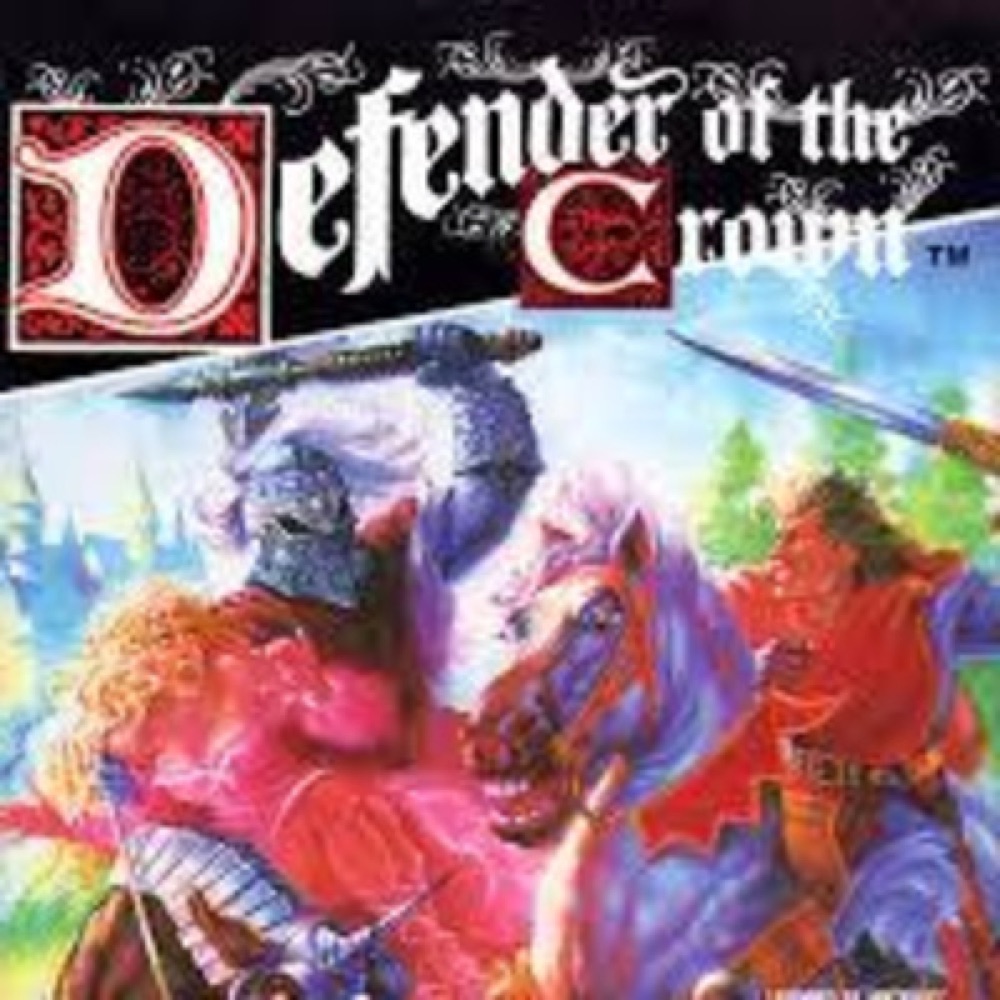
199 · Defender of the Crown
Strategy is vital in this chivalrous charade, and smarts will protect your hide better than armor as you command the role of a brave Saxon knight destined to avenge King Richard's murder. To reclaim the crown and conquer the heart of a beautiful maiden, you must outwit and outmaneuver hords of medieval marauders and Norman no-goods.
SHOW NOTES
Defender of the Crown Longplay
Play Defender of the Crown for free!
Defender of the Crown 2
Robin Hood: Defender of the Crown
Defender of the Crown: Heroes Live Forever
Nidhogg Gameplay
- To survive this Knightmare, your mind better be as sharp as your sword!
- NES Longplay
- Introductions
- A full version of this game is available online at Cinemaware.com (the full link is in the links section). The game plays in any browser.
- Overview
- The game is set in England in 1149 during the Middle Ages where, following the death of the king, different factions are fighting for territorial control.
- Gameplay
- The font
- Character Selection / Attributes
- Leadership, Jousting, and Swordplay
- Cedric of Rotherwood
- It’s nice to have a choice, but with the learning curve you are best off starting with the most average player
- Monthly Status Screen
- The Map
- You always play a northern lord in this game
- Land matters in this game. Unoccupied spaces have gold and vassel bonuses. Your ability to move freely within your own land
- Play from the center
- Buying your Army
- Soldiers, Knights, Catapults, and Castles
- Whatever you buy resides in your home base. Not where you are. I think that’s a little strange
- Conquest
- To me this is strictly a numbers game. You’re either winning or you’re losing. High Leadership did not change that
- That said, what your army is made of does matter. Knights are super effective in much smaller numbers than soliders
- I appreciate that the commands are not automatic though
- Defensive Siege
- Crossbow mechanic
- Offensive Siege
- The Catapult strategy
- Timing is everything, but this was one where I found myself being able to nail the timing once I got it down
- If you go into Sherwood Forest during your Conquest turn, you can enlist Robin Hood's help.
- The Catapult strategy
- Tournaments
- Jousting skill - determine how fast you can move your lance, and how accurately you can hold it in position.
- Since participating in a fame joust is a way to crank up your leadership, it's recommended to get someone with a decent jousting attribute.
- I’d rather just start with strong leadership than waste time Jousting
- Joust for Land
- Nice early strat to take away non-castle land from enemies on turns where you could not.
- The List
- The Melee
- Raiding
- High swordplay only gives more health.
- Gain as much control of the space as possible. Strike and then step back. You’ll eventually be in a corner, but if you find yourself there you didn’t gain enough ground.
- Side Events
- Rescuing the Princess
- You get a picture suggesting you are husband and wife. You now have a joint ownership with another lord
- Normon’s steal
- Vassals rebel
- Rescuing the Princess
- SO what’s the winning strategy here?
- Sequels and Spinoffs
- In 1993, Jim Sachs, who worked on the graphics for Defender of the Crown, designed a sequel, Defender of the Crown 2. It never really caught on though, mainly because it was only released for Commodore's ill-fated CDTV system. For all intents and purposes, this looks like a remaster of the first one
- Robin Hood: Defender of the Crown
- Defender of the Crown: Heroes Live Forever
- A new addition to the game involved the use of Hero and Tactic cards during battles, giving the user's army various upgrades during the on-screen melee.
- EGL
- Next week -
Auto-generated transcript. Each paragraph starts with its timestamp. Speakers are not identified.
Defender of the Crown, to survive this nightmare, your mind better be as sharp as your sword.
And welcome to NEStalgia, a chronological exploration of every NES game released in North America. I'm Mike. I'm Sean. And I'm Joe.
Guys, Defender of the Crown, a game that is on the NES, but also just a version, you know, you could just play this game online right now on cinemaware.com or something like that. I'll put a link in the show notes, but I think it's just funny that like, this is just a game now that is free, but people probably paid 60 bucks for it back then. I mean, it's not the NES version though, right? No, I think it's probably the... Like Amiga? Amiga was the, yeah, the version of this game that was very popular. You know, it's a very European game, right? It takes place in England and all that. And I don't think like, I didn't feel any attachment to these characters being an American. That is such a weird thing to hop on.
I mean, did you not like, you didn't like, you didn't like knights in shining armor, media? Like that's all like, there's kids stuff like that. Mike was only a cowboy guy. Just, only cowboys. It's funny though that you bring that up because I didn't know where I was going with that, but thank you, Sean. Like, you're actually right though. I hate all that stuff. Medieval times. You know, like all that stuff just not interesting to me. Jousting. Boring. Sorry to say it. You're telling me that if like ESPN ate the Ocho had like a jousting tournament, you wouldn't watch it? I'd have to know the players.
Okay. You know, like I couldn't just go in there. And I'm not saying they have to be celebrities. I'm just saying like, I'd have to be invested. I can't just go in there and pick a guy and say, oh, I hope he wins today. Because I'm going to be honest, even just playing jousting in this game was a little confusing. I'm not sure I'm going to be able to fully follow it on ESPN the Ocho. You didn't like A Knight's Tale starring Heath Ledger? I never saw it. I did hear good things, but, you know, that's my own problem. So I'll add that to the watch list. Yeah. I'm just really hoping now that ESPN comes out with a celebrity jousting.
I think, honestly, like NBC could probably do it. Yeah. That'd be great for Peacock. It would be a great, like, Olympic game. We've been doing a bunch of Olympic games. Right. Defender of the Crown, though, is not an Olympic game. It's not a series of minigames either. It's not just like you joust, you swing maces, all that stuff. This is another one of our, like, you know, grander, not grand, but, like, you know, a larger strategy-like game where it's England after the death of which king? Does anybody remember who the king is? One of those kings. One of those kings in, like, the 1100s, what have you. And all these different factions now are fighting for territorial control of England.
And the only winner can be the one who conquers all the territories, which is what you'll do. You'll be one of those factions. You'll start with your own castle, conquer other territories and other castles, take on rival factions, and hopefully conquer all the territories so that you can become the new king of England. I think as a concept, even though I'm not attached to the Middle Ages, that's fairly straightforward of a game for, like, you know, a grand strategy-style game, right? Like, the idea of just conquer all the territories, very, like, the board game Risk, you know? It's easy to grapple. I understand what's going on. I understand my objective.
Now it's just, okay, but how do I do that? What did you guys think? Well, I think the first thing that I'm sure came up in everybody's mind was that, like, comparisons to Nobunaga's ambition, right? Yeah. Like, it's the only game that we've really, like, played that was, like, kind of going for the same thing. And I think that maybe because we had just played that relatively recently, playing this makes me feel, I don't know, appreciative that it's, like, a little easier to understand.
And I'm not really sure if I hadn't played Nobunaga's ambition if I would have been maybe a little more aggravated by the things that were harder to understand. But, like, by comparison, this is, like, oh, I get it. I know what I'm doing. Like, you know, there might be some times where I'm a little confused.
But, like, as you figure it out, not that Nobunaga's ambition is not a functioning game, but it takes a lot of work on your part to, like, understand how it functions. Whereas this, I feel like you can pretty quickly get into the swing of it and, like, fully understand it and, like, know what your objectives are and know how to go about it. Know what you're doing right. Know what you're doing wrong. See, I sort of had a different experience. I couldn't really. I was interested in the. I'm interested in these kinds of games. I'm interested in this game.
And as much as I didn't really understand Nobunaga's ambition, I understood, like, the basics, but, you know, couldn't game the system in the way that a veteran would be able to. I think I understood that more than I understood this one. And I don't think it has anything to do with, like, the complexity of the game because it is.
It isn't as complex as Nobunaga's ambition. I think it had more to do with, like, I found that maybe the artificial intelligence in this game is just a little different than what I was expecting in terms of, like, what your enemies are doing. And there was just some clarity that was missing for me as to, like, what the state of my opponents was. And, like, we'll get into it. But I think I had some issues with this one while still appreciating a lot about it.
Well, Sean, you might remember in our Nobunaga's ambition episode, which was just you and me, Joe gave his thoughts the following episode, that we were talking about did they need, like, all of these different stats and occurrences to happen? Like, did they give you too much freedom in control? And you can't really make, like, a verdict there. You can have an opinion for sure, but it's impossible to say because the developers obviously wanted you to be in control of all those things.
In this particular game, Defender of the Crown, you're really just playing as the actual leader of your faction in an army-like setting. You don't have to worry about your towns. You don't have to worry about, you know, taxing your citizens or the happiness of your citizens. You're just building an army, you know, conquering territory and taking on other factions. So that's, like, for me, the most apparent difference between this and Nobunaga's ambition is that, like, the goal of Nobunaga's was too open-ended for me. And here I got the idea of just conquer territories early and often and build your army as fast as possible. And you were talking about the AI.
And something I noticed is with the AI in Nobunaga's, you saw what they were doing, you know? Like, you were able to – you could even watch it all. Yeah. Which is crazy. In this game, it's happening and you kind of have the ability to see them take territories via the map-changing colors and stuff like that. But you don't really know what's going on until you take it to your turn and start evaluating what they've done. And I have no way to, like, confirm this or not. But it seems like the AI is very busy during their turns.
And there's never really, like, a good moment to strike them. They're always about, at the very least, even with you, at least stronger. Yeah, going back to your first point about, like, sort of the main difference between these two strategy games that we played pretty close to each other now,
is that I think I preferred the focus, even though, again, like, I had trouble understanding both of them. Because I didn't play enough of it. I think if I played 40 hours of each, I'd have a better comparison. But at least, like, at its core, what I appreciated about Nobunaga's Ambition is that while it's not, like, a nation-building game, it is still, like, it's more administration-focused. Like, there's more scope to it than Defender of the Crown, which is more, yes, expansion, like in Nobunaga's Ambition, but also focusing on, like, the gallantry thing with all the weird minigames in here.
But I think, like, when it comes down to, yeah, the AI, there was, yeah, it was just that I couldn't, I could not tell what was going on. I was playing the game wrong the first two times I played it. I did the exact opposite of what you said. I basically just tried to amass an army first and then go on the attack. And by then, like, I was the last blue standing.
So, yeah, I'm rambling now, but this is my experience. Yeah, exactly. And I think I have, like, a big concept thing that I want to save for later, but I'm going to save it for later for sure. But I want to say that it's going to answer the kind of thing you were just mentioning, because I do think it's important to understand that the developers of this game did set up the game in a particular way. Joe, you were going to add something? Yeah, well, I was just going to ask, so not to harp on this too long, but so as far as the AI, the enemy AI, like, what about it was, what element of it did you find, like, was making it more challenging for, you know, to understand what was happening?
So, I think there was a point, because, again, this is in, this is while I was playing the game wrong, which is, I mean, I pretty much just played the game wrong the whole time, where I was sort of stuck. And I just kept getting attacked in my home province.
And no matter how many times I fought them off in the, like, archery minigame, and then I would, like, have some gold and I'd buy some replacements to refill my garrison, that next turn, it would happen again. And so I was stuck in this, like, negative, positive, whatever, feedback loop of just getting attacked over and over, defending for as many times as I could, and after each attack, just buying just enough to be able to defend myself and not, like, grow. So, after however many repetitions of this, I was just frustrated.
And I know that this is my fault, but that was my experience with the game. Okay, I hear that now. Yeah, I wonder if that is, like, just something that you can get yourself stuck into. Yeah, because my thing was, like, oh, are they, like, do they have sources of income that I don't as a player to, like, sort of buff the computer? What did you use, what was your most, what was your source of income mostly, just, like, the, like... I mean, I did some raiding when I wasn't getting attacked in the earlier game, and then I was just sort of, like, living off of the base amount.
Yeah. Because I feel like, yeah, I think it just played out differently for me, but I did, first of all, I did a lot of raiding. Raiding was, like, my second income. Like, whenever I didn't want to attack, I would just raid a castle.
Because I also found that that was, like, the easiest of the minigames for me to, like, get good at. Yeah. So I would do that minigame, I would come back with money, I would buy soldiers, and I would put them in different places. And then I would be able to get more castles and get more territories. So then each turn I would get more money. And I spent a couple turns, like, just building that way, getting a couple territories, like, letting my money build. And then went on to, like, finally start attacking when I had, like, a good amount of money, a good amount of soldiers, a good amount of knights.
But, yeah, so, I mean, I didn't feel, at least at first, like I was getting, like, kind of screwed by the AI. There was a point later on where I felt like I was screwed by it, but I do feel like I could have, you know, that was just me losing the game later in the game. Yeah, I find that that's me. That's what was happening. Yeah, I don't want to get too much further into, like, the tactics and strategy because I don't feel like we've accurately described the game enough yet, breaking it down into pieces. But I was just going to mention, Joe, if I made it seem like the AI is cheating or too difficult, that wasn't my intention. My intention was that Nobunaga's ambition requires more possibilities and more options to every single.
Right, more variables. So the AI could just wildly vary from your strategy, but you might be leading them in another department. In this particular game, you know, for better or for worse, the AI is basically just, you know, working on the same stuff, taking territories that you can't possibly get to yet and building up an army that's, at the very least, going to match your numbers, if not surprise you with how many numbers they have. Now, you can always check the status of your AI, but only on your particular turn. It doesn't cost you a turn or anything. You can always check in on everybody. But I think it's just surprising to see how strong their armies grow and how fast they conquer that land.
And, you know, that's probably the intention of the game is, like, if we break this down for a minute, right, you have a selection of characters. And those characters, other than just having different names and portraits, the biggest thing is their attributes. You have leadership, jousting, and sword play. And for each of the different characters that you choose, they either have a weak, an average, a strong, and a good. So strong being the best. I did them out of order there for a second. But it varies between them.
Personally, you know, I didn't think about the character selection too much, although I suppose that is some of the fun of the game. But Cedric of Rotherwood has, at the very least, just average stats with a strong stat as well. He's not weak at any particular thing. And so I just gravitated to him. I mean, it's nice to have a choice. But with the learning curve of the game, you know, you're best off probably just starting with the most average player and figuring out the mechanics that way than giving yourself a handicap.
Yeah, I actually also went with Cedric. But for different reasons, I just went with Cedric because the leadership was strong, which I knew would help in, like, overall battles. And then the one that was worse was jousting, which I was like, well, I probably won't do that much jousting anyways. And I didn't, actually.
But I think if you're good at jousting, that means that you can very easily, like, raise your leadership. But that's another section. Yeah. But then I also wasn't sure if, like, if it was just better for me to just start with strong leadership and then not have to worry about raising it. I don't know if it gets lowered at any point. I don't know. In which case you'd have to raise it again. But, you know, just as a rookie, I was just like, oh, I'll go with Cedric also. It is weird how they weight the attributes, though, right? Like, leadership is very important because that's how your army, the whole thing you're building throughout the game, that's how well they respond to your commands. So you would want that to be strong.
Jousting is just something that can either help you claim certain land against other people or gain the leadership category anyway. So you might as well, again, start with someone with strong leadership rather than build it up via jousting. Although I suppose you could conquer some territories that way. Can't conquer castles through jousting, though. And then sword play, I actually thought about, like, switching to somebody who was strong in sword play because I was struggling with that for a minute.
But it only increases the health bar of your sword character. It doesn't make them better at striking or anything like that. That's still entirely up to you and how you do it. So it's weird that jousting and sword play become almost these, as Sean was describing, the minigame stats. But leadership is the one that actually matters. Yeah. From an army perspective, you know, they should have had maybe more, you know, like a wisdom attribute or an intelligence attribute, you know, that mattered to other things involving your army. Or like tactics or something. Yeah. But I guess that is sort of covered by leadership.
But, yeah, I've read about or I watched a little bit of other critique of the game and heard that you can basically beat this game without really leaving the menu aside from, like, the times that you actually need to. Like, you don't have to do any raids. You don't have to do any defense minigames. It's like if you've really mastered the game, you don't have to do any of the other things that these stats are controlling.
Yeah. I found that. I saw that, too. I don't know how you do that. But I saw that that was a way of going about it, too. And I think, like, I'm assuming that, like, anyone who plays it kind of has their own, like, variation of, like, how much of that they do. Like, for me, like, I never held a tournament. You know, I think I was, like, invited to one tournament. But otherwise, I was like, I don't want to do this. I don't care about, you know, right now I'm not trying to get my, what is it, like, you get more respect, which ups your leadership if you hold tournaments.
And you can make money if you hold tournaments. But I was just like, I don't feel like doing the jousting minigame. I was like, I never did that unless I needed to. And, like, the, you know, like I said, I did a lot of raids. So that's when you do the raids, you end up doing, like, a little sword fight minigame, which I did a lot of. And then the other one that came up a lot for me was when my castle, one of my castles is being attacked. And you got to fight off the people with the crossbones, which I have mixed feelings about that minigame. I hate it. But I don't know if you want me to jump into that now if we're going to talk about the minigames.
Well, you know, I did, just before we get to the minigames, Joe, I wanted to just talk about the map itself. You know, it's just, it's clearly the map of England. But the way that the territories are divided and where you start are kind of important to the overall game. Because you can only ever be a, I guess, a northern lord in this game, right? You can only, you only ever start in the north. You only have, like, three choices of possible castles to start at. One of the castles is far superior than the other ones, which, you know, just a strategy that I read on GameFAQs. Because you got Robin Hood, right? What's that? Because you got Robin Hood, like, right there?
It's actually, it gives you more gold. Oh. Yeah. The territory starts you with more gold. It starts with 11 instead of 10. And then you gain an extra gold bonus. So you just get soldiers quicker.
I forget which one it is. I think it's the most centered of the northern castles. But maybe they give you that because if you're the most centered, you're, well, I guess you're surrounded by allies. So it's not. Semi-allies. You're more exposed. So, yeah. But you're more exposed. So, like, if more places get taken over, you're, like, I liked, you know, when you, for Cedric, you know, you're right on, like, the coast.
So you, there's no one, there's no one north of you that can attack. So you're, like, safe as long as you defend to the south. Yeah. So, like, I wonder if that's why they give you that extra gold. It, like, can give you that advantage in the center castle because you're exposed on all sides. That sounds like a good balance thing. Yeah. You're exposed on all sides, you know, and I think that's the interesting thing here in general, right, is that there's a lot of open territory, most of it in the south.
But the game moves very quickly from the sense of all this open territory to everybody just kind of quickly claiming the open land and then figuring out where to go from there. Do they take the land from others with the expectation that the other armies won't be there so it's, like, a free capture? Do they go for the castles to take down the, you know, the rival faction before they can accumulate too much land?
The land matters so much in this game, and it's interesting that the unoccupied spaces have bonuses of their own for the person who conquers them first. You know, like, you get a gold bonus and a vassal bonus provided to the first person. You can't just take it from somebody else and acquire that bonus. But, you know, you have this ability to move freely within your own land too.
So there's a lot of things that the map offers to you that I appreciate it almost that even though it seems like the land could be conquered very quickly, it matters right from the very beginning which direction you choose to go in. You could create a, you know, in Risk there's always that strategy of, like, starting in Australia and creating the walled garden. You know, you could try to do that from the northernmost point and just kind of continue to work your way in so that they have to fight you in order to get to your more precious things like your castle.
But you could also take the stance that, like, no, it's better to take these guys, to take these middle spaces earlier to challenge the, you know, the bonuses and the land that you're going up against with your enemies.
Any other thoughts on the map from you guys? I guess one thing, this isn't, like, specific to this game. It's more just a comparison to other strategy games that deal with maps is that I was sort of surprised that there wasn't really much of, like, a terrain bonus thing. I guess, like, England, it's not a very varied landscape. So it wouldn't really apply too much. But when it comes to territory expansion in strategy games, like, I'm always looking for choke points and there just isn't any in this map.
Which I guess, like, sort of takes away from some strategic thinking but also makes it so you can't just rely on them. That's a fair point, you know. There's not a lot of personality on this map either. Like, I think the only locations that have names would be the ones with the castles, correct?
I don't quite remember. I don't think you can name check the territories otherwise. Yeah. I know that the castle ones definitely do. But, I mean, I've played too much Crusader Kings not to, like, associate them with others.
So now that we have a layout of the objective of the game and the way that your leadership stats work and the map itself, what's the first thing you do in a game like this? You have a lot of different options, right? You can build up your army by spending your gold to buy an army. You can raid a castle to get some money. You could host a tournament.
You know, there's a lot of – you could conquer territories that haven't been claimed yet. Joe, what did you do first? Well, I mean, if we want to talk about what I really, really did first was like, oh, what is this game? Let me attack some people, lose really fast, and then start over.
But then when I did first, once I already sort of had an idea of what I was doing was, you know, my strategy, like I kind of mentioned earlier, was to start by, you know, I would defend my castle, you know, like, as much as I can, buy what I could. And then for a few turns, just raid other castles and start building up money so I could build up my army. So then I could – once I had, like, a decent army, a couple of knights, you know, a couple of catapults and a good number of soldiers, I would start taking over, like, a territory or two around me.
Then raid more castles, get more money, take a few more turns to get the income from now these other territories, and then kind of, like, do that again but, like, exponentially bigger because now I have more money, I can buy more things and try and slowly start, like, working my way out.
And that was really kind of, like, my gameplay loop. And obviously, like, a lot of those turns you have to spend – especially when you have more castles and more territories, you have to spend defending your territories.
And I'd be interested in seeing how, like, an expert does this without doing any of the minigames because that was, like, my biggest hindrance was, like, okay, I want to do this, but now I got to do this minigame. And, like, it all comes down to my skill at it, which at first was definitely a big setback. I did get better at a couple of them. Like I said, I was good at the raids. And I also got better at when – at the minigame that occurs when people attack your castle. So, like, I don't know.
It was a varied thing. But I think I actually sort of in my playthrough sort of neglected a good chunk of this game that I'd be interested in going back and playing, like, maybe with more focus on, you know, on tournaments or some of the other, like, things that you can do to build up your army. Sorry, I'm kind of rambling. But there's just a lot of – there's a lot of paths you can take, it seems like, to move forward.
The first thing I did sort of completely counter to what Joe did was host a tournament because I'm like, all right, I mean, I know that this is going to be mostly just conquering territory. So, let's see what makes this game different. So, I did that and immediately sucked at jousting and then kind of got the hang of swinging the chain. And what was the third thing you did? I don't quite remember. But – Raiding the castles with the – No, tournament. Oh, tournament. No, isn't that it?
I think it's just the jousting and the macing. Okay. I thought there was a third thing. But anyway, so I did that and I'm like, oh, okay, I can, like, sort of use this as a way to, like, get some soft power. But then I realized that, like, yeah, you're just sort of raising a stat and you're not really gaining much by hosting this tournament aside from, like, a little bit of gold. So, I was like, okay, I'm not going to do that again. I'll just go to the ones that I'm invited. And then that's where I sort of, like, lost my way and made bad decisions throughout.
So, yeah. But I did try and just do the tournament thing and see where that took me. Yeah. I'd argue the most important thing for me to do before thinking about even hosting a tournament or taking on a rival faction was just building my own army. You know, you start with 20 soldiers in your castle, the space that you occupy.
And, you know, depending on where I was on the map, I just kind of said, screw it. Like, you know, when you buy people for your army, they always go back to your castle anyway. So, I took all those guys out of my castle, put them right into my garrison and just said, like, let's ride, boys. Like, we got 20 of us. Like, let's go. Let's take some territories.
And, you know, I would immediately go for the territories too because you want that gold bonus. You want to be able to buy more soldiers right away too and eventually the catapult because the catapult is the only way that you can take on the castles and take them over to begin with. But if we could just talk about the strategy of buying in general, it's weighted in the sense where soldiers are just one gold. So, theoretically, you know, soldiers are something that should be plentiful to you at any particular time, especially as the game goes on and you acquire a lot of gold.
You could buy – you could have a soldier army of, like, you know, 40, 50, 60 people. You know, it ate caps at 250 per unit. So, clearly the game was expecting people to have high army counts if games went on for a lot longer.
Knights are 8 gold. Catapults are 15 gold. And the castles thing, which I didn't fully understand, I think that's 25 or 20. I can't remember exactly. But for me, you know, this was mostly a game of buying a ton of soldiers, maybe a few knights and stuff like that. But the idea that buying these guys sends them back to your home base, not where you are, it could work in your favor if you're constantly taking guys out of there anyway. So, this way you're replenishing your stock without being there. And since you can travel freely amongst your own territories, it's not like it's going to cost you a turn to go back.
Hopefully, it's not going to cost you a turn to go back to your castle. I just thought it was a little strange that the idea of buying your army, but you're not buying them at the place where you are. You know, I could imagine that you'd be on the territory paying a different sum or whatever depending on whether you own the territory or have a castle there or something. The game didn't really do that. Instead, it's flat rates throughout the entire game, something that could easily be taken advantage of as you get closer to the late game. That is true.
So, I think a lot of where you see that as odd comes from, like, you sort of started out by saying that you are playing as your guy. And always, like, as your guy leading the army, wherever he may go, like, that's your perspective of where you are. Whereas, I guess, like, when this sort of crosses into, like, a real-time strategy thing, I know this isn't that, but when I think of playing, like, StarCraft or something, like, when I make infantry, they come out of my base.
And so, I think that, like, if you also apply that to, like, well, if you're recruiting soldiers, you're, like, you're raising your levy in your home province. So, that sort of made a bit of sense to me. But I kind of want to touch on what you said at the end there, too, which is where everything's a flat rate.
And that does, like, make it so that, like, in the late game, having a bunch of guys is almost, like, a given. So, it sort of makes it so that, like, this game lives and dies. Your playthrough lives and dies by the early game. And if you've made some mistakes and your gold to guys economy isn't up to par, the fact that it costs the same to you as it does, like, the biggest opponent, there are no, like, size malices, you could easily just get steamrolled. And it may take several turns for you to actually lose, but you will lose.
Yeah, and I get that. And maybe this is kind of artificially created, but I do, I don't hate the idea that, like, that you live and die by your early game. Because then it feels like when you do well, you know, you play and you do okay and maybe, you know, you're like me and you lose, like, halfway through. But now I feel like if I can figure out that early game and I can get to that point, like, even if it's artificially created, I feel like it would feel so rewarding to finally be like, wow, like, now I'm, like, unstoppable.
Because I found the right path to get here. Oh, yeah. It's very, it's a great power trip once you've done it. But I think it sort of takes away from how dynamic a game can feel if, like, there's no, not to call it, like, a rubber band thing, like, in a racing game. But that there isn't different play styles that, like, oh, if you play like this, like, you're going to have, it's going to be difficult early. But later you're going to start to really start to dominate or, like, oh, this is easy because in the beginning you'll have an advantage. But later on it becomes a little more cumbersome. Like, I guess it would need to be a much more complex game to have that sort of feel.
But I guess I've been using most of my time saying, like, this should be like other games. No, but I see what you're saying. And I don't disagree with you. I wasn't even saying, like, just for the power trip element of it. But I mean for, like, the journey to get to that power level, like, it does feel satisfying. But I think that's, like, a different point than arguing with what you're saying. I agree with what you're saying, too. Yeah. You know, I like that it gives you that, you know, way to, like, find your path to getting that powerful. But I also, you know, I see that, like, there could definitely be some more complexity to some of these systems that lets you, like... There isn't just one way to win.
Right, right. Yeah. I mean, it's all the, you know, that early game being so important is all the more reason to make sure that your army is well-equipped from the very beginning. I would say that, you know, I played a few playthroughs of this game, and the winning strategy for me was, you know, withdrawing my entire army from my castle and putting it directly into my garrison. And then raiding other people's castles to get more gold right away. The only objective of the raid is just to be good at the sword play minigame, which is really just a funny side-scrolling, like, strike-with-pixel knives thing.
That, like, it's not the most intuitive thing, but it's also not that hard to learn how to be good at it if, you know, your game depends on it. Yeah. Like, if that's one of the major things, like, sorry, but you must learn that mechanic or you're not going to have a good time with this game. And once you do learn, and, you know, I'm not saying I found a cheat or anything. I just think I found a way to do this and a way to consistently win at this sword play game that it made it easier to have a big army at the start of the game, which is a nice feeling, sure, but also makes it so this way it kind of diminishes other strategies for playing this game when I know that this works better.
Yeah. So let's talk about the raiding of the castle since that was the most recent thing with the swords play and everything like that. Again, the sword play stat of your character is just dependent on how much health that they get. You always attack three small health enemies on the outside of the castle and then someone on the inside who has a much larger, significantly larger health bar. This is a side scrolling, which is weird to say, right, because it's not really scrolling. So it's just a 2D swordsman's game, much like the fencing game that we played in the track and field two. It's a fencing beat them up with one enemy per screen.
With one enemy per screen. I love it. Or, sorry, one enemy per time, but the screen doesn't change for the first three guys. They just keep coming outside one by one. Why they wouldn't just come out all three at once? Are they like, okay, he's not that serious. You go first. And then they're like, oh, shit, he's dead. I got to get outside. It's just that other warlord? He didn't come with anybody else? Yeah. He really should be sending out more of his army, especially when you later fight him and find out he has 60 soldiers. You're like, why did I just take down four? Anyway, this is a game idea here where you either strike high or strike low or defend.
I think the main objective for me here was just to gain as much control of the space as possible. And by that, I mean move forward. Don't be backed into a corner because they walk slowly. You walk slowly. But you have enough time to continually gain ground. And then it's as simple as a Mike Tyson's punch-out rhythm game thing where I would take a strike, take a step back. Take a strike, take a step back. You just strike, then step, strike, then step. You'll eventually be in a corner, sure. But if you find yourself there, it's only because you didn't gain enough ground.
Joe, you have some thoughts? No, I was going to say at first I thought that that was interesting because it sounded like what you were saying was the exact opposite of what I did, which I also thought I found a way. But actually when you continued explaining it, I think you did the exact same thing. Yeah, gain ground at the beginning and then spend basically most of the actual fight sort of like half retreating while you're kind of stabbing at him. And it all just came down to timing.
And yeah, I did like the exact same thing. But I will say that I felt like as much as that gave me like the confidence that I knew if I did – if I was in the sword fight, I would probably win 75% of the time. There was still that 25% where I'm like – it still wasn't like a perfect plan, at least for me. Maybe I could have gotten better at it if I did it more. So it wasn't a perfect plan. And it still felt like there was a little bit of risk to raiding a castle. Like I could lose.
Right, right. I mean, yeah. I don't want to make it sound like I was perfect. I guess it was like the idea of raiding for money being the most consistent way to win the game. Almost like since I was taking the same steps every time, if you don't win the raid, you just reset because it's like it's not worth it. You know, it's better to just follow the same steps again and try the raid. Sean, any thoughts on the sword play? Anything they could have done? I mean, obviously they could have done a lot, right?
The striking mechanic even, just the ability to only either strike or play defense is better in some regards, right? But it's not the full pick. Yeah, I mean, basically the only other thing that I can say differently from you guys is really just like whenever I was in that minigame, I just wanted to play Nidhogg instead. Well, I mean, I always want to play Nidhogg. Yeah. Sean, what is Nidhogg for the uninformed? Nidhogg is a fencing game where you try to gain ground on your opponent and eventually get eaten by a worm.
And we'll put a link in the show notes for those of you that still don't understand, but it is a great game and we've all played it together. We have. Actually, I want to back up for a second. Mike, you said that the best bet would be to reset if you're losing and just kind of try it again over and over again, right?
That was sort of my point, too. I did say that. I think I know what you're about to say. Okay. I'm not suggesting that this is the one true way to play the game. It's just that through trial and effort, and I did eventually beat this game, I think your best bet is just to stick with what you know, stick with what's working, and just continually try based on that. I didn't want to ruin a good thing. If I was doing well with this particular strategy, I didn't want to say, oh, well, maybe it's time to try tournaments or maybe it's time to go for more empty land early on and just have more spaces.
Okay. Which is certainly a tactic. I would say that what Mike said is it's a little bit more extreme of what I was saying. Just like, oh, if you mess up in the early game, you're already screwed, so you may as well start over. But I think that after one failed raid, maybe that hasn't happened yet. Well, right, right. And I get it for the early game if you want to start the game over, but just to be clear, you mean actually literally reset, like start over. Oh, yeah, completely. Yeah. So that's where I feel like you're doing yourself a disservice.
Like, I feel like that takes away the enjoyment of the game because you're taking away the stakes of, like, well, I lost and now I have to deal with that and, like, learn how to – Like, I feel like that's the point of this game is to, like, you lost, you lose men, you lose time, you lose a turn, whatever. Now you have to, like, maneuver around that. And, like, that's where I think the strategy comes in is, like, recovering when you lose. Well, that's sort of like – my point is that there isn't – there aren't a lot of opportunities to recover. Like, have you won – did you win a game after you had lost, like, a couple times and, like, halfway through what you thought was halfway through the game?
I mean, no, I didn't do that. But I also don't think that, like, a couple times when I failed what I was trying to do that that, like, sunk my game. Okay. So what I feel like, you know, just a little sidebar, like, what I feel like sunk my game could be something with what you were talking about earlier where I just suddenly started to feel like the enemies had gained so much – such huge armies, like, halfway through the game.
But I also, you know, I at the time had attributed that to, like, okay, maybe I started spreading myself too thin too early and I started trying to take too many territories and, you know, lost ground that way. But, like, I never thought, like – I failed at a lot of things. You know, I would fail when I would go in to do a raid or I would fail, like, defending my castle.
But, like, you know, there was some fluctuation. Like, I would start to lose a little bit. I would kind of come back a little bit. And then, you know, at one point, obviously, it just skyrocketed how much I was losing. But, like, I don't know. I'd have to play it a few more times to, like – Yeah, you're right. To, like, know if it is, like, possible or not. But I didn't feel like it was ever impossible while I was playing.
I'm sure it's possible. I'm sure there are people who are better at this game. I'm just saying anecdotally that my one playthrough where I won, I was perfect. In the sense that not that nobody ever died or anything, but, like, that I never failed anything I set out to do. If I was raiding a castle, I raided it successfully. If I was trying to take on an enemy castle, I catapulted, I threw the rocks successfully, knocked down the wall, and then, like, fought them head on. And it all worked out for me. You know, I don't know for certain that it can or can't be beat. All I'm going to say to you, and this is, you know, just an idea. I don't need a response or anything like that. But you're suggesting –
You're suggesting that it wasn't the failure that caused the enemies to gain ground on you. And I would think that that's what it would have to have been, right? Is that, like, in a game where every single turn counts towards the, you know, the abilities of your army and everything, that in that particular failure or failures, that's actually where the enemy was gaining ground on you in terms of soldier count or land or gold?
Well, sure. Of course. Yeah. I mean, like any game. But then, you know, sometimes I would win it back. Yeah, but this one happens because now it's too late. Yeah, but not – but, you know, I don't think it was – my point is I don't think – and, again, like, I also don't know because I only know. I only had, like, the experience where – you know, the one experience. But I also think that, you know, like, it was – at one point that happened, yes. But I feel like at several other points I would lose. But then I would gain it back. And I would – you know, I felt like – and maybe, yeah, the times I lost in the beginning somehow eventually contributed and was the cause of that.
But my point is that I just don't think that – you know, I mean, that's how you win or lose any game. Like, I don't think that it was so – at least it wasn't apparent to me that it was so unbalanced once you lose that, like, hey, if you lose, like, you're pretty screwed for the rest of the time. Like, I feel like I had to lose quite a few times before I was like, okay, well, now it's over. But then that's me losing the game.
I just want you to know I feel good about this conversation and that there's – you know, not only is there no way to prove it, but it's almost certainly in your favor. The odds are in your favor. I guess I'm just saying that, like, I prefer to play – As a god. A game like this. Yeah, a game like this where, like, where I'm in so deep, right? Like, it's all or nothing. But it's also not all or nothing if I can just go back and do it better the next time.
I prefer to just start over than to live with my fans. Yeah. Okay. I'm going to step in here. Especially in this age of save states and stuff. I mean, I do that too. But, like, I just feel like we – you know, I just don't think it was necessarily a fault of the games. Although it could have been. I will just step in here real quick just to remind everyone that I only agree with Mike if this happens early. I think mid-game – I also agree if it happens early. Mid-game, you can come back from losses. Sure. A hundred percent. Also because, yeah, you'll be gaining a lot more gold, so you'll be able to rebuild your army and stuff like that. A hundred percent. I agree.
I think we're all back on the same page here. So since we talked about raiding the castles, can we talk about the other minigame-like aspect, which is the tournaments, the jousting and everything like that? We briefly touched upon this, but I'd really just love to hear if there's any additional thoughts. And also just the mechanic of the jousting and I think what they call the melee, but really just swinging your mace around.
It's different than the swords play. So the objective for jousting here, you have your lance and you have to be very precise with this thing. And I think it's kind of cool how they do it in this first-person perspective where you have your lance and you've got to move it while your horse is moving. So it kind of fights against you a little bit and you see your enemy coming up. Long story short, you want to line the lance up with like the center area of their shield. Not the exact center. It doesn't have to be perfect, but it has to be pretty good in the center of this shield.
And then that will cause them to be knocked off their horse. Then you will go to the melee section with the maces. And it's not something where you just say like, okay, he's close. Attack, attack, attack. You have to deal damage. You have to let the mace actually swing for a while, which I thought was a pretty interesting thing. They could have maybe explained that a little better in the sense of like a power meter or a swing meter or something to show you. It's built in. Yeah, it's just built in. You just count how many times you saw. No, no, no. So like, okay, first of all, the jousting.
I was okay at jousting after however many times I did this. I still don't really know what all the variables are that like make you be able to get your lance over to the shield. I will say that both of these minigames like definitely feel weighty. I think that's good. Like I imagine trying to line up a lance is pretty difficult.
But when it comes to the swing in the chain portion, like there's visual cues as to like when you're supposed to hit that attack button. And it is like on the backswing. Like as soon as you are at the farthest point in that backswing and you are aiming at the correct like lower body or upper body, wherever the shield isn't, then you will land a blow. And sometimes it feels a little finicky. It's like, oh, I definitely hit him. But that sort of like I understood that pretty well. Yeah, that's amazing. You just blew my mind with that. I guess I was just getting lucky.
I really did think you had to like let it spin a couple of times. I mean, you kind of do. That went up momentum. But that went totally over my head as well. And I'll confess that the reason that I generally didn't do any tournaments was because I never really bothered to like learn how to. Every time I did one, I was like, I have no idea what's going on. And I would just lose. And I'd be like, okay, I'm just going to go back to the other part of the game. But Sean, it sounds like you liked this tournament minigame. I mean, I understood them more than I understood the rest of the game.
But I wouldn't say that either of them is particularly engaging. Yeah, I agree with that. I think that that's like a good way of describing like a few of the minigames, not even just in the tournament. But like understandable, not necessarily super, super engaging. Yeah, I mean, even going back to the rating, like I wouldn't say that that sword play was anything to write home about. If anything, it was tedious to just continue to do that in order to gain some gold. They could have probably came up with some more creative ways to get some gold.
The next thing I guess we could talk about is just the defensive siege. What you guys were referring to is the, you know, shooting with your crossbow at the enemies as they try to attack your particular castle.
Again, this is kind of like a first person point of view where you see the soldiers of the enemy pop up and you have to shoot them with your crossbow. So, you know, I think it's definitely like interesting that they chose like a unique way to like for each scenario, right? So if you're doing an offensive siege, it's not like you're the soldiers now and you got to like dodge the guy with the crossbow. Like it is nice that they came up with something for your castle being attacked that isn't just like we rolled a random number and it decided that this was the result. Now you go out and battle army to army. Like a land battle. It is cool that, right, it is cool that this was done.
But I don't really have any like thoughts on it. Again, it does just feel like a minigame in the way of the actual progress. It's not particularly hard. It's not easy though either. Like you do have to try this. If this happens to you, like you have to learn the ropes and hope to do better the following times. I didn't quite get the timing right away.
Yeah, I guess like what I liked about it in theory, not so much in practice, was that your how well you do in this minigame. It's not like it's not like you're playing as just this one crossbowman. But like however well you do, like that's how much casualties you've avoided, which is better, I think, than like an all or nothing thing. Like, oh, you successfully repelled them and suffered no casualties. They're like, oh, you just died and everybody's dead.
I appreciated that it's sort of like a war of attrition when it's like this. But if you're being rated or if you're being attacked, like you're just not having a good time. So I didn't really like it that much. But I liked the thought that went into it.
I'd say that I would have considered this the best minigame. Maybe I still do. But like the most, I think it's very balanced. And I think it's the most fun of the minigames personally.
And I think, you know, it's challenging. It's challenging but not impossible. But the flaw with it for me is that, so just to paint the picture a little bit, you know, you have your crossbow at the bottom of the screen. And you have to move around and shoot at enemies that pop up on your castle wall. And there's like three different levels of your castle wall. Like some spots are higher than others. And you have to like adjust the distance that you're going to fire. Or like I guess it's like the angle that you're holding your crossbow. Like how high up you're holding it.
And you do that just with a tap of the D-pad. But there's no real like clear indication of how high you're aiming. Until you lose several times. Yeah. So like I'll shoot the guy at the top and then I want to shoot the guy at the middle.
But like if I want to shoot the guy at the bottom, easy. Like as I'm moving the crossbow, I'm just holding down and I know I'm at the bottom. And the same thing with when I shoot the guy at the top holding up and I know I'm aiming at the highest. But like to shoot at the middle, it's just so – because you have to be using the right or left button on the D-pad to move. And then like tapping the down button the one time. And like I'm just never clear where I'm aiming until I shoot and miss. And then I'm like, okay, I wasn't aiming at the right spot.
Instead of like just this very – like there isn't a lot of information that comes from like where your character is until you have played it enough to realize that like, oh, if he's this many pixels up, that means he's going to fire at the guys on the ramparts. And if he's this many pixels down from that, like then it will be mid-range. So I think that they could have fixed this just by like changing the sprite of your guy to actually like also change what looks like the angle at which he's firing.
That's all that needs to be done. But instead it's just like copy-pasted but like offset however many blocks. It's kind of hard to describe if you haven't seen the screen. Like what I imagine some of our listeners are just sort of scratching their heads right now. But that's what I would have done.
Yeah. I mean I think even ideally – I mean obviously this might be like difficult to do but like put some sort of crosshair or even if it's not going to be a crosshair like just something in your lower right that just like says like high, mid, low or something. You can just see where you're aiming or just like has a little bar where you're just – it's like the section you're aiming lights up or something like that.
Like just so you could – it's all happening so fast. You don't have time to like think about like wait, which way does it look like he's maybe aiming? Like because then they shoot at you pretty quickly. And then the other type of siege is where you're the attacker and to do this you must own at least one catapult. It has to be on your moving army with you. On your person. Please have a catapult. And then when you choose this offensive siege, now you're greeted with what I would argue is the best minigame. I know, Joe, you like the crossbow one. I thought this was kind of fun. You're given a selection of like rocks, diseases, and like – what's the other thing? Greek fire. Yeah, like a – right, like a grenade, yeah. But 1100's grenade.
The idea that you have to then like put – let's just say the rocks since you have to start with them no matter what for this to work out well. You load the rocks onto the catapult one at a time. You have a limited inventory. It doesn't matter how strong your army is or how many catapults you have. You only ever have X amount of turns and you can only ever use a certain amount of things. I just think that's funny though that like you could have a whole fleet of catapults and like you only remembered to bring that many rocks. Your one, right, yeah.
And then you load these rocks up and you have to hold down the A button to kind of load the – or load the spring to push down the catapult and then release it. And with that it launches your rock into the air and then hopefully at a particular point of the castle wall so that it creates a little hole. And then you would go to the slightly lower part of the castle from there and aim for that.
And you can do that a maximum of four times but you really only need to do it like probably twice but I would say three for good measure to make sure that you then throw over the disease and the fire stuff successfully. Because you can't just launch that stuff at the castle. It will just act like it hit a wall or didn't make it or went over it or whatever. You have to make this incision first on the castle.
And I don't know. It was one of those things where you have to learn the timing. But once you figure out where it happens, this was something I could get pretty consistently. So I enjoyed going back and doing this once I had my catapult ready. I felt good going into it. I didn't make too many mistakes once I figured out the positions of the catapult. Then it just became a game of making sure that how many diseases am I going to throw at them or fires am I going to start. So I like that. That's the one thing though that kept – because I like this one a lot too. But the one thing that kept it from me liking it more than the defense minigame is that I felt that this one was the most fully learnable.
The first couple times it was like trial and error and I was figuring it out. But then after a while it was like, okay. Because it clicks when you pull the catapult down. So I would like, wait. I think I did like – I would count seven clicks. Let go. That's the perfect first shot every time. Every single time I would get that. And then it was like, okay, now I count five clicks or something. I don't remember what they were now. But like, okay, that's the perfect second shot. Now I got a perfect hole there. Now I just throw disease, fire. I feel like it was just – I still enjoyed it. It was still a cool little aside. But after a while I was like, okay, I know exactly how to maximize this.
And then it got less – it was like the opposite of what I was saying for the siege – or not the siege, but for the infiltrating the castle ones where it was like, yeah, I can learn it. But I could still fail. This one I just felt like it was like after a while I was like, okay, you can't really fail if you just memorize like exactly when to launch things.
So regardless of, you know, if you make the – all four hits on the rocks and throw some diseases or whatever, you still have to then do a land battle, which also can just happen in a regular conquest too. If you're just going up against somebody else who happens to be in the same territory and you're trying to claim that land, you'll get into a fight with them that way as well. So this isn't exclusive to an offensive siege. This is just a land battle that can happen at any particular time.
It's whatever that particular faction has available to them. It's not just like their entire army. That would be crazy. It's whatever they have on them versus whatever you have on you. On their person. To me, yeah, this is strictly a numbers game kind of thing. I mean we talked about that leadership stat changing how well they respond to your commands. But, I mean, maybe you need like some really high leadership. For me, this is something where like you're either winning or losing as soon as you see what the numbers are. I never saw a situation where I was at 30 and they were at 40 and it was going to matter enough that anything other than a retreat was going to help me come out of that alive.
Yeah. You know, that said, you know, what your army is made of does matter. Like if you have, you know, like 60 soldiers and they have 40, that's great for the start. But if they then have like eight knights, they might be able to take you down once you get to those knights. Those guys are strong. So like knights are much more effective in much smaller numbers than soldiers would be. But then, you know, catapults also like we were talking about how you can only ever use one in the offensive siege. But if you do have multiple catapults on you, this is where it counts.
Yeah. I mean, it very is kind of it's it's predetermined in one sense. But you can also use different strategies, which I which I guess depending on your leadership stat and against their leadership stat and however guys you have and how many guys they have. Like, I guess if you were to switch it up a bit, you could still win a pitched battle.
But it just seems to happen so fast, like immediately from the screen, like your guys start ticking down. So I think like you have to know exactly what you need to do from the beginning in order to make that correct choice. Like otherwise it is. Yeah, just that numbers game. And there might be some RNG thrown in that I don't actually know. Yeah. But I think even if you do know exactly what you want to do, like I was like I was just lucky enough that like my strategy because I always started with was often to just hold my ground, which is which is the first.
Yeah. The default. But yeah. But if like if I ever needed to change something because I saw I was losing, like there was just no time. Like there's no time at all to do any like it almost seemed pointless to ever change anything because it's like, well, by the time I just scroll down and try and select. I probably lost 20 men or something.
But I did like that. Like once I started to learn that like, you know, knights also seem to make your soldiers decrease much more slowly. Like I guess they're protecting them or whatever. But like there were times where I would have much fewer soldiers than someone else. But if I had more knights, their soldiers would rapidly deplete, which was nice. But I could never say for sure like how much of my input was mattering or how much it was just predetermined. I appreciate that the commands aren't automatic.
I think you only have like four things that you can possibly do. That gave me like some kind of feeling of a general, right? Like it's it wouldn't be instantaneous. So I did kind of like that. Like if you say retreat, you still kind of watch your numbers dwindle for like another second or two before they actually go away. Yeah. So you do have to think about what you want to do early on in the battle. And that's why I said like for me, it was a numbers game. If I didn't think I had a chance, I wasn't going to let my army dwindle down and then decide like, OK, now I have like eight guys left. I know I'm not winning. Yeah.
I just wish that they gave you an option to be like, hey, the battle's about to start. What's your initial command? Because it just defaults. It just defaults at that one command. Like, well, I don't want to give them this command, but you have to start there. And then you have to spend time in the battle to switch to your other command. I like that idea a lot. Yeah. I think you could also add some flavor to it if like if it was only the attacker that could choose how to proceed and the defender had to start at that default.
Right. Yeah, that would make sense. Don't you think it's interesting, though, that they went with like this being the one thing really other than, you know, making your turn decisions, this being the one thing that you don't really have control over? Like everything else is like a minigame that you personally are involved in in one way or another. And then this is the one where they're like, no, here you can just call out from the battlefield what you'd like them to do. But even those things aren't necessarily like prescriptive of what's going to happen. There's just like suggestions to your army. Right. I mean, I'm sure they change results on a computational level, but not something that we can see visually.
So I think it's interesting that they didn't decide like, oh, for the land battles, you'll be one of those guys out on the field like attacking other soldiers. That's just sort of one of the things that I appreciated Nobunaga's revenge for was that like a land battle is like a tactics game, even though it is a very simplified version of one. Yeah, I guess I hadn't really thought about that, but that's true. Like, yeah, this could easily be like a sword fight where every hit you get counts as like you destroying some of their numbers. And every hit they get, you know, kind of like they do it in that, well, in other games, in this game. And also, I mean, no, we're jumping way ahead here, but like in Pirates.
Ah. Right. Sid Meier's Pirates. Sid Meier's Pirates, yeah. So that's one of the bigger ideas I wanted to get back to is, you know, the inclusion of these minigames at all, right? Like, I'm not talking about this Conquest thing anymore because, again, that feels more like your general, you being the general. Of your army. The minigames, they do add an interesting flavor to the game. But do you almost wish that those became simulated as well in a sense that mattered more to stats, other stats that they could have added maybe?
Things that could have been more like dice rolls? Or do you think that the game should have went even further on the minigame side and made everything about this game into like little subsections of its own game that you have to learn those parts to succeed further? Like, should traveling have been a minigame? Should, you know, I know it sounds crazy, but you could have done it, right? It's not unfathomable. At this point, I think you're making more of an adventure game.
If you're like in direct control of your guy at all times. I think a strategy game needs to have some more like it needs to be stat based and also like decision based. So if more things are being simulated that I guess I'm sort of arguing against both sides here. What I'm trying to say is that this game is kind of is kind of schizophrenic where I'm sorry, bipolar, where there are some things that are like purely direct input and some things that are purely stat based. And they're kind of going out in random directions.
And so it doesn't really have that much of a of an identity in that regard. But I think like if you made it all like direct input, like now you walk to where you need to go. I think that that is that's more of like an adventure game thing.
And I think that like some of the simulation and dice rolling stuff that would make it a bit more strategy. If you had more more decisions to make like on a like on a map.
I'm I'm rambling again. You're not rambling because ultimately I get it. Like this is a conscious choice from the developers to break up the probably what, you know, their kid facing audience would think of as the more boring part of the game. The part where numbers are just displayed. I don't think their target audience was kids. But for the NES it works out nicely that there are these mini games that happen and they they kind of split you in a way that you describe as bipolar. And I don't think is like wrong. But it's also just a chance to try something different for a video game. Right. Is that we've already seen the version where this whole game is just numbers.
And we didn't find that to be essential. So this is another way of of tackling that. I'm not saying that they should have removed all the mini games. I'm not saying that the whole game should have just been an adventure game where you try to conquer England that way. This was the choice of the developer. So ultimately we can only judge it based on that and and have opinions on it.
You know. True. Yeah. I was kind of thinking something similar to where like I wonder if the developers you know added some of these like mini game things and stuff. And I haven't I haven't looked into the other versions of this game but like added these mini games and stuff as like a as like a remedy for for putting this kind of game on the NES. Like because we hadn't seen it really we hadn't seen it we haven't seen a game on the NES like really work and be appealing to like a large audience yet on the NES like because of just the limitations and stuff.
So it feels like maybe they were trying to like OK what's like some some NES video gamey stuff we can put in here and still keep the core of our game and kind of find strike that strike up that balance. I'd be interested to see like what the I think this is actually a pretty good port in terms of like what kind of things are in it. Like this is definitely really all these mini games are definitely in like the Amiga version.
Right. But this is to Sean's point this is considered one of the better versions because of the improvements it makes from the Amiga version actually like in terms of balancing and and stuff like that. So I thought that was interesting. You know presentationally though too like the game is the game is pretty beautiful at times. Right. You know like some of the graphics for some of the mini games might look a little funny. But if you're just looking at like some of the portraits I'm thinking about you know for that's for those side missions where you like run into Robin Hood or when you rescue the princess like those portraits are pretty breathtaking.
The jousting like with the the bugles like that was pretty cool. These are like they're static images. So I get that they were able to do better because they're not trying to make like full cut scenes out of them.
I was surprised to even check out the Amiga version and see that their graphics are even better on that one. I was like wow these are really nice looking pixel art the kind of like like a coffee book version of you know like that kind of large format. And it's it's funny that you you say that about the NES version because while it is like it's it's competent like this game got kind of popular because of its like beautiful pixel art on the computer like the PC versions. Whereas it's that that portion of it is kind of downplayed in this because it's an NES. But you're right like on the NES it still does look pretty good.
So I you know I just realized I thought we were done but we're not there. We didn't talk about those side events these these random things that can sometimes happen. You can get married. Yeah yeah you can get married by rescuing the princess and also like yeah it's nice because you get married and now you see the the blank picture next to you on your status screen now is filled with her. So it's you know it's implying that nice marriage that you guys have as a family. But I think you also now like have joint ownership with another lord right like joint gain their territory. Oh he's yeah they're their vassal the vassal stuff. Yeah they're vassal yeah. So that that's that's pretty cool.
But some other side events that can happen are that the the Normans can can steal from you and your vassals can rebel and you can run into Robin Hood who will then join you in your conquest. I think to the point where if if you if you recruit Robin Hood he will is it is it a cut scene or like does it actually affect the stats of the actual like conquest battle on land. I think it's a cut scene. I think he slips their throat when they're sleeping. I only saw I didn't actually recruit him. Got it.
Yeah I mean like that's pretty cool though. Like the the idea of these side quests in this game they're not really and they don't necessarily matter. It's cool if they happen or not. But the the Norman stealing and the vassals rebelling are you know those have bigger implications. Yeah. But that reminds me like so much about like just the intrigue of more complex strategy games where they're not just one offs where they're just like those are actually they're actually like mechanics.
So at least they are it is sort of reflected here as like wild cards that like you can sort of tip the scales a bit or have the scales tipped against you to add a little bit of flavor to it. Yeah I like those things. I wish I had known about Robin Hood earlier. I learned about him kind of late. But I so I actually never was able to use them either. Right. I thought that he like lent you numbers. So you're saying that he just gives you like he just kind of it's like a free conquer.
I think I'm maybe it's because there are three different ways you can use him and maybe one of them is more of a cut scene thing and the others are buffs. I don't I don't quite remember. OK. Yeah. I think regardless he limits your your the enemy's soldiers like he helps make that number small.
Hmm. Gotcha. Yeah. And I also had the I had a rebellion on my hands and lost the territory to it. So it was kind of you know it sucked at the time but it was kind of cool to think about like oh this this feels like an organic thing that happened. Yeah. Real fast on the sequels and spinoffs here in 1993 the graphic designer of Defender of the Crown Jim Sachs designed a sequel Defender of the Crown 2. It never really caught on because it was only released on the Commodore CD TV which I've never even heard of today.
But that's what it was released for. And I did find video footage of this which I linked in the show notes. But for all intents and purposes to me this looks like a remaster of the first game just with prettier graphics and maybe like some subtle balancing changes and stuff like that. But I couldn't actually find any new features. So if anybody wants to try and find a way to emulate Defender of the Crown 2 on the Commodore CD TV this would be probably the only way you could play it today. But that's not the only sequel and spinoff for Defender of the Crown.
The PS2 game Robin Hood Defender of the Crown is basically the 3D version of Defender of the Crown complete with new mini games. And you can only play as Robin Hood as the title implies. But you try to unite England after its king dies. That's not what Robin Hood does.
It's not what Robin Hood does. But he does it in this game. And he has a bunch of mini games that are brand new for 3D environments. Still involve like your crossbow and stuff like that though. I watched some gameplay of this. It looks pretty jank. Doesn't look like a finished game. But sometimes that's the appeal of those early 3D games. Although PS2 is not early. But it's early enough for me.
Then last but not least. Defender of the Crown Heroes Live Forever. That's a beautiful subtitle. Very beautiful. It's mostly Defender of the Crown again. Except for a new addition to the game. Involved the use of hero and tactic cards during battles.
Basically giving the user of the cards armies various upgrades during the on-screen melee. So that's a fancy way of saying that they made it into a card battle game. But also with numbers. Any interest in checking out any of those? I mean maybe the latter. I'd check that out. Okay. I feel like you were a guy who would play Robin Hood Defender of the Crown if you found it GameStop for $2.
But you're saying it's basically the same thing. But you're Robin Hood? In 3D. Same thing in 3D. You're Robin Hood. I don't know. Maybe. If you buy it for me I'll play it. Okay. Sounds good. Let's start a fundraiser. Joe, nothing, right? Does none of this interest you? Nothing at all. I wasn't even listening. There you go. All right. Well, you better be listening to this next segment because it's arguably the most important one we have. I am talking about the Essential Games List.
Joe, why don't you go first? Okay. Well, I'll start with the fact that I had a fun time with this game. I think I enjoyed this more than Nobunaga's Ambition. Now, I'll say that I think that maybe Nobunaga's Ambition has more potential for me to enjoy it if I put way more time into it. But this was nice to be able to, you know, it's a little more bite-sized, a little more, especially if I'm playing on the NES. I know there's going to be, like, limitations. There's going to be some jank.
I think that the longer I play something like this, the more I'll be like, this could maybe be evolved on another system or as it goes on. So, like, it was a nice bite-sized thing, and I think that for what they set out to do, I think it works really well. And I really appreciate, like, the balance it brings to it. It's a decent amount of strategy. It doesn't get, like, it never goes overboard. Not overboard, but it never gets too robust, which is fine for a bite-sized thing like this. But I'll say this. I feel like I'm not really saying anything. So I'll say that, like, this is a game that, like, I did at one point consider putting it on the Essential Games, which I feel like is saying something.
But what keeps it off for me is just the fact that, I mean, for one, that, like, some of the minigames, you know, like, don't feel like they kind of feed into the overall vision as well. And they, you know, while some of them might be fun on their own and others not, like, they all don't, like, it's not cohesive in, like, this strategy game always.
Although, you know, here to contradict myself again, sometimes I think that they actually do work pretty well. And I do appreciate that they, like, mix it up. But the bigger thing that keeps it off for me is just the knowledge that there are so many other versions of this game and, like, how popular it is. And I know we don't like to do that too much, but, like, I just feel like if Defender of the Crown is essential, it's not this original, well, not original, but this early NES version of Defender of the Crown.
Like, I'm sure that they've done, you know, they've done it better going forward. And I've even played other NES games that have, like, this kind of element, which I alluded to earlier, that I think have done it better. So, like, as impressed as I was with this, where we are right now in, you know, in 1989, when I step back and look at it from my 2021 perspective, I feel like it's not enough. So I'm going to say no.
All right. And then, you know, going back, it's been a while. It's been over an hour, way over an hour now. Now, Sean, I told you I had a big concept thing that I was going to save for later, and I'm saving it for right now. It's part of my essential games list vote. And that is, this game is overall, like, you know, a good time. You know, maybe that gives away too much already on my vote, but, like, it's overall a good time.
The game wants you to think that you can do a lot of things. And you can. Like, we talked about a lot of different minigames that are included, the defensive sieges, the jousting, right?
But a lot of that stuff, you know, you could choose to pursue it. You don't have to. It's not necessary. The game really is all about acquiring gold fast, building an army fast, acquiring land fast, doing this fast. The faster you play through this game, and I found this through trial and error, is that, like, the longer you let this game go on, the chances of failure just continue to occur.
I really feel like this game, rather than being an open-ended strategy game where the choices are yours, it's actually just pushing you in one particular direction to do certain things. I can't think of an actual reason unless you pick the wrong starting character. And I'm not saying, like, there's an objectively good one. I'm just saying, like, the wrong starting character that would require this to happen. I can't think of a good reason to call a tournament.
There's better uses of your turn. There's better uses of your gold. The game wants you to think that, you know, you have all this freedom and ability similar to a game like Nobunaga's Ambition. But you don't really have that if you want any chance at winning this game or doing well in this game.
Maybe after, you know, many, many hours of playthrough, you'll find other, not necessarily better strategies, but different strategies so that you can use the other elements of this game. But you don't have to ever use those elements. And so ultimately this, what I was calling grander strategy, right? It's not a modern-day grand strategy game, but it's grander than what we're accustomed to on these types of NES games. It's ultimately not that grand at all because it's kind of shoehorning you into a specific set of actions that don't necessarily make me feel like I'm in control. It just makes me feel like I'm doing things so that I can continue on winning.
And that's not fun for me in a strategy game. In a strategy game, I much prefer to be the one making those decisions. So the ultimate verdict here is that the guiding of the game, the way that the game was balanced and designed, causes me to play this game in a very specific way that I don't want to but feel like I ultimately have to. And so therefore for me, this is not an essential game.
Sean? Yeah, I mean I think that sort of touches on what I said before and like how I'm going to say again is that like there is a – this is a solved game. Like you – there's really only a couple ways to play it depending on what character you start as. And while you can deviate a little bit, the snowballing effect because there are no bonuses for weaker – bonuses for weaker nations and malices for larger ones to sort of give a little bit more leeway and latitude and how you move forward.
There's really only one way to play the game. And the fact that if after your first four or five turns you are in a bad position, you're going to be in a bad position for the entire game.
That I can't really get behind. And when it comes to like alternatives, like I don't try to always bring it back to like the modern equivalence of this. But this is basically a menu diving game with some kind of jank minigames thrown in to give you a bit more agency.
But if you're into this setting, if you want to have like vassals and then your vassals sometimes rebel and if you want to just blob on a map and if you want to marry someone but this person is like 30 years your junior and is also your cousin for some reason, then you should probably just play Crusader Kings. Like this – it's a much more complex and rewarding experience I think and it's kind of funny when you rule all of Spain but you're actually like an Italian prince or an English lord. So you can play the time period that this is trying to do in that. So this is all just a commercial for Crusader Kings 3. Buy it on my Patreon.
Very good. So not an essential game but another interesting one nonetheless. I do like it when they change it up for us here. And by they I mean – They. Everyone. Father time. I don't know. History has already happened. So like theoretically all of these games have already been decided, right? I'll tell you what has not been decided though. Okay. And that is what is going to happen on next week's episode, our 200th episode. Don't celebrate now because we're going to do a whole big celebration on the 200th episode. But yes, it is episode 200.
It is Strider is the game. And there are going to be, you know, a lot of fun stuff happening on that episode. Maybe some surprises. Maybe some shout outs. Maybe some special guests. Who can say what's going to happen on the 200th episode? But I'll tell you one thing. I wouldn't miss it. Sean, would you miss it?
What is next week? Yeah. I don't know. You know what? I wouldn't miss it. There you go. Joe, would you miss it? You know what? I'm going to hold off. I got to think about it. All right. Well, if Joe misses it, if anybody wants to fill in, you know, now is the time.
Dante, we're looking. I won't miss it. You know, Dante, if you want, you know, you beat all the games on the NES. Don't give away my spot. I changed my mind. Okay. Very good. He's back in. No, seriously, though, episode 200, it's going to be big. I'm not saying it's going to be, like, incredibly long or anything. We're just going to jam-pack it. We're going to show a lot of cool stuff. We're going to say a lot of cool things. It's a clip show.
We're going to. Yeah. Yeah, it's a clip show. Yeah, that's really all I have to say about it. I'm very jazzed about that, so definitely tune in next Friday for episode 200. And, you know, if you're feeling feisty, between now and next Friday, why don't you go back and listen to the other 199 episodes again to get caught up to speed, to really, like, understand the lore. Really? Yeah, you can do that every week anyways, like, before that new episode. Just binge. Yeah.
If you have listened to all 199 regular episodes of Nostalgia, there's no special code or anything, but just tweet at us, at NostalgiaCast. It'd be really cool to see how many of you actually listened to all 199 regular episodes and didn't skip any of them, because trust me, there are some games in there that you should have skipped. Right, yeah. There was some stuff in there. Can I add to the call to action here? Because I've been curious about this for a little bit. Please. And I wonder how many of our listeners, and I don't think you need to do it either way, but I wonder how many of our listeners play every game before they listen to the podcast.
Because you know. If you do, let us know. I'm curious how many people will respond and say that you play, or not even every game, but most of the games or anything. And also, you know, while we're at it, another call to action, if you were born in Minnesota and you listened to NostalgiaCast, let us know. Yeah, we need you. Don't let us, yeah. Yeah. For tax purposes, we need to know who was born in Minnesota. Or if you're from Yonkers, too, you need to know that. Right, yeah. Yonkers. If you live in New York, you'll know that Yonkers loves their taxes.
Yep. But that's it. Don't tell us. Anything else. If you're, you know. Yeah, if you're from, like, Texas or California or Alaska. I mean, it's all cool stuff. Those are big states, like, in the sense that they are actually large in area, not necessarily in population. Texas has nobody live in there. Yeah. Well, it's, like, spread out, right? It's, like, spread out and then it's very dense.
Yes. Just like the beginning of Defender of the Crown. The map, you know, all the territory is very spread out, but then it gets dense once you claim those territories. You know what I've been thinking about? density.