442 · Princess Tomato in the Salad Kingdom
Princess Tomato in the Salad Kingdom is a video game by Hudson Soft originally released in 1984 for the NEC PC-8801, NEC PC-6001, FM-7 and MSX Japanese home computers.
From Wikipedia: Princess Tomato in the Salad Kingdom (CC BY-SA 4.0)
You do not play Princess Tomato. You are Sir Cucumber, bravest knight of the late King Broccoli, and the royal advisor Mr. Pumpkin has staged a coup, stolen the royal turnip emblem, kidnapped the princess and holed up in the zucchini mountains. Mike, Sean and Joe were all there, and the title is as honest as it gets. What we could not agree on is who the game was meant for.
What works
- A list instead of pixel hunting. Every screen offers Move, Look, Check, Talk, Take, Use, Give, Buy, Hit, Fight, Praise, Dump, Item and a Percy button, and the game works out who you mean when only one person is on screen. It was the easiest point and click adventure we have played, with no death and no dead ends, so you can brute-force it by trying everything everywhere.
- Percy. His button gives a hint just vague enough to keep you honest. At a shrine with an apple statue where nothing seemed possible, his nudge sent us back to look at it three times until it blushed. He also calls everyone "boss," which wore on us, and he is on the menu before you ever meet him.
- Pure oddity. An asparagus donut, Brussels sprout soda, Percy the persimmon, Mr. Corn (our pick for best character). A human woman, Lisa, is Princess Tomato's sister, and nobody in the kingdom notices. We spent a long time on the logistics of a world with a juice shop and a deli selling strawberries, and landed on something close to Bojack Horseman.
What wears thin
- The fruit gag runs out. A pepper is funny at first, and by the third or fourth chapter the strawberry is passe. The game uses being produce for little beyond names and puns.
- Lots to check, little to do. Plenty of verbs are dead ends, and several actions only work after four or five tries.
- Bolted-on extras. The forest maze at least has color and a compass, and we still wanted graph paper. The rock paper scissors fights, where winning lets you pick a direction that must match your opponent's, felt like extra security rather than play.
- Art that fades. The picture sits small inside a storybook frame, and the detail of the early screens drops to line drawings later.
Changed for Nintendo
The computer original from 1984 had four chapters and the NES has nine, including a prison stretch and the resistance town of Sobville. The shower scene was toned down, the liquor store became a juice shop, a cigarette became a donut, and a Shinto rope on a tree went away. A perfect run is about two hours.
The bottom line
Skip it. We all voted no on the Essential Games List. We liked the charm and the generous hints, and it is a good beginner's adventure, but the gameplay is thin, the style isn't for us, and we never worked out who the audience was.
Written from our conversation in this episode.
- You're a Cucumber. But you're also a Knight of the Realm.
I. Setup & Premise
- The pitch: a vegetable knight goes to rescue a kidnapped tomato You play as Sir Cucumber, the late King Broccoli's bravest knight, in a kingdom populated almost entirely by talking fruits and vegetables. The royal advisor, Minister Pumpkin, stages a coup: he kidnaps Princess Tomato, steals the royal Turnip Emblem, and drags both to his fortress in the Zucchini Mountains. King Broccoli then dies of grief. With his dying breath the king promises Cucumber the princess's hand and the throne if he pulls off the rescue. Cucumber is helped by Percy, a baby persimmon sidekick, and a resistance led by Tomato's younger brother, Prince Lettuce.
- It started in 1984 as a Japanese home-computer adventure
- Hudson ported it to the Famicom in 1988, and that Famicom version is what got translated and shipped to the NES in North America in February 1991.
- Developed and published by Hudson Soft.
- It is a menu-driven adventure game, closer to Shadowgate or a point-and-click than to anything with a sword you swing in real time. You pick commands like LOOK, CHECK, TAKE, MOVE and HIT off the screen and watch the story play out in still pictures.
II. What Makes It Stand Out
- The whole world is produce, and it commits to the bit
- Threatens that the kingdom could be "tossed into a frenzy, or even into a bowl with a dash of oil and vinegar."
- A talky, menu-driven adventure about a vegetable was a genuine oddity on the shelf.
- The story was expanded from four chapters in the original to eight in the remake (HG101),
- New to this version:
- getting captured and escaping prison
- a second town (Sopville) that you explore while disguised as the enemy
- three maze sequences
- and the Finger Wars combat.
- The jail warden is named Sergeant Pepper. When the game hit the Wii Virtual Console he was quietly renamed Lieutenant Pepper, almost certainly to avoid a fight with the Beatles' estate over Sgt. Pepper.
- In Chapter 5, if you use HIT on the picture in Lisa's room, the game reveals a hidden picture it identifies as Tom Cruise.
- Lisa, Princess Tomato's sister, is inexplicably a human being in a kingdom of sentient vegetables, and nobody acknowledges this.
III. Gameplay Structure
- Most of the game is static pictures with commands lining the screen.
- You drive the story by choosing the right verb on the right object.
- The command and item loop You wander screen to screen collecting objects (water, flowers, keys, gold) and using the right verb in the right spot to advance.
IV. Unique Gameplay Elements
- Percy the persimmon is the heart of it
- In the computer original he just hands you info.
- In the NES version he is promoted to full squire: his own command, useful in puzzles, calls you "Boss," and supplies most of the comic relief.
- You almost cannot lose. There is no way to die and no real way to get permanently stuck. The only fail state is losing the Finger Wars against Pumpkin, and you just try again.
- That makes it a great gateway adventure but a low-tension one. Compared to Shadowgate, where death is everywhere, this is a stroll.
- No battery save, passwords instead You continue via passwords rather than a save chip, which dates it hard.
V. History, Localization & Censorship
- A cigarette shop became a coffee bar, a liquor store became a juice shop, and a Shinto shimenawa rope on a tree was removed because it would not read to US players.
VI. Sequels and Spinoffs
- There is no real sequel Princess Tomato is essentially a standalone, ported across many platforms rather than continued in new entries. NES-only players got their one and only taste here.
- The one true "spinoff" is a cameo Princess Tomato resurfaced decades later as a playable DLC fighter, "Princess Tomato Bomber," in Super Bomberman R in 2017
- Comparison games Shadowgate and Deja Vu: the obvious NES adventure shelf-mates, but darker and deadlier. Princess Tomato is the friendly opposite.
- Portopia Renzoku Satsujin Jiken: the Japanese adventure touchstone, and the source of the silent-hero-plus-talkative-partner format Percy slots into.
- Maniac Mansion (NES): another verb-menu adventure squeezed onto the console, good for contrast on how clunky or clean the interface feels.
VII. Essential Games List Vote
- Case for Essential
- It is charming, funny, and an ideal on-ramp for anyone scared off by adventure-game difficulty: no death, no dead ends, generous hinting from Percy and Mr. Mole.
- Case against Essential
- The gameplay is thin: still screens, menu verbs, and rock paper scissors fights that mostly come down to pattern memorization.
- The mazes and Finger Wars feel bolted on rather than designed in.
- The redrawn NES art is a clear downgrade from the colorful computer originals, so the NES version is arguably not even the best way to experience the game.
- Prologue. Minister Pumpkin, once a trusted advisor to King Broccoli, turns power-hungry and kidnaps the king's daughter, Princess Tomato. The king dies of grief, and his loyal knight, Sir Cucumber, sets out to rescue the princess and restore the kingdom.
- Chapter 1: The Adventure Commences. Sir Cucumber travels through the celery forest and revives a thirsty baby persimmon named Percy, who joins him as a companion and adviser. He helps Prince Lettuce (the princess's younger brother) and some dried-up melons, earning a gate pass. The pass fails at the town gate, so he finds another route and slips past the sleeping guard into the town.
- Chapter 2: Saladoria. In the town of Saladoria, Sir Cucumber runs a chain of favors and errands, delivering coffee, a letter, and food, while gathering items and clues. He learns that a secret resistance is forming against Minister Pumpkin. At the bookshop, Percy warns that the clerk is working for the enemy. Sir Cucumber confronts him and grabs a key, but on his way out he's captured by the farmies, Pumpkin's henchmen.
- Chapter 3: Captured! Locked up, Sir Cucumber gets a file from a fellow inmate and is dragged in for interrogation by Lt. Pepper. He escapes the torture room, helps a garlic wanderer in the jail, and uses a fake soap grenade to scare Lt. Pepper before tying him up. Disguising himself with a lantern, he walks out of the police station.
- Chapter 4: The Forest Maze. He aids Watermelon and a mole, picking up word of a monster called Saladron, and gets water wings to cross a stream Percy can't swim. This is where combat begins, played as Rock-Paper-Scissors. After navigating the Parsley Forest maze, he defeats Saladron at its lair and digs up a medal. Mr. Leek meets him to close out the chapter.
- Chapter 5: The Resistance Base. Using the medal, Sir Cucumber proves he's a resistance member. He meets Lisa, the princess's human sister, and General Cantaloupe, the resistance leader, who hands him the resistance crest. After recovering Lisa's lost pendant, he gains access to the arms room and takes a nut bomb, then learns of a monster named Bananda near Peanut Village.
- Chapter 6: Peanut Plateau. In Peanut Village he gathers info and supplies, then enters Bananda's cave and destroys the monster with the nut bomb, freeing a captive named Nutty trapped inside. With a battery from the village chief, he pilots a war machine called the Dice-O-Matic and battles Minister Pumpkin's machines, then Pumpkin himself, who escapes. At a giant tree he finds chameleon grass and instructions for it, then disguises himself as a farmie to end the chapter.
- Chapter 7: Sopville. In the town of Sopville, Sir Cucumber works with resistance contacts using the crest and pieces together word of a tunnel leading to the castle. An old lady finally gives him the route through the dark passage, and he digs out the far exit of the cave.
- Chapter 8: The Minister's Castle. Inside the castle, Sir Cucumber searches room by room for the princess, who always seems to have just left. He slips past a sleeping guard, frees imprisoned vegetables, and collects a caterpillar. He discovers Princess Tomato disguised as an old woman and uses the chameleon grass to reveal her. After crossing a perilous basement maze guarded by a monster family, he defeats Minister Pumpkin in a final battle and heads for the garden exit with the princess.
- Chapter 9: The Celebration. At the heroes' celebration, Pumpkin's son, Jr. Pumpkin, challenges Sir Cucumber. Beating him in a fight accomplishes nothing, but using the caterpillar on him settles things, and the game ends with peace restored to the Salad Kingdom.
Auto-generated transcript. Each paragraph starts with its timestamp. Speakers are not identified.
Princess Tomato in the Salad Kingdom. You're a cucumber, but you're also a knight of the realm. Princess Tomato in the Salad Kingdom.
And welcome to NEStalgia, a chronological exploration of every NES game released in North America. I'm Mike. I'm Sean. And I'm Joe. And this really is a game where the title doesn't miss anything. Like, it's not hiding anything from you. Princess Tomato in the Salad Kingdom is just about the most perfect video game title I could think of. You know what? The one thing that it misses, it does the Legend of Zelda thing where like, I thought I was gonna be playing as Princess Tomato. But no, I am not Princess Tomato. No. We are some... I am Cucumber something or other. Sir Cucumber.
Like, I wanted to be Princess Tomato. I thought you should let me do that. And I think I have to, before we even talk about the video game, I have to address, or maybe I have to dressing on the game here a little bit. The Princess Tomato in the Salad Kingdom and all of this, like, the whole game with all the fruits and vegetables and everything. I'm just wondering, like, how additive is everything here being fruits and vegetables? Like, they really lean in hard on it in the marketing and especially in the front of the box. Like, did you guys see the box art for this game?
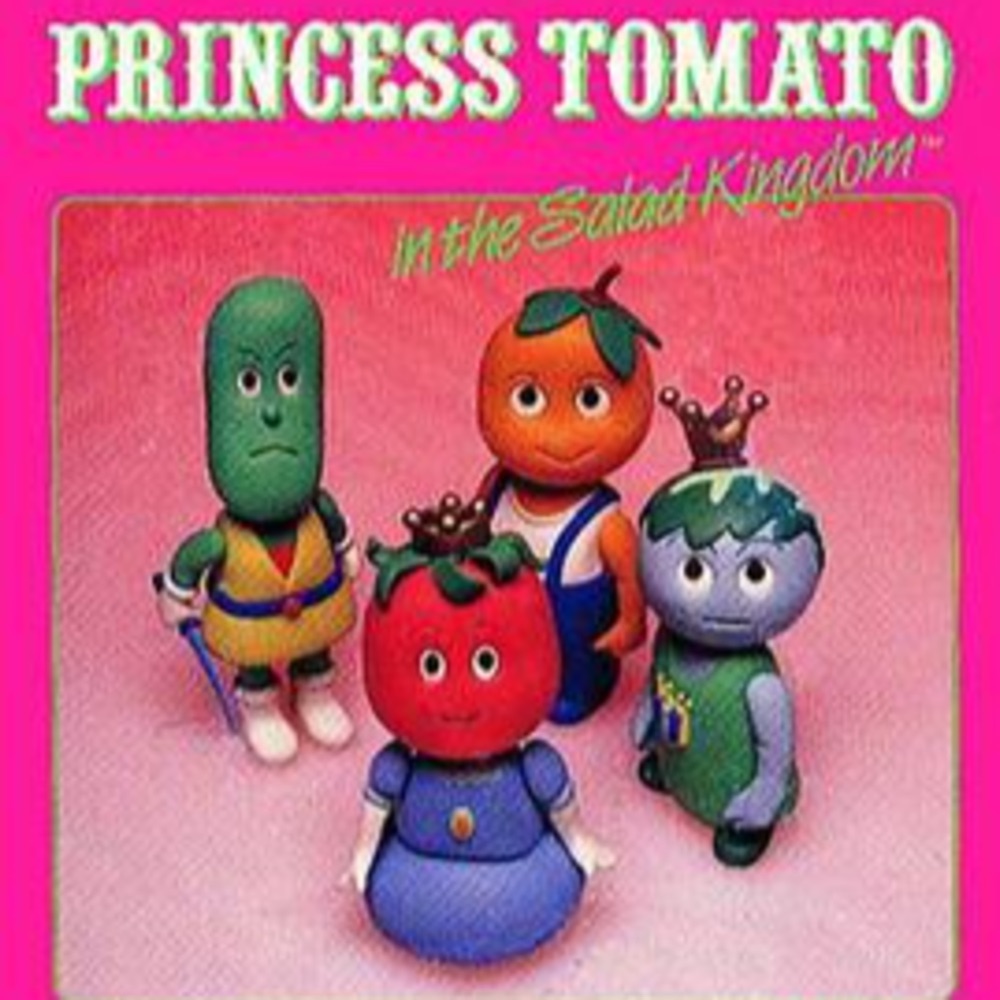
I do. I see it right now. You mean VeggieTales? And it's just like, I'm trying to think about, so for those of you who can't see it, it's the cover art for the episode, but it's like claymation characters of all of the, you know, various people you'll see in Princess Tomato in the Salad Kingdom game. But they're just like, on a, they're in like a pink void room, and they're just kind of like looking up at you, I guess, to buy them or something. And if I saw the cover for this, like, in Toys R Us, I would run away from this game. Yeah, I think like, AI art is based on this.
It looks kind of like an old band photo before like band photos got creative. And you just sort of like stood up straight and like, this is just, this is just more for posterity to make sure we know who's in the band.
And yeah, it kind of gives me that vibe. I also don't like how Princess Tomato is like one font and sizing and then like in the Salad Kingdom is just like thrown in there. Oh, it's perfect. Yeah, it's a, maybe they're trying to hide that part. They're like, all right, it's a little embarrassing that the game's already called Princess Tomato. Maybe they won't notice that it's happening in the Salad Kingdom.
So you mentioned like how, like what the, the fact that they're all fruits and vegetables adds to the story. It's got to, yeah, exactly. It's got to pay off, right? Like if you're doing all of this Princess Tomato stuff and the whole thing is fruit puns and, you know, vegetable characters. Like, does the game like strengthen that? I agree with you. Does the game reinforce that? I agree with you because like every time I watched Toy Story, I was just like, why aren't they people? Like they should just be people, right? Well, not toys. Maybe not. Yeah, I feel like, I was going to say, and I thought Sean was really agreeing with you and I was like, great. I'm going to be alone in this one again here.
But I was going to say, I think that like it is the, the thing that sets this apart from another point. Like for that very reason, like that's what it adds. It makes me like, I'm interested in it because I'm like, oh, what's this next character going to be? Like what's the pun going to be? I do love vegetables also. There are so many vegetables and fruit in this game as characters that by the time like a human just shows up, it's actually like bizarre. Yeah. It's like, whoa. That is very bizarre. And she's the sister of Princess Tomato.
Yeah. What's the, what's the family tree look like there? I didn't, well, maybe she was cursed into a human, you know, like, like usually you'd be cursed into a tomato, but this is the salad kingdom. So it's like the reverse happens. But I also don't understand, like if we're going to get into the deep lore a little bit, like why are the fruits also like in the mix here? Like fruits, like biologically are, are there for us to eat them. Like the, the plant wants us to eat those fruits, uh, so that we poop them out and more, more plants come out. Like, whereas vegetables, vegetables, I understand if it was all vegetables, I'd totally get it. But once you get fruits in there, like you, like you're going to get us botanists all up in a tizzy.
Now, isn't a tomato a fruit? So is the cucumber. Well, I mean, I think that's more like a culinary thing or like a, I don't know. Well, no, if for, by your definition of the part of the plant that wants to be eaten, so the seeds will be pooped out, the tomato, cucumber, you know, those are like. Oh yeah, that makes sense. Yeah, botanical fruits or whatever.
Jumanji fruits is, I think what they call them. Right, right. Well, no, because I feel like Princess Tomatoes, you know, she, a tomato, uh, if you will, is doing the job of both the fruit and the vegetable. And so it's great that like, you know, they have this unifying leader of like, she can be both. Yeah. She can represent both sides. You know, she's a, she's a, uh, I don't even know if, if I want to make this joke, but you get where I'm going with it.
You don't need to say the rest. It's okay. Thank you. You know, there is a lot going on here in the story, but before we get into the story, I just want to continue to say that like, they, they did lean into this in more than just like the game. And by the way, Joe, I wasn't saying that it's bad that this whole game is based around fruits and vegetables. I just wanted to make sure it was earned, that this isn't just like, and our characters are tomatoes because that's more interesting than humans. You know, I do like that right in, right at the beginning of the game, the first thing you have to do is go collect some water to throw it on these vegetables to wake them up, you know?
Right. Uh, but, but even the, like any posters or like advertisements for the game, uh, cause they did have a marketing budget for this. It's like, you have a cucumber who's, uh, you know, dressed like a knight and then you have the tomato and she's, uh, dressed as a bride. And the, the tagline is, do you, sir, cucumber take this princess as your lawfully wedded tomato? And I still am sure like if they're selling the game to anybody at this point.
And that's also just, yeah. Replacing the word wife with tomato isn't like, oh, it's not earned. Yeah, exactly. There's not like a, it's just, you just said the thing that it is. Right. But I think, you know, I think that you're right. Like I, I think that throughout this game, it's never like, oh my God, I get it. We're doing this because we're vegetables and we're doing that because there's not a ton of that, but I still think there's still enough value to just being like, oh, it's cool to see them as vegetables.
It would be more valuable if it was like, if it was like, you know, in Toy Story, it's like they live as toys and they do a little more like, I don't know, things that are toy related. This is just like, yeah, what if people were vegetables? Well, no, no, no. I mean, there is some class struggle here. Like there's the farmies and I think those are humans, right?
Right. Yeah. And they, they want to be eaten. And that's where like my problem with the fruits and vegetables thing happened. But like, excuse me, they're at least like, they're incorporating that into it. Well, I don't understand why the pumpkins, but the pumpkins, like how, how they kind of make their own class out of it. I'm not really sure where that comes from, where, where the double entendre is there.
But you got to add it to them. They did do it. But, um, and yeah, uh, I don't know what the, um, what, what would you call it? I don't, what is, what's Parsi, Percy, Percy's a what now? Percy's a persimmon. Persimmon. Okay. I've never had one of those. Which is great. That works. Percy the persimmon. Yeah. I'm down. Could have called him Simon too. I would have been down with that. Yeah. Now, here's the thing.
When I hear Princess Tomato in the Salad Kingdom, I agree that maybe I thought I was going to be playing as Princess Tomato, but I also think that it's like a game for little kids. Yeah. Of which this is not. That's bullshit. Right. I don't know. Right. Because, and this isn't like, this is something that I noticed pretty early on. I think it's in like chapter two. It's not something that like, oh my God, this is inappropriate for kids. But you talk to Miss Peachy at the juice shop, which the fact that there's a juice shop, oh, I think it's just at the deli, but the fact that there's a juice shop is another
horrible, horrific thing that's going on in this world of all fruits and vegetables. But you talk to Miss Peachy, and then if you like examine her, it's like, she's a third year college student studying speech just for kids.
That's what kids want to know about is like what you're, you know, what this sophomore in college is studying, and it's like a very non-kid, like, career. That's a junior. I read that completely different, Joe, because I read it like, you know, you're a pervert, like how dare you examine this third year college student. I thought it was just like, yeah, she's in college, she's studying speech. Yeah, there's a bit of a, there's a bit of a, a, a back and forth here because I not pronounce you, or, or like, do you take her to be your lawfully wedded tomato would,
kill a room of third graders, I think. Yeah, yeah, that's true. Should have been your lawfully watered tomato. Wow, see, you're already there. You're, you should have been there.
But, but then, yeah, then we have weird, weird observations about how old this peach is, and I mean, she is, she is, you know, she is a southern bell peach. Peach, I'm not really sure what kids get out of that, but yeah, they, I think that one was for the adults watching their kids play, the muesli. And the, and the game only gets more risque from there. I mean, I've never thought I wanted to see a vegetable in the shower, but that's a scene that you can get.
And I'll tell you right now. Where's that scene? I mean, I don't think it got to that scene. I definitely didn't get to that. Yeah, you don't have to, you don't have to worry about that, but I'll tell you one thing that's funny about that scene is that they actually did scale it back in the NES version of the game. I mean, she's covered, obviously, like she's through like a steamy shower glass door and she just pops her head out. But in the original computer version of this game, all of the women fruits and vegetables
were big breasted, which is just like impossible to, to like, you have to look at a video. I can't say it enough. Like to, that it's crazy that Nintendo saw this game and was like, it's fine that you, that you have all this. Please just remove the breasts. Okay. So it's funny that you say this because I got to, I got to the resistance base, which I'm looking now is chapter five out of what, like nine or yeah, the nine.
So from where I had gotten, there were just a few times where I, I did have like the sneaking suspicion that this game was trying to give kids like future fruit and vegetable fetishes. But like, it never got that far where I was like, I was kind of just saying it like jokingly. I'm like, yeah, it's like, oh, they keep talking about how pretty this eggplant is. Like, that's weird. Are they trying to, but like, it sounds like maybe they really were. I'm so confused because like, yes. And I didn't play too much of this game. Like you guys got farther than me, but the game itself is just so simple. And, and like the, the language that it uses to walk you through it is, is so elementary
that I would have thought that this was more marketed at kids, but, and yet it has this raunchy stuff. I'm not really sure where they were coming from. Yeah. Honestly. Yeah. Like I said, like the, up until right now, all the stuff that I thought was raunchy, I thought was me kind of like jokingly saying, but now it seems like, yeah, they continue to double down on it if you get further.
But like, to your point, as I'm playing this game compared to any of the other, like, I guess point and click adventure games or, or things adjacent to that, that we've played. Dude, this has been the easiest where it's like, you know, it's not like I always know exactly where to go, but like, I really pretty rarely had to like, look up what to do next. It's, it's pretty much like you can brute force your way through it. You can just get through it by like, usually just figuring it out.
And so it's not a lot of like puzzle solve these stuff. That's the thing, Joe, is that like, unlike the other point and click, or even just adventure, you know, style games that we've played, this doesn't have like the, the soft lock thing where it's like, oh, you might accidentally screw up or, you know, not be able to move any further. Like there's no fail state in this game. So just as long as you continue to go to every single screen and hit every button, like you have a chance to continue to make progress. And when I say hit every button, like this one also has more options than any other point and click game we've played thus far.
Move, look, check, talk, take, use, give, buy, hit, fight, praise, dump, item, and Percy. I like Percy having a button. I think, I think what's even better is Percy's a button before you meet Percy. I don't know who Percy is, is I think one of them, what it will say when you. Yes. Yeah. Right.
And it's just, it's funny that they, it was just probably easier for them to just add that line of dialogue than to remove Percy from the menu for like two minutes at the beginning of the game. Yeah. They couldn't just add it in. They were like, no, it has to be there at all times. But like, that's a lot of things to check off. So if you are lost, which, you know, I agree is kind of hard to do at first, you know, and you will learn the game. But if you are lost, there is a lot of like things you could potentially do on any screen before you can like move forward. Right. And don't get me wrong.
I, I, there were times where I was like, I don't know exactly what to do next, but I was always confident I could figure it out if I tried enough things. And like, usually, usually it was not just like, let me just try anything. It was like, oh, I wonder if this will work. Or I wonder if like, it was stuff that I feasibly thought could work. Right. But I think that there being this many, um, this many buttons. And also like when you go into a, one of these buttons, sometimes there's like, if you check, there are things to check. There's like a ton of things to check and half of them don't do anything.
Personally, I actually think that's kind of a positive. No, it is. Because the game, yeah, the game is so linear that it's like, it gives you, yeah, it gives you a lot of like things where it's not just like really obvious what to do next. It makes you feel like you are making decisions. In a game design perspective, from a game design perspective, it's better simply like, because a lot of, uh, a lot of detective style games will do this where they just give you a boat load of options. So you can't just deduce, uh, everything just, but without even playing the game. Um, and, but, but, you know, that also is kind of taking from some legibility and, and
some playability and especially if you're, uh, pressed for time while recording a podcast, it's a little more difficult that way. But yeah, I think it, as far as the actual game design goes, that was a plus. And especially because you don't have to, and this is more so just for my own, uh, preference, but instead of pixel hunting and clicking on the two pixel wide door out in the distance of whatever screen you're looking at, it just gives you a list.
And I appreciated that. It's a lot, it's a lot quicker to go through, uh, any scene that way. Yeah. And sometimes like if you've got to talk to someone, there's only one person on screen, just get click talk. It knows who you're going to talk to. And you'll talk, you know, there's a lot of things like that where it's like, yeah, yeah, we know what you want to do. Like you clicked it. We're good.
And it's worth remembering that that is the entire game. So it is great that they have all those options in front of you because there is no other part of this game. There isn't like, oh, and suddenly when you enter, uh, the town, now all of a sudden it's a platformer or now it's a puzzle. Like it's always just about checking everything around you, talking to those things and kind
of trying to figure out what item you need to have for specific situations. But where I will say the game does a great job at even like weird things that you might not guess, uh, is something early on, uh, when you get to the, the little house by the lake at the beginning and you have Percy with you at that point, there is a, uh, a shrine and a statue at that shrine of an apple.
And if you, uh, try to do anything on that screen, it doesn't really seem like there's any options. You can't take the shrine, the statue. Yeah. You can't hit the statue. You can't praise it. So if you hit the Percy button, he gives a clue, which I don't have in front of me, but it was like just enough of like the kind of thing that sometimes you want game FAQs to be where it's like, don't tell me the actual answer. Just like, you know, nudge me towards it. And it was the kind of thing was like, Oh, maybe I should look at this statue. And then I noticed that like, that didn't do anything because it wants you to look at it like several times to make it blush.
But it was like enough to make me think like, no, I think I was supposed to look at it though. And I wound up clicking it three times and getting the apple to turn red. And I thought that was very like, I thought that was very smart in a way that we haven't seen some of these games that have obtuse puzzles handle otherwise. Cause it didn't, it wasn't like Percy just said like, you should look at the statue, right? It just was like, the way it worded it was a way that made me think like, I don't think I'm done here yet. I don't think I should leave this screen. Right. I thought overall Percy was the Percy button was a very helpful button where it would give you hints that are, yeah, that are not too on the nose.
The, the only thing that like, I, I, the only thing about what you're describing that I didn't love is how often this game makes you try things several times, sometimes four or five times before, before something will happen. But like, I guess after, you know, after the first couple of times you do that, you realize that that's part of the language of the game and then it stops becoming this like thing you never thought of before. But it does just make, make me like feel like I got to try everything like six times to know that it's not going to work.
And, and Joe, in contrast to you liking the Percy button, I very much did not like Percy. Um, you know, when you sort of transition, like, and he gives you that stupid look on his face while it's like, sorry, boss, I dropped all our stuff. And I'm like, are you fucking kidding me right now? Yeah. Like, yeah. Is he a baby or like when you find him, it's like, he's a crying baby. And then after it's like, Hey boss, like, yeah, sorry, boss.
What'd you say? I can't stand him. He's one of those guys at the deli who just calls everybody boss. It doesn't matter who you are to him. I guess he is helpful. Yeah, he is helpful. But he's also an asshole. I think he's very helpful.
Well, he's living in a pretty fucked up society, Sean. So he's doing the best he can. Okay. To get to the story for a second, as we mentioned, you play as Sir Cucumber. He is the late King Broccoli's bravest knight in a kingdom populated almost entirely by talking fruits and vegetables. I say almost entirely because yes, there is that one human woman who's related to Princess Tomato. The royal advisor, Mr.
Pumpkin, has staged a coup in the salad kingdom land, kidnapped Princess Tomato, stole the royal turnip emblem, and is now doing what he made like a fortress in the zucchini mountains. And it's like, you're just reading all this. And it's like, it's hard. It reminds me of there was an episode of the Rugrats where they take the babies to a movie for the dummy bears. That's what they were, Joe, right? Yeah. The dummy bears? Yeah. And they go to like the land of make-believe.
And Grandpa Lou is like, the land of make-believe? More like the land without brains. And it's like, that's exactly what's happening here. It's like, they're taking themselves way too seriously with all this vegetable stuff. And it's like, but meanwhile, there's like actual, like, if you're a kid, maybe the politics stuff is all like hitting you, like, you know, it's missing you.
But it's all like weird stuff, like coups and kings being assassinated and wishes over your, you know, your deathbed and stuff like that. It's like, this is heavy stuff. My thought is that maybe the intent, if you take out the weird, like, sexualizing fruits and vegetables stuff, other than that, maybe the idea was like, oh, like, yeah, this is like for kids, but also for the parents. Like, you play it together.
The parents get to be like, oh, yeah, I understand. Like, that's funny. There's a coup happening between a pumpkin and whatever. And the kids are just like, oh, look at the colorful fruits and vegetables on the screen. I mean, I'd say that's probably pretty close to intent.
I was just thinking about that shower scene again. This is our second NES game that we've played that has a shower scene where you can peep. Mike has not stopped talking about the shower scene prior to us recording. On our Nostalgia Bites episode we did from Metal Slater Glory, that was another thing that you could do is like, you could peep in at the shower.
I do remember this. Yeah, there's a lot of weird stuff with that one. It drives me crazy about, like, anime also. Because I don't watch a ton of anime, but I'll watch it sometimes. And then every once in a while, something like that comes up. I'm like, okay, well, like, don't make me feel creepy for liking what you're providing here. I just want to watch your show. I don't want to, like, see this, like, creepy stuff that just, like, randomly is in here all the time. Yeah, so let's keep dunking on anime.
I'm a fan of this. I know. I know you hate anime. Anyway. Now, the original computer game was only four chapters. So this was expanded into four additional chapters for eight total. No, is it eight or nine? No, it's nine total. So, wow, five extra chapters here. But it also added, so it added getting captured and escaping the prison, which I think is where you left off, Joe? No, I went to the Resistance base. Oh, Sobville? Is that what it is? Is that where it is? Yes. That town is also exclusive to this version of the game. That's where you have to, you're disguised as the enemy?
No. No, I'm in the Resistance base. How do you disguise yourself as a pumpkin without killing a pumpkin? Are you, like, are you wearing somebody's face? For all we know, in this fucked up reality, Sean, maybe they're also just eating pumpkins. You know, we saw at the deli that they're selling strawberries. Yeah, they're selling strawberries and there's a can of Brussels sprout soda.
Yeah. There's an asparagus donut. There's a juice shop. I mean, what else are you juicing? The deli has pictures of, like, fruits and vegetables on the wall with prices on them. It's pretty crazy. Anyway. When you're at the prison, the jail warden was named Sergeant Pepper. But when they, which is fun, but when they, when the game came out on the Wii for the virtual console, he was renamed to Lieutenant Pepper. What? Like, is that, it's like way too late to be worried about getting sued. Well, maybe they were. Yeah. They were, like, still litigating it. I mean, like, you can't, like, unrelease a game back then, but maybe they were sued. I don't know. It wasn't on the Wikipedia.
And also, we mentioned Lisa, who is Princess Tomatoes' human sister. And, you know, we talked about our own theories, but it's worth mentioning that nobody in the game acknowledges that she is a human in a kingdom of sentient vegetables. Well, maybe it's just because they're beyond that kind of racism. Just because you're the same species as the people oppressing us doesn't mean you're one of them. But then how do they decide which fruit or vegetable is, like, is just doomed to being turned into soda and which are just, like, bequeathed personhood? It's a lottery. Is there, like, human meat for sale somewhere in this world? Is that why she's the last human? Maybe. Maybe that's why the Farmies are uprising.
That sucks when that comes when that comes when that comes when that comes when that comes when that comes when that comes when that comes when that comes when that comes when that comes when that comes when that comes when that comes when that comes when that comes when that comes when that comes when that comes when that comes when that comes when that comes when that comes when that comes when that comes when that comes when that comes when that comes when that comes when that comes when that comes when that comes when that comes when that comes when that comes when that comes when that comes when that comes when that comes when that comes when that comes when that comes when that comes when that comes when that comes when that comes when that comes when that comes when that comes when that comes when that comes when that comes when that comes when that comes when that comes when that comes when that comes when that comes when that comes when that comes when that comes when that comes when that comes when that comes when that comes when that comes when that comes when that comes when that comes when that comes when that comes when that when that comes when
Thank you.
They're like spices or something. Like they're like, they're not, they're like vegetables with wings too. They were like cherry. I think they were like cherry birds as well. Oh yeah, there was a cherry one. Yeah.
Which doesn't make any sense in the logic of like equating it to our world. It's not like birds and humans, like birds are like, oh yeah, yeah, they're kind of like humans. It's like, no, they're birds. Like they're completely different. They don't, it's like, is there something going on in the water that everything has to be fruit, it has to have seed based culture? You know what it is? This is actually has the same world building and internal logic as Bojack Horseman.
Okay. I buy that. Yeah. It's just birds. It's just like animals and people with normal jobs and everything. But otherwise the world is the same. It's funny that you say that because, well, yeah, I played with the two friends of the show, Mark and John, who you've all heard of many times.
And they brought up Bojack Horseman and they said, this is just like when like someone goes to, when like he orders a ham sandwich from like a waitress who's a pig and she just like shakes her head. It's just frowned upon. It's not monstrous. Right. Yeah. She's just like, yeah, she kind of just like tuts and like goes, disgusting.
And just knowing that most of the game is these static pictures, I guess what I was getting at is just that it has to be some, it has to be pretty good to look at or, you know, pretty recognizable, readable situations. Does it, does it accomplish either of those? Is it pretty to look at? And is it clear what you're looking at? I mean, I think it's at least very clear what you're looking at. And I think it looks good too. I mean, it looks kind of like one of those MS paint things, but like it's decent, you know, it's not like beautiful art.
Yeah. And I did appreciate that at least in the parts of the game where you're kind of in that labyrinth that most of these sort of pointing point and click games throw in there to, to change the vibe a bit that I think we all hate. Um, and most of those, it's just like basic, like almost vector drawings of places of like, of just tunnels. Whereas at least in this one, it was kind of a full color, like forest. And it was still a very rigid, uh, like maze, but at least it looked, it was at least a little bit more interesting to look at. But it was less confusing because like the directions you're looking at look different sometimes, plus it gives you a compass eventually. So it was like, yeah, not just exactly the same image over and over again.
I think with all of those kinds of mazes, regardless, like it is helpful that there is like actual, like distinguishing because it's in color and because it has more detail that there is distinguishing features. I think just in general though, with these kinds of mazes, you just best to break out the graph paper and at least have some kind of sense of a map, you know, that you can refer back to because there's never going to be any, any of these games that like handled that part correctly, where you can like refer to where you are in space outside of the current like square you're sitting in. But at least this one had a kind of rotating compass that made it easier to keep track of yourself, but you're probably best off still making that map.
And I guess like, you know, it's not, it's just not the prettiest game to look at on, on the NES. And I I'm surprised by that because the screen is rather small. So they really did do a lot of, you know, the HUD on this and then just put like a, like a wooden mortise to put it in like some kind of storybook frame.
Uh, so, so the actual image you're seeing is pretty small on your TV because they're using so much of the, the TV space for the UI that I'm kind of surprised at how some, sometimes the drawings are a bit crude, especially the characters. Like I get that there, that it's a style, but I didn't, I didn't love it. It did start off strong. And then I kind of like, they, they, they ran out of time. Like there was a lot of, a lot of detail and a bit more painterliness in like the first five screens of like level one.
And then they decided that took them three years. Yeah. And then the rest of them, they had like a month to finish. It's like, now we're just doing line drawings. And so like outside of experiencing the story, which I don't think I want to give a walkthrough to the players.
Uh, you know, that is basically what, what the game throws down here is that you are, you know, using these commands to engage actively with a, uh, a storybook that does not have, uh, a choose your own adventure component to it. Right. There aren't choices you have to make. There aren't things that you can miss, uh, and solve differently.
It really is just about continuing to, uh, take the author's intended path, but doing it in a way that, um, you know, you might visit a different shop first and talk to the person and be like, I'm not sure what they need, but now I need to go find that. Which on paper is like what Shadowgate does too, but this one feels like maybe it could have used a little more for, for what it is, you know, maybe more rock, paper, scissors.
And that, that was the, that was the one thing I wanted to bring up to her. Like there's just this baffling other element of this game where you play rock, paper, scissors to fight people, which is also new to the NES game. Really? Were there actual fights in the original? And they were like, we got to tone that down. No, I don't, they might've just not even had the fights in the, you know, cause it's just, there was less chapters.
Huh. Well, it's, it's not even just regular rock, paper, scissors, which is weird. Like you play rock, paper, scissors and then if you win, you get the opportunity to then choose a direction. And if you choose the same direction as your opponent, then you like win, win. Yeah. It's like double elimination. Yeah. Rock, paper, scissors. Rock, scissors. Or like maybe more, more like two factor authentication.
It was an unexpected fight thing though, cause I think we were all kind of expecting at that point that it would become turn-based, right? Where you have like a new set of commands that you have to use of attack, defend or whatever. Yeah. But thankfully I think it, you know, I don't know if this solution is better, but I don't think that this game wanted to all of a sudden, just like it suddenly springs on mazes onto you that you also wanted to then have to like grind for experience and, you know, buy equipment to take into your fights, you know, like, Oh, get the better sword or something or learn this magic spell. I think the game has enough going on in terms of just being something that you have to, you have to read a lot of text.
Like this is when perfectly played a two hour long game. So for most people who are just gonna, you know, walk around, explore, not know exactly where to go. This game gets significantly longer and that just means that it just becomes more reading. This really is a visual novel more than a game. Like, but I guess a visual novel is a game. Like I'm going to upset somebody by saying that, right? I guess, you know, you buy them, you buy them from video game dealers. So I guess that's it.
Yeah. And I was on PS4, like it's a game, right? I've never, I like, I guess I've never really played something that I've been like, Oh, this is a visual novel. I'm sure I have that. I just didn't realize it's a visual novel, but like something like this or, or other point and click adventure games we've played on the NES. They do seem a little more gamey because it does at least give you the illusion that the choices you're making are pushing you forward.
Is that what like a visual novel you'd get on PS4 would be? Like you're making choices or is it just, you're like kind of clicking to, to move through the story. From what I know. You do make dialogue choices. Yeah. From what I know of the one visual novel, the one modern visual novel I've played, which is Doki Doki Literature Club, you basically will make, uh, yes, those, those dialogue choices that will lead to the same outcome. Like you'll just say something slightly different.
Um, or if I guess if there are some that have like different endings, but, uh, and then they'll just be like, Oh, you're going to go here now. Like I, I, you are pressing a button to go somewhere else. But that is literally what could have happened in just a regular scene transition.
Sure. Well, I guess what I'm trying to say is that while playing princess tomato in the salad kingdom, I didn't feel like I was strictly a passenger. Like I did feel like, okay, I got to figure out what to do next. Like I did get that. And granted, I always was like, it always felt like I was inevitably working towards figuring it out. Like I never felt like I was going to be completely stuck, but like it did. Like I, I did feel like a pretty active participant in the story in the same way I did with shadow
gate. Now, whether or not that, that like, you know, like shadow gate had more puzzle elements that I had to be like, I got to really like figure out how to solve this where this was just like, I got to figure out what to do next based on what people are saying. But like, I guess in that sense, it did feel less like, Oh yeah, I'm just watching this happen and clicking buttons once in a while. This definitely is not a visual novel because there are, there, there's a way to play it wrong. And I don't think there's a way to play a graphic, I'm sorry, a visual novel wrong.
Correct. A visual novel doesn't have any gameplay elements other than, you know, now you're presented with your choice of, of, you know, what you want to see. You know, it's, it's a choose your own adventure book in that regard. It is mostly just reading. Whereas this has like actual screens to explore. You technically are doing nothing different than if it was some kind of like side scrolling platformer and you went into the buildings, you're just instead moving in a first person POV from square to square rather than, you know, some top down Legend of Zelda style. Indeed. There is no sequel though. Uh, the, the, I guess the salad, uh, was tossed here.
Um, the, the, I don't know if I was expecting to find out there was a sequel, but just knowing that this game had a long life first on the computer in like 1984 and now on the NES in 91, uh, it is kind of surprising, uh, but apparently princess tomato did show up like relatively recently in the grand scheme of things in 2017 princess tomato smash shows up as a, uh, as a character in super bomber man are so, uh, everybody's here. Yeah. Everybody's in that game. I guess. I wonder who else is in super bomber man are besides princess tomato, but that's actually because I think Konami owns Hudson soft now or something. Ah, so that's why, cause Konami owns bomber man.
It is a missed opportunity because I could see a game that, uh, instead of fruits and vegetables, it's like dairy and meat products, not animals, dairy and meat products that you're talking to and everything is themed off of that would be really rain project products. Yeah. Cause like we have Mr. Corn in this. Isn't corn technically a grain? Yeah. I, I think Mr. Corn, by the way, best character in the game. Very excited to announce that, uh, also in super bomber man are is pyramid head.
No reaction, Sean. We don't know who that is. Oh, I laugh. Speaking for Sean. Oh, it'd be really funny. Actually, it would be funny if I didn't say that, uh, pyramid head. Joe is from, uh, silent hill, but Simon Belmont is in a super bomber man. So how about that? Good snake ratcheting clank. All these guys right next to, you know, standing shoulder to shoulder with, with princess tomato, princess tomato. Uh, they all get bomber added to them too. So she's princess tomato bomber.
Huh? So she's a terrorist. And her description here is a princess from the planet salad. I don't think we knew that. I thought it was just the salad kingdom. Yeah. Just the salad kingdom. Right. But they're saying that she's. Oh, but this whole planet is planet salad. The planet. Right. Like the earth, earth kingdom.
So it's, she's a princess from the planet salad. She's the daughter of King broccoli, the former ruler of the salad kingdom. So it's, it's a small planet. It's the salad kingdom also makes up the entirety of planet salad. Yeah. Uh, and it says, Oh, some closure here. She now rules the, uh, she now rules over the once again, peaceful kingdom in her father's place. Can anybody rule over anything peacefully? Like that's not, I don't think that's putting it politely. She now rules over. Like it's like, Hmm. Yeah. Maybe more like over.
Right. She now collects taxes on the peaceful kingdom in her father's place. She's at peace. We mentioned, um, shadow gate a lot. Uh, I guess you could throw deja vu in there too, but we, another, sorry guys, nostalgia bites episode. And I promise these aren't plugs. These are genuinely interesting games. But, uh, Sean, we played Portopia, uh, serial murder case, um, as one of our early bites games. And, um, that was a game that like came out around the same time as the home computer version of princess tomato. And had a lot of these, you know, same, same, uh, gameplay elements, but Portopia was, you know, you playing as a detective, not as a night.
And so a lot of it did become more of like, you know, talking to people and figuring out the story and everything. Whereas here it's more about collecting the right objects to give to the right people. Yeah. This is a much simpler game. And also it just, it's, I think it's also a bit more polished. And I think that just shows in like release date, even though I think that this game, you said this game originally came out around the same time, right?
Yeah. Mm-hmm. So I, I think they polished it up a little bit here. Cause I remember there was still a lot of quality life complaints in that. And I'm not asking here, which one's the better game? Because I'm sure we would come to an obvious conclusion, but also the essential games list is coming up. So not asking for that, but just, you know, maniac mansion.
Is another one of those like verb based games, uh, that managed to work on the NES, but it handles it all differently because it's happening in real time. And so forget about the actual games themselves, but from a, uh, you know, from, from a design standpoint, does the maniac mansion system of having it all in real time while you're, um, doing the command system work better than the shadow gate deja vu princess tomato, uh, realm of things.
I think you gotta, it just depends on how you design your game. You know, I wouldn't want like a game like this where I wouldn't be like, yeah, I wish shadow gate was all working out real time. Cause I feel like the game's not designed around that, around that, but I do think it generally worked in maniac and maniac mansion. So yeah, I don't know. I think it just depends on if it's made well enough for, for either situation. I'm going to answer your question with the answer to a different question and that this is definitely more playable.
Um, it's easier to do. Um, but I guess like, is it as interesting as that? Maybe not. Um, but there's definitely a lot of ways that you can fail in maniac mansion just by virtue of not doing something fast enough, which is not possible here. So more playable. It's funny that we keep talking about this game as like a storybook and more playable for younger audience members. And we've mentioned the shower scene, which I've been thinking about all day, but there are a couple of other things that were changed too. Uh, I think, you know, you guys made reference to the juice shop, which was originally a liquor store in the original game, but the coffee bar.
Oh, what about the donut? Uh, the donut was originally a cigarette. Yeah. You had to bring the homeless guy a cigarette. Right. It was a cigarette shop and then they turned it into a coffee bar. And then there was also like, um, uh, uh, Shinto, you know, Japanese religious, uh, like rope on a tree. But like, because that's now just a rope on a tree for us players, it does not read that at all. And so they had to make sure that they removed that.
So, you know, I, again, something that we talked about throughout this whole episode, but like, I just starting even just with the tomato fruit motif. I'm just not sure who this game was for. I've never landed on the target audience from the moment I opened the game from the moment I looked at the box art to, you know, the research to the marketing material. I can't figure out who this game's audience was.
Just sigh up against our children. Or maybe it was, you know, cause you guys were saying like developing a fruit fetish and a vegetable fetish. Maybe it was just like, you know, the, uh, the food and drug administration was like, this will make kids love vegetables. Like let's pour some money into an English translation. Love vegetables. Yeah. They'll love vegetables. They'll want to take a shower with their orange. Just like you'll want to take a shower after you hear our votes on the essential games list.
Joe. Like, I won't pretend I didn't enjoy playing this game. I mean, it, like, it was a fun little story. I thought, uh, at least as far as I have gotten. Um, but yeah, I mean, it's, it's, it's unfallible really.
Um, and it's, I think, I do think that like the, the, the quirks, the like very, like the very surface level quirks of like everything's a fruit or a vegetable, like check it out. How interesting is that? Like kind of worked on me. I was like, Whoa, this guy's a pepper. Like, wow. So like that did work on me, but yet, no, this isn't essential. I mean, it's, it's the most like base level point and click adventure game type thing. Um, it's, it's not like the, the prettiest to look at, you know, anything like that. I just thought it was a, uh, an interesting anomaly of a game that, that did keep me interested longer than, uh, than a lot of the games that we play, but definitely not an essential game.
Sean. Um, yeah, I have the exact same opinion, like moment to moment. It, at least like, like kept me awake is like, wow, this is bizarre. And then you go to another screen. It's like, this is also bizarre.
Um, uh, eventually it does wear off and it's just sort of like, Oh, this strawberry is very passe now. But, uh, regardless, yeah, it's, it's still like, it's still well put together. Like it's not, it's not frustrating, uh, unless, uh, you, you, you get annoyed by selecting the same thing every, uh, like over and over sometimes. But, uh, yeah, it's just a, it's just an okay, not recommended game. So not essential.
Yeah. I mean, it is charming, uh, a little funny at times. I, I do feel like because it, because of its difficulty, right? There's no death. There's no dead ends. There's pretty generous hints from Percy without just straight up telling you what to do that. It is like a good ideal beginner's game, even if the game isn't necessarily a child friendly. I mean, it's child friendly by today's standards. Kids are looking at crazy shit, but, but here's the thing, like the actual gameplay, because we're not categorizing it under the visual novel, uh, element that the gameplay is thin.
Uh, I don't love these still screen. I don't even love the design of them, but I also just don't love that like style of game. Like I would rather be in a world I could walk around and explore. There's a lot of these menu verbs to check and the weird additions of the maze and rock, paper, scissors fights to like, uh, you know, to add something actually don't wind up adding anything to the game.
So like in that regard, like those things just feel bolted on. Not like they were designed and we would know that they weren't designed as part of them because they're not in the original game. So I think while, you know, maybe the additional chapters make this game a enhanced version of the computer version. Uh, I, I can't say that I want to like get to the end of princess tomato in this out kingdom because I don't think it like went extreme enough in any particular direction. Like this could have been like a, a, a strictly comedy game. That's just like meant to make you laugh out loud. And it's just so absurd that you want to see how it ends. It doesn't go there.
It could go all in on the like, uh, fruits and vegetables element and like have to come up with some neat ideas about like cooking your friends or something. And it doesn't do that. Like it never goes anywhere off rails. It's pretty, it's pretty standard fare. And so I think that's why by like the third or fourth chapter, I thought, you know, how much more do I need to see? So that's my honest take three nose, but you know, you got something here. Um, you know, maybe, maybe add a little balsamic to it and then you got something.
All of these, uh, all of these fruits and vegetables have skeletons. I guess what I'm saying, Sean, is that, uh, you know, the fruits of their labor haven't grown yet, but there's a, there's like bones inside of these fruits. Yeah. Those seeds need a little more watering. If you catch my drift.
All right. I thought Joe was going to join him with one for sure. I was thinking that