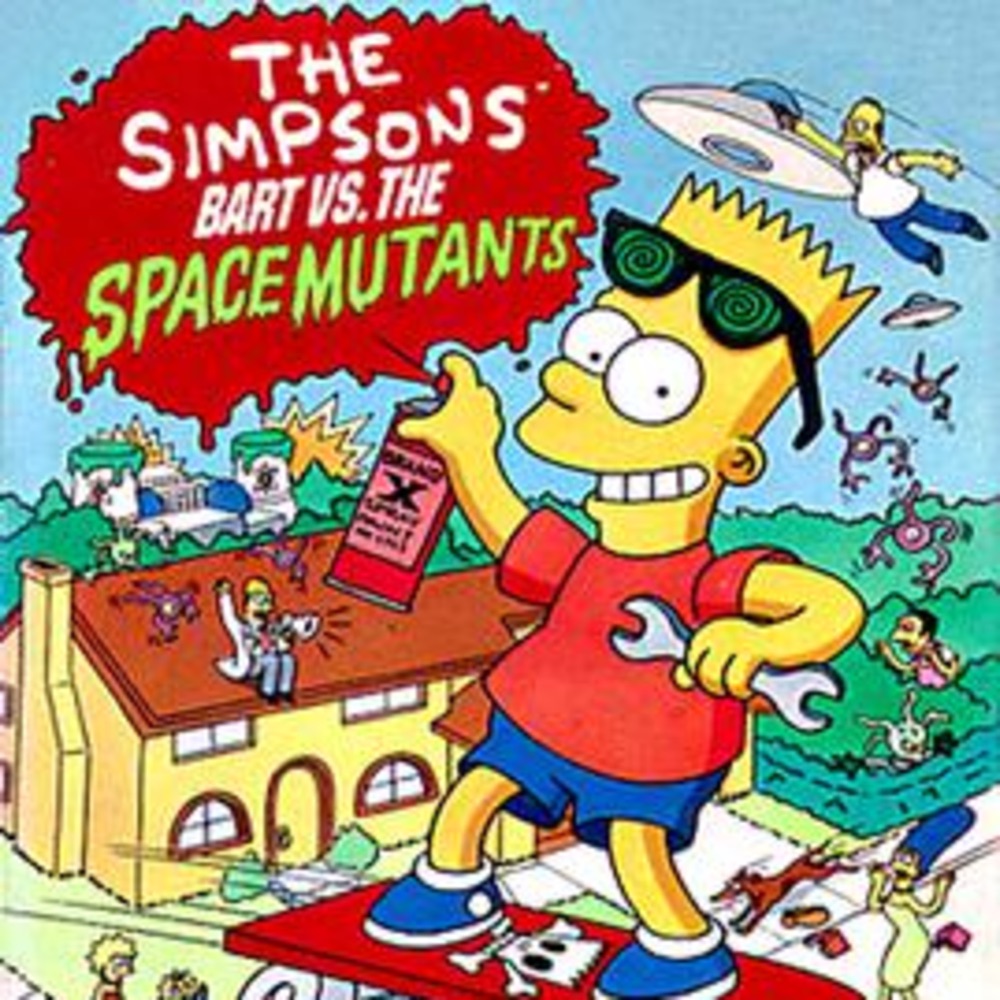
443 · The Simpsons: Bart vs The Space Mutants
The Simpsons: Bart vs. the Space Mutants is a 1991 platform video game based on the animated television series The Simpsons. It was originally developed by Imagineering and published by Acclaim Entertainment for the Nintendo Entertainment System, and was later released for the Amiga, Amstrad CPC, Atari ST, Commodore 64, and ZX Spectrum by Ocean Software, and in 1992 for the Sega Genesis, Master System, and Game Gear; all ports were developed by Arc Developments. In the game, the player controls Bart Simpson through five levels as he tries to ruin the aliens' plan to take over the world, collecting specific items and avoiding enemies.
From Wikipedia: The Simpsons: Bart vs. the Space Mutants (CC BY-SA 4.0)
The first Simpsons game on the NES comes from Imagineering, published by Acclaim and designed by Gary Kitchen, the Battle Tanks guy. The aliens are not Simpsons characters, and Kang and Kodos would have been the obvious choice. It came out in 1991, with about two and a half seasons of show to draw on. Mike, Sean and Joe played, and we ended up talking more about the show than the game, which says something.
What it has going for it
- A first level with personality. You turn everything purple in Springfield back to normal, and there are odd little ways to do it: spray paint, towels, spilled paint. It is the one level that feels like a puzzle game, and it has most of the show's flavor. We kept wishing the spray paint idea ran through the whole game.
- The phone. You can prank call Moe, with insults like "stupid idiot," one of the few things that feels like Bart on the show.
- Little things that landed. The theme song is faithfully recreated, though hearing it in the level too felt like a lot. The manual has Bart address you, ending with "Save the Earth. Play this game."
What gets in the way
- A scavenger hunt in a platformer's clothes. Each screen asks you to grab, spray or knock loose objects, and it works best in level one. Afterward you are mostly collecting. Level two, in a Krusty-style park, lacked the first level's charm, and a natural history museum turning into a forest left us baffled.
- Fiddly controls. A far jump takes two buttons, one of which wastes your spray paint or slingshot. Run shares a button with jump. The wrench and hydrant puzzle needed repeated tries and the right place to stand. To pause, you cycle through a menu to find Pause.
- Missing Springfield. You see Moe's and the Quickie Mart from outside and never go in, you only play Bart, and some characters are absent.
- A generic shape. Why does a Simpsons game need combat and platforming? We would have preferred Maniac Mansion style exploring, or a text adventure.
Beyond the game
We designed our own versions. One was built from the opening credits, each level a family member getting home. Another was an extraction shooter with five players racing to the couch. The game's TV matches the Season One model, a hint the developers had little to work from. The next Simpsons game is Bart vs. the World.
The bottom line
Skip it. We all voted it off the Essential Games List. Joe could see a cult following and respected the work that went in, but the execution falls apart. Sean called the controls and UI atrocious and said it did the bare minimum a licensed game should. We plan to give the next one a fair shot.
Written from our conversation in this episode.
- Space Mutants are invading Springfield!
- Sean and Joey Jo-Jo Junior Shabadoo
- There are no Simpsons NES games and there never was! That’s right lots of quotes coming this episode
- The Simpsons invented Yoink
- Nothing can possi-bly go wrong
- Don’t have a cow man
- Everything is coming up Millhouse
- You’ll have to speak up I’m wearing a towel
- They’ve tried nothing and they’re all out of ideas
- I just think they’re neat!
- 1. The premise and its cult movie connection
Bart finds X-ray specs in the back of a comic book and discovers aliens have replaced half of Springfield. The specs are a direct lift from John Carpenter's They Live, where Roddy Piper's sunglasses do the same trick. Surprising for a kids' game in 1991. - 2. Who made it and when it landed
Developed by Imagineering, published by Acclaim, designed by Garry Kitchen (the Battle Tank guy). This is the first Simpsons video game ever, released February 1991 at the height of Bartmania. - 3. Why it's not the game people are thinking of
This isn't the beloved Konami arcade beat-em-up. Different developer, different genre, and it actually came first. Good to clear this up early since most casual fans conflate the two. - 4. Scavenger hunt disguised as a platformer
Instead of racing to the end of a level, Bart combs each screen for things to grab, spray, or knock loose. Level one leans almost into point-and-click adventure territory, which is the part people remember fondly. - 5. The five Springfield levels and their gimmick
Streets, Mall, Krustyland, Natural History Museum, Nuclear Power Plant. Each level fixates on one target item (purple objects, hats, balloons, exit signs, nuclear rods) that you need to hit a quota on before leaving. - 6. The family-help mechanic
Beating disguised mutants drops letters. Spell a family member's name and they show up to help with the boss fight. A clever license-flavored twist on "saving the world." - 7. Control quirks worth flagging
Tap-then-hold A to run (B is busy spraying paint and firing weapons), which trips up anyone raised on Mario's hold-B-to-run habit. A+B together gives a long jump you'll need later. - 8. The flaws that get worse after level one
Fake 3D depth platforms are wildly inconsistent about what's actually solid ("depth perplexion"). Puzzle logic gets obscure (buy a wrench, use it on a fire hydrant, no real hint). You also lose every tool at the end of each level, so there's no sense of building power. - 9. High Score Board trivia
The payphone prank call gag in level one, where Bart can call Moe's Tavern asking for I. M. Adope, Stu Piddiddiot, and Isabelle Ringing. Runner-up: shooting the "E" in the Kwik-E-Mart sign for three extra lives and a hidden sound test. - 10. The rushed development and surprising commercial success
Acclaim wanted it out for Christmas 1990, production started in May 1990, and it missed the deadline anyway, shipping early 1991. Kitchen has said the later levels suffered from the rush. Despite mixed reviews, it sold over a million copies and became an NES best-seller.
I. Setup & Premise
- The pitch in one line
- Bart gets X-ray glasses out of the back of a comic book, and instead of seeing through clothes he sees that half of Springfield has been replaced by aliens.
- He is the only one who knows, and he has to wreck their invasion one purple object at a time.
- The story
- The Space Mutants are building an "ultimate weapon" and need specific items to fuel it.
- Each level they fixate on one thing: purple objects, then hats, balloons, exit signs, and finally nuclear rods.
- Bart's job is to collect or destroy those items before they can grab them.
- Who made it
- Developed by Imagineering, published by Acclaim, designed by Garry Kitchen (REMEMBER HIM?! Battle Tank).
- This is the first ever Simpsons video game, February 1991, riding the absolute peak of Bartmania.
- The simplest way to frame it for listeners
- This is not the Konami arcade beat-em-up that everybody loves. Different game, different company, came first.
- It is a slow, puzzle-flavored scavenger-hunt platformer. Closer to "find every purple thing on the screen" than "punch your way to the boss."
II. What Makes It Stand Out
- The They Live premise is the whole hook
- The X-ray specs that reveal aliens hiding in human bodies are a straight lift from John Carpenter's They Live, where Roddy Piper's sunglasses do the same trick. Hard to believe that made it into a kids' game in 1991, but here we are.
- It is a scavenger hunt wearing a platformer's clothes
- Most NES platformers are about getting to the end. This one is about combing each screen for things to grab, spray, or knock loose.
- The first level genuinely has a pinch of point-and-click adventure in it, which is what people remember fondly (1UP/Bob Mackey).
- Early-Simpsons weirdness baked right in
- The villains are the Space Mutants, a throwaway alien gag from the show's earliest seasons. If this game were made later, it would star Homer and the bad guys would be Kang and Kodos. It is a time capsule of season-one Simpsons (TV Tropes).
- The devs had no pre-release material, so they watched episodes as they aired and crammed in whatever references they could catch (Retro Gamer, "The Making Of").
- High Score Board
- The marquee weird detail here is the payphone. In level one Bart can prank-call Moe's Tavern asking for fake customers, and the names are pure Simpsons: I. M. Adope, Stu Piddiddiot, Isabelle Ringing. Acclaim did not have to put that in, and the fact that they did is the most charming thing in the game.
- Runner-up: fire a rocket at the "E" in the Kwik-E-Mart sign and you get three extra lives plus a hidden sound test (GameFAQs). One of the better-known NES easter eggs of the era.
III. Gameplay Structure
- Five themed Springfield levels
- The streets of Springfield, the Springfield Mall, Krustyland, the Natural History Museum, and the Nuclear Power Plant.
- Each level gives you a target item type and a quota to hit before the exit.
- The controls have one quirk worth flagging
- D-pad moves, A jumps, and you tap-then-hold A to run, because B is busy spraying paint and firing weapons (Neoseeker). Anyone raised on Mario holding B to run will fight this for a while.
- Press A and B together for a long jump, which you will need for the meaner gaps later on.
- The family-help mechanic
- Beat disguised mutants and you collect letters. Spell out a family member's first name and that Simpson shows up to help you in the boss fight (Wikipedia).
- It is a neat license-flavored idea: you are not just saving the world, you are convincing your own family you are not lying.
- The coin economy
- Jumped-on aliens drop coins ("proof"), which you spend on tools like rockets and on the Krustyland mini-games.
IV. Unique Gameplay Elements
- "Get rid of everything purple" is a genuinely fun design idea
- You are not just collecting, you are also neutralizing. Spray a purple poster red, knock a hat off someone's head, prank Moe so he runs outside and you can paint his apron.
- When a solution clicks, it feels great. That is the part defenders defend.
- The fake-depth platforms are a real gotcha
- The game fakes 3D by letting you "walk" along rivers or stand on the horizon by jumping onto the background. It is wildly inconsistent about which background is solid (TV Tropes calls it "depth perplexion").
- A lot of the puzzle logic is obscure
- Buy a wrench, use it on a fire hydrant. Use a whistle, but only in the exact right spot or a dog mauls you. This is a game that quietly expects you to have a guide.
- Be honest about the flaws
- Level one is the most thought-out by a mile. The difficulty spikes hard afterward and the later stages get genuinely punishing and less reference-packed (Mackey; Sega-16).
- Bart slides on his landings and the jump is a little jerky. Not broken, but stiff (Sega-16 argues the "worst controls ever" reputation is overblown, for the record).
- You drop every tool you collected at the end of each level, so there is no sense of building up power (TV Tropes, "Bag of Spilling").
V. History, Development & Reception
- Built fast against a fixed ship date
- Acclaim wanted it out for Christmas 1990. Full production started in May 1990 and missed the deadline, shipping early 1991 (Retro Gamer).
- Kitchen has openly said the game's quality suffered from rushing to a fixed date, and that the later levels needed more tuning he never got time for (Wikipedia, citing the Hickey interview).
- A monster commercial hit anyway
- Reviews were mixed, with the controls and difficulty taking the hits, but it sold over a million copies and became an NES best-seller (Wikipedia).
- Contemporary reviews split along fan lines: Crash and Your Sinclair loved it, Nintendo Power warned it was frustratingly hard, Entertainment Weekly gave it a B and praised the puzzle-over-reflex design (Lou Kesten).
VI. Sequels and Spinoffs
- Where it sits in the Simpsons-game family
- Followed the very same year by The Simpsons: Bart vs. the World on NES, basically the same engine with a globe-trotting coat of paint.
- Then a wave of Bart games: Bart's Nightmare, Virtual Bart, Krusty's Fun House, all the way up to the much later The Simpsons Game.
- The port story is its own wrinkle
- The NES version is the original. Everything else (Genesis, Master System, Game Gear, the home computers) was ported afterward by Arc Developments.
- There was reportedly an isometric Simpsons game in development for home computers that got scrapped in favor of this conversion, and at least one reviewer thought it looked more interesting (MobyGames Amiga review).
- The Genesis version quietly dropped the Simpsons theme song that the NES version proudly included, and lost some references to licensing issues (Sega-16).
- Comparison games
- The Simpsons (Konami arcade): the obvious contrast. Same license, far more beloved, completely different genre. Good debate fuel for "why did the brawler age better."
- Hudson Hawk or other Acclaim license platformers: useful for placing this in the early-90s licensed-platformer boom.
- Any point-and-click adventure: worth raising because level one's "use the right item in the right spot" loop is closer to that than to Mario.
VII. Essential Games List Vote
- Case for Essential
- It is the first Simpsons game ever and a million-selling cultural artifact of peak Bartmania, and that first level remains a legitimately clever, reference-stuffed piece of design. If the list is about NES history and not just the best-playing carts, it has a real claim.
- Case against Essential
- The game falls apart after level one, sliding into stiff, obscure, punishing platforming that most kids never pushed past, so what you actually remember fondly is about one-fifth of the cartridge.
Found automatically from the transcript and checked, but it can miss things or pick the wrong page. Spot a mistake? Tell us.
Games
- The Simpsons: Bart vs. the Space Mutants mentioned at
The episode's game: the first Simpsons video game, a 1991 platformer where Bart has to stop aliens from taking over Springfield.
- Rugrats: Search for Reptar mentioned at
The PlayStation Rugrats game Joe says holds up better than expected.
- The Simpsons: Hit & Run mentioned at
The 3D open-world Simpsons game the hosts hold up as what a Simpsons game should be.
- The Simpsons: Road Rage mentioned at
The Crazy Taxi-style Simpsons game that finally got the series right, and got sued over it.
- Crazy Taxi mentioned at
The Sega arcade game that Road Rage copied closely enough to draw a lawsuit.
- Home Alone 2: Lost in New York mentioned at
The Game Boy action platformer the hosts compare this game to, and expect to cover on the NES.
- Maniac Mansion mentioned at
The point-and-click adventure Mike says would have been a better model for a Simpsons game.
- Back to the Future mentioned at
The NES movie-tie-in game compared for how it retells a story in game form.
- Garry Kitchen's Battle Tank mentioned at
The earlier NES game the hosts joke Kitchen couldn't put his name on.
- The Simpsons (arcade game) mentioned at
Konami's four-player Simpsons beat-'em-up, which lets you play as the whole family.
- The Simpsons Wrestling mentioned at
A cult PlayStation Simpsons game Sean was hunting for at Blockbuster.
- The Simpsons Skateboarding mentioned at
The Homer-on-the-cover skateboarding game the hosts mix up with the Bart era.
- The Simpsons: Bart vs. the World mentioned at
The next Simpsons NES game the hosts plan to cover.
Companies
- Imagineering mentioned at
The developer of the game; Wikipedia covers the company under its name Absolute Entertainment.
- Acclaim Entertainment mentioned at
The game's publisher.
People
- Matt Groening mentioned at
Creator of The Simpsons and Futurama, joked about in the opening banter.
- Garry Kitchen mentioned at
The designer of this game, who also made Garry Kitchen's Battle Tank and was remarked on for putting his name on the box.
Film, TV and music
- The Simpsons mentioned at
The TV show the game is based on; the hosts compare how the game uses (and misses) the early seasons.
- Futurama mentioned at
Groening's other cartoon, which Joe prefers to The Simpsons.
- Kang and Kodos mentioned at
The recurring alien characters from the Treehouse of Horror episodes, who look nothing like the game's Space Mutants.
- Treehouse of Horror mentioned at
The Halloween episodes where Kang and Kodos appear, including Bart's prank call to Moe.
- Rugrats mentioned at
The cartoon Mike compares to The Simpsons for licensed video games he played as a kid.
- Moe Szyslak mentioned at
The bartender Bart prank-calls in the show and in the game.
- Kwik-E-Mart mentioned at
One of the Springfield locations the game shows only from the outside.
- Krusty the Clown mentioned at
The clown whose theme park appears in level two.
- Do the Bartman mentioned at
The Bart-focused music video from the Bartmania era of the early seasons.
- Bart vs. Thanksgiving mentioned at
The 1990 episode that started the "Bart vs." naming pattern.
- Bart the Daredevil mentioned at
The episode where Homer attempts to skate over Springfield Gorge.
- Abe Simpson mentioned at
Homer's dad, whose badly drawn portrait appears behind the couch in the opening.
- The Simpsons shorts mentioned at
The original Tracey Ullman Show shorts, whose rougher look the hosts call haunted.
Articles, videos and sites
- NEStalgia Essential Games List mentioned at
Where the hosts' verdicts are collected; all three voted this one not essential.
Other
- Blockbuster mentioned at
The video rental chain where the hosts rented games for a weekend as kids.
Auto-generated transcript. Each paragraph starts with its timestamp. Speakers are not identified.
The Simpsons, Bart vs. the Space Mutants. Space Mutants are invading Springfield.
And welcome to NEStalgia, a chronological exploration of every NES game released in North America. I'm Mike. I'm Sean. And I'm Joe. The whole gang is here. We got Mike, Sean, and Joey Jojo Jr. Shabadoo. Hey, don't say my full name, okay? I can't believe you just doxxed it. Yeah, we never revealed that. Yeah, Joey Jojo Jr. Shabadoo. Yeah, Joe, that's the worst name I've ever heard. Yeah, that's why I don't use it.
Now, you guys wouldn't know this because I think we have to tell our audiences like you guys don't give a shit about The Simpsons. I like Futurama Two episodes is nuts. Same Yeah So, yeah, so it's not like Matt Groening ever did anything to you guys. You just No, yeah, Futurama's good. It's the It's mundane Futurama. Yeah, it's what? Present-a-rama? Yeah, present-a-rama
They happen to make a game that features The Simpsons. And this one especially with Bart versus the Space Mutants. I'm aware that like some of the movies that Bart would see featured Space Mutants and stuff like that. But there was they are not characters in the show. This is not like a this is not even a reference that you should know. It's kind of weird that Bart is fighting anything right? Like the Space Mutants. He should be like fighting the principal. I have a question then. Yeah. Because now I'm remembering maybe a third episode that I had seen before that I'm vaguely remembering it being about aliens.
Oh, there are aliens on the show. They're just not Space Mutants. They're not these Space Mutant aliens. Yeah, you're thinking of Kang and Kodos who look way different than these aliens. Okay. And they are, you know, they're still on the show. They only show up in the Treehouse of Horror episodes, but you can always count on them being there. That is different than this. And just so again, it just feels like another weird thing to do is like, you could make a game about The Simpsons, or you could just have Bart fight like some video game enemy, which the Space Mutants kind of fulfill. So I guess my question is, did you have before you learned that it wasn't a very good game?
Did you have any assumption that it would be like because you know, it's just my idea of of games that are based on already existing property at this point is that you should probably expect them to not be great. You know, that's a great observation, Sean, and it's true. I think about even like before we would ever do this podcast, like when I was a kid, and I would get like, the Simpsons equivalent of young Mike would be like watching the Rugrats. When I got a Rugrats video game, it was never good either. There are no good Rugrats games.
There are not. There's an amazing PS1 Rugrats video game, and I played it recently. Oh, I never played the Rugrats PS1 game. I mean, I don't know if it actually was good, but it was a, I remember there being a dream sequence.
The Search for Reptar. Yes. That was, I missed that one. I did play it relatively recently, and it's better than I assumed it was. Like, I loved it when I was a kid, and I was like, it's probably not that good. And I played it, and I was like, well, it's actually pretty good, but like, it's good for like kids, you know.
It's easy. Right, but even those Rugrats games that I played on the Game Boy or whatever, they were platformers, and they meant well. It was just kind of weird to be like, you know, again, fighting like enemies as the Rugrats. Like, I just feel like there's like a different, there's like a different kind of idea here. And with the Simpsons game, it's like they tried nothing, and they're all out of ideas. Yeah. They do like it, at least it doesn't, okay, it's kind of weird, because you would think that they'd have the Space Mutants so that you'd have something to shoot.
But you are mostly a pacifist in this game anyway, and you're really just like collecting things. Because I guess there are boss fights in which you throw things at dudes, but most of the game is like puzzle solving and not really combat. Yeah, I mean, unless you're kind of jumping on their heads, but you know, that's pretty tame.
But yeah, I mean, I did think like, because you mentioned like the puzzle solving thing and everything. Like, I did think that they, there's a lot of potential here in this world that they made, where there's like, yeah, like the first level, notoriously, you have to take out anything purple. And there's a lot of like, kind of unique ways to do that. And, you know, and I think that like, they're on the right track for something pretty interesting. But like, one, I think it's the only level that gets really that puzzly. Other levels, you're just like collecting things. Yeah. And two, it's just like, the puzzles, or like, just the methods that you have to do things like don't really work that well. No, no, they don't. But the idea is there.
This first level is like, significantly longer than the rest of the game, too. It gives the vibe that they like, spent way too much time making this, or maybe this was the pitch is like, yeah, this is what the game will be like. Bart will be, you know, in Springfield doing an adventure like this. And they were like, great, we'll take it next week. You know, and they're like, oh, shit, we gotta make like four more levels.
I, I'm just surprised that, you know, they show all of these places that I do know, like, you know, I'm enough in just culture in general to know about Quickie Mart and Moe's. But you don't get to see the inside of either of them, which I think is just a bizarre decision. Yeah, but you do get to call Moe. You can call Moe, that's true. Yeah, I think that's important, because that's, that is something, like, that is one of the rare things in this game that are like, oh, okay, that does happen on the show, too. Bart always makes prank calls to Moe.
There's one in a Trails of Horror episode, which would have featured Kang and Kodos, if you're paying attention, Joe, that he calls him and he's allowed to just say, like, Bart has, like, a superpower that makes him all powerful. So everybody's just afraid of him. And instead of having, like, a clever thing to call in and make him say, like, you know, what does he say in this game? He has a couple, he has a couple. There's stupid idiot. Yeah, stupid idiot. That's pretty, that's pretty clever. Jock strap. Yep. So instead, he calls Moe during this Trails of Horror episode and just says he's looking for, I'm a big stupid idiot with an ugly face and a fat butt. That's pretty good. It's so good.
And, you know, that is, that is, like, what this game needed more of. I'm not saying it needs to be Simpsons hit and run level of, like, the whole world is living and breathing and you can go back home and explore the house. Like, I'm not asking for that. But it's just, it already starts off strange with this whole space mutants thing. And then it gets a little stranger with, like, after, especially after the first level, how little references there are. And it's not like, I mean, you know, I know game development took time and everything, but the game's coming out in 91.
So we have about, like, two and a half seasons of Simpsons content to work with. And you could have just really used, like, one whole episode as the basis for a game. So it's just strange. I mean, heck, this whole game could have been, like, a recreation of the opening theme where, like, each level is, like, a different Simpsons. So you're Homer at the nuclear plant and then you're Bart skateboarding home and then you're Lisa at band practice. Like, that could have been a game. But instead, we got this.
And I think just the most confusing part of the game is not the puzzle logic of the first game. It's not the fact that you can only play as Bart and that some of the characters are missing outright. I think it's also there's this, like, cartoon level logic to, like, what you can even jump on in this game. Like, what has platforms.
But doesn't that fit? But no, but it's not even cartoon level, right? Because it's just, like, it would never happen in the show either. The show was, you know, the show's a sitcom. It's kind of like, you know, with the exception of the later seasons and, you know, things get off the rail kind of quickly. It was, like, it was grounded in some kind of version of reality. Yeah, and historically and, you know, famously did not have any glitches.
Right. So I agree. The animators never made a mistake. I would expect that there would at least be enough polish that you wouldn't have to find a specific angle or just, like, place to stand to solve, like, the wrench and hydrant puzzle. Because I tried the wrench on the hydrant three or four times and it didn't really work. Jumping feels weird. You have to press two buttons to get a, like, a far jump and one of those buttons is going to waste your, like, either your spray paint or your slingshot. It's all very strange.
But, yes, I know what you mean. I know what you mean. And this scavenger hunt that, you know, could be, I guess you could say it's disguising itself as a platformer here. Instead of just getting to the end of levels, you know, Bart has to go through each screen and look for things to grab, spray, knock loose.
And, you know, level one leans into that the most. But then the other ones, you're still collecting things. I don't disagree with, like, the criticisms of the first level being, like, kind of obtuse to figure out these things. But it is also, weirdly, the most interesting of the levels. Like, every level after that is just kind of, like, kind of plain and boring. And even from a, like, level design standpoint, like, I'm thinking about that one that has, like, the huge ladder that you just keep climbing up. And it's, like, kind of sucks. I mean, that one was better than level two. Which, like, I just appreciated that you could interact in goofy ways in the what's-his-name world.
Can you tell me the clown's name again, please? Oh, Krusty. Krusty, yes. Like, at least you could interact with the, like, the strong man thing and shoot the lady into the water like you would in a- But I don't know if that- Is that, like, referencing an actual place? Is that, like, a real thing in the show?
Krusty land is, I guess, what they're- Like, it doesn't look anything like that. And it was- It's one of my favorite episodes of the whole show. But it doesn't- That was, like, season six. So this exists before that. Oh. So it's- They made that up. If anything, I can't believe- Yeah, I can't believe the Simpsons are stealing from NES video games by indie devs. Technically, Simpsons still did do it. NES video games did it first. Yeah. Yep. Yeah, that's what we have to say going forward, right? Simpsons video game did it.
But yeah, level two sucks and doesn't really have anything as- That has as much personality as the first one. Like, because that's, like, you really- You have to admit that the first level has personality. Yeah. Absolutely. And I think what the game overall- I mean, and maybe the first level is the least- The least offender of this. But, like, what it suffers from is this, like, need for games in this era to be a combination of, like, a platformer and, like, some sort of combat game.
And, like, it's like- I feel like it's, like, what people who weren't, like, really into video games thought of immediately when you think of a video game. And whenever there was, like, a- think of, like, Home Improvement, the video game. Like, they just- like, it's like, you're fighting dinosaurs in that, you know? And this game reminds me a lot of a game- A game that I played a lot as a child, which was on the Game Boy, and I think it actually might be coming up eventually in the NES, which is Home Alone 2.
Yes. And it is, like, it is just, like, an action platformer. And, like, I know, I get it. It's Home Alone. How do you make a video game out of it? But, like, this is The Simpsons. I mean, honestly, I would prefer- like, assuming I'm a Simpsons fan, if you take a property I love, you can take a Futurama game.
Honestly, even that's a bad analogy, because there is combat in Futurama. But you take a game that I- something that I do like, a cartoon that I do like, like this, Rugrats, for instance. Yeah, give me something that's kind of just, like, an overworld exploration thing where I can, like, find some stuff, solve some puzzles. I don't need to be in- I don't need a gun, you know? I don't need to jump on the heads of enemies.
It's cool enough to be able to explore that world, and it just takes a little- it's a little more of a difficult, creative exercise to come up with a way to make that a fun video game. It should have been a text adventure. But, like, it's definitely been done. I agree. Yeah, yeah, yeah. Just make it a text adventure. Just make a book, a choose-your-own-adventure book.
It could have been, like, some kind of Maniac Mansion-style game, though. Yes. Yeah, something like that. Or, you know, and that's asking a lot, because that's one of the best games we've played. But- And other places that you- Yeah, I- yeah, there's definitely ways to do what you're describing. I'm just being an asshole.
And to go to the title for a second, this Bart vs. the Space Mutants thing, like, there was an episode of The Simpsons the previous year, in 1990, Bart vs. Thanksgiving, that, like, would become a thing. Like, they would name several episodes after that, Bart vs. Thanksgiving, Bart vs. Australia, Bart vs. Lisa in the third grade. Like, there's- It does become a thing, but it is just- Again, it's another interesting quirk, but you have to remember, at the time on The Simpsons,
Bart is the most popular character on the show. And they even did, like, a parody with- Do the Bart Man. And it was, like, a big music video and had a song and everything. Like, Bart Mania was a thing in these early seasons before Homer kind of, like, took over as, like, the funny main character that was seemingly more relatable. So, I guess, like, this being the very first Simpsons game, it has the same kind of weirdness that that first season of The Simpsons has, where, like, not all the details are fully fleshed out and, like, the animation, like, the rules are being broken. So, there's a lot of, like, if you pause at the right moment and, like, look at a frame, it looks kind of, like, haunted in a way.
I know what you mean. If this game was made later, it would have had, like, Homer as the star and he's trying to take down Kang and Kodos. But that's literally what happens in The Simpsons Hit and Run. So, you know, it just goes to show that, like, they only have so much material to work off of. It's just strange that they use so little of even what they have to make anything that would just be fun to, like, watch the cartoon or play the cartoon.
Maybe the thing they nail, though, is another very important part of any licensed game, and that is that if you have recognizable music to make sure that you put it in the game, maybe they just put it in too much. Because while they faithfully recreated The Simpsons theme song on the NES and you hear it during the opening animation, you also then also hear it in the level. And it's like, oh, okay, I didn't want to listen to only this. So, nobody had a problem with hearing the theme song over and over again? I have no idea what you're complaining about. It's the best song ever.
And yes, it's not every level, but it is that first level, which is a huge time sink. I think the only note that I have about, like, having Bart be the main character is, and maybe I just associated it with my age. Whereas, like, when I was younger, when I thought of The Simpsons, I did think of Bart.
And nowadays, even though I didn't watch it then, I don't really watch it now. Yeah, of course, I think of Homer. So, you're saying that that was like a marketing strategy, that the main character basically changed in that time? Absolutely, yes. Okay. There's no mistake about it, is that it was very centered on being a cartoon, and kids will watch this, and they'll watch Bart, and so Bart's the main character. And then it just slowly drifted into Homer-focused episodes almost entirely. Huh.
Now, to go back to the game, you know, I didn't read the manual, but I have to imagine that there's some explanation of, like, Bart is listening into the space mutants talk about, like, what their next plan is, because if only we see that scene, where they're saying, like, we're gonna turn everything purple, and that's how we'll take over. I don't think that's it. If we're the only ones seeing it, it doesn't make sense. I don't think that explained. I think the only thing that's explained is that he somehow has x-ray specs, and that's how he knows that there are aliens.
In the very beginning of the cutscene, I love that we have three different, like, opinions on, like, the lore of this game, but the very beginning cutscene, you do see Bart overhearing them. Oh. Really? But then, yeah, in those, yeah, like, they come out of their, they come out of their, like, I'm watching the clip, he's wearing the specs, too, so that's how he's able to see them. Yeah. But then, but to your point, in between all the levels, yeah, I don't know, can you still hear them? Yeah. Maybe he bugged them when he first overheard them. Yeah. Well, I don't think Bart is at this industrial plant. Yeah. Where the purple things go.
Yeah. The space mutants are, like, in level, it's, like, one thing, but the ones that we, like, see at the factory are just, like, terrifying and don't fit the Simpsons' mold at all. Yeah. They look like they're from a different video game. Well, maybe they're from a different world. Maybe that's the point. That's deep. I'm looking at the manual now, and Bart does have a word to the gamers before. It's very tubular. It's a very radical note. Yeah. Hello, fellow humans, Bartholomew. You know, I'm not sure he would, I don't have, I have notes on the manual, I guess, but anyway, he introduces himself, and it seems like he knows that you're playing a video game,
but he says at the end, if you're a decent person, a patriot, and somebody who cares about this sorry planet, you'll do the right thing. Save the Earth. Play this game. Thanks, man. Which is funny, because you already bought the thanks, man works. Yeah. Thanks, man.
Yeah, so while maybe not everything in this game is coming up, Millhouse, I do think that there are some things that are just neat about this game. Okay. Go for it. I don't know if I'm going to list them all here or anything.
Prove it. Well, here's the interesting thing, I would argue, is that even though you only play as Bart, right, and the future, like the Simpsons beat-em-up game by Konami that everybody thinks about as like maybe the de facto early Simpsons game gives you the freedom to play across all four of them. What is interesting here is just that as like the, as the game goes on, it doesn't, it doesn't become like, like I guess like the Back to the Future game, right? If I think about that.
That was trying to like tell a cohesive story of the movie like recreated in video game form without Doc. And so it had like this weird factor to it. This, this game never like, it never departs from like the thing that it set out in the beginning. And so it is kind of cohesive in that regard. Yeah. Like, of course you're going to recruit your, uh, your, your baby sister to throw bowling balls around in a Simpsons game like that. I mean, they probably did that in one of the babysitting episodes.
Yeah. I mean, I didn't really expect, I guess it's, it is Bart verse. So I guess I just wasn't expecting to play as anybody else, you know? Yeah. And the natural history museum thing is a strange location. Uh, one, I can't think of it, uh, from the, from the episodes. I can't recall a great natural history museum episode, but also like when you go through the museum and then you're like in like, all of a sudden you're in the forest area and like the game just looks different.
It's just like, there's a lot of moments like that where like graphically I have, I have no idea what they're going for sometimes in this game. I was expecting that to continue like just sort of, Oh, we're just going to default video game locations now, but at least they brought it back to the, like the nuclear plant for the last one. But I, that, when I was, I didn't get to that part. I could only get to level three. Um, but you know, scrubbing through playthroughs when it got to forests and stuff, I'm like, were there, were there many Simpsons episodes in forests or in ancient Egypt or whatever? Yeah. But that back, that forest background, beautiful.
Worth it. Of course. Yes. Right. But it's like not part of like the design document from the game. I know that's even better. I know that's even better. Yeah. is there a game where they just kept the spray paint uh thing the whole way through like bart you know bart always has the graffiti for el barto uh should that have been like what the game was is like constantly changing the color of things and like if you asked me before i played the game i would be like no you should like change it up cool yeah do some different things but now that like now that i've played it i mean that's the most interesting like part of that's the most interesting thing you have to do to beat these aliens because it introduces a lot of other puzzle
elements where it's not only spray painting sometimes you gotta cover things up with towels or like anything that's purple you gotta spill you see paint sitting on a ledge you gotta find a way to spill it on something that that's completely lost pretty much in the rest of the game at least as far as i got so like i guess at that point just keep it spray paint and make it uh a little more
puzzly throughout the game was developed by imagineering published by acclaim and designed by one gary kitchen uh the battle tank guy remember we said that he can't we said he can't put his name on the cover of the box well at least he learned i just was confused you know like why he didn't say gary kitchen's bart in the space mutants so you're right joe he he did take our feedback to heart
he got uh he became a bit more uh humble and i think also you know it's like the simpsons probably is the bigger sell here like battle tanks anybody can uh you know build battle tanks so better better put gary's name on that i feel like the simpsons needs to be because even you even see on the box it's the simpsons bart versus the space munits not just called bart versus space munits hmm and it's the very first simpsons game uh there's some more of these bart versus games that we're gonna get on the nes um so like look forward to that uh but there's also like there's
good simpsons games out there right yeah i mean you know we played hit and run um everybody loves the wrestling one the simpsons wrestling that's a joke i know that nobody i was gonna say i was no it's like that that's actually a niche one to call out i appreciate that that was one that like when i found out that it existed blockbusters were still around at the time and i was like hunting blockbusters just to try to rent the game to play it for a weekend because i knew it didn't have like
enough content to warrant buying it but i was like i kind of i just need to get my hands on this and see what it's like and to this day i still have not played simpsons wrestling or i believe also on playstation one simpsons bowling hmm i might have rented the bowling one i rented a lot of games for a weekend back in the day but uh the wrestling actually i probably rented the wrestling one too yeah i just remember like that uh that you know stereotypical scottish guy um played a big part in that one simpsons bowling only in the arcade apparently oh okay then it was just simpsons
wrestling was the playstation one yeah yeah and maybe maybe it's like weird that like road rage was the one that like finally like got the simpsons video game thing right after all those years but it is just a crazy taxi ripoff yeah like they got sued over it and everything like but that's almost like what i was talking about what i kind of want with a game like this i don't even care what the game is if it lets me really explore the world that i like watching on tv that's i'm in it and i didn't even
look i wasn't even a simpsons fan really but i did know enough about it kind of like like sean said like just from being in in that culture that like i loved just getting out of the car and hit and run or road rage or whichever one or just like seeing these areas in in like a 3d polygonal space you know agreed it was the simpsons skateboarding i was thinking about as the other playstation game um not bowling i think that's just like another it's like okay the simpsons can where was simpsons
tennis at this point you know it's like are they just are they your sports representatives like i don't know what's going on there what was this was this the bart era when that no no no this is this is homer era you can see it right away every game just features homer on the front cover so it wasn't even bart skateboarding it was homer skateboarding that's crazy well homer homer does have a very famous early episode where he tries to skate over a dam and um yeah he thinks
he's gonna make it but he doesn't and to this day the scene of them uh you know uh airlifting him back up uh in a stretcher still makes me belly laugh uh even though i know exactly what's gonna come it's very funny it's very so cromulent so you do watch the simpsons no i just know that there are references that you people always have okay all right it's dignity sean don't you know dignity when you're looking at it i don't know that one i'll be honest i've been sitting here this whole episode
with a list of simpsons references that i found on yeah i googled and uh been trying to work one in haven't been able to so i'll just give up at this point what is that joe what was that you'll have to speak up i'm wearing a towel sure it sounds like you're an old man uh shaking your fist at a cloud mike i feel like i'm in danger well yeah there you go great did a leprechaun tell you to burn things
all right that's enough that's enough i can't keep up with you okay i you win yeah it is enough but i did want to say like one thing that i if i have to call out anything for the simpsons it's something that i actually learned recently uh and don't make me pull up a source for it but i'm pretty sure this is true the the phrase yoink that is a simpsons invention that is something that sounds like it's been around for a really long time but the simpsons are the first recorded use of the word yoink
wow that's pretty that's pretty crazy so when you know i felt like i needed to share a million year onomatopoeia you know yeah it's kind of like when you find out that the first high five was invented like in the 70s you're like what nobody high fived before 1970 what they just shook their head
uh you know we we've talked a lot about this game before we get to the essential games list i guess i just want to ask what did you think about my idea to just turn the opening theme song into a game was that any good should i pursue that i'd have to re-watch the opening theme song but you know it's like they're all trying to get home it's like homers at the nuclear power plant so it's a um this is a a roguelike where you have to get no no well i guess it could be there's nothing stopping it like doesn't it change all the time so you know yeah like your randomization every time
yeah they would have well no oh that's a good point sean i love your idea see that the the game is always the same but at the end the last level is a roguelike that changes based on the scramble to the couch yep oh okay that is fantastic you could even make it so that you have like a instead of being a roguelike you have like a five player online game where one person's playing as homer it's like an extraction shooter you're all trying to get to the couch from your respective areas you know from the school or from the factory and then you have to fight it out at the end i'm just jealous that you like sean's idea so much so i'm trying to right no i think it's a good idea but of an idea
you did say five players so you're imagining maggie as like as a player that you could control or are you thinking that like the couch i think maggie i think maggie why wouldn't maggie be a controllable player no no it's true it's just that in the opening she doesn't really do anything in the opening where does she like with someone already yeah she's with marge she gets scanned at the grocery store okay and when when she gets scanned the uh the cash the cash register it reads nra forever which is just one of the many right-wing radical messages that matt graining put in the show
okay okay uh and then one thing since we're talking about the opening theme obviously um when it plays in the beginning they show the simpsons at the couch watching tv and there's two interesting things about this one is that their window is like it doesn't have a window pane it's just like an open window in their house uh i guess anybody could walk through it but it's nighttime like moons out and everything i feel like i don't really see the simpsons at night like that uh i'm just used to seeing
them in the day and then okay behind them is a behind them is a is a portrait of abe simpson uh homer's dad and it's like the worst drawing i've ever seen of a simpsons character well i mean it's supposed to be painting if it's like you know a a simulacra of a person within a simulacra of people then you have to like expect there to be like as you get more inception leveled it's gonna be worse art i guess
i thought of it just more like a portrait though it's like a copy of a photo yeah well i love simulacra i want to use that word all the time now let me ask you guys this because i had some some weird i guess i guess glitchy issues with the game where it took me forever i kept trying to like adjust the settings to try and get the the skin tone color to look right but it they just looked really yellow to me and i was adjusting the color of my tv i couldn't i couldn't fix it yeah well i
thought you were actually i thought you were before you made the joke i thought you were going to comment that they are actually just a little like they're a little spicy brown mustard instead like the green yellow and the orange yellow the simpsons are a little burnt in this game yeah all right say the line mike well he's hijacked the episode he's the captain now wow um all right it's time for the essential games list
joe i believe you go first well i appreciate the um the like the attempt at least in the first level to like make something feel a little bit like springfield i do feel like that part is there um i yeah the game the game just fails in in its execution pretty spectacularly um one with the the weird button combinations that we talked about for like your your extra jump or like the run button being like the same as the jump button got very confusing uh i don't think we even talked about the fact that to pause the game you have to cycle through options on a menu to find pause before you can pause the game which almost defeats the purpose of pausing the game if you know you got
to run somewhere or something you know you know you got to hit pause um all that stuff already keeps it off and i think that just overall like the yeah i can see there being a a cult fouling for this game because it like they i do think they put a lot of work into it and that shows um but it just doesn't do it for me uh at all so uh i'm going to say not essential sean yeah um it really is the controls of this game really are atrocious the controls the ui how those two mesh together like we we really should have harped on that menu system uh for a good five minutes uh judging on how we talk about
other games but you know i guess we have enough to say about simpsons in general that we didn't really uh we didn't really stick to it but other than that you know the it did what a what a licensed game at at the bare minimum should be uh which is just like give me some opportunities to be like oh i wonder how they're going to incorporate this or like i wonder when we're going to see this character and i at least had a little bit of like a huh i i recognize that guy um i guess that's the boss of this one um and that's that's very low bar um but it's it's not a great game but it does have a lot
of personality mostly in that first level but yeah not essential not essential yeah we we really didn't talk too much about the gameplay we talked about like how like the objective of the games and i really derailed us with the simpsons stuff but like you know bart is especially in these early seasons like bart is super funny he's somebody that like if you're a kid you want to be like bart because he's not like he's not like nelson and jimbo uh the other kids at school who are like bullies and you know quote unquote cool he's like this mix of like he's kind of uh he's like a dork but at the same time not a dork like a bookworm and so you know like i feel like it's a huge mistake to make
playing as bart not fun at all like it's not fun to be bart it's just a means to an end to experience more simpsons content and they should have focused more on like in that first level when you get the skateboard and then you're skateboarding as bart through uh the streets which i will remind people happens in the theme song so could totally be lifted into my version of the game uh you know like that's that's an idea like there's something there and then like you know uh you could look at other things bart was doing in the episodes and and make that this way it's like this is this is what it means to play like bart and this is what uh works on the show so let's do it here however looking at
this opening screen again and we've looked at it now five times so there's a lot of eye-opening stuff here that the tv that the simpsons watch is very noticeably uh a recreation of the simpsons tv from only season one of the simpsons which would imply a new tv season two yeah they did get a new totally better looking tv it has uh the knobs are on the side instead of down below um yeah it looks great in in uh every other season and it's also purple in uh those other seasons in the game it's like again it's mustard like the simpsons but it's kind of like orange-ish in the season in season one
but i think like that's just a good hint to say that like yeah well even though the game came out in 91 if they're basing it on uh if they're basing the tv on the season one stuff there's a good chance they had like very little to work off of in this game and i imagine that a lot of early simpsons content was like that because if you look at the um you know like the original simpsons uh from the shorts like that's just like a totally different show it's the haunted version right yeah that to me that's not funny it's not uh it's kind of scary to look at homer doesn't really look like homer um so you know
there's just a lot going on there and uh i i guess we have to forgive them for bart versus the space mutants even if it is a uh a not essential game we have to forgive them and we have to try to give them a second try for i believe the next simpsons game will be bart versus the world so if he's if he's already dealt with outer space now it's time to take the battle straight to the helm take it home
yep hopefully um i i you know hopefully there'll be a point where i will at least feel like i'm beckoning someone to eat my shorts but i'm not i'm i don't really i don't have high hopes i i think i have a a d is for someone who doesn't watch the simpson who's seen like three episodes of the simpsons i think i have a decent like i intuitive idea in my head of like this spatial of my my own spatial awareness of the environments in the show and when i'm looking at this opening uh
this opening screen of the game i don't remember their couch being up against the corner of the wall like that is that like that mike no it's not like that that reminds me other way you know i feel like the camera is on the other side it's like you're looking into a mirror but the the way that it is here reminds me of futurama their couch and futurama is kind of like in the corner of the room so think about that for a while the space mutants it's it's uh we are seeing futurama from the past into the future oh i like that something no one needs to hear but joe since you're on that
screen with me what's going on with homer and the remote and like the the pink stuff like is one of them supposed to be like a button but it's also the same color as marge's dress and then like there's like a little bit of it under the remote too is that like is there a glow see to me it looks like he's got his hand out flat like a server holding a tray he's got the remote sitting on top of it but like no way to press the button i see that this is the kind of content people come here for by the way i think it's worth mentioning we could do a whole post show about this remember do you think marge's arm fell asleep maybe oh yeah that's a robot
what episode ever owned a bear what episode did we just talk about the the the cover of the game for the first 30 minutes oh donkey kong uh classics yeah let's bring that back cover that was the menu menu that's what i mean yeah yeah yeah they'll never stop the simpsons have no fear they've got stories for years