432 · Adventure Island II
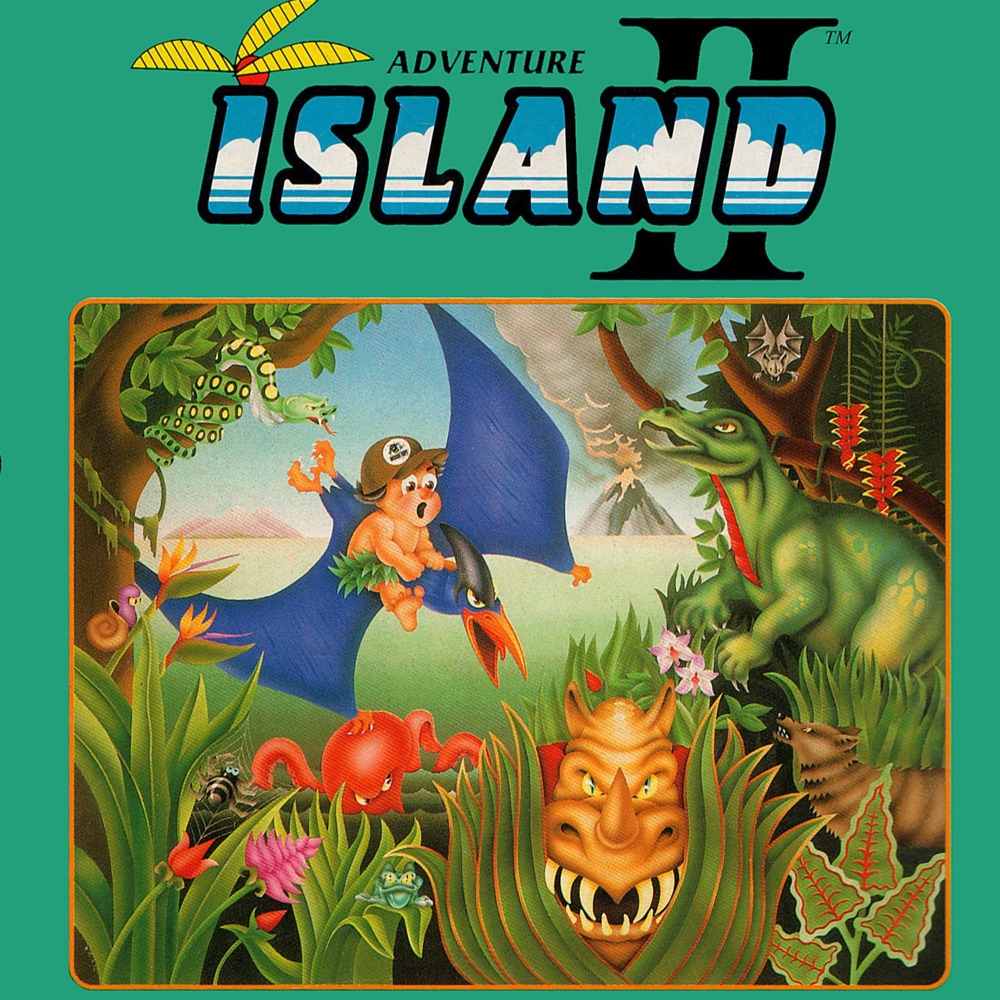
Adventure Island II is a 1991 platform game developed by Now Production and published by Hudson Soft for the Nintendo Entertainment System. It is the sequel to Adventure Island and the second game in the series for the NES. While the first game was an adaptation of Sega's Wonder Boy, Adventure Island II is an original work, as were most of the subsequent Adventure Island games. A portable version was also released for the Game Boy in 1992, titled Takahashi Meijin no Bouken Jima II or Adventure Island outside of Japan.
The last time we recorded an Adventure Island, COVID hit and the episode went missing, so we spent the opening nervously predicting what would go wrong this week. Nothing did. Adventure Island 2 is the same run-right, eat-fruit caveman game with a bigger toolbox, and we all had a good time and still voted it down.
Why it's pleasant
- Dinosaurs. The headline feature. The companions each change how a level plays: the red one fights and lives in lava, the blue one does not slip on ice and has a tail kick, the underwater one swims. You can bank them and bring the right one to the right island. They also soak up a hit, but unlike Yoshi, they vanish when you take it.
- The pteranodon. It works like the Super Mario World cape. You can fly over almost any stage, though you still have to dip down for fruit.
- An overworld and branching paths. Eight islands, short levels (none over three minutes, some under 60 seconds), and a hunger meter that keeps you moving. We joked that it is Survivor with a caveman.
- Controls. Smooth, with a Super Mario balance of slip and weight. The slopes are the exception: we kept pressing down expecting to slide.
What keeps it in the middle
- Master Higgins plays exactly as he did in game one. The dinosaurs are the only gameplay change, and with no mushroom to bank a hit, you are in trouble without a dinosaur.
- The timer is the closest we have come to liking one, but it is still too generous. It stops you from standing around, though we would have made it more reckless.
- Invisible eggs. Hidden pickups give elevators, a free dinosaur or an axe, with no clue they exist. Warps in Mario had breadcrumbs. These are only found by throwing an axe in the right spot. A Game Genie debug menu will show them, and they look like ordinary pickups.
- Easy bosses and dull end-of-level eggs. We kept expecting dinosaurs and got 100 to 1,000 points, always the lowest on the first pick.
Worth knowing
The first Adventure Island started as a port of Sega's Wonder Boy before it diverged. A world select screen opens with right, left, right, left, A, B, A, B on the title screen. And Joe thinks he would have worn this out as a kid, the way Kirby's Dreamland was for him.
The bottom line
Skip it. All of us voted no. Joe said it feels better than it looks, and is fun, but never reaches essential. Sean called it pleasant and a sequel that improves on the original in almost every way, but did not feel engrossed. The third no came because even the original Super Mario Bros. is a more interesting platformer, with this one feeling empty by comparison. We agree it is an improvement on Adventure Island one, and fun to play.
Written from our conversation in this episode.
- It’s gonna be a WILD ride
I. Setup & Premise
- The Lost Episode and COVID
- The pitch: A caveman in a baseball cap and grass skirt throws axes. He eats fruit or he dies. His girlfriend got kidnapped again. There are eight islands to explore
- North America actually got it before Japan, which received the Famicom version in April.
- The first Adventure Island was essentially a licensed port — Hudson acquired the gameplay engine of Sega's Wonder Boy arcade game from developer Escape, swapped out the characters and music since Sega owned those, and shipped it as their own NES title.
- Adventure Island II is the first entry in the series developed entirely by Hudson independently.
- The central tension worth dwelling on: the first Adventure Island was a tight, brutal, single-minded experience — run right, don't stop, eat fruit, throw axes, survive. Five years passed between it and this sequel. What Hudson came back with was a game with more exploration and branching paths.
II. What Makes It Stand Out
- The world map and branching paths holds up
- The first Adventure Island had no map. Eight worlds, each a string of linear stages leading to the next. Adventure Island II introduces a top-down overworld for each island, showing the available stages as nodes connected by paths.
- Depending on how you play you may reach the island boss by clearing only a fraction of the available stages ala Super Mario Bros 3.
- This is a real structural improvement. It gives skilled players a faster path and rewards exploration without punishing players who take the long route. It also means repeat playthroughs feel genuinely different, because the islands aren't fully mapped in your head after a single run.
- When you fail to beat an island boss, they relocate to a different stage on the map. You have to hunt them down. It's a small touch that keeps the world feeling alive rather than static
- The inventory system holds up
- Between stages, Adventure Island II lets you carry items forward. Weapons collected but not consumed, dinosaurs rescued but not yet ridden — they go into an inventory screen that you can draw from at the start of the next level.
- This means preparation is possible. Going into a boss stage, you can choose which companion to bring. Heading into a water level, you pull out the aquatic dinosaur you've been banking
- Finding a hidden Hudson bee logo in a cave on the first island prevents your entire inventory from being wiped when you game over.
- The four dinosaurs holds up
- This is the game's headline feature and it earns the attention. Each of the four companions has a distinct ability that changes how you interact with specific level types:
- The red Triceratops breathes fire — useful for offense and, crucially, lets you enter lava-filled levels without instant death.
- The blue Triceratops is steady and non-slip on ice, making it the essential companion for the frozen island.
- The Pteranodon (tuh-ran-uh-don) flies — hold the button, float above the level, bypass ground-based obstacles entirely.
- The water dragon excels in underwater stages, turning the slow, awkward underwater movement of the base game into something fluid and manageable
- Each dinosaur also functions as a free hit point. Take damage while mounted and you lose the companion rather than your life.
- The hunger bar mixed
- Inherited from the original. Your energy meter depletes constantly while moving, and collecting fruit is the only way to refill it. Let it hit zero and you die regardless of how many hits you have left
- Always moving, always looking for the next piece of fruit — is the series' most distinctive mechanical fingerprint
- Whether it holds up is a legitimate debate. The argument for it: it keeps the pace aggressive. Adventure Island is not a game that rewards cautious play or standing still. The hunger bar enforces forward momentum and turns idle exploration into a calculated risk. The argument against it: by 1991, the NES library had conditioned players to expect that health bars depleted by enemy contact, not the passage of time. The hunger mechanic is strange, slightly punishing, and not explained in a way that new players immediately internalize. Die from starvation while your health bar reads full and you've learned something the hard way
- The secret warp rooms and hidden eggs holds up
- Scattered throughout the levels are invisible breakpoints — areas where throwing an axe at empty air will crack open a hidden egg containing a warp, a free dinosaur, or a power-up. Nothing on screen telegraphs these locations. You find them by attacking constantly as you run, or by following a tip from a friend, a magazine, or thirty years of accumulated wiki knowledge.
- The debug menu buried in the game's code — one of the most comprehensive ever found in a retail NES release — lets developers see where every hidden egg is. That menu was never meant to be found, but it exists, fully functional, accessible with a specific button sequence on the title screen
- WORLD SELECT: To access this level select menu, on the title screen, press Right, Left, Right, Left, A, B, A, B.
- DEBUG: use the Game Genie code AASXEXZA and then use the world select screen.
- https://tcrf.net/Hudson%27s_Adventure_Island_II_(NES)
- The bosses mixed
- A significant improvement over the first game's largely interchangeable boss encounters. Each island's boss is visually and behaviorally distinct, requiring a different approach rather than the same pattern applied repeatedly.
III. Pop Culture, Legacy & Connections
- The Wonder Boy divergence: By 1991, the Wonder Boy series that birthed the original Adventure Island had already moved on. Wonder Boy III: Monster Lair, Wonder Boy in Monster Land, and Wonder Boy III: The Dragon's Trap had all shipped — evolving the franchise toward action RPG territory, open exploration, and character progression.
- The Super Mario Bros. 3 shadow: Adventure Island II arrived in North America in February 1991 — about a year and a half after Super Mario Bros. 3, which had launched in the US in February 1990. The world map structure, the branching paths, the item inventory, the varied world themes, the dinosaur companions that absorb one hit — the DNA is obvious.
IV. Closing Bits
- Adventure Island II is the rare sequel that improves on its source in almost every measurable way — more variety, better structure, more interesting companions, a deeper inventory system. And yet it sits in the shadow of the Mario games it was clearly studying, judged not against what it came from but against the best the platform ever produced.Can a game be genuinely excellent and still be overlooked because it was competing with the greatest platformers ever made on the same hardware?
- Tease next episode - CONAN
Auto-generated transcript. Each paragraph starts with its timestamp. Speakers are not identified.
Adventure Island 2, it's gonna be a wild ride!
And welcome to NEStalgia, a chronological exploration of every NES game released in North America. I'm Mike. I'm Sean. And I'm Joe. Guys, last time when we recorded an Adventure Island game, there was only one of them, now there's two, but more importantly, it was the last episode that we recorded before the COVID-19 pandemic, and was famously a lost episode, but I guess I'm not worried, it's no longer lost, so I'm not worried about that part. I'm just worried that next week, something really bad is going to happen.
Yeah, and is there some way that this could become a lost episode? Like, you're gonna get, like, fumigated out of your house and you're not gonna have the file anymore, because the first time we couldn't go back into our office building, which is where we used to record. So now there's gonna be some reason you can't go back into your house. I appreciate you choosing fumigated instead of on fire.
Yeah, yeah. Like, there's a way for me to get back in the house eventually, not that we've all hope is lost. Yeah. And I like the idea that getting fumigated is something that, like, happens to you, you don't, like, have a say in it, it just, like, happens in the middle of the night and you gotta get out. Kind of does. You don't have time to pick up your stuff.
Well, I, for one, welcome the coming disaster. So, do you guys remember the first Adventure Island now, knowing that it was basically six and some odd months years ago? Not in the slightest, no. I, having played Adventure Island 2, I either pretty decently remember it or have invented memories of what it was. But I think I kind of remember it. Like, I think these eggs were pretty involved, right? Like, it was very similar looking, right? But it felt a little worse? Yes. If I'm remembering correctly? Yeah. Very similar looking.
Still, same guy. He's kind of the mascot of the series. I'm sure he, oh yeah, he, his name is based on, I don't have this in front of me, but his name is based on the guy who could hit the button like 16 times. Yeah, it's like Master Bennington or something. No, no, it's not that, but you know what I'm talking about. Hit the button? That guy. Yeah, he was able, he had like the, he did like a trick thing on, at the arcades where he could hit the button like 16 times in like 10 seconds or something like that. Well, that doesn't sound very hard at all. Got a whole show about it.
Oh, none of that's ringing a bell? Just, well, 16 times in, I'm assuming, a limited amount, not just 16 times like overall. 10 seconds, I think I said. Okay. Oh, okay. I didn't hear that part. Yeah, his name is Takashi or something like that. I don't know. This, this is why you, this is why you write down the characters names, but I guess it's only his name too in the, in the Japanese version of the game. Cause I'm not seeing that Japanese name anywhere in the US manual. I'm not seeing a name. No, it's like, it's, it's Master Higgins. Master Higgins. Oh, there it is. Yeah. You, Master Higgins must explore eight different islands. Yeah. So that's close enough to Takashi.
Close enough to Bennington. I'm telling you though, that guy was able to hit the button a lot of times. What button? And he was famous for it. Like the, the, the button that you use to attack things on a controller, like on a, at an arcade. God. They're not called the A and B buttons, right? Well, I mean, I just, they're just, it wasn't even in the context of video games. It was just the button. Well, there's only one button that we all care about. And if somebody pushes that button, we're in trouble. I thought it was that button in that scenario where like, if you press it, you get a million dollars and, but someone randomly dies somewhere in the world. Yeah. Hit that 16 times in a second.
Yeah. That's why it made him so famous. He was able to get $16 million when the original rules were to only get 1 million. All right. It's getting a little off the rails, but yeah. Caveman, baseball cap, grass skirt. You run from, uh, you run to the right and, uh, emphasis on like the, right. Emphasis on the speed there though. Like it sounds like a caveman is just taking the place of an Italian plumber, but it's not the same kind of like platforming as, as Mario.
There really is an emphasis on just like constantly moving to the right to get to the end of the stage and, and not so much on the exploration front because you're hungry. You have this hunger meter that is gradually depleting all the time. And so you need to constantly seek out fruit. So it has like this middle ground between Super Mario Brothers and Sonic the Hedgehog, where it, it wants to go fast. Yeah. I mean, the fact they made the guy have like a metabolistic like problem, uh, I thought was pretty ahead of its time too.
Like that you, that you constantly need to be eating or you die. Well, I thought there was some like time like shrinking here where it's like, oh, this is like, this is taking you like a week. So you have to be here. Oh, it's like a survival game. Yeah. Right. It was just like, you're very condensed.
Condensed across eight, uh, worlds. Yeah. Eight islands, uh, not worlds. Like you spend like a month on each island. So it's survivor. Yeah. You spend 39 days, 18 people, one survivor.
I thought I saw Jeff Probst in this game. And the first adventure island is basically that it is a, uh, you know, a very single minded experience, run to the right, don't stop, eat fruit, throw some axes to hit the occasional enemies survive. Five. Now, five years of past both in like the development of those games and also like six years have passed on this podcast.
And this is, you know, adventure island two is kind of like, it is a bit different. It not in the gameplay sense, but like they at least leveled up to the times and they came back with a game that has a lot more, uh, of the exploration encouragement, uh, some branching paths, some, uh, you know, like an overworld maps is where you can go from stage to stage. The first adventure island was just going from screen to screen. You never had this kind of, um, uh, story set up for it that, that you have here, this top down overworld, but it still is just set dressing really to just get into the actual stages, which remain mostly the same. They, there, there isn't a like heavier emphasis on vertical platforming or, um, uh, large, uh,
larger timing to, to jump over pits and stuff like that. Like all that stuff basically remains the same. So the big difference is the, uh, the dinosaurs that you collect now, the, you know, this is the game's headline feature is that there are now four companions that have distinct abilities that change how you interact with all these different levels. The dinosaurs arguably are, uh, more important than the caveman because the caveman guy, uh, master Higgins basically performs the same way he did in the first game with no changes whatsoever. And these new dinosaur companions are the only thing that impact gameplay.
Yeah. I think it's like really, uh, and I don't know when was, when was Yoshi introduced to the world just before this, right? Cause we, Super Mario world is already out or no, Super Mario world is out in Japan. Gotcha. Cause this feels kind of like a, like a move over Yoshi. We've got like five dinosaurs and they're all very distinct and very cute. There's dinosaurs. There's an overworld map, right? Where you move on the screen from like, it is very Super Mario brothers. Yeah. A Super Mario world.
But the dinosaurs that they're giving you here aren't like Yoshi. I mean, they kind of are in the sense that they also act as that one more hit mechanic. Uh, so like you, if you get hit, you don't get the game over like you would if, if you didn't have the dinosaur, but you don't get to like jump back on them either. They're gone. And now you have to go find a new one. And then they have these different abilities. Um, the, the red one, uh, does like a, uh, what is he? He does like a fireball.
Yeah. He can, he can live in lava. Right. I mean, that's big for a whole, uh, there's a bunch of lava filled levels. Uh, so that's like a, and I think they're all kind of like that. The dinosaurs exist to also be complimentary to specific islands and such. So the blue one, uh, he has, he makes it easier on ice. He doesn't slip on the ice. So like, he also has a cool tail kicking move thing that makes combat a lot easier, but you know, you would mostly want him for those ice levels.
And so you can bank these dinosaurs too. You don't have to say like, okay, I just hope I, now that I have it now, I'll, I'll, um, just keep it going until I get to the ice stage. It's like, you can tuck them away and use a different dinosaur or no dinosaur, uh, as you enter each stage. And then when the time comes, use the correct one.
Yeah. It's an interesting dynamic that like, you might find a dinosaur that isn't all that well balanced for whatever, uh, level you're in, but you'll need them later. Um, I'm looking at the, uh, weird swimming dratini looking thing. Yeah. Is that even a dinosaur at that point? I don't even know. Yeah. It's like a, like a water horse or like lactose monster, you know? Yeah. It's a, it's a, it's an underwater, uh, uh, Saurus underwater source, I think is the actual name.
Um, but, uh, he kind of sucks on land and, but if you want him for the underwater levels, which you, you're probably going to want him, uh, you, you have to kind of extract him from whatever above ground level that you're in. So it gives you a little bit of like a challenge. I mean, it's not like you can't beat the other levels with like without the respective dinosaur, but it definitely helps.
And while there's eight islands and a lot of stages in each one of those individual islands, the game is pretty fast paced. Again, it encourages you to kind of just always have your thumb on, on the, uh, right D pad, uh, and just moving forward in order to satisfy your hunger. But also the levels themselves are, are very short. They don't, uh, I don't think a single level could take over three minutes. Uh, that's even that one's being generous. Some of these are under 60 seconds if you're just going, uh, to the right.
But then there's also the, um, what I thought was a pterodactyl. And then I looked it up and apparently it's a pteranodon. Um, it's, it's a pterodactyl. Right. But they say pteranodon. So, okay. And, uh, this one is like a weird cheat code in a game that doesn't need it. It, it, it is very similar to the super Mario world cape where like now you can just kind of pick up enough speed and then fly off over through the entire stage and come back down when the time is right.
The only exception of course, is that you do have to eat. So you have to occasionally like dip down a little lower and look for some food, but it is weird that there's not much going on above most of these stages. And so you could just literally fly over, uh, quite a few of them and the few birds that occasionally like spawn in, uh, you know, as long as you're paying attention won't necessarily like disrupt anything. So you could ride this pteranodon through most stages and avoid the game completely.
Yeah. I like the, well, like the sentiment of what of what you just said about, uh, having to dip down for food because I don't know if it really was pulled off perfectly, but it is a nice little like solution to that problem that we kind of talked about a little bit in super Mario brothers three super Mario world of like, wait, are we just skipping the level? Like this is like giving you that little bit of risk reward or it's you can go above, but now you have this different challenge of like, you still need to come back down to get food and think of it there.
I think that maybe it needed to go like a little bit of a step further for it to be like, uh, balanced, but yeah. Cause I don't think you do need to, I think that the levels are fast enough that you can kind of ignore the timer. Like that's sort of a larger issue with this game is that I, I like the, you know, we've always had issue with timers because they end up being long enough that they don't really matter. And then this game comes along and kind of centers that and makes it a more core part of the game, um, going fast, but it's still like your limit is still way too,
it's still way too, uh, generous so that, yeah, if you're taking your time, it, it'll, it'll start to get way too close for comfort, but you're probably not going to be like cutting it that close. Um, yeah. And your biggest problem is going to be dying in the normal way of running into an enemy or projectile.
But I think it does help you with, or not help you, but like help, um, encourage you not to take your time, you know? And I, like, I usually have a problem with this too, but I think that in this sense, like, this is like maybe the most that I've been okay with a timer that I can remember because it is like, oh, it's just telling me not to just like stand there and figure out what my next move is. And that adds like a little bit to the challenge where it's like, I, I feel like I could have no problem getting through these levels without the timer running low. But like in some other games I might like stop and be like, okay, let me think about what to do next. This is more about like, uh, you got to react, react to what's coming at you.
So I got, you know, I don't, I don't hate it as much as I do other timers. Yeah. I think it should have gone that step further and made it less like, oh, you can't just sit there and make it more. All right. You have to be a little reckless and, uh, sort of figure it out on your own. But I guess that's a different game at this point. Thanks to the, um, power of our Patreon and April Fool's jokes of the past. We have actually reviewed, um, both Super Mario World on, on our Nostalgia Bites, uh, Patreon.
And, uh, we did a April Fool's episode many years ago of Sonic the Hedgehog. I don't know what you're talking about. Oh, right, right. I'm so sorry. Uh, clear it from the record. Now, here's the funny thing though. When you look at both those games, Super Mario World, you know, is an exploration based game with all those like keys and, uh, secret exits and stuff like that. Like it does want you to look around and it gives you a timer that while still probably unnecessary, um, you know, is plenty of time to, to explore a particular level and everything.
And Sonic the Hedgehog, um, has a timer that is, I think in the episode I recall saying it's a little strange because the game wants you to go fast. And so, or at least implies that Sonic the Hedgehog is fast, but there's a lot of things that stop Sonic the Hedgehog. There's not a lot that stops, uh, Master Higgins here from getting along.
Like there are enemies that you have to get through, but like for the most part, you're either like quickly recognizing those enemies in front of you and attacking them or you're, um, jumping over them or, you know, and avoiding them completely. There isn't like a lot of walls or, or vertical movements that require you to like slow down for a second. And like, what am I looking at here? That, that is not present in this game. So this is like both the fastest version of these three games and also, uh, the, the one that has like the, the most urgent timer.
That's that. Yeah, that's true. Um, I think as the, you know, early on, there isn't much stopping you because I think it, the balance is a bit, it's easier. There's a, there's a, like a difficulty curve here. Um, so you really can just kind of like YOLO it and, and half the time you'll be okay. If, as long as you've got your reaction speed down, because you're also shoot pretty fast and it's, it's pretty responsive there. Like if you get really close to an enemy, you might just be able to like shoot them before they touch you and you're fine. Um, but I, I think as the game goes on, like it, it, it kind of, it's a little bit harder to do that. I, I at least noticed that, uh, the, the, the skill ceiling shifts a bit as the game changes.
Yeah. I think they put more enemies in, right? So it's like, you can't, you could try to, but unless you memorized where they are and such, you're most likely going to take a hit. And in this game, even though the enemies also only require one throw of your ax or one hit from the dinosaurs, uh, so, so is true of, of the caveman here. So you have to be very careful about, you know, there is no like mushroom that you can safely grab and be a little bit bigger and, and bank a hit, you know, if you don't have that dinosaur, you're, uh, you're going to be in trouble.
Yeah.
scattered throughout uh a lot of these levels uh are some invisible uh egg like hidden eggs that uh there's no there's no way to know that they would be there um they usually like give you either like i think it's an elevator uh up through the stage or there's a couple different things and then you are you you know it's not it's not always a warp sometimes it's like a free dinosaur or uh the axe power up the these things are there's no there's nothing on screen that
telegraphs these locations but because they're like i i feel like the warp ones should have had some kind of clear communication of how to like find break points in in the game whereas like the free dinosaur thing is inconsequential and so that's fine if you just want to make that like a hidden thing but to literally have no way to know other than just spamming your axe and hoping you hit one of these invisible targets which isn't even clear like when it happens like why it happened
it's like oh because i threw my axe into this particular spot and egg spawned like you might think that that's just like a mistake or a glitch in the game yeah yeah it's almost like it basically just gives it's basically rng even though it's like not it's like you are the rng like you are what makes it random and like you couldn't have you couldn't have tried to do it it just happened to you because you happened to be there at that time you think i found one or two and i mean it's not
even that's why i don't really have a problem with them being hidden because it wasn't all that that crazy i mean it's it's definitely bonus stage material yeah i guess i think about like the warps though you know like that since since we're comparing it to super mario brothers so much it is like one of those things where even in those games like even though it's hidden like whether it's the warp whistle or um the warp zones behind uh the underground sections in super mario brothers
like there was a way to find them and think like oh i wonder if i could go here and then turns out you can like there's there's nothing about that here and so it feels like i know you're probably just spamming axes all the time anyway because you don't have in a limited supply and there's no reason not to if you're trying to like clear enemies you might as well just always be throwing your weapon but it just feels strange that they are just arbitrarily placed somewhere in the stage and there's not
even like a way to know if like did i miss a warp like would there have been one in that stage like what do i have to do to find out where these things are if i if i wanted to seek them out well that's that's why they're secrets oh and then maybe a less exciting secret uh because it requires cheat codes which i still don't know how people ever figure these things out but there is a world select uh screen
if um that you can access from the title screen by pressing right left right left a b a b which is like another pretty common cheat code i feel like like it's not the konami code but i feel like that's a good one to try in video games i think that's one that you like if there's any code that you could stumble upon it's that right because it's just and then maybe try up down up down as well if right didn't work is that the one that gives you unlimited weapons in grand theft auto oh that's a good
question it's been a long time no i don't think so there's a lot of shoulder button presses in that yeah those ones were also crazy complicated but that one i feel like just people either like like there was entire cheat magazines dedicated to like okay here's the latest grand theft auto cheats here's what you can do um and the reason i called out the specific code though is because oddly enough
there there's a way to do it without a game genie but i can't explain it so with a game genie if you put in the code a a s x e x z a and then use that same world select screen code um right left right left a b b b b on the title screen instead of getting the world select screen now you get this giant like debug menu oh like you where you basically just have like developer things and there's a lot of interesting things there's there's free movement there's uh you could turn on immunity to pits a
letter to the developer's wife yeah but here's the most interesting thing you can turn on the ability to show where all the hidden eggs are in the stages so you don't have to guess anymore and you could just have them turned on and does it even like it probably just looks like that's how it should have been in the first place these eggs are just pickups yeah but i feel like that's too obvious right well yeah i mean if just i'm just saying as opposed to it being hidden in like just that they weren't
supposed to be hidden at all because they're not like i think i think that a warp zone needs to be hidden in some way yeah i mean i agree it should have been hidden in some way but i'm just saying i think that between the two like it being completely just invisible and just hidden completely it probably wouldn't look like well if you can see them it doesn't look like oh that's a secret it just looks like that's a pickup because it's just sitting there in the open right yeah yeah yeah i don't
really know what i'm saying tomato tomorrow the last the last thing i wanted to talk about was the bosses um in this game uh they they do offer some interesting variety from just the scroll to the right mechanic and and hit everything with one hit but other than like having a you know there's a different enemy or uh you know like there's really not a lot to them like you just have to hit them a bunch of times and they're kind of in good well-spaced rooms and everything like it is kind of easy to
avoid like i didn't feel like the bosses were adding anything i i think they added at least like some dynamic some dynamics with like your weird dinosaur friends like you know you get off of them they are no longer a means of transport and they're like your friends and they'll they fight with you like as a separate entity and yeah i mean it's it's a weird shift from like sort of running around and hitting stuff to this more like kind of i i'd say set piece is a strong word but it's
definitely a different mode of like movement and like game interaction like when you get into these boss fights where it's just more like it uses the whole screen um but i i mean at least it's a change of pace instead of just run as fast as you can to the right yeah and i get the vibe overall that this game is deliberately not very challenging like you know it's like trying not to be like uh the boss battles are just like it's another fun colorful thing to interact with and like have a good
time you know it doesn't feel like they're like trying to really design uh a robust challenge rather than like maybe give someone who's not like a crazy good gamer something to something to be good at so joe you see this as more of like a hang game where you just kind of like pass around the controller between stages and stuff and just have a good time yeah and i can i feel like if when i was a kid like and i didn't play this game when i was a kid but when i was like i feel like this would be a
game i would go to all time because i could because i could get far in it you know a little like kirby's dreamland was for me you know right right and another similar thing to kirby's dreamland that this game has at the end of every stage there's kind of this like harmless inconsequential choose an egg thing that rotates through in kirby's uh dreamland you um you like fall onto a cloud and have to press it at its apex to shoot up and then whichever cloud you land on you get its reward
um this like i i feel like i was expecting to get dinosaurs out of these eggs and i was always just getting like points like 200 points why would you expect to get dinosaurs out of eggs and not random numbers i don't know maybe the game trained me to think that dinosaurs come from eggs i i was very disappointed in the eggs just because like i wasn't even i don't know why my brain didn't even go the dinosaur should come out of the eggs but i was just like oh like everything i was picking it's
just like i got 200 points 300 points a thousand points like this means nothing to me these are the numbers at the top of the screen what about all the cool colorful stuff on the screen give me a power up give me a weapon yeah give me a dinosaur as i've seen one ups come out of them but i mean yeah it's usually like 100 200 1000 points and so i would just immediately run into the first one that came out because and then that usually wound up being 100 points like i don't know why it was like taunting me it was like yeah we're giving you the lowest amount because you chose the first one all right so you
don't have to go based off of like their powers or anything but just who is the coolest dinosaur in this game i kind of like i don't know i kind of really like the derpy underwater one just got like a cool like mystical vibe red yeah i was gonna say red too red just seems like a chill guy to hang out with yeah i mean it is it is kind of about the powers with him because like he gets to take baths in lava and i like to take baths in lava of course we have like every kid like what would like to uh the original adventure island uh i don't even know if we covered this in the original episode but
because i didn't listen to it unfortunately before this one uh so if i've ever tried a little bit of ground here i promise it's worth it um the original adventure island was originally going to be a port of sega's wonder boy and um it wound up diverging from that and becoming its own thing and by 1991 uh the wonder boy series is a lot different than what adventure island uh has become there is wonder boy 3 monster lair wonder boy in monster land and wonder boy 3 yeah i guess there's a second third game does that make sense like so it was like pokemon red and blue like wonder like final fantasy 13
and then like the other two final fantasy 13 games well i thought so right but this is just wonder boy 3 monster lair and wonder boy 3 the dragon's trap um and all three of those games have already come out
and uh there's you know there's some of those games are have like some rpg elements in them some open exploration things character progression whereas like adventure island is very much fixated on like the original idea of this is just a side scrolling platformer uh and we're not trying to like take it any further than that huh and i guess you know this will come up in our essential games list thing but it's worth mentioning of course that like adventure island 2 is coming to us like not only after super
mario brothers 3 but super mario world in in japan and everything it it it is like for me as somebody who's playing all these games over and over again it is like a a return to like what we used to do on like it's a much simpler game and not in a bad way but this is this is a game that is is very much pick up and play you don't need to look at a manual you might have to look at a manual to understand
like something about it later on but for the most part like this is one of those old-fashioned as soon as you turn it on you just move to the right and attack enemies and there's not much else to it and i think that's fine yeah i mean i um i i missed a couple episodes because i i couldn't stay on the side of joe but what were the last couple like it was contractual reasons i i have in my contract is i have to get paid more than sean and then it was this whole thing well my my whole thing was that
uh of what you did to me but the uh but like we're the last couple more so um like menu based things like was it almost like a nobunaga oh no you didn't you didn't miss any um nobunagas you missed wayne gretzky hockey no i was there for that oh okay sorry you missed zombie nation zombie nation what did we do last week and we did a patreon only uh oh yeah good plug joe yeah get on the nostalgia bites everybody if you want to hear more of joe and not sean who is now my enemy
true true well anyway yeah i guess i i do agree that this is more so like just just the classic you know it's it's a platformer it it's a it's fun yeah and it feels like the controls have
it's like the controls that are now the standard controls that you would expect from anything so you just pick it up and it's like you into if you've ever played a video game you intuitively know how to play this game yeah specifically about the controls too uh it it is very you know it is it is very super mario that they seem to be like the closest in a lot of ways to like oh that's that like good balance of slipperiness and and weight until like you get to like my one nitpick is that
like the the slopes don't feel good bad bad feels on the slopes but that's that's my last note i did find myself a few times like pressing down like in the mario games and think expecting to slide down the slopes uh and no dice which is funny because i don't the slopes were in sumire brothers 3 or is that a world three they definitely were okay so they're introduced in three yeah i got it okay uh we will we've determined that the game is fun but we have an even bigger thing to determine and that's whether adventure island 2 belongs on the essential games list
joe yeah well i think on first glance of this game like i will say that playing it feels a lot better than it looks like it should feel if that makes any sense i just feel something about the look of this game i thought it was going to just feel very stiff to play and that quite the contrary it's actually very smooth and feels pretty good and i think at the end of the day this game is a
pretty good looking and moderately fun game that like you know you'll have a fun time playing but i think it never really gets beyond that it's it's maybe i don't know if it's too i don't want to say it's too simple but it's just it's not doing it's not doing that that extra work to get me anywhere near essential status but like yeah it was fun sean yeah i agree this game is pleasant um and doesn't really uh out outlast its welcome uh there's enough there's enough variety moment to moment that it'll hold your attention but i didn't i didn't feel super engrossed at all times it was just sort of that middle middle ground of i'm having enough fun to continue doing this for a bit and that's
totally fine uh but you know not essential i'm glad that adventure island 2 took the uh sequel route of mega man 2 and ninja gaiden 2 of just like continuing to do the original thing rather than all of a sudden make adventure island 2 some kind of um arpg or something like that so i'm glad that they did that i do think it is one of those rare sequels that improves in almost every way
variety on on the original so i mean there's more variety uh there's more there's finally companions uh there's a deeper inventory system here with being able to bank them are they romantical companions though do you remember they we do need to romance these dinosaurs i was gonna bring that up in my essential games list vote thank you for that sean yeah it's a huge bummer that i
can't hit on my good friend the red dinosaur uh who hopefully has a name uh that i will learn in due time when i pick up his number maybe that's why you weren't successful you didn't even know his name yeah right didn't even yeah i just took a name and i was like joshua like maybe maybe he's joshua uh but you know here's the problem it's not it's not that you can't romance the dinosaurs it's
actually that all those like additions still put it deep in the shadow of the super mario games and even like forget about super mario brothers 3 and judging it by super mario world is not fair because that's a super nintendo game but even like the original super mario brothers is still a more interesting platformer than what we have here and i think that's because even though controls wise it's
mimicking a lot of what super mario brothers has sure you can put more enemies in stages and you can design like you could add lava pits and ice stages and stuff and that's all like notes from the super mario levels as well but it's just kind of empty in there like it it feels good to complete the levels because they're fast enough so you get that dopamine hit and you know you have to you have to be alert because they do put enemies in there but there's just not like a lot of platforming
happening in the way that like super mario brothers makes you engage with it and i feel like that's what's happening is like i'm missing some engagement in this game we have to up those numbers you know we have to get synergy uh in in this uh in this podcast together so for that reason it's a no for me as well but it sounds like we all at least think that this is an improvement on adventure island one
and an overall pretty fun game yeah it's definitely an improvement on my potentially made up memories of eventually adventure island yeah you speak for yourself like i didn't say that at all you guys not remembering adventure island one is just a symptom of long covid that's true oh yeah it's like you lose your sense of taste and also your memories of adventure island one that's what they have we should actually call uh who about that if they're still around who you
you! you! you! you! you! you