441 · Metal Storm
Metal Storm is an action-platform video game developed by Tamtex and published by Irem for the Nintendo Entertainment System (NES). Irem released it in North America in February 1991 and in Japan on April 24, 1992. The game is defined by its central mechanic of the player's ability to reverse gravity at will, upon which all of its levels and challenges are built.
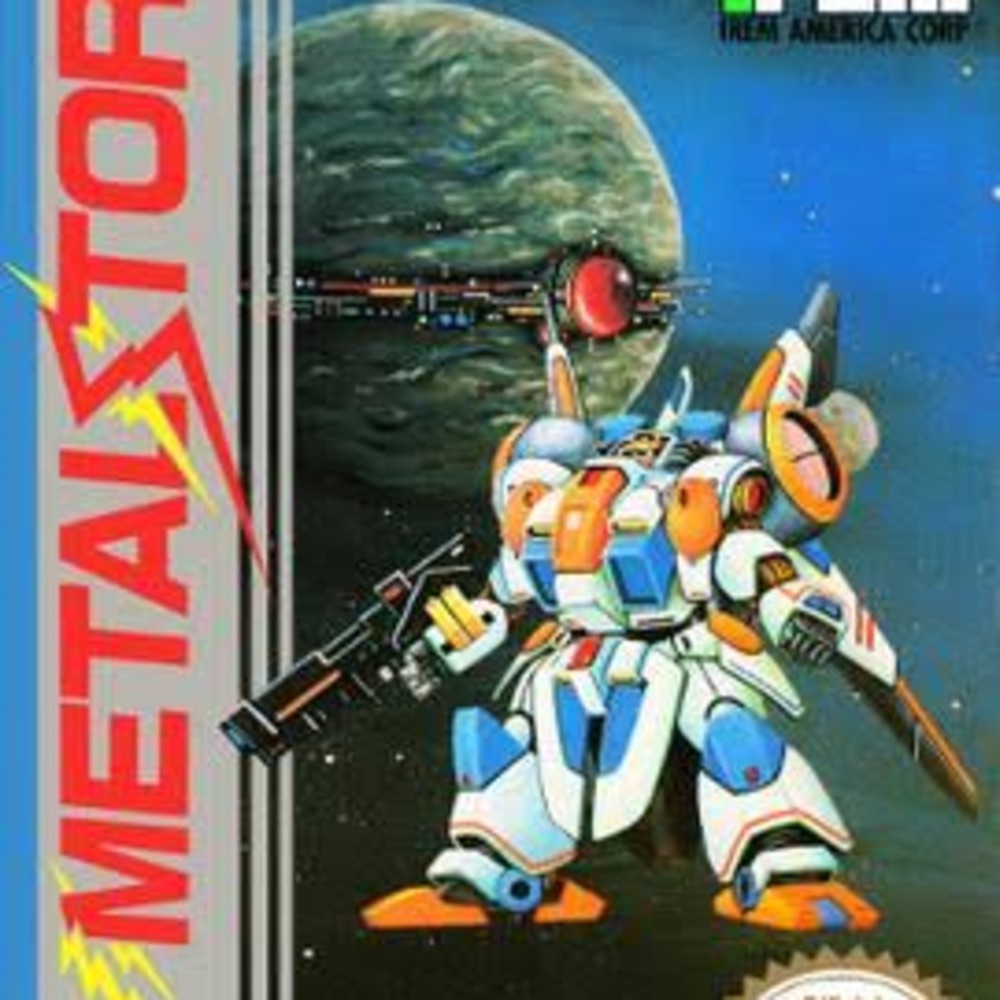
It is the year 2501, the defense laser on Pluto has gone rogue, Neptune is already gone and Earth is next. You pilot the M308 Gunner, a giant mech with one trick: press up and jump together and you fall upward onto the ceiling, press down and jump to come back. Mike and Joe played it, with no Sean, and it was a pleasant surprise. We would still like to know why the mech on the box is white, blue and orange and the one in the game is salmon.
Why we kept playing
- Every level is built around the flip. Doors flip with you, platforms you can only jump up through become landings once up and down trade places, and bosses want you on the ceiling for some weak spots and the floor for others. Near the end you ride two circling tanks, and a missed flip is death. Joe's comparison was Magician, which had a great system and no world around it. This is the reverse.
- It reads clearly. Solid platforms look like stamped metal, and the two-layer parallax backgrounds, which took a custom mapper chip, separate foreground from background.
- One hit, but fair. The death explosion is a great one, and the second try at any section usually shows you the answer. Six stages is the right length for a game where you die often. Combat is basic, wait for a turret to finish firing and then shoot it, and we were fine with that.
- Power-ups that fit. Armor buys one extra hit. A shield you can aim, though lasers go right through it. A P that punches through surfaces, and a G that damages enemies while you flip. You hold only one at a time.
- Easy to start. No manual needed and no training area, just platforming with light shooting around it.
Worth knowing
- Stage two traps people. We both wandered up the infinite vertical scroll for a long time without noticing that walking right was the way forward.
- The story was cut. The US cartridge switched off the cut scenes, though they are still in the code and Game Genie codes bring them back.
- Press and price. Tamtex made it and Irem published it. It got the cover of Nintendo Power issue 22 with a 12-page guide, but sold badly. A complete copy runs about 525 dollars. Retro-Bit and Limited Run reissued the Japanese version in 2019, with the cut scenes and a color-correct mech.
- A second quest brings tougher enemies, rearranged hazards and fewer power-ups.
- IGN ranked it 46th best on the NES, which we took as an order to vote for it.
The bottom line
In the episode Joe voted it onto the Essential Games List first, and Mike followed, citing how easy it is to start, how rewarding it stays, and a difficulty you feel you can beat with enough hours. That made two votes out of two. Flipping gravity never goes stale, so if you like VVVVVV or want a short, sharp mech game, this is a good one to try.
Written from our conversation in this episode.
- NO ORDINARY COMPUTER VIRUS
I. Setup & Premise
- The pitch: You pilot the M-308 Gunner, a walking war machine that can flip gravity and fight. The job is to break into a malfunctioning battle station and blow it up before it blows up Earth.
- The premise: It is the year 2501. Humanity has colonized the solar system, and a defense station on Pluto called Cyberg houses a giant LaserGun built to fend off alien invaders.
- The gun malfunctions, turns on its makers, and starts destroying planets. Neptune is already gone, and Earth is next (how is that the order?).
- A fun bit of manual flavor The manual gives the M-308 Gunner a full spec sheet: 9 feet tall, 2100 pounds, built from "Geopolyum Alloy," 1300 KW generator, and one listed Special Function: Gravity Flip.
- Developed by Tamtex, a Tokyo studio that was a subsidiary of arcade giant Irem, and published by Irem.
- Combat is light and the whole game is built around one idea: flipping yourself between the floor and the ceiling to survive. The cleanest modern comparison is VVVVVV, the gravity-flip indie game.
II. What Makes It Stand Out
- The entire game is the gravity flip Press Up and the jump button together and you fall upward and land on the ceiling. Press Down and jump to flip back.
- Its headline trick is simulated parallax scrolling, layered backgrounds moving at different speeds for a sense of depth, which the NES could not do on its own. Tamtex faked it with a custom mapper chip in the cartridge and clever memory bank switching.
- The result is up to two independently moving background layers
- The mech is a big, smoothly animated sprite and the bosses are multi-part machines that look straight out of Gundam or Macross
- Metal Storm landed the cover of Nintendo Power issue 22 with a 12-page strategy guide, yet it was a commercial failure. (Wikipedia)
- The US cartridge has the game's story intro cutscenes sitting in the code, just switched off. They can be turned back on with Game Genie codes (SNKEPULO and OOKEZLVP).
- There is also an R-Type ship cameo hidden in the game.
III. Gameplay Structure
- Stage layout Six main stages, each split into two acts, then a seventh stage that is a climactic boss rush.
- The environment is the real enemy
- Hazards switch on and off depending on which way is down for you: lasers, crushing blocks, and gates that flip when you flip, where simply flying around a gate kills you instantly.
- Later stages add screen-wrapping, a level that loops endlessly as you fall, a moving cage you have to stay inside, and platforms that scroll up and reappear at the bottom to scramble your sense of up and down. (Hardcore Gaming 101)
- The first stage has a defined floor and ceiling, but the second stage does away with this, creating an infinite vertical environment where the floor is the ceiling and the ceiling is the floor, and you can step off a platform and fall down to land back on the same platform. That's the mechanic graduating from "neat trick" to "rethink how space works." There are even infinite-drop sections where you fall forever until you move left or right to catch a platform. Great bit to describe out loud because it sounds impossible until you picture it.
- Three main power-ups, only one active at a time:
- P upgrades your shot to punch through surfaces,
- S is a shield
- G turns you into a damaging fireball each time you flip.
- Otherwise you die in one hit, and grabbing a shield wipes whatever weapon you were holding, which is a brutal trade-off.
- For an Irem game it is still relatively forgiving: unlimited continues and a password system.
IV. Unique Gameplay Elements
- Almost every boss forces smart gravity use. The first one has a weak spot that jumps between three points, two of which you can only hit while upside down, all while dodging ring shots.
- Later fights include a wall of laser turrets that makes you jump nonstop, a mech that quarters the arena with crossing beams, a robot that bounces around a cage, and a transforming machine with three forms.
- Expert Mode
- Beat the game and you unlock a second quest. Enemies and bosses get tougher, hazards are reconfigured, and power-ups are stripped down.
V. Reception & Legacy
- Loved by critics, ignored by shoppers
- Reviews were strong: EGM 7.75 out of 10, Computer and Video Games 88, Mean Machines 88 percent, and Game Player's called it a must-buy. (Wikipedia) But it sold poorly
- IGN ranked it the 46th best NES game, 1UP called it a hidden gem, and CBR named it the best NES game released right before the SNES.
- Low print run plus rising reputation turned it into a pricey collector's item, with copies going for as much as roughly 200 dollars.
- In 2019, Retro-Bit and Limited Run Games reissued it, based on the better Japanese version and translated into English for the first time, complete with an M-308 Gunner figurine modeled on the Nintendo Power cover. (Wikipedia / reviews of the 2019 release)
VI. Sequels and Spinoffs
- No true sequel, but there is a "director's cut" There was never a Metal Storm 2. The closest thing is the Japanese Famicom version, Jūryoku Sōkō Metal Storm, or "Gravity Armor Metal Storm," which arrived more than a year after the US release. (Wikipedia / The Cutting Room Floor) It is the more complete build: a full intro cinematic, extra dialogue, the correct white mech, a tweaked gravity-flip input, and an even nastier stage 6 with electric barriers on the ceiling and floor. The 2019 reissue is a translation of this version. (Hardcore Gaming 101 / Wikipedia)
- Japan added the "Gravity Armor" subtitle because an executive felt the plain name "Metal Storm" did not convey what the game actually was, according to pixel artist Kiyoshi Utata. (The Cutting Room Floor)
VII. Essential Games List Vote
- Case for Essential
- It is one of the most technically jaw-dropping games on the NES, with depth effects the hardware was never built to do.
- The gravity flip is a genuinely original idea, and unlike its peers the whole game commits to it, with level and boss design to match.
- It is tough but fair.
- Case against Essential
- One-hit deaths and the shield-wipes-your-weapon rule can feel harsh.
Found automatically from the transcript and checked, but it can miss things or pick the wrong page. Spot a mistake? Tell us.
Games
- Metal Storm mentioned at
The episode's game: a 1991 NES action platformer where a mech flips gravity to walk on ceilings.
- Magician mentioned at
The previous week's NES game, contrasted with this game's gimmick-driven design.
- VVVVVV mentioned at
The indie platformer in which you flip gravity instead of jumping, compared with this game.
- R-Type mentioned at
Irem's shooter franchise, whose ship cameos in a background of this game.
- The Legend of Zelda mentioned at
Cited as the model for this game's second quest after you beat it.
- Super Mario Bros. mentioned at
Its original Famicom box art, with a very different Bowser, is used as a comparison for the Metal Storm box art.
- Super Mario 3D World mentioned at
The Wii U Mario game whose final boss is Meowser.
- Crash Bandicoot 4: It's About Time mentioned at
A recent game with a mechanic you can use to flip repeatedly and almost fly.
- Metal Slader Glory mentioned at
A Famicom mech adventure game that the hosts recorded for a bonus episode and kept thinking about.
- Metal Gear mentioned at
The other 'metal' game with a giant mech, named in a joke about mech vocabulary.
- Holy Diver mentioned at
A heavy-metal-themed NES game the hosts covered on a bonus episode.
- Metal Mech: Man & Machine mentioned at
An upcoming NES game whose title has both metal and a mech.
Hardware
- Super Nintendo Entertainment System mentioned at
The console whose Mode 7 effects the parallax is compared to.
- Game Genie mentioned at
The cheat cartridge that can restore the game's cut cutscenes in the US version.
Companies
- Irem mentioned at
The publisher of Metal Storm, also known for R-Type.
- Limited Run Games mentioned at
The publisher that co-released the 2019 Metal Storm reissue.
Film, TV and music
- Star Wars mentioned at
The film franchise the hosts bring up at the end of the episode.
Terms and events
- Pluto mentioned at
Where the story's defense station with a giant laser sits.
- Alderaan mentioned at
The Star Wars planet destroyed by the Death Star, compared to the laser destroying Neptune.
- Parallax scrolling mentioned at
The layered-background effect where layers scroll at different speeds, which this game pulls off with a custom chip.
- Mode 7 mentioned at
The Super NES graphics mode the parallax effect is compared to.
- Memory management controller mentioned at
The custom mapper chip in the cartridge, plus bank switching, that makes the parallax possible.
- Hoth mentioned at
The ice planet where the hosts say they have seen the AT-ATs.
Articles, videos and sites
- Nintendo Power mentioned at
The magazine that put the game on the cover of issue 22 with a 12-page strategy guide.
- Computer and Video Games mentioned at
The British magazine that gave the game a score of 88.
- Mean Machines mentioned at
A British video game magazine named in the reception rundown.
- IGN mentioned at
The games site that ranked Metal Storm 46th on its list of best NES games.
Other
- Gundam mentioned at
The giant-robot anime franchise that the mech on the box art recalls.
- Samus Aran mentioned at
The Metroid hero, compared for a damaging spinning move similar to the game's gravity power-up.
- Metal Storm 2019 reissue mentioned at
Retro-bit and Limited Run Games re-released the game in 2019 based on the Japanese version, with cutscenes and a color-accurate mech.
- Bowser mentioned at
The Mario villain who looks very different in the original Famicom art.
- AT-AT mentioned at
The Star Wars walkers the hosts mix up with AT-ATs and scouts when looking at the game's enemies.
- NEStalgia Essential Games List mentioned at
The show's list of NES games that define the system; this episode adds a game to it.
Auto-generated transcript. Each paragraph starts with its timestamp. Speakers are not identified.
Metal Storm, no ordinary computer virus. Metal Storm, no ordinary computer virus. And welcome to NEStalgia, a chronological exploration of every NES game released in North America. I'm Mike. And I'm Joe. Joe, what is an ordinary computer virus? An ordinary computer virus would be like, I don't know, I don't have anything in the chamber. Yeah, like one that was like, one was like, you know, hey, I caught you watching a lot of porn and now I'm going to upload it if you don't pay me Bitcoin.
Is that like an ordinary computer virus? I think that might be, that might be like a step, like, just one step out of the ordinary. I feel like people need to know since I brought up that very extreme specific example that not only has that not happened to me, but if it does happen to you, it's a scam. It's not something that they likely don't have the footage.
Yeah. I think another ordinary computer virus is like your antivirus software is out of date and we've detected 2,000 viruses on your computer. Right. It's very meta, a computer virus, because it references so many other viruses. Yeah, yes, yes. And, and this is no ordinary computer virus in Metal Storm because this virus is threatening to blow up the earth, which is something that no computer virus has ever told me it was going to do.
I feel like I've gotten that like once maybe, but. Right, right. They should adapt to the times and start thinking about that. They're like threatening you on a personal level isn't going to cut it anymore. And that new computer viruses need to like, you know, they need to like threaten your family or your like local town. Like, you know, your, your neck, your Christmas tree lighting will go poorly if you don't pay this ransom. Yeah. What would be poor? Like, would it be, would it be like changing the colors of your Christmas tree lights to, or like, would there be like. To just blue and white. So now it's like a Hanukkah thing. It's like, oh, we really got them this time. Like now the Christmas tree is just blue and white.
Maybe, maybe just like you can create like shapes or images that could like, it can put text, your social security number written out in the Christmas lights. You know, speaking of getting the color scheme wrong on things, what happened here with, I don't know if this thing is called the metal storm or not, but this, this Gundam thing that you control on the box, it has like a really cool color design of like white, blue, orange, some yellow. It looks like a pretty awesome thing. And in the game, it's just all orange. It's like, it's like salmon. Yeah. Beat the whole game and then beat the whole game wearing a salmon suit.
Such an. I don't work there anymore. I don't make those references. I don't even know if anybody would understand that joke, but I'm making them anyway. It's not a, it's not a deal breaker. The fact that he's not colored in the same way as the box. I just want to know what happened. That's all I'm asking. I just want answers. There's gotta be accountability. I think that they had to take all the color, all the like color variety that was on the box and they had to splash it throughout the background of the. The first level. Right.
Now I will say that the reason I bring that up at all, of course, is because metal storm, while not being a game that I knew about or had played before. I, I just am familiar with that box art for some reason. And maybe it's because I like, you know, giant mech robots and I want more of that in my life. But I was so familiar with the, um, with the box that I, I, for some reason I thought like, oh, this is, this is a game with like a lot of reputation behind it. I don't know if that's true.
I don't know if like, this was a game that a lot of NES people played or not. Yeah. I had never really heard of it, but it, it, while I'm playing it, it feels like something that I'll say at the very least deserves some recognition. So I wonder if it did get some recognition and I just wasn't familiar with it. It is the year 2501.
They really covered themselves there by adding an extra year. So this way it'll last one year longer than just the year 2500. This game will still be relevant in the year 2500. Uh, humanity has colonized the solar system. There is a defense station on Pluto, which presumably is a planet again in 2501.
And, um, that defense station, uh, houses a giant laser gun, which, uh, if we've, as we've learned, that's like a necessary thing in the future. We just need to, it's like the steps are, uh, land on Mars, build a giant laser gun on Mars. Am I right? Uh, yeah, I think you actually build the giant laser gun on the way to Mars. You drop it there. So it's there when you get there. Cause you can't be on Mars without the giant laser gun. Yeah. I think you could just order it on Amazon and have them send it. Yeah. Uh, now the gun malfunctions and, uh, turns against earth and starts destroying planets. By the time the game has started, Neptune is already gone and earth is next.
How is that the order? Who is it? Who's deciding? What computer virus? Is it just like a crazy computer virus? That's just like doing random shit. Or is there like a malice behind it? Sounds like there's malice behind it because it showed like it did like a little Alderaan thing there where it was like, yeah, we can do this to anybody. And we did it to Neptune and you're next. And it's like, why am I next? Like, it shouldn't it be Saturn?
Maybe it's like, all right. I will admit I'm not super up on the lore of this game, but does most of humanity still live on earth? That's a good, that's a good point. Maybe half of civilization moved to Neptune. Yeah. Is it like a threat like look what we can do? Yeah. We can do this. We chose Neptune at random and you're next. Damn. All right. That's true.
And, you know, that's about as much story as you need in a game that is a platforming action game, right? Like, this is that's the appropriate amount anymore. And it starts to be like, what is this? Is this like, am I role playing as this? But, but the, the thing that I'm not sure if it's nickname is Metal Storm or not.
It's known as a M308 Gunner. And in the manual, they give you a pretty awesome like spec sheet and like bio on the, on the M308. And this thing weighs 2,100 pounds, seems kind of light for a giant mech. It's nine feet tall, which again, seems kind of small for a mech. And it, it has a 1300 kilowatt generator, which I tried to like ask AI, like, what's that? Like, can you give me like some appliances that that would be the equivalent to?
And thankfully, there is no, it's not like, it's not like they outdated themselves. And that's like one microwave, you know, like they, they future proof that 1300 kilowatts in someone's house is not a good idea.
But it does have one special function. And that's what the game is built around. The special function of the M308 is the gravity flip, as it is known. And that makes it so that it can distort gravity so that it can walk on ceilings and back onto the floors interchangeably. The only interesting thing about this though, is that the M308 seems to have that ability, not only for itself, but for other enemies as well. What do you mean? The other enemies flip, don't they? I thought that they were just someone, oh, do they like flip over like their sprites flip when you flip? In that first stage, don't they like flip when you flip?
They might, and I will, this is where I guess I'll have to admit something. I didn't really notice the, I didn't know about the flipping mechanic until you got the next level. Probably the second stage. And now I'm watching a video and yeah, it looks like they do flip when you flip. But I don't think anything in the game, I mean, trust me, I got a lot further in the game than the first stage.
But I don't think anything in the game after that ever flipped with me. That's funny. Maybe there weren't a lot of things walking on the ground. Maybe those, maybe those walking like turret things just also have the same ability you do. Oh no. Okay. So I'm watching, there are some on the ceiling and some on the ground, even while like the guy I'm watching is on the ground. There are still some walking on the ceiling.
Oh, okay. So maybe I, maybe I have it backwards. Maybe I thought we were affecting gravity, but it just happens to be that everybody that's just like, that's cybernetics 101 in the year 2501. Everyone can change gravity at will. Yeah. Um, yeah. I don't remember exactly when I discovered it without doing it.
Well, I assumed that when I realized that I didn't notice if anything flipped, but it was late. It might've still been in the first stage. It might've been after the first stage, but it was a while. I think there's probably a moment where you have to flip. And that's when I was like, oh, okay. I realize what you're doing. I don't know if that comes in the first stage or after, but yeah, it was like too long for me to have not known that I could do that. Right. Cause the entire game is this gravity flip. You, you press up, um, and the jump button together and, uh, you will start to this. This sounds weird, but you fall upwards.
Now the gravity is shifted and you'll land on the ceiling. You press down and jump to flip back. And, uh, I, I totally understand. Uh, I'm not like, I'm not trying to say like, uh, anything about your play style there, Joe. I totally understand because the first level is designed more as a, uh, traditional platformer action platformer game.
And once you get to the second level, that is where all of a sudden just the layout becomes very specifically like video game designed to like add in some sort of platforming puzzle element of like, Hey, it's not just enough that, uh, you have to, you know, get to the end of these stages. You have to figure out how you'll get to the end of these stages, cleverly using the gravity flip. And that, that switch gets flipped right away in the second stage.
Yeah. Cause now there is a, uh, an infinite scroll mechanic where you can kind of loop between the top and the bottom of, uh, of the screen in a way that you could never do in the first stage.
Yeah. Um, and two quick things. One, I am seeing that these turrets, a lot of them do flip when you flip. So you weren't wrong there. And two, I'm all, I definitely, uh, it was during the first stage when I realized you can flip. Cause I'm seeing that there is a point where you are required to do so in order to move on. So it must've just been late in that first stage. I'm, we're on such agreeable terms. I'm so glad both of us could be right on this podcast. Nobody's ever wrong. Only the listener is wrong.
Now the, uh, the second stage, besides introducing the, uh, infinite scroll, uh, it, it just, it changes the game so dramatically from what we experienced in the first one in the first stage that, uh, I had to, um, had to just look at it. Look into like, is this going to be the full game or is this going to happen like just for this level? And then the third stage is going to be completely different, but it just seems like something about that opening level was like, you're entering the, uh, the, the defense station. And now you're like, from there on out, you're inside it.
And, uh, the puzzles evolve a little bit in terms of like, there's doors that open and, uh, and close and you have to time out. There's different types of enemies that you'll encounter. But the core idea of, uh, gravity flipping for multiple different reasons too, uh, not just to like for platforming, but also like there are certain, um, solid platforms that you can only get to by flipping gravity so that you can jump through them as opposed to landing on them. And I just realized how difficult that sounds to the listener.
Like it is something that you have to like see to comprehend because it's the kind of puzzle that like can play tricks on your brain too, as you're playing where you think you're like locked into a space. And it's only by gravity flipping that you sort of unlock another part of your brain that is like, Oh, now I can go in this direction because I'm facing that way.
And it does it in this really clever way that kind of hijacks a sort of like shared language that we have as like gamers, or at least like, like an intuition that I have as I'm playing where I'm like, I look at some platforms and I'm like, I can land on that platform, but I can also jump up through it. And it's, and it's, I don't know why I know that, but I just intuitively know that based on like the way the platform looks like there's a lot of games that let you do that.
Like, I never felt like, Oh, I needed to be told that like, okay, if a platform is like this texture and it's kind of pink, that means you can go through it. If you're jumping up through it, that sounds way more complicated, but it's like, I don't know. I just, you can just tell.
Yeah. I like, and I think that then adding the ability that you can flip onto the ceiling, if it's like, you can only jump through something from below it, you land on it from above. If you can reverse what is below and above, it makes this whole new gameplay thing out of like this mechanic that we all sort of intuitively are familiar with. And there's a lot going on with the, the color palette here to communicate like different types of solids and, and, uh, you know, uh, what's in the background, what's in the foreground. It isn't, uh, one of those games that suffers from being like unclear about like, I didn't know that was a platform or I didn't know that wasn't a platform.
Yeah. Yeah, definitely. And it's like a lot of it is like, like platforms are solids or like, they look really rigid. They look like metal stamped together by a machine. They look like solid items. Whereas other things look a little more organic or things look a little like maybe like wispier lines and things like that. It's just, it's just an, I don't know. I can't even really dissect it, but it's an interesting, um, thing that my brain is doing when I'm looking at all this stuff. And in a lot of ways, this, uh, gravity flip, uh, acts as just like a, a form of a double jump with some extra steps, you know, like it's a way to do, to reach some areas that look on inaccessible in the moment.
But because you are, um, are falling, you know, you're in like a free fall state when you switch gravity in the air that you could potentially, um, cover, you know, additional ground that you otherwise couldn't reach. And so a lot of times in these stages, uh, even after you've cleared out the enemies, you still have to kind of, uh, understand that the, the jump and when to do the gravity flip in order to successfully move on to the next part of the stage.
That is where for me, metal storm shines like the best, uh, the, the combat with the enemies is like a secondary thing. It's like an obstacle to not just constantly make forward progression. Yeah. I mean, I agree. The combat, the combat is fine, but it is pretty basic, you know, and it's, it's, it's like a, I mean, it's almost like shmup combat, but it's not a shmup, you know, and it's, that's fine.
Yeah. It relies a lot on like, okay, this enemy is currently shooting projectiles or attacking, and I just need to wait for it to stop. And then I destroy it before it starts firing up again. And so that, you know, it's, there's still a rhythm there. There's timing to it, but it isn't, um, it isn't, uh, more involved than that.
A lot of, uh, enemies in the game are, you know, like they'll, they'll move and then they'll just like continue to move. There's very few enemies in this game that like home in on you and continue to follow you and you must get rid of them. Uh, you just have to make sure that you either clear out the ones that are in your way, uh, so that you, you know, you can, you can time it right to continue to move on or dodge them successfully so that, uh, they don't deal damage to you.
Yeah. The unfortunate side of that, of course, is that you, you know, you, you are allowed one hit. Right. And, and while, while, when you hit, when you're hit and you die, that explosion is fucking bad-ass. Maybe one of the coolest death animations ever, but that doesn't fully soften the blow of like how quickly you can die. Yes. Everything. And then again, it's just another reason for like, you, you know, you have to take this game. Maybe, you know, you're a giant mech, so you should be taking it slow to begin with, but you want to take it, uh, a little slower because it's, it's easy. It's easy not to die provided that you just have patience.
Right. Yeah. And like a lot of times it is like on the second time I try something. Okay. Now I know what's coming. There's, there's usually like a pretty clear solution. You know, it's not just like everything's coming at me and I hope I'm good enough. Like usually no, like, okay, I got to go up here, shoot this guy and then fall back down to shoot that guy and then like take cover or whatever.
But, um, but yeah, it's, they're not being like a health bar. There is, I mean, you do get shields and you do get like, I think you get like, I guess it's like a one up that does give you like one extra hit. I don't know exactly what it is. There's something that gives you one extra hit, but like, yeah, for the most part, it's a one hit kill. Just another thing about, uh, you know, how good the game looks too.
Uh, we were talking about how the readability of the platforms and everything, uh, the boss fights, uh, the, the sprites are very nicely designed, but all of the backgrounds, um, in these stages have a parallax scrolling to them. So it's like a layered background where you can tell that there's a sense of depth there because the background and the foreground are moving at different speeds.
So, um, so it creates this kind of like effect that you're, you know, you're moving, you're making forward progress and that there's depth behind you. And I was looking into it because it's, it almost feels like some proto like mode seven style thing that we see on the super Nintendo. But apparently, uh, this was not like actually just possible with a base NES cartridge and the developers had to, um, uh, put a custom mapper chip in the cartridge. Interesting. And do like some memory bank switching to make this possible so that there would be two independently moving background layers to create this scroll.
Interesting. And now that you mentioned it, I'm like, this does look, I mean, parallax scroll aside, like just the backgrounds in general look like more robust than most NES backgrounds. Yeah. And I think there's just something about, um, that effect happening. That's more than just flare. It helps with this whole like legibility issue of like not just having sprites moving on two different planes at the same time would, would probably create a confusing look. Whereas here they look purposefully separated because you can tell what is background and what is foreground.
Right. Uh, you, you mentioned, um, the, the part, like the, uh, kind of the way that you use the, uh, the gravity switcher and, and the way that you can kind of use them to, as a platforming, device, not just switch being your favorite part of, or where the game shines the most, I want to share where I think the game shines the most, which is the, it does the opposite of what last week's game. And I think the game magician did for me where it's whole, every level is built around its gimmick. And I just, I love that the, that there's levels where, you know, when you switch gravity, the gravity of like the doors switch as well.
And that either blocks you from certain places that may create a little puzzle element. Every boss battle has something that is like, that requires you to think about the way you're switching gravity in different ways. Like there's a boss where he's got different weak spots that appear in different ways. I think it's like the first boss, different weak spots that appear in different ways where you got to be on the ceiling for some and on the ground for others. I think the next boss has like, it'll chase you to different quadrants of the screen and you have to keep switching from the top to the bottom. But there are like laser lasers that you have to avoid as you switch and you've got to like really think about which quadrant of the screen you're in.
There's a whole level where you're in like a scrolling box and it, and you have to keep changing like which side of the box you're on based on like, as enemies are coming through the box. Like just, they really like designed each level based on like, what's our gimmick and how will we utilize it? How will you have to keep thinking about how to use it? And to me, that's where like this game just hit it out of the park compared to Magician from last week. Right. Cause it's not just one note of like, Hey, you can do this thing called a gravity flip and that's a great way to dodge enemies. You know, it continues to iterate on that design.
And I think what I was saying about what I like so much with these jumps is that there's an indie game that I'm sure a lot of people know called VVVVVVVV. And, uh, I think that that is like a super clean comparison to Metal Storm because it acts in a similar way where, you know, you, you are flipping the gravity to make some jumps. And while that game maybe did some more interesting things with the platforming than Metal Storm does because Metal Storm is also heavy on the action part. Uh, there are a lot of times in this game where you have to like do a well-timed gravity flip in the air and you can't like, you can't uncommit. So once you've done the gravity flip or maybe you can, can you, now I'm trying to remember. I think you can do it like once.
Well, I think it's like, yeah, you can be in the air and then flip. But once you flipped in the air, you can't flip again. That's what I, yeah, that's what I'm trying to say. So, okay. Yeah. Right. So what I'm saying is like, and what makes that great is that you still have to have like, there's some weight to your decisions and everything. But sometimes you'll see, especially in the later stages, that there are, you know, platforms that, uh, the next logical one is one that requires a gravity flip, but there's a bunch of spikes in between them. And so, you know, you have to be precise about your jump and everything, or know that you have to go through a certain platform to land on another one.
I love all of that stuff. But funny enough, while we're talking about so much of the, um, you know, the legibility and, uh, and I don't disagree with anything we said in that regard, I was stuck on the second stage for a while, maybe because it was just new, uh, the concept of the gravity flipping and everything. But I kept going in the infinite scroll direction for quite a while, because I just didn't recognize, because it's not a door or anything.
I didn't recognize that I was in the part where it's like, oh, if I just walk to the right, I'll enter the next part of the stage. I kept looking for something to like, show me to move forward. And I, for some reason, I just thought that was like the end of a scroll because the scroll from top to bottom was infinite and left to right was, uh, you know, was not. So when I hit the end of the right part of the stage, I just assumed I wasn't like going to walk through that area for some reason. And I just kept going up and up and up and up and up rather than.
Right. I did the same thing. And I'll admit that like when I did get to the end of the stage, I didn't even realize that that had been, it sounds like that had been available to me for a long time. I thought like, okay, I must have done something that unlocked this that I didn't know of. But yeah, now that I'm thinking about it, I think I probably just missed it a million times and finally walked through it. So yeah, that was the only time where I was also like, where actually I thought the infinite scrolling thing hurt that level because I was just like, there's like no indication of what I'm supposed to do. Okay. Bye.
Metal Storm landed on the cover of Nintendo Power issue 22, along with a 12 page strategy guide. That feels like a huge get for this kind of game. Like it's not made by Nintendo. It's made by, it's developed by Tamtex and published by Irem. iram obviously we know um and and iram has a uh a cameo of their famous r-type uh franchise in this game the r-type ship can be seen in the background with all the other ships um
but i guess what i'm saying is is like metal storm got a pretty big like uh you know press thing here but apparently a commercial failure really did not sell well that's surprising i mean because on top of you know it being a pretty competent game like we're describing it also has that cool factor that you think would like attract people to it you're a giant mech exactly giant mech shooting lasers you got your like laser shields there's robots everywhere i mean
everything's a mess of colors it's because they didn't uh do the color palette correctly on your mech and because he was just salmon kids were like i'm not a girl i don't right i don't play with pink characters i i think that coupled with the fact that 12 just isn't enough pages to have in nintendo power right at least 14 if you want people to buy your game uh the u.s cartridge of the game
also uh turned off all the cut scenes of the game's story um but it's in the code it's just been switched off so you can use game genie codes to get that stuff back uh but again like this isn't the kind of thing that needs like a big story you know you're just yeah it's six stages they're pretty uh they're pretty quick uh the game is challenging especially because it is one hit and some of those
boss fights that like if you watch them um either by a speed runner or just like on a complete playthrough uh you know it'll look easy you have to keep in mind that uh especially the later ones when there's so much going on in the screen and you know joe you talked about the ones where you're in boxes and you have to dodge stuff it's like remember that one hit and you and you know and you're toast uh so it is a punishing game in that regard but it is a um it's an achievable play
and uh i did make a lot of great progress on it didn't beat it but did make a lot of great progress on it i think it's it's hitting uh it's hitting like the ideal length i want these nes games to be when dying is frequent you don't want to find out something is like 50 levels and you're dying all the time yeah i yeah i think this it seems like it's the perfect size for for what it is whereas like if you weren't dying that frequently you had a bunch of lives and you can get through the levels quicker you'd probably notice how short it is but like i i think a lot of times we look at it like a negative where it's like well games were games were made really difficult to artificially extend the
length of them but sometimes if it's designed right like well that's the point of the game it's a hard challenge and they're short because it's challenging enough to be short i think though that's done not just as like a cheap way to make you play it for longer i think that it works i think that's just kind of a rare situation that that happens and if you do happen to beat the game uh taking a cue from the legend of zelda uh this game does have a second quest uh you beat the game and now the enemies and bosses get tougher hazards are reconfigured and the amount of power-ups you can find are stripped down
that's a pretty dramatic change when you say hazards are reconfigured does that just mean like the a lot of the like the actual platforming stuff is changed around i think it just means more spikes
yeah okay gotcha and we and you know we said power-ups are stripped down but i don't think we talked about the power-ups yet you do you mentioned the shield uh which is good to have because that kind of gives you that um extra hit but uh there's also a p and a g power-up that you can pick up and the p is the one that uh lets your shot uh i guess the p is for punch uh punch through surfaces with
with your fire uh power and then uh g uh i can't figure out maybe maybe it's gravity uh but it uh makes it so that when you do your gravity flip uh you have uh you can do damage similar to like samus's um uh shock spin uh it's not called shock spin i forget what samus's thing is called but the you know you do a damage while you're doing the flip which is a cool power-up to have
yeah i and again it's a power-up that fits very well with the gimmick of the game yeah and interesting though you can only have one of these at a time so uh if you have the shield you lose your uh combat power-ups but you have the bonus of having the shield what's uh your favorite to have i think unfortunately the boring answer is it's the shield because it's just it just buys me you know
it buys me one more hit because uh you know i'm just not used to i play a lot of modern games i'm just not used to the one hit death games but it buys you like that's why i'm confused about the shield does it have like a power level because it buys you it's seemingly infinite hits if it hits your shield oh unless it goes away after a while i think i think you're right about that actually i i do have the manual up so i could see if it says anything about the the shield uh laser fire can
penetrate it so that's the difference that's why it seems like so so bullets um are fine but lasers uh will go through the shield so you'll still take damage that way gotcha good but it is also cool that it's like a shield that you have to actually aim it you can aim it up and down and left and right and as long as the attack is coming from that direction you will be mostly i guess unless it's
laser fire and vulnerable to it so like there is risk to it it is not just a shield that is a bubble around you gives you extra hits it's like still something you have to actively use as the player and i think that that's something we don't see too often either yeah yeah and the one you were talking about with the um the extra hit it's not the shield one at all actually it's a separate one it's that a
one the armor oh that makes sense the armor gives you one additional hit there's also a couple of extra bonus ones that are like for points and stuff that no one's going to care about but yeah uh there's an extra time one never felt like i needed that like is there a time limit i didn't even know there is it's at the bottom left uh hand of the screen uh and it's funny because they give you more than
enough time i feel like you'd have to be playing pretty slow uh you know i think now i think i do remember noticing it when i was on that second level and i had just been looping forever and i was like well i'm gonna run out of time right but otherwise it just kind of blended into the background for me and in the manual they also have the mention for like you know what the uh
barriers mean uh the ledges and the barriers of like if you see the arrows going in the up and down direction on on any particular ledge then it's a two-way barrier but if you see it only having down arrows it can go down only so you know another reason why it's always good to uh read the manuals folks i'm sure that was covered in the nintendo power issue as well yeah there there were four pages on it uh this was loved by critics at the time as i mentioned it was ignored by shoppers but um egn gave
it a 7.75 out of 10 uh computer and video games gave it an 88 uh mean machines i don't know i'm not 88 uh ign ranked it as the 46th best nes game 46th best i mean that technically that's like they're telling us to put it on the essential games list i was just gonna say yeah what's our how many do we got out of right we i think we currently have 36 let me see oh yeah and that's definitely that we definitely 42 yeah we have 42 so we have to put it in i think yeah yeah we're basically uh
being told to by ign um but it had a uh because of the poor sales it had a low print run so um it's now uh a bit pricey on um if you go on price charting or anything like that and search for metal storm i'm gonna see what a complete in box one goes for because that's gonna be yeah complete in box goes for 525 folks so i don't know if any nes game is worth 525 i'll be honest yeah probably not probably not right like you're buying that for a different reason um at that point and it's not
a commodity yeah yeah uh but here's the good news in 2019 retro bit and limited run games reissued it uh based on the japanese version of the game which had the cut scenes and more importantly than the cut scenes had a color accurate uh m308 gunner so uh the colors you saw on the box art it had all of those not just the one salmon note do you consider the box art the color accurate not the actual sprite
it's a good it's a great question joe i'm glad you asked that because uh even super mario brothers um original art on the famicom bowser and uh bowser looks like completely different there than anywhere else so it's like why wouldn't we why would we consider that the official right right like if like why am i picking and choosing box arts based on my own personal headcanon have you ever seen bowser in that original famicom super mario art yeah i think i have actually i mean it just looks like a
regular dinosaur or something yeah yeah much more dinosaur like and i guess bowser's actually like he's a turtle he's uh a dragon he's a cat he's like cat i didn't know there's cat dna i feel like well what is that there's got to be something in there with the claws yeah right because maybe that's just part of the dragon thing but yeah i mean there is meowser oh that's a real thing yeah meowser uh is
the final boss of um super mario 3d world never knew it's awesome awesome game i love super mario 3d world but we're here to talk about metal storm um uh there is there was never a metal storm 2 but the as i mentioned the uh the famicom version has all the necessary tweaks and i believe came out later after the u.s release so if you want the uh the correct white mech the uh tweaked uh oh wait they
tweaked the gravity flip i wonder how they did that i don't have any information on that maybe i got citation needed next to that wikipedia source um maybe they let you flip in the midair so this way you can just constantly keep changing but i feel like if you could do that couldn't you just fly through the level by technically just like hovering in the air by flipping up and down at all times yeah if you could just constantly do it yeah if you know that there you know crash bandicoot 4
which came out a few years ago had a uh an ability where you can do exactly this and that was a lot of the game was like you can flip pretty consistently a lot of the game was about like by the end of it you did have to almost fly in the way you were flipping right so you know it's not unheard of and what is it about like mechs in video games that have the promise of being like something
cool i don't know i think that it's like i mean you know everyone thinks any sort of like a fighter jet or a tank is cool but this is adding this level of fantasy this i mean you're in this giant thing walking around i mean it's just a it's a wish fulfillment like yeah i would love to be able to pilot a mech suit and you know it's it's like part part superhero part robot part you know vehicle i
mean it's just what what more could you want if you recall um a couple months back on our nostalgia bites uh podcast which is a separate podcast you can get by going to patreon.com slash nostalgia uh we recorded metal slater glory another metal game um and that one had uh a mech in it as well and was a completely different kind of game too but again sold that like cool experience but i'm just remembering now between um between metal storm metal slater glory and um metal gear which also was like
you know a giant mech there's something in like japan's vocabulary for mechs and metal and i think that's pretty metal yeah yeah i think it i think it makes sense i think it's metal to call mechs metal ah i see you cut out on the word metal i think you said it's pretty reasonable it is i think it's pretty reasonable it is also metal like the opposite word of reasonable like just like as far as vibe hardcore if you will yeah it is very metal to call mechs metal um and uh i will say i i thought about
metal slater glory a lot while i was playing this game it just it reminded me of it it's one of the few games that i like can easily remember and we often talk about sean forgetting games and i think that gives me a little bit of a shield and people don't notice how often i forget these games but it's at least as often as sean does so it's it tells you something about these mech games that they're sticking with me like this and something that continues to stick with this podcast is the essential games list
joe all right so i think i'm gonna make last week's episode and this week's episode a sort of duology or or like this is the companion piece that you must listen to magician before you consider listening to uh joe's metal storm vote yeah and that should be like pretty you know obvious you know it's just pretty intuitive that you need to do that but whereas magician had this really cool
mechanic but didn't build the world around it like we talked about this already this game is the exact opposite of that like this game has a gimmick and you know we often think of the word gimmick as like a like a bad word when we're coming to a big game but i think it's a it's only bad when you didn't build your game around it in a way that that utilizes it in an interesting way and this game i mean every step of the way i do think that like it's it's doing something interesting with the fact that you
can flip gravity you know there i mean even like i guess it's not the final boss it's close to the final boss you're just riding on two different tanks that are like circling around each other and you have to just keep flipping gravity in order to stay on them because if you fall up or down you're dead you know it's just like every time i get to a new level i'm like oh this is a new way to think
about this thing that i've been learning how to do the whole game and i think with that and the levels being well designed the combat being fun and not over complicated and in you know i guess very functional i don't know i think that like you can't not have fun with this game um i think i gotta give this an essential vote i i had a blast with it and i think it's a really cool mechanic i won't call it call it a gimmicky but i think it's just a cool cool mechanic that they they explore to the fullest so
definitely definitely essential in my mind it is definitely a cool mechanic even if it is just um a platforming trick like if it's not doing anything in like a 3d space with the gravity if it's just this way you can now walk on ceilings it still works in a way where yeah i totally agree with you that they never waste the opportunity to find something to do with it it's not just like okay this boss now has like he hangs out on the ceiling so make sure you gravity flip and up now he's coming down to the floor so make sure you gravity flip it's never that boring but the game is also incredibly
accessible right from the very beginning uh in a way that like you know all all of the best games on this system do that kind of thing where you can just go right into them it's not like you you know reading the manual will help you but it's not like you need to read the manual from metal storm before you can just jump right in and even when you jump right in and this isn't a knock against all rpg games because rpg games do have menus but since you made the analogy to magician this is the
kind of game that uh never it never stops like you'd have to stop uh it it doesn't ask you uh to to learn a new thing in a way that is so complicated that you have to go to a a training area and and learn how to do that thing it's just pure platforming uh with some light action combat around it i will also be voting this for the essential games list because i think that it's so easy to get into so rewarding
to keep playing and still just challenging enough to hit that sweet spot of um you know it's it's not an easy game you won't be able to just like play it and beat it but with enough time this is something i feel confident even as i'm watching the the final boss fight i feel confident that if i put the hours in i will eventually uh be able to complete this game and that's like the sweet spot for all these nes
games is it's just long enough that it doesn't overstay its welcome it's just challenging enough that it kind of inflates its runtime by uh causing you to become better at the game through repetition and all of that repetition doesn't feel uh you know mundane or um uh overdone because there's so much else to do besides just you know change gravity there's so many other parts of the platforming and parts of the combat uh that keep you engaged would it have been better if there was more to the combat uh better
is an interesting question there because sometimes when you just add features for the sake of adding features uh i don't think so and so i think that this game is one of those games that's getting on the essential games list because it chose to do just enough with the mechanics uh without making any mistakes that i could make a case against it being essential uh joe i know you already voted but thoughts on that idea of like if they would have added like if this would have been more of like a
a run-and-gun mech game would that have hurt metal storm i think i think it would have based on what they built here you know i think that like this is a really good iteration of what this is i think they'd have to rethink this is how the whole game just i think that is a that is like a reconfiguration of the whole game for me and i'm not saying it would make it not essential but i'd have to see more
changes than that you know to kind of fit around it because i have to stick with my thesis statement here of it they really built this game around the one thing so now i you know as the companion piece to magician i have to keep it or else that whole magician episode will be uh ruined as well hopefully we get some more metal games yeah hopefully we get some more reasonable games it's funny is is with the metal games too we also did play a game that was metal and uh for nostalgia bites as well and that
was holy diver that just had like a lot of metal music references uh including the the hit song holy diver uh but i'm gonna run a quick command f here for a second on metal and uh we do have one coming up very soon metal mech man and machine uh wow it's a it's metal and it's a mech yeah this is yeah i didn't i didn't know that that was allowed um but i'm looking at it and yeah you're in like um
80 80s are those the big elephant ones or are those you know i always confuse 80 80s with atsts i never know what it is but i'm just glad you didn't call it an ad at you know it's i of course i called it an ad at my entire childhood the only reason i the only reason i'm just like what do we call atsts then atsts right yeah you can't call them atsts i so i totally agree but i just found out i'm happy to
report 80 80s or the elephant ones now do you know what 80 80 stands for uh you know i feel like i used to but i don't is it all terrain something yes all terrain armored transport i'm gonna give you i'm gonna give you like 90 of the credit even though you only gave me 50 like i think that that was pretty impressive to to go out there on that all terrain i've only ever seen these motherfuckers on hoth like
what are we talking yeah no yeah they're not on yeah they're oh yeah are they in um are they on moon okay i was actually thinking of yeah because they because the ewoks like hit it with a branch or something and it blows up i remember that oh or no i think those are the standing walkers yeah i think those are the atsts which yeah they uh they are all terrain scout transports oh i see little star wars
here for you guys at the end you know nice little treat here a little uh yeah every 400 or so episodes we throw on a little star wars how crazy is that to talk about star wars in a completely positive way uh that's not toxic towards the fan base or the or uh shitting on the movies that's so nice of us well you know you let me on here long enough and i won't be toxic but i'll shit on some of the movies so
Thank you.