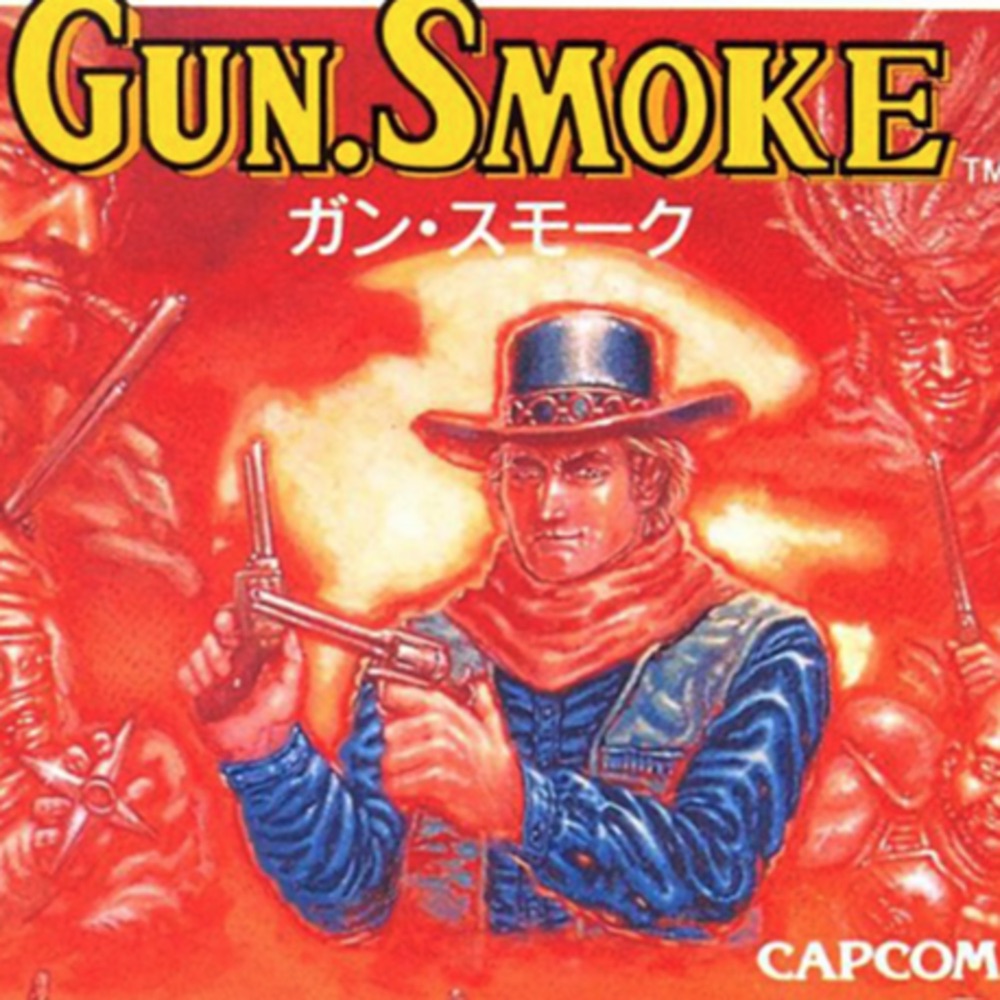
093 · GUN.SMOKE
New to SHMUPs? Read our guide: How To Enjoy SHMUPs →
Ranked #7 in our Top 10 NES Games of 1988 →
IT'S HIGH NOON. YOU'RE ALONE. YOU'RE QUICK. OR YOU'RE DEAD.
It's a bad day at Hicksville. In Gun.Smoke, you're lightnin' quick, gun-totin' Billy Bob. Come home to find your peaceful mining town overrun by no-good varmints. So you'd best be gettin' to work.
Gun.Smoke is a shmup where you are a cowboy, not a spaceship: a lone gunman walking into Hicksville to take down the Wingate gang. We expected another Commando and came out calling it one of the most fun games we'd played on the NES so far. It was designed by Yoshiki Akimoto, the 1942 designer, and it looks like he learned something.
What works
- Two buttons, three directions. A fires diagonally right, B fires diagonally left, and both together fire straight ahead. Needing two taps for straight fire felt awkward to some, but it turned the game into bobbing and weaving, with diagonal fire for 65 to 80 percent of one playthrough.
- Points are money. Kills fund a general store run by a man (weapons) and a woman (ammo and extras). It gives a shmup a reason to kill everything, and the first shop shows prices you can't yet afford, so you start saving.
- Guns with personalities. The machine gun is a built-in turbo button, the Magnum pierces a whole row of enemies, and special guns run on limited ammo. The smart bomb eats a hit that would have killed you and wipes the screen, which is great against bosses.
- Ground that matters. Bridges, rivers, rocks, fences and cliffs shape each stage, and enemies react to you instead of marching in patterns, so we couldn't tell if it was even on rails.
- Bosses about timing. They aren't brutal, but each has its own cycle. The twin Wingates finale, where the second pops up the moment the first drops, was a fake-out we hadn't seen.
- Polish. The music sounds like Western music, the art is clean, and the opening story scroll has a rider slowly approaching in the distance.
What doesn't
- Wanted posters. You need one per boss, and you either buy it or shoot an empty patch of ground until it appears. That felt like a cheat, and finding a later poster early lets you skip the grind for the next few stages.
- Enemies from behind. From stage four they appear at your back, and you can't shoot backward. We disagreed on how much it hurt, but we agreed it was a gap.
- The loop. Miss the poster and the stage restarts. Staying in the flow hid it, but it hurts replay.
- Ninjas. Nobody could explain them in the Wild West.
Beyond the game
The manual is thorough, with wanted-poster art and names for every boss and stage. Capcom said Gun.Smoke inspired its early Red Dead Revolver, which later ended up at Rockstar. The Amstrad CPC port was renamed Desperado and got a sequel. The NES version has six bosses against the arcade's ten.
The bottom line
Essential. The episode vote was split: Sean and Joe loved it but called it Play it (Joe's "golden play it"), Sam's mailed-in vote was also Play it, and Mike voted it Essential after it dethroned Stinger as his top-ranked NES game. Under the majority rule it missed the list that day, but it was added later in the Best of 1989. Mike's case: a hidden gem, essential on the NES even if other shmups beat it today.
Written from our conversation in this episode.
- Back of the Box
- Manual
- Introductions
- Captain Commando Challenge is still around
- On Rails Shmup
- Tales from the Manual
- Very detailed! Names of enemies, towns, refers to the inventory as a general store
- In 1849, the Wingates attack the town of Hicksville, kill the Sheriff, and cause trouble every day until Billy, the main character, comes to town (with a sunset behind him).
- Gameplay
- On-Rails vs Commando Style
- How you shoot
- A.I
- Inventory
- The Horse
- Wanted system
- Was hiding them in hidden spaces the best route?
- Does inflating their cost add anything to the game since it’s just a loop
- Stage Design
- Boss Fights
- Psyche out final boss (technically)
- Only six of the ten bosses were in this version (Master, Ninja, Cutter, Wolf Chief, Los Pubro, and Fat Man)
- Repetition
- 1942 and Commando
- Yoshiki Okamoto
- Creator of Street Fighter II
- But also 1942
- Red Dead Revolver, the first game in Rockstar Games' Red Dead series of western action-adventure games, was originally developed by Capcom as a spiritual sequel to Gun.Smoke, before they dropped the project which later got picked up by Rockstar Games.
- Sequels and Spinoffs
- The Amstrad CPC as Desperado – Gun.Smoke; this platform actually received a sequel called Desperado 2
- EGL
Found automatically from the transcript and checked, but it can miss things or pick the wrong page. Spot a mistake? Tell us.
Games
- Gun.Smoke mentioned at
Capcom's 1985 arcade western shooter and its 1988 NES port, the episode's game, with a dot in the title.
- Driv3r mentioned at
Game stylized with a number in its name, used as another example of odd title styling.
- L.A. Noire mentioned at
Detective game the hosts compare to an imaginary 'smoking gun' NES game.
- Gumshoe mentioned at
Zapper game for the NES that one host expected to be a noir style game.
- Commando mentioned at
Capcom's 1985 military run-and-gun shooter, repeatedly compared with Gun.Smoke.
- 1942 mentioned at
Capcom's earlier shooter, also by Gun.Smoke's designer and compared to it.
- The Legend of Zelda mentioned at
Used as the example of a manual that actually helps with the start of the game.
- Section Z mentioned at
Earlier NES shooter where A and B fire in different directions.
- Renegade mentioned at
Earlier NES game where one button attacks in each direction, like Gun.Smoke's controls.
- Contra mentioned at
Konami NES shooter with a spread gun, compared to Gun.Smoke's shotgun.
- Kingdom Hearts mentioned at
Role-playing game mentioned as an example of grinding for levels early on.
- Red Dead Revolver mentioned at
Rockstar game that began as a Capcom project with Gun.Smoke as an inspiration.
- Red Dead Redemption 2 mentioned at
Rockstar western, jokingly called the sequel to the Gun.Smoke line.
- Ghosts 'n Goblins mentioned at
Capcom NES game used as the example of a fake-out ending that sends you back to the start.
- Super Mario Bros. mentioned at
Used in a hypothetical about a fake-out Bowser fight.
- New Super Mario Bros. mentioned at
Mentioned as having a surprise Bowser fake-out.
- Punch-Out!! mentioned at
NES boxing game from an earlier episode, cited for giving only the control you need.
- Street Fighter II mentioned at
Capcom fighting game produced by the same person who made Gun.Smoke.
- Desperado mentioned at
Topo Soft's Amstrad CPC western shooter based on Gun.Smoke, discussed as a related game.
- Desperado 2 mentioned at
Topo Soft's 1991 sequel, a side-scrolling shooter only loosely tied to Gun.Smoke.
- Stinger mentioned at
Konami NES shooter the host ranks just below Gun.Smoke.
- Shaq Fu mentioned at
Fighting game cited in a joke about collectors buying every copy.
- Color a Dinosaur mentioned at
Odd NES game the host jokes about buying every copy of.
Hardware
- Sega Genesis mentioned at
Console whose three-button controller one host wished Gun.Smoke's layout resembled.
- Amstrad CPC mentioned at
European 8-bit home computer that got an unofficial Gun.Smoke-style port called Desperado.
Companies
- Capcom mentioned at
Developer and publisher of Gun.Smoke, Commando and 1942.
- Rockstar Games mentioned at
Publisher that took over Red Dead Revolver from Capcom.
People
- Cable (Marvel Comics) mentioned at
Marvel X-Men character, used as a comparison for how Captain Commando looks.
- Sergio Leone mentioned at
Italian director behind the spaghetti westerns, mentioned when calling this a sushi western.
- John Wayne mentioned at
Classic western film star, one of the hosts' examples of old westerns' acting.
- Yoshiki Okamoto mentioned at
Capcom designer of Gun.Smoke and 1942, later producer of Street Fighter II.
- Sam Smith mentioned at
Singer whose name matches a listener-mail writer's name in the joke.
Film, TV and music
- Shane mentioned at
1953 western film named as a good cowboy movie.
- Gunsmoke (TV series) mentioned at
Long-running western TV show whose name is why Capcom put a dot in the game's title.
Terms and events
- Spaghetti Western mentioned at
Italian-made westerns, the basis for the joke that Gun.Smoke is a Japanese 'sushi western'.
Articles, videos and sites
- Essential Games List mentioned at
NEStalgia's running list of the NES games the hosts call essential.
Other
- Captain Commando mentioned at
Capcom's mascot character, who delivers messages in the manuals of its NES games.
- Mega Man mentioned at
Capcom's NES series, compared with the Captain Commando challenge as a game you must beat to unlock something.
- .hack mentioned at
PlayStation 2 series whose title also includes a period, raised when discussing the title's punctuation.
- Hicksville mentioned at
Fictional town in the game's story, distinct from Hicksville on Long Island.
- Yoshi mentioned at
Mario character, compared with the game's horse that takes extra hits.
Auto-generated transcript. Each paragraph starts with its timestamp. Speakers are not identified.
Gunsmoke! Are you ready to climb in the saddle and accept the Captain Commando challenge?
And welcome to NEStalgia, a chronological exploration of every NES game released in North America. I'm Mike. I'm Sean. And I'm Joe. And guys, in other news, the Captain Commando challenge is still around. I just, I kind of forget that that exists. That's still a thing. 1988, here we are and Captain Commando, who hasn't even had his own game yet on the system, is just basically Capcom's mascot at this point. But I'd argue almost any other Capcom game that's come out could have been their mascot instead. It's like that whole like, why do you keep trying to make Captain Commando a thing? It's never going to be a thing. I don't understand it. I'm waiting for a Captain Commando reboot.
Yeah? Yeah. We refresh our memory. What is the Captain Commando challenge? Well, the Captain Commando challenge is just beat the game, kind of. You know, and it's like, if you look in the manual, it's always like a special message from Captain Commando. And this is for all of the games that have that. And it's just like, thanking you for buying the game. And then just like, you know, one of the, it's part of the Captain Commando challenge series. Right. So it's not a challenge to complete, compete all of those games. Like, once you beat all the games, you've completed. You get a t-shirt.
Yeah, you've completed the Captain Commando challenge. I like the idea better. It's like Mega Man, where like, you actually have to beat all of these games first, and then you send in the beating games, and then you unlock Captain Commando. Yeah. You know? I think they ship you a game that's like the final level with all of the games incorporated in some way. Yeah. And actually, now that we were talking about Mega Man, Captain Commando wasn't part of that. Right? Mega Man was just his own thing. It wasn't like part of the Captain Commando challenge. I think that maybe like Captain Commando is just Mega Man in disguise.
Okay. He's more like Cable from, not Cable TV, Cable from like Marvel. Like X-Men Cable? Yeah, X-Men Cable. He looks a lot like that, except for, from what I can best tell, he just wields guns on both hands. Like, he has no hands, he just has guns for hands. I dig it. I like it too.
One thing also we should note is that I called this game Gun Smoke, but there is a dot or a period in there. So we didn't call it Gun.Smoke. I didn't think of it like the .hack series on the PS2. I can't tell if we should like refer to it as like, like DRIV3R for Driver 3 or like all these weird like stylizations of names. I didn't realize that it started so, so early. Mm-hmm. I feel like, I feel like DRIV3R is ridiculous. I love DRIV3R though. Like that's very clear to me what it should and shouldn't be.
You know, like, that would be like saying, is it 007? You remember DRIV3R though, right? I'm just saying like, is it 007 or is it ooze? Like... No one says it. Those are the letters. Seven gets the, it's like four being the letter A. Like, could it decide these things? But it could be, is it 007 or is it just seven? Right, oh yeah, yeah, yeah. Because you don't pronounce the two O's before. Yeah, in fact, there's actually an infinite amount of zeros in front of any number. Right, yeah. That's important to remember.
Oh, excited. Is that true for even like things that have zeros after it? Yeah. So if it's like a million, there's still like millions of zeros in front of them? I mean, you know, mathematics is just a concept. So, I mean, if it virtually has zeros in front of it, then it doesn't matter. I boomed ya. Okay, cool. You boomed me and now I'm going to boom you with a fact.
We are playing another shmup, but this time you're not a spaceship. Wow. Yeah. What are you, Sean? You're a cowboy. Yeah, you're a cowboy in the wild west. It doesn't sound like it translates, but... Yeah, this is what I called to the guys earlier this week is a sushi western. Yeah, I love it. Because for those of you that don't know, spaghetti westerns and all that with Sergio Leone. It's kind of weird that the Japanese have chosen to make like a very American focused game here, but I welcome the variety in shmups. Yeah. I mean, it does make sense. I mean, westerns are popular everywhere.
And you still see movies that sort of incorporate western into it too. I'll admit it, I like a good western. Even old westerns like from the, from as far back as the 40s and 50s. Like I watch those movies as more like a guilty pleasure because things are just cool. The plot sucks. The acting is pretty bad. John Wayne's not a good actor. Don't at me. And like all these things are happening. I wonder what the crossover for that is. Yeah, I just like the, yeah, please now let me know if you actually like John Wayne and I have a fact. Shane's the only good cowboy. Yeah. Okay. That's true. Shane's a good cowboy flick. Shout out to Sean McLaughlin for showing that to us.
Okay. It took me a second. Yeah, it's getting all over the place here. But I was just saying that I really like the aesthetic of the Wild West. No, I dig it. So I welcome Gunsmoke.
But did anybody watch the Gunsmoke TV series? Never. No. But it's not related, right? No, it's not. But I imagine that's why they had to put the period in it. Oh, yeah. Forgot, right? If you just call it Gunsmoke, you'll be like infringing on copyright. At that point, they might as well just put an extra space. We wouldn't even have noticed. An extra space between Gun and Smoke. Does that count? That makes sense, too. Or was Gunsmoke one word? It doesn't matter. What about smoking gun? But that's also a thing. Yeah, that's actually, that sounds like an L.A. Noir style NES game. Yeah. That's what I thought gumshoe was supposed to be. Right, right. You were really looking forward to that.
So this is an on-rails shmup. But to be fair, I think everything has been. It's a shmup in every way except for like some control differences. Yeah. And a new coat of paint.
But like, you know, this game sort of has, it looks like Commando. Mm-hmm. Yeah. There is definitely like a Commando meets 1942 vibe going on here. Yeah. Except it's better. Yeah. I will say it, I also think it looks better than both. Like, I don't know if that's what you meant by looks, but I think like aesthetically, art-wise, it looks much better than both of those. Yeah, I meant it like, whereas you are controlling a, you're controlling a person.
Right. Top-down, shooting at people. Top-down, shooting up sort of thing. Yeah. Well, yeah. And we'll definitely get into all of this. I actually mentioned those two because those are Capcom games. That's true. So they do come, even in the arcade versions, they come before this. So this is clearly like a, let's look at our catalog to get. Take what we learned. Yeah, take what we learned and we'll see if they learned anything later on. But before we get into gameplay, we should do a little Tales from the manual.
The only, the only thing I really wanted to mention outside of the plot, which I think we should get into because that's always fun, is just like the level of detail that has gone into this manual to give you like a level of awareness of what you're doing in a game that doesn't tell you much. Like, you get the names of all of the enemy bosses, you get the names of the like locations for each stage, you get the names of every single enemy. I just, I like this level of comprehensiveness that we usually only see in like Nintendo NES manuals. Right. And it's funny because before this podcast, it seemed like that's just a given. Put that stuff in the manual.
Right. That you should just, that stuff, information should be available somewhere. So it's weird that it doesn't show up more often. Yeah. And I even like the art too of like the wanted posters. Yeah, the wanted posters are cool. Um, I, I think that it's not even close to being like our most like ludicrous manual. Oh no, I still think that kind of goes to like Legend of Zelda for just like really covering like how to do most of the beginning of the game and like having a. Oh yeah. You mean in terms of actual usefulness. Yeah. Okay. So I meant more sort of like a, like a scoon. Oh yeah. Yeah. Where there's an opera inside of it and everything like that. Uh, Sean, do you want to walk me through the Gunsmoke story?
So in Gunsmoke, uh, you are a, uh, you know, a lonesome stranger that walks into town of Hicksville. Do you remember the name? Billy Bob? Billy Bob it is. Okay. The fearlessness Billy Bob. The, the, you know, you have the fearlessness of Billy Bob. I don't know. Wait, are you Billy Bob or do you just have his fearlessness? Yeah. You just have his fearlessness. Well, you technically just have his fearlessness and he is Billy Bob. You're the player. You're not like possessing Billy Bob. You're more like watching it. Okay. As you're playing it.
Um, well, you know, uh, when he gets there, uh, it, it seems that some, some bandits have taken over, um, by the likes of, uh, Bandit Bill and Cutter Boomerang and among others. Yeah. The, the big names being the Wingates. Yes. Uh, those are the, uh, I guess like the mob bosses. Yeah. What do you call those guys in wild west? The gang. The gang gang.
The Wingate. The Wingate clan. I don't know. And they attack the town of Hicksville, but not the one in Long Island. Is that it? There's a Hicksville in Long Island. I just don't want anyone to think that's under, uh, under discussion. Yeah. It's very far west. And then I don't know where I got this information from, but, uh, during my research of the game, I also found out that it takes place in 1849. Well, it's very important. Is that mentioned in the, in the manual?
Well, you know, because Hicksville was a ghost town in, in 1850. So, after all the senseless killing that Billy Bob does in this game. Well, I think those are the bad guys. All Billy Bob has done is delay the inevitable by six months. Um, so you really are just fighting a losing war in this game. And you should know that, um, if you, if you, if you read your history. But anyway, so you, you, you do all the killing and, uh, then, you know, when you win, everybody loves you.
Yeah. Okay. Fantastic, uh, description of the game. I'll add that, uh, the, you know, kind of the objective of this game is to, uh, walk through the levels. Yeah. Kill, kill, kill. Kill. Walk through the levels, find the warrants to produce the bosses. It's not a warrant. It's a wanted poster. Oh, okay, okay. Sorry. Because you don't want to kill the wrong person while you're indiscriminately shooting at everybody that you see. Right. You know, and I don't know why, but all week I've had warrant in my head for this game. You may as well still see the warrant. It's always said wanted. So I feel like I either have a warrant out for me or there's a warrant out for somebody.
But yes, you collect the wanted poster, uh, which has it at the, it, at the beginning of the level, it shows you like a pretty detailed picture of who you're going after. Right, that looks good. It's got his name, it's got his weapon. Yep. So you have to track down that wanted poster and then once you do, the boss will produce himself and you, if you can take him down, uh, that'll clear that poster and you'll be able to move on to the next stage. Uh, however, if you don't, uh, find the wanted poster by the end of the stage, you just wind up back at the beginning. It's a never ending town. Yeah. You can buy it too.
Yeah. You can buy it. In fact, I bought most of them before I realized you can find them. And then I was like, Oh, this is, but yeah, that's another, that's a completely new mechanic as well. Yeah. It's the general store. Yeah. And we'll, we'll talk about that. So first let's just talk about how you shoot. Joe, what makes Gunsmoke's, uh, shooting mechanics different?
So it's not completely unique. We've seen it, I think twice before. Once we liked in section Z where the A button shoots to the right and the B button shoots to the left. And then we saw it in Renegade. Is that what it's called? Well, Renegade was like that. Yeah. It was trying. It's not a shmup. Yeah. You punched with one, kicked with the other. But you attack in one direction with like context. With A and the other direction.
Yeah. Which it didn't do well because it had the whole punch kick thing. And this time similar, A shoots to the right, B shoots to the left, but still in front of you. So on a diagonal. Yeah. So you can shoot to the left, to the right, and A and B together shoot straight forward, which I really liked. I think they pulled it off well. See, this is something that I was sort of of two minds about because I was always hoping that they would find a way to do this. Um, and you know, A and B together does make sense.
Like it's, it's a logical conclusion you could draw from like the control schemes, but it seems a little too much for you to do just to shoot straight. It seems weird to me. I thought that initially, but as while playing it, I never had a, I never had a problem. It actually, I mean, I got to it at that point. Yeah. I mean, I'm on the Sean side on this because I think it, you know, based on how I played through the game, a lot of the game is actually straight shooting, which requires two button taps, both A and B at the same time.
And yes, you're still, you know, use the diagonals to your advantage, but if you're using those less often than the main thing, that means that you're usually pressing two buttons instead of one. And so it's like, I almost wish that it was like a Sega Genesis style controller where there's A, B, C and B would be right. That would definitely be preferable, but I didn't annoy me. I'm not saying like it's, it doesn't even lose a point. But to Sean's point, if you're looking at like, you know, the flexibility of the controls themselves, it is a bit annoying that the most dominant thing you have to do in the game is tap two buttons.
See, I see what you're saying, but I disagree that that was, for me at least, I think I fired diagonally 65% of the time, like way more than maybe 70% of the time I was firing diagonally. That because it was so ergonomically unfeasible for me to like hold down both buttons, I know that like, like what am I, a child that can't hold down two buttons? Regardless, because it didn't feel right to me, I ended up probably shooting diagonally 80% of the time. And it almost gave it like a different rhythm to the game because you're trying to bob and weave instead of just like in front of people.
So, I don't know, like it was kind of a weird blessing out of a janky mechanic. There's a lot of dodging involved in this game. And I feel like because of that, you're back and forth on the screen a lot. And I felt like for that reason, I was shooting diagonally way more than I was shooting. Shooting forward was like, oh, this guy right in front of me, like hone in on him this time. But for the most part, I felt like I was shooting diagonally. Shooting straight forward actually becomes a lot more valuable too once you start using the additional power of weapons that you require. Yeah, the Magnum, the spread one.
That was really good. The machine gun. Yeah, the machine gun. I thought those things, you know, definitely used it too. The kick-ass. The spread one is the shotgun, right? Yeah, okay. Which is weird, right? Shotguns don't really do that. Yeah, they do. That's what every shotgun in video games has ever done. Oh, damn. Really? Like. But it's just not quite as visible. There's not slow bullets spreading out. Right. That's what I'm thinking of. It's like slow, like producing three different bullets. I feel like this is one of the early times in like in an NES game we've seen a shotgun where we're seeing all the bullets, right? I mean, we just saw that in Contra.
Well, yeah, but that was called like a spread. I didn't necessarily. Well, it was basically a shotgun. Got it. Okay. And S could stand for shotgun. So who am I to judge?
All right. And then since we're talking about just like basic mechanics, there's also, you know, like a stage design thing that's worth talking about here because since you're on rails, in most like shmups that we've played, there aren't really like obstacles. There's just enemies in the way and you have to just, you know, take down the enemies or else more keep gathering on the screen. In this one, there are like, you know, set pieces that you cannot, you know, you can't just like be. There are cliffs you have to walk through.
There are bridges you have to walk across or wade through the water, which I think slows you down. Yeah. It felt like it at least. It slows you down. But even just like there's trees in the way and like those or rocks. Headstones and buildings. There's even at the beginning, there's some like fences, I guess, that you can use as cover. You can stand behind them. Bullets won't hit you. You can shoot over them.
Yeah. I was doing it. Oh, I don't think I think I was able to do it from like a distance. But as I got closer to the fence, for some reason, it didn't work. Really? But I was using just the basic weapon for that. This is a thing I remember.
Really? I hope so. But no, no, no. Because I remember to think like I went through the same thought process of like, this is really useful. Like you can shoot over the fences. But then like as I got closer, for some reason, it just didn't work. See, I found the opposite. I couldn't shoot from a distance because sometimes enemies were right up against them. And when I would shoot, it wouldn't hit the enemy. But then when I was close, I could shoot over. See, I found the opposite in which like I couldn't shoot at all. And all the guys just kept shooting me. It's funny that the fences were shooting me out of their gun.
So in the arcade version of the game, though, the stage design matters even more, actually, because if you, as the screen is auto-scrolling, if you are behind like, let's say, a tree or rock or anything in the game, it will crush you. You know, even though it doesn't make any accurate sense.
It would just like, it would be the end of you. In the NES game, that's just not true. It warps you like over a little bit. That at least makes sense. Whereas in the arcade game, it's saying that like this is a void behind you and you have been sucked out of existence.
Yeah, they left that plot detail out that there's actually like a tornado behind you. And that's why the screen is scrolling. And so what did you guys think for the stage design as like in terms of actual placement and design? Like, I don't, I'm not saying like it was random or not thought out, but it also didn't feel like it had any necessarily like, oh, we got to put a tree here because enemies are
coming down this way and this will be a good approach for the main player to work around. Well, I think it does help in, at least in variety, for variety's sake, in that there are different patterns coming at you. I mean, usually the game sort of defaults to, I'd say that at least like 40% of the game is sort of open, open prop, like an open field with maybe a couple like trees around.
But then you will get into like the bottlenecks of, oh, there's a set piece where you have to cross the bridge. And so I think at least it gives it a little bit more texture as opposed to other shmups, which are just enemy patterns they have to worry about instead of what the actual ground is. Right. And each actual level is different enough that that kind of variety is cool. I really liked the valley level where the guys are with the snipers at the top of the areas are like shooting from the sides at you because you can still get them, but they're kind of like hiding in like these caves or something like that. They pop in and out. Yeah.
And then there's even, is it Death Mountain or something like that is like the second to last stage. And that one is really hard, but there's, there's some cool like motifs there with like what's accessible to you versus the enemies. There's a lot of guys jumping around on the mountains.
Oh, ninjas. Yeah. That's a whole nother story. We, we, we can talk about the AI in general though. I actually have one more thing about the, this is something about placement in the levels. I'm not sure if it was intentional, but, but later on in the game, their enemies start coming up behind you. And it was then I started noticing there was a lot more diagonal cliff walls coming from the back that you could kind of use as like almost like a reverse cover to get away from those people. I did notice that too. I'm glad you brought that up. I wasn't sure if that was like intentional because it seemed very useful to me. I, I just wish that it, because you have no way to shoot backwards, I wish that they didn't do that.
Um, but I, it must've been intentional because it seems that the levels in which it's more prevalent, uh, are designed for you to keep cover from them at least until you can get behind them. Right. And, and now that we're talking about the enemies, what did you guys think about like their AI or like how the, the variety there's, there's a lot to discuss here, a lot to unpack. So feel free to just say whatever comes to mind. I think there's plenty of variety in it. Like it, it, for, for a shmup, I mean, we've, we've had shmups with probably more and definitely had shmups with less variety.
Yeah. But, um, but you know, there's different enemies that take different amounts of hits that shoot different types of weapons. We were talking about there's people off to the sides firing arrows and there's people who throw bombs and there's all kinds of things that you have to think about as you're playing that you kind of change the way you navigate. And they don't seem to be quite on rails. They, they, they will follow you and they'll try and react to you, um, as, as simple as it may be. Right.
We, we don't see, we don't see any of that. Like the, the enemy misses you and just keeps walking the color off screen. Like what was their, what was their mission? Right. Which I prefer in this kind of instance, just because, you know, a lot of times we argue for like purposeful enemy placement, but I, I, I think the way they enter the screen is generally about the same, but depending on where you are, how you control. It's a different situation. Yeah.
They might change around the situation, which is, which is better off than just saying like, this guy is like a football player. He's going to go up and then he's going to juke and then go right. You know, it's like an exit stage. It's like, that doesn't really make sense in, in this kind of thing for even a ship. I can understand that kind of logic of like the ship is going to do this maneuver and then leave the stage.
Well, like a classic, you know, spaceship smup is, is much more focused on patterns than this one is. I feel like, I don't know if it was intentional or not, but I think just the, the, I guess patterns in which the enemies come towards you are much more random and you have to be more reactive instead of recognizing a pattern. Yeah. And it felt like enemies could leave from the top of the stage and come back in, which I thought was interesting.
The idea that, you know, like it's keeping track of them when they're not, yeah, that even though they're not on the screen, which I'm, which I'm not even sure is entirely possible. So maybe it's just like a trick that they're doing where it's not entirely true. Because each, well, cause each enemy only takes one hit to die with the exception of like a couple of regular enemies. Most enemies just take one hit.
But, but what I'm saying is, is like the guys who would have like the shotguns or stuff like that, like they would enter and they kind of do like a walk around in a circle. So maybe it's, maybe that kind of thing is programmed where like when they come in, they leave a certain way and then it's timed where they'll come back around the other way. You know, like regardless, it is, it is enough variety of, of enemy situations that we are having trouble figuring out if it's on rails or not. So yeah, right.
It's a, they did a pretty good job in terms of that. Yeah. The one enemy I was not a fan of it. I'm, I'm guessing based on the manual here that he's the stabber and that's the guy who just like, he jumps from like anywhere off from the side of the screen and then just like lands. Like he's like planting a sword in the, in the like dirt, you know, not purposeful at all. Not like coming. There's no homing at you or anything like that. He just does that. He jumps again.
He lands. Oh, right. And then he jumps again and he's off screen. I'm not even sure at this point after playing through this whole game, I'm still not even sure. Can you hit that guy? Yeah. Of course. He would always just be, he is doing what I was saying before, just walking through and then walking off screen. You're like, where's he going? Don't mind me. I'm just stabbing rocks.
You can kill him. I've killed him many times. You can, you can kill him, but I'm relatively certain that, you know, unless you're using like turbo that you're going to need one of the special, yeah, one of the specialty items will take care of him. You, you can't, uh, realistically hit him the number of times it takes to kill him. He's one of the enemies in the game that takes more than one hit. Uh, you can't kill him fast enough with just your regular gun to like, before he jumps again. Yeah. And he's not worth it, but he, I think he has more points than others and points are going to become valuable in this game. So we'll talk about that. We'll be right back.
So points in this game actually like become currency, which is nice to see because we don't care about high scores or anything like that. Uh, it's just in the top center of your screen and you know, you have to kill a lot of people. A lot of enemies to, to accrue points. And then you bump into like townsfolk and there's like a man and a woman and they just kind of repeat, but they're sometimes offered different things than the first time you saw them.
Is that right? Well, I think that, uh, it like the, the dude always seemed to offer me weapons and then the lady seemed to offer me ammunition and other miscellaneous things. Gotcha. Okay. And, um, the, the one thing about the point system here though, is that sometimes you, uh, especially early on in the game, you get to one of the townsfolk and the idea of buying things is introduced, but you won't possibly have enough points to buy anything.
I think that's actually like a smart thing to do. Yeah. I think that if you're exposed to like, Oh, I can do this. And, Oh, this is what these points are for now. Yeah. You know, immediately to start saving up. Yeah. Right. And I also think that, um, you know, because you don't have any specialty items yet because you run into the woman first, she's offering you ammunition and it's like, that's not really clear what that's for yet. Uh, and even though it's the cheapest item, you can't go ahead and waste your points on it just yet because you don't even have the funds for that. Yeah. But it's all, it also introduces decisions already of like, Oh, do I want to save up for, uh, the, the machine gun or do I want to dump what I got now on the shotgun?
I, I, I always like when you have that amount of choice in a game like this. Right. And, and for a shmup, it's cool to see it use the points in this way because it gives you much more incentive than I felt in any other shmup we've played to kill things. Except, yeah, yeah. Yeah. Really. Other than, it's usually just stay alive runs for me, but now it's like, I need to kill everything to get as much money as I can. That's a great point. Because I need to keep buying things. Because there are at times a lot of enemies on the screen too. So you'll want to just like take out as much as you can. You know, you almost come off like bloodthirsty.
Right. Because like, and when there's a few times where I'm like, I'll just let that guy go. I'll just pass this guy. I'll get around that guy. But like in this game, I'm like, no way I got, I'm going to get as much rack up as much as I possibly can. And now how did you guys feel about, uh, enemy point values compared to, uh, what things sell for in the shop? Did you find it fair or did you have to run through a stage a couple of times before you could afford the big ticket? I couldn't even, I wasn't paying attention.
I just was, I would, I would go to the man or woman every time and I would, then I would be aware of my score and then I would budget accordingly. But I was never actually like, I wasn't monitoring it as I was playing because I, I didn't, I couldn't split my attention like that. Yeah. It's almost because I'm, I'm wondering, you know, there's the, the whole wanted poster, which is always the most expensive item in each level. Uh, there's that where in certain stages it's as much as like 50,000 points. Yeah. And I guess like, you know, does inflating their cost add anything to the game since it's just looping the same level again?
If you, if you don't have enough points. I didn't think that the cost of those were too bad though. Cause I, like I said before, it feels like I played this in a little different way than you guys where I bought most of the wanted, wanted posters instead of finding them. So I, I was thinking about that every time I went to a shop, I was like, okay, do I want to buy this new weapon or should I just save it for the wanted poster?
And playing it that way, there were one or two times where I felt like I had to loop around again to get, to buy the wanted poster. But for the most part, I felt like I was, I was racking up enough points that way organically. Got it. I never felt like I looped a stage more than three times, but it is, it is a little frustrating to, to notice the loop too. There, there's a lot of nice set design things that we talked about and enemy variety, but you very quickly, I think even as soon as I would loop the first time in a stage, I noticed, I was like, I'm just back where I started. Like, this is kind of weird.
And I just wonder if they could have maybe thought about, you know, like, well, you know, we have to make the points worth this kind of thing to make sure that the player has this amount by the first. Yeah. I mean, I guess, I guess that's your experience. I guess I was too much into that state of flow where I was just, I was just idly focused on crowd control for the most part that I wasn't really noticing these loops. Got it. So the repetition of the loops doesn't bother you in this particular game. In this case, it did not. I didn't notice the loop at all either.
I mean, I knew it was looping, but I was never like, like maybe if it was the level with the bridges over the water, I'd be like, oh, that's weird. Another river with bridges over water. But I don't think I looped that far in that level. Got it. The other levels, I don't remember noticing any repeats. Okay. Cool. Which I'm sure there were. I just didn't notice. Yeah. No, no. It definitely happens, but I'm not, I'm not actually saying that it bothered me either. There, I think it's just something to keep in mind for like, you know, replayability of these, of this kind of game.
Like, you know, how many times do you want to deal with going through the same loop over and over? And then we also have with the inventory, you can buy at the general store, you can buy the machine gun, the shotgun, the napalm bomb. I, yeah, I never got to use that. I don't know. The napalm bomb, is that what it is? It's something bomb. Yeah. Smart bomb, right? Smart bomb. Oh, smart bomb. Smart bomb. And, um, it's not the napalm thing. The eye bomb. Napalm is contra. That's what I was thinking of.
Um, it's the magnum. Yeah. Oh, yeah. Yeah. It's the only other thing. Um, I don't think there's a napalm bomb in this game. There's no napalm. It's just a big bomb. Something bomb. The smart bomb is really cool though. I didn't know how to use it. Oh, so here, here's the thing. You're so good at this game. That's why. You, if you select it, the problem is, is that when you, when you select most items in this game, you start using them immediately.
When you select smart bomb, it, it has it selected, but you go back to using your normal gun. Yeah. Once you take a hit, it automatically, instead of registering as a death, registers the bomb to go off and takes out everything on the screen. Oh, that's cool. I mean, I would not say that I was that good. I just real, I just like would select it and then immediately unselect it when I didn't notice anything. That's what I figured.
Breaking news. Yes. It is the napalm bomb. There's no smart bomb? In the manual, it says napalm bomb. I think in the game it's called smart bomb. It definitely said smart bomb in the game. Yeah. Okay, cool. That, this is driving me crazy now because I feel like, where am I in regards to Contra time? Uh, which was a great game. So, no wonder I'm thinking about it.
But then, uh, the reason why I like the bomb, uh, smart bomb so much is because when you're fighting a boss, it seems like a really valuable thing to have because sometimes, you know, with the additional enemies that enter the screen while you're fighting the boss, you're bound to take a hit. Yeah. And so, it felt nice to just kind of like, not only get an extra, like, life, but also, like, get everybody off the screen and go back to just fighting the boss. So, smart bomb was appreciated.
Yeah. I also really appreciated, as we talked about earlier, the shotgun and, uh, the machine gun was great because it is like having a turbo button. Yeah. There was a, there was a point when I was not feeling the machine gun. When I first started using it, like, with a lot of people around and I was like, that was fine, but I was just as good with the, uh, without it, like, just rapidly pressing the fire button.
But then when it got to the bosses, that's where I thought the machine gun was, was really helpful. Totally. And, and, you know, we didn't talk about this, but there, there's limited ammunition on these special guns, uh, which I think is really cool because in most games you get the power up and you just get it until you die. And then you, you know, you go back to using your normal gun.
In this one, you have like a limited amount of ammunition. And then if you use all of it, you can't use that weapon until you collect more ammunition. It's cool. But you have the weapon that you bought forever. You have the weapon, but it would be cooler if you could monitor it while you were using it. I would have appreciated like something in the bottom right or left. Well, that's just unrealistic. Yeah. I know. No, I don't think it is actually though. I think I can't see a reason why if they're, if they're able to display.
No, I know you're joking. I mean, unrealistic in like you, like you can't do that with a real machine gun. Yeah, I know. But like the numbers, you know, are already up there. It doesn't seem like, you know, if they just even had like just a gun with like gun equal, you know, like a gun symbol equals. And then like when you have the normal thing, infinite when you have, you know. I would like to backtrack a little bit. Sure. Regarding other items that are not things that you buy from the general stores.
There are boots everywhere and then there are rifles everywhere. And I'm not really sure what they, what they do because they are not listed in the manual. I'm going to take you through it. Okay. This one I did look up because I myself was curious. There is a cap to this until you die. But when you get the boots, that increases your walking speed around the screen. And when you get the rifle, that increases how far your gun will shoot. Okay. Which is very useful. Yeah. So like if you, I think it's up to three. So like once you get the third of something, you can't go any faster or shoot any further. Yeah, I guess I've never noticed.
But you'll notice that, yeah, all enemies do not have the rifle bonus because all enemy projectiles will like eventually hit the ground or something. Okay. Oh, okay. You know, like. Yeah, they do stop. They just stop. They disappear. So I imagine they just like. They're all using muskets. Yeah. Just drop the bullet. Like where did that bullet go? No, don't worry about it. Hit the dirt. Yeah, because I think the only reference to it in the manual, these two items, is the fact that if you pick up the skull, it reduces the value to both of those. And I kept picking them up thinking that they were like some kind of score bonus.
Right. And I thought that the skull and maybe it does this on top of all of that. I thought it also like reduced your ammunition a little. Yeah, I'm not sure. Yeah. The skull thing for what it's worth. I thought it was cool. So I was collecting them for a while.
You know, I was like, oh, sweet. Like maybe this is worth 500 points or something. Like who knows? Because, yeah, you know, there's something about like this game taking the time to like demonstrate certain concepts while just like abandoning other ones altogether. That's just kind of weird. Like even the ammunition thing. Did you guys ever actually run out of ammunition on anything?
I ran out of the ammunition on the machine gun. The machine gun makes the most sense because that's the one that you just kind of like once you have it, you just hold down. I never even purchased the Magnum. You never purchased the Magnum? Well, because I didn't start really using the power ups until later in the game. And then I was using the machine gun and the shotgun. But like I said, I was still buying these posters. So I was just like, I'm fine with the machine gun and the shotgun. And with the Magnum, I hear, is pretty good.
So maybe I would have benefited from it. That's good for boss battles. The Magnum's great because especially also though in the last two stages when enemies really go all over the screen because the Magnum goes through enemies. So if there's three guys behind that other guy, it'll take out all three of them in one shot. So that's why I think it's really good for like shooting straight because you can kind of line up everybody and then just shoot them down. Maybe I'll go through and do a Magnum playthrough. Yeah. Magnum only.
And, you know, I just think like there's enough variety in those three guns that like, yeah, sure, you can add more guns to buy and stuff like that if you want. But I was satisfied. Yeah. I think this covers all the bases of what you can do. Yeah. And I'm not expecting like a lot from this game to begin with.
I almost never hear it get talked about. I think it's like balanced enough where like if they added more, there's a good chance there'd be some unnecessary things in there. Yeah. What would they have added to? Like, like I can't I can't even think of like another gun that would like a laser. No. Yeah. No. A katana. Oh, that's true. Because we need to address this right now. The ninja in the room that we're not talking about. What are ninjas doing in the Wild West? I don't know.
It adds some variety to the enemy behaviors. But I don't think that the enemy behavior couldn't have been applied to some other kind of Western archetype. Yeah. There's also like the yashichi or yashichi that you pick up. The one ups. Yeah. It gives you an excellent. But it's like we couldn't think of any like Western symbol. I couldn't have put like a like a cowboy hat. Yeah. Or a shoe. Yeah. Fedora.
Fedoras and cowboy hats are not the same too. I think that's worth mentioning. I don't know why you would say fedora in the first place. No. Because they do. I think they look close enough. Do you though? Well, no. But other times. I've seen people wear cowboy hats. I've seen people wear fedoras. To be honest. People with cowboy hats on look much better than people that wear fedoras. I'd say they're both pretty embarrassing. Well, depends on where you live. That's true. The last thing in the inventory that we forgot to mention is the horse.
You know, that you like ride. Yeah. You're saying it like it's bizarre. Well, no. I think like it's nice. But it's also like kind of weird that like it pauses gameplay for a second. And like this horse just kind of like you grow on top of it.
As silly as it was, I liked that. I liked that it was like. It's a little clip clop coming up to you. And it was nice. It's no more ridiculous as these people just standing in the middle of a war zone. Just ready to sell you a wanted poster. Yeah. That's true. Right, right. Or just the quantity of enemies. Like if you think about a Western, when they're like, the gang, you know, whatever, the rough gang is here. It's not like 100,000 people running through the city like raiding everything. Right, right. In fact, where are the innocent civilians that like you need to protect? They were all in those buildings in Hicksville. Like, you know, they were taken hostage. Yeah, at the saloon drinking their soldiers away.
Sean, you mentioned the wanted system, which is something I definitely think we have to start talking about, considering it's the main mechanic in the game to progress. Do you want to walk us through that a little bit? Sure. So wanted posters are basically a key item that you need to progress to the boss battle,
even though you may have just run across the boss by shooting everybody indiscriminately anyway, but in the game, like if it serves as, you know, you need to accrue this amount of points or just find it lying on the ground while you're playing before you can fight the boss. And, you know, you get to fight the guys in the posters from the manual now. And was hiding the wanted posters like really the best course of action here? I don't know why there are two ways to go about getting them. I think it would have been it would have made more sense to me to to make it that you have to purchase it, at least in terms of actual, you know, challenge.
Right. And also just the fact that they're not hidden in the barrels that everything else in the game is hidden in. They're hidden in like empty spaces, like things that you actually would have to just blindly shoot at. I didn't know that. I just saw them pop up because, again, I'm just crowd control. I'm not really focusing on any one thing. And I would see it on the ground and I'd pick it up. But I thought that it was I thought it was in a barrel.
Yeah, it's tricky because the very first stage does lead you to believe that because it appears there's an empty space right above two barrels that it'll appear in. But later stages, it actually is just like no better than just hopefully they put enemies around where this empty space is because it also, you know, I don't know how true this is. But the manual says it takes eight shots to reveal the the wanted poster. I never felt that way. But I felt it took just as many as a barrel. So maybe like two or three.
But when you're doing that, you know, why hide them? Why not put them in the barrels or make some kind of like, you know, go make a loop around this tree and, you know, like, I don't know, like something more creative than that. Otherwise, you know, like the best puzzles you can do in a in a constantly scrolling thing, you know, I'm just saying, like, maybe there's some more purpose to where the wanted posters are. Maybe you actually like find them posted up somewhere, you know, you can grab them. Yeah. Maybe they're like hard to get to, but you can see them. And it's like a risk reward thing.
And I think that like, you know, it's either that or just leave them to be bought. You know, it almost feels like a cheat when you when you find them in these empty spaces because you're it just kind of appears and you're like, well, the wanted poster. I almost paid for that. Exactly. It's sort of like in I mean, it really isn't the same, but it gives me the same kind of feeling of dissatisfaction when like these remakes of Final Fantasy games, just like you just just pick what level you want to be. And it's not quite that, but it's like, well, then why? Why would I go through the trouble?
Yeah. Not to mention that if you find one of the later wanted posters by accident, which I did in stage four, I think. If you find that the rest of the game is pretty much just like make sure you survive because you now by skipping a stage that requires a ton of points, you'll now have easily enough points banked to afford the next one. And by the time that the sixth one is due, you'll have the points for that one, too. You won't have to shoot down a ton of enemies and crowd control, you know, stuff like that. Right. So, you know, before I started thinking of it and you can find these wanted posters, I actually thought it was interesting.
Once I'm on stage four, I started thinking, you know, I could play through this again. And there's like another way to play this game where you grind in level one to get a lot of money. Like, that's just like it's just like it's interesting to me that there's that option in such an early game. Yeah. This is the kind of thing I do in like RPGs now or like that I've played before. I'll go back and I'm going to get to level 30 in Kingdom Hearts before I leave the island or like. No, it's true. But to your point, too, it's like and I did do this.
I grinded in the first level to at least have one power up weapon. Like I made sure that before I got the wanted poster, I picked up like a machine gun or something. Right. You know, even though I would have gotten the wanted poster faster if I just would have bought that out. But you could even like take this easier level one and get enough money to be able to purchase the next five wanted posters and then just blow through the next five levels.
Right. Assuming you can live through them. Yeah. That's true. It would be easier to do than trying to buy the wanted posters in those levels. Absolutely. Or trying to find them in those levels. Yeah, that's true. They're very hard to find. And I didn't I didn't love that. But I also didn't love that starting in stage four enemies appear behind you. Yeah, we sort of touched upon that.
I don't know why this this keeps happening in these games where you can only shoot in one direction. And I get that it's a challenge, but it gives me more frustration. Than anything. Yeah, it's definitely a flaw. And as soon as I saw it, I was kind of aggravated. I was like, well, this is going to be annoying. Not a flaw that it's like done like accidentally. No, no. I think, yeah, there's a flaw in like the. They wanted us to have to deal with this. It's not a feature. Yeah. But it didn't bother me as much as I thought it would. As I was playing, it didn't it never seemed to like really frustrate me while I was actually playing.
It never seemed to like I don't remember. I mean, I remember dying a lot, but I don't remember dying a lot of times where I was like, oh, those enemies weren't coming from behind me. They seemed to take. That's what I felt like the most, actually. I felt like. See, I felt that they were actually taking it easy on you when they were behind you. They didn't seem to shoot very often. They shoot a lot less. Yeah. But I even found, you know, maybe this speaks to my like a shmup abilities. I found myself just focusing so much on what's in front of me in those stages that sometimes I would just actually bump into them. And that counts as a kill, too. Yeah. You will die. Well, they shank you. You bump into them. Okay, great. Yeah.
You know, even though they don't show that, I guess that makes sense. Yeah. They would. They would kill you if you bumped into them. Hey, watch where you're going. Wait, I was going to shoot you anyway.
You know, I just find that in a game that gave you a lot of solutions with how to deal with things, it feels like almost like they left out something. Like they forgot. Like, oh, yeah, we designed those enemies that come from behind, but we forgot to give anybody a way to deal with that. Or it also could have been a case of the difficulty progression wasn't progressing quite as much as they wanted. And late in the game, they were like, let's add enemies that come behind you that you can't shoot at.
That'll make it harder. Well, maybe if you had your, like, horse, you know, he could just, like, shit everywhere. And then that would, like, you know, they'd trip on that or something. But the horse does help because it gives you, what, like, you get a few extra hits. Oh, I think three hits. Three hits. Or the horse dies and then you get to keep going. It's like Yoshi. Does the horse have, like, poop animations, too? Yes. It's like, this is the prequel to Red Dead Redemption 2. You know, it's funny you say that because the Wikipedia, the only source for information, tells me that this game played some role in the inspiration for Red Dead Revolver. Really? Yes. So I did do a little digging on that because I saw that as well.
Well, you know, here's what's tough to say. I don't like to do this in the middle of the episode, but it's the only point I have anyway before we get into the essential games list. So we'll do it right now. Now, Red Dead Revolver is a rock star game, right? No. Red Dead Revolver actually started as a Capcom game and Capcom was developing it back in, like, 2001.
I remember watching some of the early gameplay for this game. It was wild. They released a demo at E3 in 2002, like, just like a video demo, like a trailer, I guess, with, like, the press could play. Nobody else ever got to play it. But this is when Capcom had it. And Capcom did say that this was a, like, gun.smoke was the inspiration for Red Dead Revolver. It wasn't going to, like, have ninjas.
It wasn't going to, like, it wasn't going to expand on, like, the whole, like, Wingates or anything like that. Animated poop. Right. It wasn't, yeah, you know, it wasn't focusing on those things. It was just saying, like, we're looking through our legacy properties and, you know, looking for exciting ways to make new games. And this is, like, you know, their thought on it.
I'm actually less clear on how Red Dead Revolver got to Rockstar from that point afterwards. But they didn't keep much from the Capcom demo. I do remember watching, like, a YouTube documentary about the development of the game. But unfortunately, most of it has escaped my memory. But it was a weird, like, odd couple marriage. And then I think there was some skullduggery involved. But, you know, it's interesting that, like, in one way or another, it doesn't matter how relevant it is anymore. This is the beginning of Red Dead Redemption 2. Yeah, thank you for that tangent, Joe.
Which you definitely felt like, I felt like you didn't know about that. No, I didn't. I was just saying that I was, like, I just thought it was funny to say Red Dead Redemption 1 wasn't the prequel to Red Dead Redemption 2. That's funny. Okay, well, here you go. Look at that. Look how knowledgeable it secretly was. Yeah, Gun.Smoke is actually just a sequel to the Gun.Smoke TV show. Right, exactly. Yeah, so they're all connected in the Gun.Smoke cinematic universe.
All right, so we talked about the enemies. We talked about how I don't like that they come from behind you. You guys seem indifferent. You guys seem indifferent to that.
You know, I'm going to say I'm definitely subtracting points for that. So that's me. We have not talked at all about boss fights. You guys want to talk about boss fights?
Nah. Sean seemed more eager. Even though he was kind of reluctant also. I'll start the conversation. Of course I want to talk about boss fights. I'll start the conversation here. For me, what's interesting about the boss fights is that the bosses themselves are not actually that tough. And don't get necessarily tougher as the game goes on. But it almost becomes like a lesson of timing and knowing when to strike. Specifically because later on, too, there's only certain points you can attack certain bosses. You have to wait for them to, like, jump and then land. And then you can shoot them. And that's honestly where I found the machine gun came in handy. I'm just shooting at him no matter what he's doing.
I thought that a couple of them at least had interesting cycles that they go through. I forgot the guy's name, but he seems to be wearing armor in the Wanted poster. Okay. And he will, I think it was like level three. Yeah, the Devil Hawk. Okay. Maybe it was Devil Hawk. No, it wouldn't have been Devil Hawk. Was it Cutter? Was it the Boomerang guy? I think he had, like, a burlier name. Fat Man. Yeah. Sorry, Devil Hawk, also I just realized, is the Native American level.
Right. Yeah. That was my favorite level. But. Oh, it's not. Yeah. It's not the most sensitive. Yeah, exactly. It would behoove us to mention that. But that boss, at least, that Fat Man, would sort of lunge at you if you came into range. Um, but, like, depending on if you have enough, you know, gun points, you may have to get into that range. So you do have to bob and weave in certain situations with that, while also, again, dealing with crowd control, because most of these bosses have mobs that are just surrounding you.
Um, but, uh, no, I mean, I thought that there was at least a little fun variety in their designs. Yeah, no, I think the variety in their designs, but, you know, I want to state that I don't think that they're, like, super easy, but I think that they're, um, they're more, there's so much more about, like, knowing when to strike and dodging appropriately that I actually see them as, like, great practice for other shmup games. Like, if you can, you know, like, if you can learn how to dodge, like, these types of bullets coming at you, you'll be better suited as a shmup player in general, uh, to get around these things. Because each one of them does attack differently.
Yeah. They basically use different versions of guns that you have in, in certain circumstances, too. Yeah, yeah. Absolutely. Uh, I forget which one of them early. I think it's Cutter Boomerang. He uses the shotgun, I think. Yeah. No, he uses the boomerang. Yeah, I think it's later. I think it's, like, five that uses that shotgun. Yeah, but that would be Fat Man. So, yeah. Fat Man just does everything. For those of you wondering. It's always Fat Man. Yeah. The Big Man. It's not the Wingates. Yeah, it's Fat Man. Oh, my God. Shut up. Yep. Uh, and then, so, the final thing that we have to talk about, uh, stage six, uh, is when you finally approach the Wingates, uh, and they're twins.
And, I don't know. There's just one guy that just got up again. Yeah, I was confused by that. I realized that he came back. I didn't, I guess that's probably more accurate. I thought they were twins.
Um, I thought that was, yeah, that was just like a, I mean, I was confused. I was like, was that like a trick? That wasn't really him? Here he is? Yeah. And so, what's funny is, is like, I remember reading, you know, while I was doing the research for the game that they were twins, but I completely forgot about that by the time that I got to the ending. So, when I, when I beat the, the, uh, first Wingate, you know, it was kind of like a clutch moment for me. Like, I was in the, completely in the zone.
I, I'm, you know, like, I just feel good saying it. I didn't even get hit once during that boss fight. I just, I felt like I was in a rhythm and I completely forgot that there was, you know, like, cause I, I, this, that's something that anybody should know, uh, that as soon as he drops, it's like another one just comes at you. And I was like, done.
I was like, I had it in my lap and I had to be like, Oh my goodness. Like get bang up. And I thought that was like a cool thing that we haven't seen really. Yeah. Uh, the fake out. Yeah. The fake out. Yeah. There's been no fake out. You know, it's like if, if at the end of super Mario brothers, if when you'd finally defeat the world eight Bowser, if he actually came out of the lava and started attacking you, you know, which happens in new super, uh, new super Mario brothers. We, I know that's, that's my favorite part of new super Mario brothers. We, well, there has been a fake out that we've done before with, uh, I think was it ghosting goblins where you beat the boss. Wait, you got to play the entire game again.
I feel like that's such a worse. Like imagine if that was what it was though. You only killed one of the wind gates to kill the other one. You have to go through the holes, the whole game again. Like that would have been awful. So I'm glad they didn't do that. Uh, and, and there's a couple of like, there's a couple of other bosses too in the, um, arcade version of the game. We only got six in the NES version, but there are, um, there's a total of 10 in the arcade and you actually have to fight the whole wind gate family. Uh, in, in the arcade version of the game. Grandma wing gate. Yeah. Grandpa wing gate. I don't think it goes that far back. Uh, but yeah. Mhm. When we started the episode, we mentioned the 1942 and Commando connection.
I'm just wondering how you guys feel about the on-rails approach that Gunsmoke took versus the Commando approach where you got to freely walk around in the same similar kind of layout. Would you have preferred to be able to just navigate yourself through this Wild West? I found that because I was not a fan of Commando in any regard, that the fact that you were just sort of shooting out the front of you at all times was what really did that game in for me.
And I think that because there's no way to strafe in that game, if you were to be able to freely walk around, it would basically end up being just like Commando. Whereas with this just slowly walking you forward, you can treat it as like just another space shmup, at least in the feel of the controls and allow you to be a lot more maneuverable in yourself. I really hated the feel of Commando. And if this was just walk yourself, it would feel just like that. I didn't hate Commando, but if you were to ask me that question before I had played either of these games, I would have said I would like to freely move around.
But there's definitely other factors into why I liked this game so much more than Commando. But that's one of them. I think it's one of those things. We talked about it in the Punch-Out episode where it doesn't need to give you control over things that you don't need control over. And I think that's part of what makes this game good. You're focused on killing everyone. You're not focused on where am I going next. Yeah. And that's what this game is about. I agree. It's about focusing on that stuff.
Also, to add to what you were saying about the Commando controls, if you're able to turn and face other directions, that A-B mechanic is going to get real confusing real fast if you're facing other directions. And like, which direction does A shoot now when I'm facing this way and which direction does A shoot when I'm facing that way? So that would be an issue.
Cool, cool. And I think kind of where I stand on that is after hearing this whole thing, I kind of wonder what Commando would feel like if it was on rails. I think I would like Commando a lot better. If it was on the rails. I think there's just something too about, especially in like these early games, the way that it presents itself when it's on rails.
You know, like how enemies enter and approach. And like, I just think one of the problems with Commando was is that the way things spawn in and stuff. That game was a graphical mess too. Right, right. It was just that. There are a lot of other flaws with Commando. No, no, no, but I'm saying like it happens because you're more in control of things.
Like I wonder that, you know, if it would have put itself on rails, if it would have had a better opportunity to be like, these people are going to be specifically behind bunkers and these guys are going to come out from the water at this point, you know? But because you were in free control of how you moved, you didn't really, you know, like the game couldn't time those things out for you. This game was made by Yoshiki Akimoto.
Does that ring a bell? We talked about Yoshiki on the 1942 episode like a year and a half ago. Oh, man. The only reason why that's important is because Akimoto is the creator of Street Fighter 2. Oh, yeah. So the creator of Street Fighter 2 has not made that game yet, but has made Gunsmoke at this time. The prequel to Street Fighter 2. Yeah, yeah, absolutely. Absolutely. He's improving. Yeah, I think so. I think a lot of the things that, you know, like 1942's best thing for it was the aesthetic of it. I always liked that. And the theme song, obviously. Yeah, obviously. Yeah, that catchy music.
Actually, this game has okay. It says good music, yeah. Yeah. But I think, like, that was maybe the only lesson that transferred over here because there's very little of 1942 that shows up in this game. And maybe that's because it came later in life and they were able to learn from other shmups, too. Also, you're not a plane. Yeah, yeah. That helps as well. That's big. Yeah. There's no, like, power roll. You can't do a back flip. Yeah. There's none of that.
So, Akimoto's learning, but not even making fighting games. So, we'll see how Gunsmoke comes into play in Street Fighter. Are we? I don't think so. And then, before we get to the essential games list, I do have a, like, a cliff note for the sequels and spinoffs. This game did not get any officially. Mm-hmm. The Amstrad CPC.
Amstrad CPC. Yes. That's a computer. Like a fax machine or something? Yeah, I mean, like, imagine, like, an 8-bit computer back in those days, but made by Amstrad. So, I think that was, like, European-focused. Okay. That market. So, we didn't really get those in the States. The game got many ports, and one of them was on the Amstrad CPC, and it got renamed to Desperado. But it's pretty much the same game with just absolutely terrible graphics.
But it did so well, I guess, on the Amstrad that they made a sequel for Desperado called Desperado 2, which I guess you could consider a Gunsmoke sequel as well if you just, like, want to hold, you know, like, the ties as loose as possible. You just want to be like, well. Was it just the same game? Yeah, yeah. Desperado 2 is even worse, if you can imagine it, on the graphic fidelity side. But it also turned it into, like, a side-scrolling platformer.
Okay. So, you know, it just doesn't. To me, it's just a Western game that has a Desperado name instead of Gunsmoke. So, I didn't even think of them as sequels and spinoffs, but I thought it was worth checking out. I'll put a link to both games in the show notes so you guys can check out the videos. Any stray thoughts? I have some stray thoughts.
And all of them kind of pertain to the polish of this game. Because I don't think we have conveyed, at least the way I feel, is exactly how polished this game is. Like, I feel like it is the music. You guys mentioned the music's pretty good. I thought the music was really good. I thought the music, not only that it was, like, just good music tracks, but it was immersive. It felt like Western music. It did sound like Western music, yeah.
But the art of everything felt very clean and something that's kind of rare on a lot of these NES games, especially the shmups. And especially at the very beginning of the game, you read a little scrolling bio or intro to the story. And as you're doing it, I don't know why I found this so charming. As you're reading it, there's a guy on a horse in the distance slowly getting closer and closer. And, like, I'm realizing, as I'm reading it, I'm realizing in my peripheral vision that he's getting closer and closer. And I'm like, oh, this is so fucking cool.
So, as I'm going through, I'm just, I was pretty charmed by this game. And it takes a lot for me to be pretty high on a shmup. Yeah. Because we all know how much I don't like shmups. Okay. So, I think that this game had a lot of polish, like, that a lot of shmups don't. Very cool. I think with that in mind, Sean? I will sing. Instead of subjecting everybody to Sean's singing, we will go into the Essential Games List.
This Essential Games List comes with a very interesting turn of events as we are going to include some listener mail. Listener mail. Into the Essential Games List this time. It comes from Sam Smith from New York.
Sam could not be on the episode, but he did write in with his thoughts on the Essential Games List. So, we'll let him vote first. To be clear, that's Sam from the pod. I don't know if everyone knows Sam's last name. That's Sam from the podcast. Not Sam Smith. Wait, you made a vote. His last name. That is really funny, though, too. Sam Smith. Like, you know, not the music celebrity. Sam Smith Doe. Yeah. Oh, I see what you're saying. Yeah, yeah. Sam Smith is a... I forgot the music man. Yes. Very good. Anyway, the correct Sam Smith wrote in to say,
Sam Smith is a... Sam should write in to the show more often. It's very succinct and well thought out.
Sean, what do you got? So, I had way more fun with this game than I thought I would. I had never heard of Gunsmoke. While I do more recently like the Western setting, even just scanning by and seeing this on the list of games coming up didn't trigger anything in me. And I was really put off by the fact that this was going to be similar to Commando. But no, this game was like a hell of a lot of fun to play. I thought that while it wasn't always perfect, the changes to the controls were very unique and I guess creative in a way. I got into that flow very often. But I don't know if it's enough for the essential games list simply because there are so many other choices for good shmups. I will agree with Sam that this is definitely a play. I think it's in the Hall of Very Good Games instead of the Hall of Fame.
But I'll continue to play this, but I don't know how long I will. Okay. Very well said. Joe? So, I'll be honest. I actually really struggled with this decision for a while. I went back and forth quite a bit on this.
I loved this game. I mean, it's like I said, for a shmup to get that response out of me takes a lot. Or maybe just shmups haven't been that great so far. Maybe I need to play more of them. But just having a unique setting, I think part of that kind of already gives me this like feeling of like, oh, this is different and it's fun and it's new.
I think that there's just – if I look at the essential games list now and the games we have on there and I look at this game, I think it's like – it just doesn't quite meet that level of greatness that these other games have had. And if I were alone making the essential games list, this game would be an honorable mention. Like that's how close it is to me. I think this would be like so close but like just doesn't make the mark.
So I will – I did land on – I'm going to say it's a golden play it, which I just coined. I love that. Stick around for Joe's own podcast where he gives out golden play it.
And I recommend you check this game out. I just don't know if it's quite on the level where I can say this is an essential game in 2019. Not to ramble, but I do think if you're playing exclusively NES games from all the games we've played so far, play this one. This would be essential on the NES. Okay. And to be clear, when Sean voted it out, that was the moment that it couldn't even be on the essential games list. So because of our new rules where it has to be majority.
I will keep mine brief, but I have to say that for me, I like to rank every NES game I play. And currently looking at this, it has dethroned Stinger on my list. Oh, my. And I consider Stinger essential, so this must be essential to me if I'm playing by my own rules. Or we take Stinger off. Right. And so – no, it's a good conversation, and I think it's worth having. Not something we can do on this particular episode. But I think that for me, Gunsmoke is essential at this moment looking at this list. I feel very – I feel like this is one of the most fun games that I've had on the NES so far.
And I think that it's been an incredible time to be an NES gamer right now with Mega Man, Contra, and Gunsmoke all coming up. But I will say that obviously Gunsmoke is not in the historical society like how Mega Man and Contra are. It's definitely a diamond in the rough, though. Right. But it's – yeah, I think as of right now, this has like a kind of like hidden gem or cult status for me. That's what I meant. Yeah, for me. You know, like I'm feeling that right now. So, you know, it's kind of cheap because there's no consequences to me voting it essential because it doesn't wind up on our list. But I have to admit that it's doing more for me than Stinger is at the moment. And so I'm definitely going to say it's essential.
All right. Well. All right. That is Nostalgia. I hope everybody does play Gunsmoke after hearing all of this. I don't think it's that expensive of a game when I looked it up. But, you know, no one's under pressure to buy games because we talk about them on the podcast. But you should. Most eBay sellers pay us to do this. Yeah. Actually, yeah. We are or actually I buy all the copies of the games we're about to play and then I sell them on eBay. I try to buy as many copies of Color of Dinosaur as possible so that by the time we get to that episode, I will be able to own all of them.
No one's done that, right? Like, think about it. There's a guy, I think, who's collecting like every copy of Shaq Fu and his like for Sega Genesis or something or Super Nintendo. No. Fats movie on Sega Saturn.
There's a lot of stuff. We're doing a lot of things, and you guys are doing a lot of things. So write in, let us know. If you're a fan of the show, let other people know. That's honestly the most important thing you can do. I've had so many people write in and say they found out about it through Reddit or through other people recommending it to them or me approaching them on the street. Stumble upon. Yep. Yeah, stumble upon is another way to find us. If you just happen to get lucky.
It will show up. Also, there's those people right by the New York City subways that hand out postcards of our faces. That's me. If you go building to building, every building in the world, all your entire life, you might run into us.
Podcasting. Just make sure it's the same time that we're in those buildings. I'm Michael Esposito. You can find me on at Esposito Film on Twitter, and I'll talk to you soon.nennennennennennennennennennennennennennennennennennennennennennennennennennennennennennennennennennennennennennennennennennennennennennennennennennennennennennennennennennennennennennennennennennennennennennennennennennennennennennennennennennennennennennennennennennennennennennennennennennennennennennennennennennennennennennennennennennennennennennennennennennennennennennennennennennennennennennennennennennennennennennennennennennennennennennennennennennennennennennennennennennennennennennennennennennennennennennennennennennennennennennennennennennennennennennennennennennennennennennennennennennennennennennennennennennennennennennennennennennennennennen Thank you.