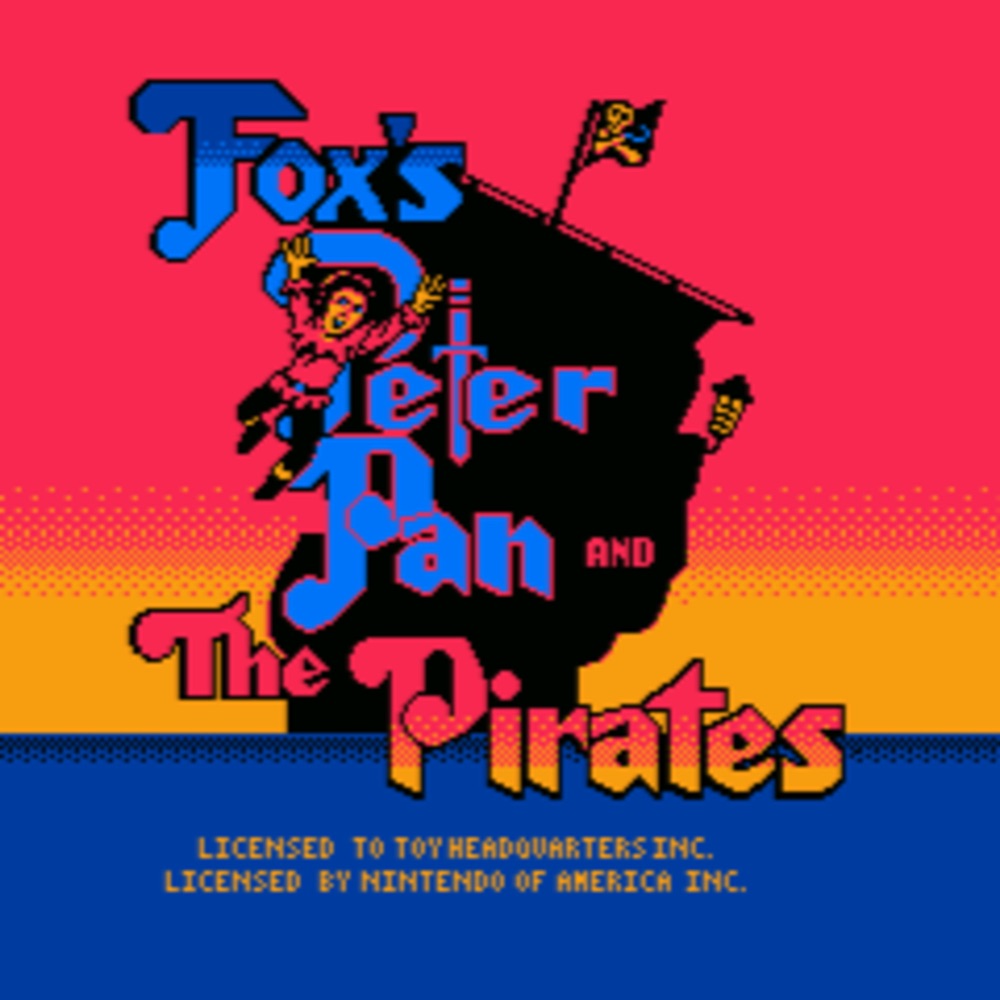
427 · Fox's Peter Pan and the Pirates: The Revenge of Captain Hook
Sean was out, so this was Mike and Joe. The full title is Fox's Peter Pan and the Pirates: The Revenge of Captain Hook, and it is based on the 1990 Fox cartoon, with no relation to the Disney movie. Our first impression was that it felt like an NES bootleg, and by the end we couldn't argue with that.
What's wrong
- No weight, no feedback. Flying and jumping share a pose, with no animation on either. Peter's knife is smaller than his hand, you can't tell when a stab connects, and touching an enemy drains health continuously for as long as you stand there.
- A pause that doesn't pause. No pause sound, and the music keeps going.
- Flight. You press jump and up together, there is no real diagonal, and landing takes a while. We kept flying by accident while jumping.
- Repeats. You can't leave a stage until every pirate is dead, which keeps you from flying over everything. When we first noticed a stage repeating we assumed the enemies had moved. They hadn't: same layouts, same placements, new palette. Maybe three or four stages are original.
- The interface. Joe and his friend Mark called the health icons telephones, and they turned out to be treasure chests. The brown-haired head that looks like Peter is the pirates remaining. The manual says the flight bags are food. The music is one thin beep going up and down.
What works, a little
- Easy, in your favor. Collect enough chests and you can brute-force it, which beats games where the jank is also brutal. There are no continues or passwords, but you barely need them. A cage trap that falls on you is mostly funny and sometimes sends you to a bonus round of health pickups.
- Cannonballs. They sit in the level and you can fire them only while touching them. We came around to liking that more than a limited supply.
- The ending. You can't just stab Hook. You knock him off the ship down the plank, and the crocodile gets him. The pirate ship stage has the best pixel art in the game.
Beyond the game
Equilibrium, an American studio with nothing else to its name, developed it, and THQ published it as its first release. Tim Curry voiced Hook on the show. Disney sued Fox over it and lost, then bought Fox Kids Worldwide in 2001, and there is no legal way to watch the show now.
The bottom line
Skip it. Joe was plain: it kept him curious, it was more fun with a friend to laugh at it with, and he never wants to play it again, so not even Play it. Mike thought it feels like something that could run on an Atari 2600 with stick figures. It did not go on the Essential Games List. If anything gets a reissue, we'd pick the show.
Written from our conversation in this episode.
I. Setup & Premise
- The pitch: Captain Hook challenges Peter Pan to a duel for the fate of Neverland. Pan fights through several stages of pirates, traps, and repeating color-swapped environments until he reaches the Jolly Roger for the final showdown. Hook walks the plank. Roll credits
- Developed by Equilibrium — a studio with virtually no footprint beyond this game. Published by THQ in January 1991. This was THQ's first game ever released. The company that would eventually build an empire on WWE and Nickelodeon licenses started here. That context matters
- Based on Fox's Peter Pan & the Pirates, the animated series that ran 65 episodes on Fox Kids from September 1990 to late 1991. The show was legitimately good — Tim Curry voiced Captain Hook, the writing was darker and more faithful to Barrie than most adaptations, and the entire pirate crew got real characterization. It was Fox's first real push into children's programming and one of the earliest Fox Kids shows, period
- The central tension worth dwelling on: a genuinely beloved, underrated cartoon got paired with one of the laziest licensed games on the NES. The gap between the show's ambition and the game's indifference is where the conversation lives
- Worth noting: Disney sued Fox over the show, claiming infringement on their animated film. They lost — but eventually acquired the series anyway when they bought Fox Kids Worldwide in 2001. It's been effectively buried since. The show that Disney didn't want you to see got a game that nobody wanted to play
II. What Makes It Notable (For Better or Worse)
- The kill-everything structure feels dated
- Every stage requires you to hunt down and eliminate a set number of pirates before you can exit. Wendy or a Lost Boy will pop up to nag you about remaining enemies. The objective never changes across the entire game
- By modern standards this is pure filler design — it exists to stretch a very short game. Without the kill requirement, most levels could be cleared in under a minute. With it, you're combing back and forth through flat environments looking for stragglers
- The honest problem: it turns a platformer into an extermination checklist, and the levels aren't interesting enough to reward the backtracking
- The sword feels dated
- Peter's primary weapon is a short sword with extremely limited range. You will eat hits constantly from enemies that look like they should be within reach but aren't. The hitbox is ungenerous in a way that feels punitive rather than challenging
- Red balls can occasionally be found and thrown at enemies for ranged damage, but they're rare drops — not a reliable alternative. For most of the game, you're stuck closing distance against enemies that have no interest in letting you
- The flight mechanic broken
- Peter can collect fairy dust to fly — the one mechanic that should make this game feel distinct from every other NES platformer. In practice, diagonal movement barely responds to inputs. Transitioning from diagonal to horizontal flight almost never works cleanly. You fly into platforms, lose your momentum, fall, burn through fairy dust restarting, and repeat
- The flight should be the game's identity. Instead it's the primary source of frustration. A Peter Pan game where flying feels bad is a fundamental design failure
- The level recycling indefensible
- Many stages are literal repeats of earlier levels with swapped color palettes. Same layouts, same enemy placements, slightly different sky. The game is under ten stages long and still couldn't generate enough original content to fill them
- This is where the "licensed cash grab" accusation becomes hard to argue against. Even by early-'90s NES standards, this is thin
- The Hook bookend mixed
- At the end of each level, Captain Hook appears running back and forth — a brief, almost comedic visual. In the final stage, you actually make Hook walk the plank. It's the one moment the game earns something that feels like payoff
- Worth asking: does the final encounter work because it's well-designed, or just because the rest of the game is so empty that any conclusion feels like relief?
- No continues, no passwords feels dated
- The game offers neither. Extra lives come from bonus stages, and that's it. For a game this short, the lack of continues is less brutal than it sounds — but it means any death spiral in the later color-swapped levels sends you back to the start with nothing to show for it
- The music mixed
- Composed by Ed Bogas with sound programming by Jeff Lefferts. The soundtrack is functional but unremarkable — it doesn't embarrass itself the way the gameplay does, but it never rises to the level of making a bad game worth enduring for the audio alone. No one is putting this OST on a City Pop deep-dive playlist
III. Pop Culture, Context & Connections
- THQ's origin story: THQ would go on to publish some genuinely great games — the WWE SmackDown series, Red Faction, Saints Row, the Destroy All Humans franchise. Their first release being this catastrophe is the kind of humble beginning that reads as charming in retrospect and probably felt like a warning at the time
- The show's legacy vs. the game's legacy: The cartoon is still remembered fondly by a small, passionate fanbase
- Thematic relatives:
- Hook (1991 film) — released the same year, also a darker-tinged Peter Pan property struggling with tone. The cultural moment was ripe for "Peter Pan but edgier" and nobody quite nailed it
- Disney's Adventures of the Gummi Bears and DuckTales NES games — the proof that licensed cartoon platformers could actually be great, which makes Peter Pan's failure sting more
- Tiny Toon Adventures (NES, Konami) — another Fox-adjacent cartoon platformer from the same era that actually played well, a useful benchmark for what competent execution looked like
IV. Closing Bits
- The question to leave listeners with: The show is effectively locked in Disney's vault with no streaming presence and no reissue. The game is forgotten. If you could rescue one — give the show a proper remaster/release or give the game a ground-up remake that actually does the license justice — which do you pick? Is there any version of a Peter Pan platformer that works, or is the concept itself the problem?
- Tease next episode
Auto-generated transcript. Each paragraph starts with its timestamp. Speakers are not identified.
Fox's Peter Pan and the Pirates, The Revenge of Captain Hook.
And welcome to NEStalgia, a chronological exploration of every NES game released in North America. I'm Mike. And I'm Joe. There was not even room for the back of the box. There was so many words on the front of the box. Fox's Peter Pan and whenever I say Fox for some reason in that regard, it sounds like it's not the studio, but like a Fox has ownership over Peter Pan. Oh, Fox. Yeah, like just an animal.
Fox's Peter Pan and the Pirates are at it again. So this is Fox like Fox, the studio. Yes, this is this is their little animated show that is not at all related to the Disney movie, which I'm sure Disney threw a fit about or whatever. But it's like it shares no like no inspiration whatsoever. It has a larger focus, as you can see from the title, Peter Pan and the Pirates. It has a larger focus on the pirates than on like Peter Pan and London, Big Ben and all that. Like that. Yeah, that's kind of removed. And instead, it's just like Adventures in Neverland. Right. There's no Wendy.
But there is Tinkerbell. Yeah, there's a lot of them. So that. Yeah. Oh, yeah. Yeah. You're assuming it's different Tinkerbell. I mean, I guess it probably is. She's she's like doing the like single take camera shot thing where as soon as the camera is gone, she like runs to the next frame she's got to be in.
And I think we have to get it out of the way. I, you know, we're both huge Kingdom Hearts fans and it they have a Peter Pan level and Neverland level, if you will, even though it's not really. Isn't it weird that they say Neverland, but it really just all takes place on a boat. Like shouldn't it be the name of the boat is? I mean, in like theoretically the boat is in Neverland, but like half of the world is London, which is not. You should bet you should have to go up to shore and do some exploration and never. Yes, which you do in Kingdom Hearts Birth by Sleep. Oh, that's cool. And it's a it's a great music, if I remember correctly.
Well, Peter Pan, the Disney version also has some great songs, some all timers. So I guess like what I'm saying is, is like my familiarity with this Fox series is zero because it came out in 1990, ran for about a season, never really got replayed anywhere. I wasn't really watching Fox as a kid anyway for cartoons. I was mostly sticking to Nickelodeon Cartoon Network and WB. So like my exposure is zero here. But like for Peter Pan, like I'm a fan. See, I've never seen the Disney movie. My exposure is also Kingdom Hearts and, you know, maybe like one or two viewings of Hook when I was a kid. Okay. Otherwise, like I, I know what I know about Disney's version, mostly just from Kingdom Hearts.
It's a bit of a confusing way to find out a lot. Yeah. Yes. Because it does not like, you know, and I definitely like before Kingdom Hearts came out, I was tangentially aware of like the gist of it enough to know like when I'm playing Kingdom Hearts, I know this isn't how it happened in the movie. And I know that there's like, you know, a whole band of lost boys and everything that are missing from this. And, you know, I know there's like other characters and all that. And, you know, I think I might have seen like a middle school play when I like one of my middle school might have that might have been the musical.
And like we all went as an assembly to go see it or something. Like I definitely saw it like in the theater version of it, if you want to call, you know, 12 year olds doing a performance of Peter Pan, a theater version of it. It is a very popular play, though. Like it is, especially in schools, I feel like it is something that maybe is like easy from like a set design standpoint or something or just fun to do. So it is it started as a stage play, I believe, or maybe like at the same time, like maybe the book and the stage play were written by the same author or something like that.
And so, you know, that is also another way to experience Peter Pan and without watching the Disney movie. Yeah. And I think that when you mentioned like the book, I'll be honest, I kind of thought this was just like generic Peter Pan, like maybe based on like the book or something. I didn't know this was based on like a television license.
Right, right. And it's also like, how did they get this license? Like this would be like, you know, not Fox because they're owned by Disney now, but this would be like Warner Brothers acquiring the license to Aladdin, you know, and being like, it's not it's not the Disney Aladdin. It's just it's just our Aladdin. But can't that happen? Isn't that like really easy to do? Because these stories are all in the public domain, right? Yeah, of course. But like it feels like why aren't they happening then? Like, yeah, I think I think there is one known instance of it happening with like Snow White. Like I think somebody made a Snow White. Like there's all those bad.
Right. There's all those bad horror films which are like, oh, it's in the public domain now. Let's just make a horror film Winnie the Pooh or a horror film. Like those are low effort. But, you know, for a high effort thing, like Peter Pan was a movie, I think, in I want to say like, I want to say it's like the 70s, like early 70s. Maybe it's like 73. It might even be 68, actually. My Disney timeline's all over the place right now. But it kind of goes untouched for a while after that. And then you got this animated series.
And then you get this game based on the animated series, which makes sense. The animated series came out in 90. They were working on the game probably at the same time. And so they released it in 91 here on the NES, even though the show's kind of basically done at this point. And the game, you know, and we'll break it down the traditional way, but I just feel like it's worth saying that the game, to me, like if we're going to go back to the old school first impressions, it just felt like a bootleg. It felt like an NES bootleg game. That's a good way to put it.
Bootleg didn't jump out to me. But now that you say it, I completely agree. To me, it just felt like it's like I thought I've said this before about other games. It's like I thought we were done with games that looked cheap like this, you know, or felt cheap. It's not like this game looks terrible. Actually, some of the art is actually pretty good, especially like the backgrounds. But just something about it feels like, I don't know, like the physics are like the bare minimum.
Yeah, like there's no animation to the flight. Like he just kind of stays in the same position. But there's also no animation to the jump either. Like he just goes into a jump pose. It's one pixel to another. Yeah, and it like looks, the jump and the flying look the same.
And like, you know, it sounds like small nitpicks. But even like there's no, there's no weight to the character. And it just. There's no collision when you're, when you're fighting. Like you have. First off, you know, Peter Pan in this game. I don't know about canonically across the series. But in this game, he has like a shiv, essentially. Like his world's smallest knife.
And it's like, did he go to prison? Did he make this like on his spare time? And now he's getting revenge on the pirate? Is this supposed to be a knife? Or is it like a sword? And it's just like a kind of bad. Like. I think it's supposed to be a knife, right? Okay. Because when you're flying, it's longer. That's true, actually. Yeah. So like, I don't know if there's some weird perspective going on here.
Or what? But like, yeah. It's like smaller than like the pixels that make up his like hand when you're just walking. Yes, it's too tiny. And then like, you can't even tell if you're making contact with the other pirates to defeat them because there's no feedback. It's just like you're stabbing. And it's like, oh, maybe I'm not there or not. You know, like maybe I'm just not. I have to get a little closer to this guy. And so then you just wind up being in like a stab off. Right. With the other pirates. And it's like, I'm sorry. What game is this? Like, this is Peter Pan?
Right. And the worst, I think, side effect of that, which we've seen in other games. And I just don't know how you don't fix this when you test it and notice that this is what happens. But like, there's no pause between times that you can register damage. So like, if you're touching someone, if you bump into someone for one second, you're going to lose like, you know, whatever. One unit of health. But if you're for every like millisecond that you're touching that person, it registers as another hit. So you're you could just be for standing like on someone. You're just like your health's just draining.
And like, I feel like we haven't seen that in a long time. You want to talk about no pause. There is no pause sound effect. I'm glad you brought that up. But because I forgot. I did make a mental note of that. The game music just keeps going, too. So it's like actually nothing feels paused other than the fact that like your controller doesn't work anymore. Yeah. The the and start and select both pause. But like, yeah, you wouldn't know it. And efficient use of right. Use of two buttons. Two core buttons.
To back up a little bit, maybe if there was a story for this game, there isn't. But the manual wants us to believe that Captain Hook has challenged Peter Pan to a duel for the fate of Neverland. Now, I didn't know that's how it works.
I assume maybe that's like some Joker logic. Like, you know, he can just continue to challenge Batman for Gotham. And because Batman won't kill him, it's just like the duels ever going. It's like maybe the same rules apply with Captain Hook here. It's like Peter Pan's not going to kill Captain Hook. So it's like what's stopping Captain Hook from just making a doing a duel monthly with Peter Pan, like every time he gets out of jail. Yeah. But if he wants to do a duel, why is everyone trying to stop you from getting to Captain Hook? It's like, hey, wait, you I was invited. Yeah, but it's like rigged against you. You know, it's like, oh, come duel me all the way out here in stage nine, you know, and I'll be chilling.
I think there's actually, I don't even think there's nine stages, but it's several stages, some that repeat too. They try to trick you by swapping the color, but, you know, pay attention enough and you'll notice. I was going to ask you about that because I'll be honest. I got to, what is it, four or five were the first time it repeats.
And I was maybe three quarters of the way through when I was like, wait a minute, like, this is the first level again. It's such an unmemorable design. It's not like, you know, it's not like you're doing something that requires precise platforming that you would notice you're making the same jumps again or whatever. Yeah. In fact, you could just skip platforming altogether by flying over things too. So you don't even have to. But so is anything else different in the repeat other than the color swap? Like, are there enemies in different places or something or? It's a good question.
I'm going to give them the method of the doubt here and say that I don't think the enemies are just placed in the same exact location. Yeah. Now, the rule is in this duel off that you're not allowed to leave the stage until you've killed all of the pirates.
So even if you, even though it's a side scrolling platformer game, if you make it to the end of the stage and you haven't killed all the pirates, you have to go back. And I just feel so wrong saying Peter Pan's killing these pirates, but maybe like incapacitate. And if you don't incapacitate or with your knife, all of the pirates, then you have to go back to the stage, find them. And there is a little tracker that tells you, and it's not hard to find them. If you go from the right to the left, you know, from left to right, you will see them. So you just have to engage with them, essentially. You can't skip them.
But then there's also like giant spiders and other like, I don't know, those like pterodactyls. Yeah. Right. It's like, what's going on in this? What's going on in Neverland? Like they're having an identity crisis, but those things are not mandatory. And in fact, they're just best not to interact with them since they could drain your health. Yeah. As Joe was mentioning, by the millisecond. And I haven't been able to confirm this, but I'm pretty sure the spiders and the pterodactyls are like those things that if you stand still for too long, they will just automatically appear. Definitely the spiders feel that way.
Yeah. Like I'm saying you're probably right on both accounts, but I've noticed that like you can make a spider spawn by just like chilling out. Yeah. So what do we think about the kill everything structure? Is that just a way to pad this game because you could otherwise skip the entire level by flying over it? I mean, yeah, I guess it's a way to make you engage with the enemies rather than just running through because I guess like you don't have to, especially, yeah, I didn't even think about the flying element. I mean, yeah, you can run out of, I guess, pixie dust, but you really don't.
Like, you know, I can go for a pretty long time without running out of it and there's plenty to pick up. So maybe it is just a way to make sure that like, yeah, you have to play our game. You can't just fly through it all. I did at first, I didn't read the manual. So I did at first just like go to the end of the game and I got a little like title card or like a little image card of Wendy saying like, hey, you didn't kill everyone. Go do that.
She's so particular. Yeah. But it sounds like you read the manual and I had a bunch of questions that I think I'm answering right now as I'm like looking at the heads up display because I wasn't sure what a lot of these things meant. One was like, okay, I can help. You're picking up what is your health and I played with friend of the show, Mark Pascualato and we were just jokingly calling your health telephones.
Now, I can so obviously see right now as of one minute ago that they are treasure chests. Like there's, I don't know how I couldn't see that until like seconds ago, but yes, there's so obviously treasure chests. But then. But it's weird that that's your health, right? Yeah. Like it's not Peter, Peter Pan's face in the UI is below that to indicate how many lives you have. But then there's just this, first off, health isn't even measured as like a bar. It's like an actual number. It's a quantifiable thing that can get infinitely larger.
Like Peter Pan could technically scale up to have 999 health if he wanted to. Well, and you mentioned Peter Pan's face being, this is a little issue I have with this game. Peter Pan on the screen, he has brown hair. On the right side of your heads up display, there is a guy with brown hair, a guy's head with brown hair. I would think that that is my, that would be my lives because that looks like Peter Pan's head. But what is it, Joe?
It's the pirates that you have to kill. Yes, the pirates remaining. Yes. So, and now I'm seeing like, okay, I guess there's like, there's a, there's a suggestion of facial hair on that, on that, but like, you know, you can barely tell because it's like one pixel. But like, why didn't they give the one that's supposed to be your lives, like the same,
at least color hair as the spread of your character so you can recognize it as that person's head? Well, here's, here's my very, very specific nitpick about that same, you know, say I'm giving the same note, but it's not that Peter Pan can't move to the left. Like, it's not that he can't turn around, but the direction that you go is from left to right. And the direction the pirates go as they see you obviously is from right to left. Like they're coming towards you. Yeah, that's a good point. And yet the UI, they are flipped. Yeah, that's true. Peter Pan is facing left and the pirates are facing right.
It's just like, they, they, that's something that they unintentionally screwed up. So even though they made a ton of screw ups in the actual game too, they still made even just minor mistakes throughout in addition to their, their blunders. Yeah. I can say blunders because it's kind of like a piratey word. So it works even more so on this episode.
True. Yeah. Blunder, like plunder. Yeah. Um, so another question I had, well, I did originally have a question about what the music note is, but I also separately figured out that you can turn off the music and just piece together that that's why there's a music note up there. It's telling you if the music's on or off, but there's throughout the levels, there are what Mark and I were calling poker chips. They're clearly not poker chips, but they're little blue circles with like black inner circles.
Yeah. And to be fair, they do look like poker chips. That looks a lot more like poker chips than these treasure chests that look like telephones to you. Do those just up your score or like, what do those do? What's the point of those? Those just up your score. Okay. So that's, that explains why I didn't care about that. I'm sorry to give like the worst answer in the world. Yeah. Nobody wants to hear that, but that's all they do. Well, I think that concludes my-
No, but it's, we could, we could slur it in there. Yeah. I got to be careful. But, um, well, I'm assuming they're bags of pixie dust and the app is for flight. Okay. See, that would be amazing. Right? Like, I, I think that it could stand for, it could just be pixie dust, right? It could be, um, it should have the P, but it has an F. It could just be like flight dust instead. Like, oh, don't want to get sued. I don't even know if that's true. If Disney has ownership over pixie dust versus flying. But flight dust sounds so much more like a drug than pixie dust. Right. Even though like pixie dust can be, like some drugs I feel like are referred to as pixie dust, but flight dust? In the manual, it's canonically food.
It is? Why, yeah, why would, why would he eat food to be able to fly? Yeah, that just doesn't make any sense. Uh, is, was, was this game developed in the West? This game was developed by a studio named Equilibrium with a studio with virtually no footprint beyond this game. But like in English first or was there a translation?
Oh, that's a good question. No, I think this is, I think this is just an English game. I don't think this is like a reskin of a Famicom game. Right. Because that was the only thing I could think of is like, maybe there was just like a weird in the localization. They're like, yeah, let's make these bags food. But like, I mean, I feel like that's like, if you don't know anything about Peter Pan, like the one thing you know is that like there's pixie dust, right? Like pixie dust that makes you fly. That's like the thing. Right. Yeah. It's actually all Western developed because Equilibrium, again, don't have anything else on them, but they made this game. They're the developers of this game.
They, they're an American studio, but then it's published by THQ. You know, THQ. Yeah. All the Nickelodeon games. Right. This is their first game ever released. Really? Yeah. So they, you know, they're going to do all the Nickelodeon stuff, all the WWE stuff, but it's kind of crazy that like, this was, this was the first thing that they were like, yeah, we'll latch onto this.
But I guess they were just always, you know, on the idea of licenses in general, because this is a licensed game and that's pretty much what they're known for. And I feel like they're also like pretty known for like licenses that like nobody else is doing. Like, I mean, I guess everyone who has license, like they're probably the only ones doing it, but like, like the SpongeBob video game, the Avatar, the last air, but they're like these like secondary licenses and they're kind of usually like secondary like games.
And this is like, yeah, we'll do Peter Pan. We'll do SpongeBob. We'll do like, I think there was like a, you know, Nickelodeon cart racer or something like that. Just like, I guess, yeah, just do these like random licenses that like, yeah, just like they seem, I don't want to say they seem like cheap, like bad, but it seems like, yeah, here's like a quick license we can do. And it's like, nobody's like begging for these games. So we don't need to be like held so accountable by a huge fandom.
Although I do think nowadays Avatar Last Airbender does have a huge market for like a big game, but I know that they, THQ made some like, just like real quick games on the PS2 and stuff for that kind of thing. And so, you know, we've talked about how short the sword is. We've talked about the kill them all aspect of the game. The flight mechanic, it's something we described as a little janky, but I don't think we talked about why it's janky. And I feel like the one thing to know about Peter Pan is, especially if you know the Disney version, it's the song You Can Fly. And he has the three kids that he essentially abducts and sends to Neverland, even though they kind of want to go.
He did kidnap them. Like he's, Peter Pan is forever a boy, right? But like, he's been alive for a very long time. Yeah, so how old is he really? Right. He's able to make decisions that these other young boys aren't able to like make for themselves. But he says, hey, your parents are out for the night. Let's go to Neverland. And by the way, I don't know how to get your back.
And, you know, that is like the flight mechanic is like the one mechanic that should make this game feel distinct from other NES platformers. But in practice, even triggering it is a little strange. Like you have to press jump and the up arrow at the same time. And it's like diagonal movement, not really happening. Like it's a very still like you're moving like you're on a grid. And so transitioning from diagonal to horizontal flight almost never works cleanly. Like you fly into platforms, you fall and then you're like stuck in something that you didn't mean to be stuck in and you try to fly out of it, but you're being heard at the same time.
Yeah, I think it what comes down to is it's a much, much worse version of the like raccoon tail Mario from Super Mario Brothers three where it's like it. I actually knew I take that back. It just that was wrong. But completely because like in Super Mario Brothers three, you can like you can go straight up if you want with the raccoon tail and things like that. But like this is I feel like normally you're going at a diagonal and it's like, you know,
maybe what they were going for with this is like, oh, you're not you don't have full like you're not like this OP level of flight where you can just go anywhere you want, which I think is fine, but it just feels too weird. Like I had a hard time figuring out how to stop flying, let alone like, you know, control precisely where to go. I mean, granted, flight still helps me a lot. But like a lot of times I'm like, OK, I don't I don't want to waste any more of my my flight power, but it takes me like a while to land.
Yeah, I think once you once you get over the novelty of it and realize that it's kind of it's frustrating to use. I really only use it in the sections where it's impossible to otherwise like get over the platform. Yeah, I used a bunch of those and I did use it sometimes to like get around enemies and things like that. And then I think maybe equally as those two things, I used it many times when I didn't mean to use it just because like I just naturally press up while I'm jumping sometimes. And and that makes you fly. Yep. Now, here's something terrible, Joe. Earlier in the episode, I gave them the benefit of the doubt and said that they probably changed the enemy placements.
It is confirmed that they do not. Wow. The same layouts, the same enemy placements, different color swap of the palette. The game is under 10 stages long and they couldn't even generate enough like original stages to fill that. And what I mean, is it just three original stages before you get to the ship before it loops? Oh, that's a yeah, it's a good call. Well, I think I didn't count at most four. It might be. Yeah.
But it might be four stages because like I just don't know like how I'm not a game developer, but how much more work would it be to just like replace all not replace like reposition all of your enemies in that level and just like add a couple of new enemies. Then you're still saving the time. You're not designing a whole new level. You're not designing a new art for the level. You're just putting the enemies different places and making it even just that much different for your player.
There are no continues or passwords. Not that it needs it, of course, because I think the one positive you could put on this game is that it is easy. Like it is achievable to as long as you collect the treasure chest along the way to like have enough health to just kind of brute force your way through the levels to face off against the pirates. And even if they do some chip damage at you, you'll always come out on top. Do you agree? Yeah, definitely. I mean, we've had so many games like this where because they're jank, like we're describing a lot of janky things in this because they're jank. They're also impossible. And this is like jank, but very achievable.
And actually, like I will say it makes it a lot less like unbearable than other games that are like this. Like I didn't, you know, it's not like I was only there were times I was having fun with this game. I will say that like I think just because like, yeah, it's pretty achievable. And I think I just find a lot of the game mechanics kind of interesting. But like it's fun to explore that when you're not like constantly just like getting your ass handed to you by bad mechanics.
Yeah, that's a good point. That is a good distinction that the game is jank in your favor in this case. Because even things that should make it more challenging, like when when Captain Hooks traps the jail cells that fall over you when you touch a specific spot and then you're like locked in them, it's more just like kind of funny that it happened and you get out of it. There's no like real consequence of like, oh, now I'm stuck in here and I'm going to take so much tremendous damage.
Like it doesn't really you're not really like placed in a situation like that. And that was another thing I wanted to ask you about, because I'm not sure if you have any more information than I do on this. But those traps, sometimes when I'm in the trap, I end up in a bonus level. And other times I just get out of the trap. So at no point is the trap a bad thing. Sometimes it's a neutral thing and sometimes it's actually positive for me.
So do you know what triggers the bonus round and what triggers the trap to just like go away? You know, you you are opening up my eyes because it did happen to me, too. But I didn't question it when I didn't go to the bonus level because the bonus level is so inconsequential. Like it's just basically a place where you pick up health. Yeah. In a limited amount of time before you just go back to the stage and you don't like lose any progress or anything. So I didn't I didn't question it when it didn't happen because I didn't really recognize it. Like, oh, that's weird. I didn't go to that cool bonus stage because it's not cool. So I don't know what would what would trigger that.
Yeah, I just I found it weird because sometimes it would be the exact same trap. Like I would die and then go back to that same trap and then it wouldn't take me to the bonus level that it previously took me to. Right now. It says in the manual on the section for pirate traps on each level, the pirates have a have set a trap to guard one special treasure chest. If Peter tries to take this treasure, a heavy cage will fall on him and he will be at the mercy of the pirates for a few seconds. So it doesn't even mention. Yeah. That little bonus level. Yeah. But I guess now that you mentioned it, that is like the negative is that you're at the mercy of the pirates for a few seconds.
But it's like they're not placed where there's like four pirates. Exactly. You know, it's so it's not like and yeah, there are pirates with guns, too, by the way. And they shoot like way too big. They shoot like cannonballs at you. Yeah. What do they have like bazookas?
But they are there are actual cannonballs because there are cannons, but there's just cannonballs just like sitting in the level. This is one thing that I did fight at first. I found this like stupid. But as the more I played it, I was more inclined to find it an interesting mechanic where there are cannonballs just sitting there and you think it's like a power up like you're going to go. It's a pickup. You're going to go pick it up. And now you have the cannonball. But instead, what it is, is like if you're touching the cannonball, you can fire it only if you're touching it. So it's like they have designated spots you can use this power up if you're standing at this spot where the cannonball is.
And at first I was like, well, that's dumb. But then like there were I mean, I'll be honest, I found it useful a lot of the time. And it might even have been in a game like this might even have been more useful than if I had like a finite resource of it that I would have just like wasted too early. And then, you know, it's like there were a lot of times where I'd see enemies and I'd be like, oh, but there's a cannonball there. If I can get to that, I can shoot the enemy from afar.
I don't know. Just a cool mechanic. You're giving them some credit for the placement of those cannonballs then too. Yeah. I mean, and I, you know, I'm sure that any good placement was an accident, but it doesn't make any sense within the world. But I do like that as as a mechanic is a way to kind of change things up.
And, you know, since we're now on the apology tour for the game and trying to make amends with now defunct developer Equilibrium, I will say that the ending with Hook is like a, it's an undeserved moment for the game where they actually did come up with something cool where you actually do have to like fight him on a duel across the plank. And the only way to like, you can't kill him by just stabbing him enough. You have to force him off the ship and make him walk the plank.
That's a great moment. Yeah. I didn't get to this, but I did watch the ending of it because I was just not about to play the same three levels two more times to get to this. But first of all, this level looks cool.
Um, I mean, there's way more going on here than anywhere else. And like, it doesn't look like it has upped the, the ante at all as far as mechanical game design, but like art, this looks really cool. You've been in the jungle the whole time. Now you're going like jumping across a bunch of pirate ships and, uh, it's, it's, it's great pixel art, but, um, but yeah, watching you fight Hook, it does look like a kind of a, a decently and appropriate climactic boss battle for this game.
Like it's not like super cinematic climactic, but it's, it's pretty cool to see like, oh yeah, there's captain Hook, the guy that we were promised from the beginning and we have to knock him off his own plank. And then the crocodile that took his hand, if that's a, if that's a Peter Pan reference outside of Disney, um, then eats him.
Love to see it. That is a good question. I presume I never read the book. That has to be true in every iteration. He already has the hook. So there has to be an explanation. That's true. He has it. Um, and you know, for the, for the, the ending, it probably works well just because the rest of the game is so empty that, uh, it, it, this, uh, this like moment of something different or just even just like being aware of like creating a definable moment rather than just wandering around stages. It just feels nice. I do think like, you know, Captain Hook could have been a bigger sprite. Right. Better recognizable.
Like it is, it's definitely like he's a pirate. Sure. And he looks different than the other ones, but like, I don't even really see his hook. Does he look different than the other ones? I think. Yeah. He has the same color palette, but I think he does look like he has the official like pirate's hat that they didn't have. But I think there is one enemy throughout the game and I think I'm piecing something together right now that looks like him. I'm looking back at the first level. I remember a specific moment where this enemy appears that it looks exactly like him. And a few times I was going to mention this as far as jankiness, I get to him and he vanishes.
Like as if I killed him. But that is Captain Hook at the end of each stage. Yeah. You're talking about Captain Hook. Yeah. I didn't know that. I was just like. That's just the Captain Hook apparition. Okay. Yeah. But he counts as one of the pirates you need to kill. Yes. And when he disappears, it counts as like, okay, he got rid of that pirate. Okay. So that is Captain Hook that you see throughout each stage. That was just one of his heartless. Yeah. Right. Perfect. Yeah. First, in the first stage you kill is heartless. Second stage you kill is nobody. And then he's re-completed. Yep. So. And then he's inorted.
Yep. Everybody knows organization 13 Hooks. What would Captain Hook's like nobody name be if he was in organization 13? Right. Because you have to add the X. Yep. And then do you rearrange Captain Hook? Does he have a first name? Is it like an I am Lord Voldemort situation where you can. That's an interesting question. Does Captain Hook have a first name? Gonna say no.
So it would just be. Yeah. But then like does Captain get the X treatment? Like do you have to put Captain Hook the whole thing into an anagram to come up with his nobody name? Yeah. I mean. I think. I think that maybe you can just go Hook. And it could be like. Hawk Sock. Or something. There. There you go. All right. Send it to Nomura. Yeah. Does anyone. Does anyone listening to this know what we're talking about? What we're saying? The rule is just in case you want to know. If you want to make your own Kingdom Hearts nobody name. You just have to make an anagram of your real name. And then just add an X anywhere in the name. So that it kind of sounds still like something. So. You know.
My nobody name. Is Zalchum. With an X at the beginning. And I think that's pretty cool. But it's just Michael X. I have like Oxage. Is like the best I can do. Okay. I think that sounds pretty good. Yeah. It's all right. What's your element? No. I don't know. I haven't thought. Maybe. Maybe like wind. Like oxygen. Air. Oh. I love it. But like that's kind of like Zaldan. This is why Sean shouldn't ever be allowed to not come on. Because he needs to prevent us from just spiraling into Kingdom Hearts. Yeah. Because then he just gets to say like. Oh. Did you Norda bitch? Or something like that. And it like kills the conversation.
All right. So to get us back on track. We'll stop talking about the game for a minute. And go back to THQ for a second. Because it is worth mentioning that. You know. It's funny that they. This is their first thing out the gate. Because they're still around. You know. They were going to publish some genuinely great games in the WWE Smackdown series. Red Faction. Saints Row. Destroy All Humans. So. Their first release being this. This release. It's kind of like you know. From humble beginnings. We can all get there. Like we can all be the big publisher. And they always had their eye on the licensee prize.
So. The game. The game legacy did not obviously match the show's legacy. But does the show really have a legacy outside of. And we did not mention this. But Tim Curry being the voice. Of Captain Hook. In the show. Now I might have to watch it. Right. I feel like that's what it's known for though too. Is like it's not really probably that memorable of a show. But it's like hey. Tim Curry voiced Captain Hook for 60 episodes. Like you might want to watch it.
Hmm. On a scale of the hotel owner from Home Alone 2. To Nigel Thornberry. Where does Tim Curry like. Where does this performance fall? It's closer to the Home Alone. Okay. Interesting. You'd think. It's not it. You would just think. Oh animated. He's going to be closer to Nigel Thornberry. But. Yeah. But Nigel is like. It's just such a. He's friendly. Such a crazy performance. Yeah. And you know. You mentioned Hook. Obviously. Which was released the same year. Did you know that? That Hook is 1991? I didn't. Okay. So. Same year. Obviously. A.
Weirder Peter Pan story. Where he is now. A. A lawyer. And kind of forgot about. His life. And. Is also like. His wife is like. Wendy's granddaughter. Like. What the hell? He was. Is that. I thought he was. With. Wendy. Is he just like. I mean. But. Bank on that family line forever. Didn't Wendy like not. Didn't Wendy go back to London. And then grow up. Yeah. Of course. But like. Now he's a lawyer. And he's grown up. He's Robin Williams. I'm assuming. That he. That she went back. And grew up. And then he stayed in Neverland. For like. Two generations. And then left. And then grew up. Okay. I buy it.
And I'll say. I don't really remember. The movie Hook. What I do remember about it most. Is how it made me feel. Which I feel like. Is like. Like. Honestly. Like a great. Like. Compliment to the movie. Because I just remember. Like the. Like. I wish I had more nostalgia for it. Because I remember. Like. The vibe of it being. This like. Emotional. Like. Making me want to feel like. Yeah. I don't want. I want to be a kid. I don't want to grow up. Well. I think. You know. You have to give Spielberg. A lot of credit for that. He's good at that feeling. That's true. He's always good for that. And I was just going to look up to.
Although. It might not. Give me one second. Yeah. John Williams did the music too. Obviously. Oh yeah. If it's a Spielberg thing. So like. Those two are like. The one two nostalgia punch. For anybody. In the 80s and 90s. And the one two punch. To end any episode. Of nostalgia. Is when the. Two. People on this show. When it's usually three. Oh geez. I blew it. Yeah. You were on track. Without explaining it. I think we. Yeah. I'm talking about the essential games list.
Joe. I can't say that this game. Didn't hold my interest. I did find it interesting. I think part of it is because. There's a lot of like. Unique things. There's a little bit of. Different. A different goal. Throughout. There's like. You know. I was. More. I was. Infinitely curious. About what all these. Now very obvious. Heads up display things. Meant. And just. You know. I was just like. Oh. Interesting. This is like a. A license. I wouldn't have expected. So like. Interesting. Is what I would say for this game. Good. No. I would not say good.
I think maybe part of the interest came. Also because. I was playing with a friend. And it's always a little more fun. To like kind of laugh at some. Games when you're playing. You know. Playing with a buddy. So. I think. I had an okay time. Messing around with this game. But. Like. I don't ever. Want to play it again. So I think that. That tells you right there. Definitely not essential. I don't even think I would say play it. But. Interesting.
Indeed. You know. I. I agree with you. That. It's not the worst game. We've played. But I don't. I don't know if I agree. That it could be fun. At any moment. It works. You know. Did I say fun? I don't know. Maybe at one point. I might have said I had fun with it. In the episode you did. Yeah.
And I just feel like. Sure. The controls. Are capable of working. But like. I just want to stand by like. The bootleg part of the game. Yeah. There's just so little. Collision detection. And. Animation going on in the game. That it. Does feel. Even though it looks like. An NES game at times. It does feel like. Something that. Would be on the. The Atari 2600 instead. Like it just has so. It has the bare minimum. Of response.
And. Design around it. That if you did just have. Stick figures. Instead of these sprites. You could effectively. Also have this game. On the Atari 2600. The same way. And I'm not sure. That that is. It's definitely not a good thing. But I'm not sure. That that's true. Of most NES games. I feel like most NES games. Is like. Well you do need the 8 bits. To get it done. And here. I'm not sure. That. You're getting anything different. By all that extra hardware.
It's worth mentioning. That. Disney sued Fox. Over the show. Claiming infringement. On their film. So. They. You know. They did try. To do that. And bully people. But they also lost. That case. But then they won. Because they eventually. And this is before the merger. They. Eventually just acquired. The series. When they bought. Fox Kids Worldwide. In 2001. So. They've had this.
Fox's. Peter Pan. And the Pirates. For a very long time. And they have. Buried the show. There are no releases. It's basically. In the Disney vault. If anybody remembers that. They used to put things in the vault. And then like. For a limited time only. Now the Disney vault. Is just. Disney plus. But you're not going to find. Peter Pan. And the Pirates. On Disney plus. Either. So there's really like. No. Way to watch this show. I'm sure it's all over YouTube. But there's no way to watch it legally.
And. I. I think if I have to choose one. The show or the game. Like as a. To get a proper reissue. I'm always going to choose the show. Even though I haven't watched. One minute of it yet. So is. Is that the reason to buy this. For Disney. To bury it. Presumably. Right. Like. Wasn't it like. Buried enough. To even need to spend the money. Like. Was anyone looking for it. There's no way. That they chose. Like. I guess. I. What I. What I was implying. Was more like. Once they acquired Fox Kids.
They were like. Well. We're not going to. Yeah. Suddenly bring these things. Yeah. Either. Because I forgot. Yeah. They acquired Fox Kids. They didn't just acquire this show. Yes. Yeah. It wasn't. Yeah. Right. I want to add something to. What you're. What you're saying about. It being kind of. Feeling like bootleggy. And I. I forgot. That this. Is like. To me. A big factor. That contributed to that feeling. Is. The music. Something about the music. Feels. Thin. In like. A way that feels like.
Really. Archaic. Game. Like. Game. Music. Design. I get almost feels like a game and watch. Soundtrack. Oh. It's like one beep. Going like. Like. I just. We were beyond that. You think of the Super Mario Brothers 3. Music. And it's like. It sounds like a little. Like. Chip tune orchestra. Is in there. This is like one. Beep. Going up and down. In like. You know. It's not a terrible melody. But it just sounds. Thin and annoying.
And this is one where. Like. Oddly enough. We know. The composer. It's Ed Bogas. Which. Sounds made up. That's his name. Ed Bogas. With sound programming. By Jeff Leffert. So. These people were willing to throw their name out here. For Joe. To throw them under the bus. I thought you were saying. We know them like. From something else. Oh yeah. A friend of the show. Ed Bogas. Yeah. That sounds like bogus. Like this music. Yeah. This music's bogus. Next week. We will be playing. Kicks. Which. Is spelled with a Q. It's not. It's not a soccer game. It's a soccer game.