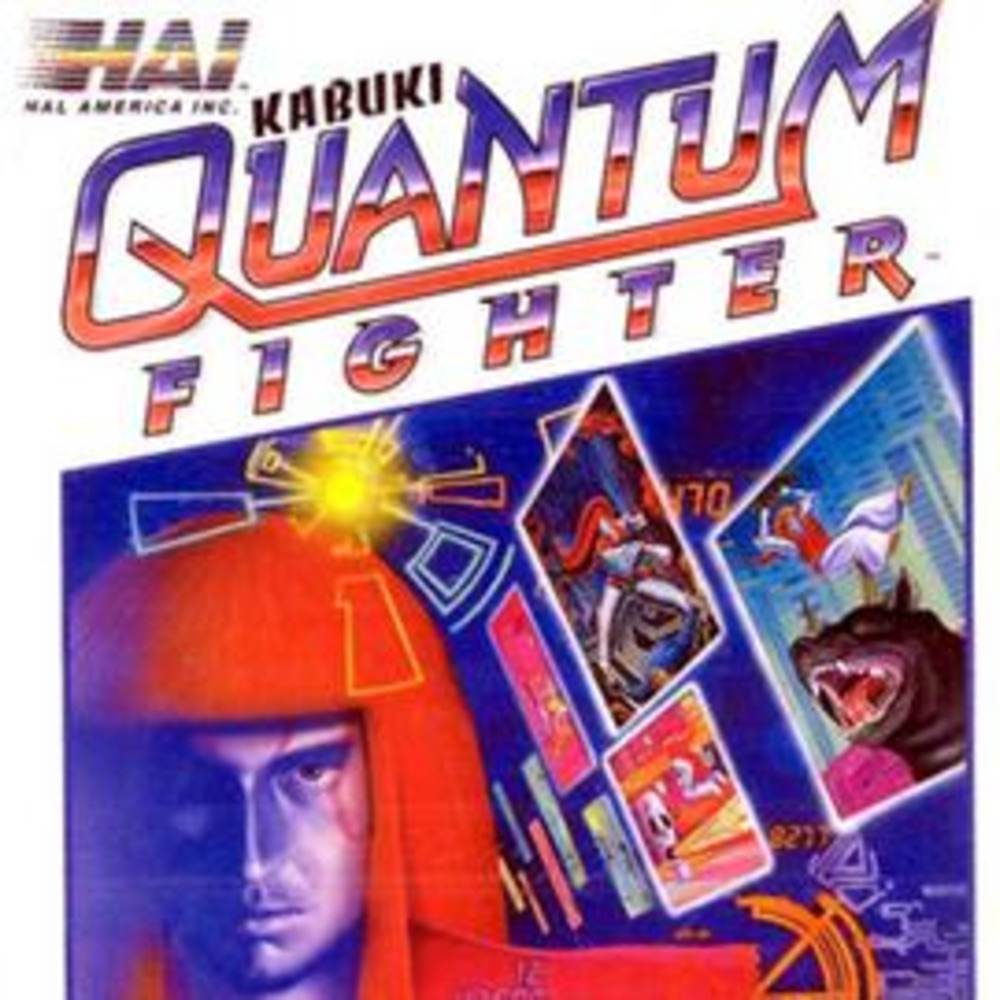
425 · Kabuki Quantum Fighter
Kabuki: Quantum Fighter is a 2D platform game developed by Human Entertainment and published by HAL Laboratory for the Nintendo Entertainment System. It was originally released on December 21, 1990, in Japan and was released in January 1991 for the North American market before being released in Europe on February 20, 1992.
It's 2056, a virus has taken over the defense supercomputer that runs the nuclear weapons, and the fix is to upload Colonel Scott O'Connor into it as data. The system builds his avatar from a kabuki actor ancestor, so he arrives in white face paint with long red hair, and he fights with it. Mike, Sean and Joe played, and the gap between a deadly serious plot and a hero headbanging at robots is where most of the charm lives.
Why it's fun
- The hair. It out-ranges your punches by a lot and feels crunchier. Crouching oddly drops you back to punching, which we decided exists so you appreciate the hair.
- The hooks. Tap A for a short swing, hold for a full arc, and let go to hang when you reach the next one. Mike said this is how he wanted the grapple in Bionic Commando to work. We kept pressing A again on landing and falling, then stopped.
- Chips. Hair is free, while weapons won from bosses cost chips that drop at random from enemies. The fusion gun's three-way spread speeds up boss fights, and the bolo ties that hunt on their own were a favorite. During a boss you can pause and press up or down to trade health for chips at two to one. That is on page 17 of the manual, and we hadn't read that far.
- Bosses with patterns. The first is your size and moves like a player. The third-stage green spider robot hangs from the ceiling, sends minions first, and has to be baited down. The penultimate boss is a mech you climb. The last fight is on the computer's guts, and the floor is squirming.
Where we split
- The levels. Mike's complaint is dropping blind into spikes and enemies, then redoing a hook section, plus enemies spawning in unfair places. Joe and Sean enjoyed traversing it.
- A story that fizzles. The intro warns that going in could change who you are, and nothing comes of it. The ending is a virus from space and Scott saying "I'd like to return to my body now."
- Not very kabuki. The costume is all there is of the theater, with no percussion and no staging, and the stages look like biological dark fantasy, not circuitry.
Beyond the game
Human Entertainment developed it and HAL Laboratory published it. The Famicom original was a tie-in to a 1990 film called Zipang, which from what we could find is about navy men and a comet-shaped bead, not a kabuki hero. We couldn't tell where the kabuki came from.
The bottom line
Play it. On the Essential Games List, Joe voted yes: one of the best action platformers we've played, short enough for one night, and he loves the music. Sean and Mike voted no, so it didn't make the list. Sean called it competent but not something he expects to replay, and Mike said the level design holds back a great character and great bosses. A hidden gem, in Joe's words.
Written from our conversation in this episode.
- EARTH, THE FUTURE
I. Setup & Premise
- The pitch: It's 2056. A rogue virus has hijacked the planet's defense supercomputer — the one controlling nuclear weapons. Conventional countermeasures have failed. The solution: upload a soldier's consciousness directly into the machine as binary data and fight the virus from inside
- The twist: Colonel Scott O'Connor (Reference to Terminator?) volunteers, and when his mind enters the system, it manifests using the self-image of his great-great-grandfather — who was a Kabuki actor. So your digital avatar fights with traditional costume, white face paint, and extremely long red hair
- Developed by Human Entertainment, published by HAL Laboratory — yes, the Kirby and Smash Bros. people
- Released December 1990 in Japan, January 1991 in North America
- The central absurdity worth dwelling on: The manual commits hard to the science of consciousness uploading — and then the avatar fights with his hair. That gap between the game's pretensions and its reality is where all the charm lives
- Mixing a very old art form with a futuristic outlook
- The opening screen: Before you take control of Scott, the game opens on a wall of what looks like real assembly code — pseudo-code inspired by the actual 6502 instruction set the NES runs on — with the Kabuki floating in it. People genuinely thought their cartridge was broken. It's one of the more committed pieces of scene-setting on the entire console holds up
II. What Makes It Stand Out
- Visual identity holds up
- Kabuki theater itself: The game actually gets the iconography right — the oshiroi face paint, the exaggerated hair, the mie poses read through pixel art. It's not just a label slapped on a character.
- The environments look nothing like a computer — the virus manifests as biological corruption, so instead of circuit boards you get organic demons, mutant creatures, and body-horror machinery. It looks more like a dark fantasy platformer than a cyberpunk one
- Worth raising: was this a deliberate metaphor for a "biological" virus, or did the designers just run with what looked cool? Either way it works
- Movement/Combat mixed
- Standing: the long-hair flail — close range, fast, your bread and butter throughout
- Crouching: switches to punches and kicks — even shorter range, useful for low enemies
- Wall-climbing: Scott can grip and scale certain surfaces, feeds into the vertical stages
- Hook-swinging: grab overhead hooks, tap A for a short swing or hold for a full arc — one of the more satisfying movement mechanics in the game
- The range is the honest conversation to have: the hair whip's reach is genuinely frustrating by 2025 standards. Modern action games have conditioned players to expect more. You will eat hits that feel like they shouldn't happen
- A lot of random drops in the vertical environments that are basically leaps of faith. You’ll land unknowingly into spikes or enemies. Not ideal
- The chip weapon system is a boss-to-boss unlock tree mixed
- Energy Gun (start): single fireball, 1 chip — your basic range option
- Super Fireball (after Stage 1 boss): upgrades to three fireballs across the full screen width, 2 chips — a genuine step up
- Fusion Gun (after Stage 2 boss): three giant fireballs simultaneously — diagonal up, diagonal down, and straight ahead — great for spread or airborne threats
- Quantum Bomb (after Stage 3 boss): thrown dynamite with a wide blast radius, the most powerful area option and devastating on bosses
- Remote-Controlled Bolo exists but most runs lean on the Quantum Bomb and Super Fireball
- The honest verdict: in concept the weapon variety is interesting — in practice, most runs default to the hair whip anyway because chip conservation matters so much. The system rarely feels as consequential as it should
- The boss health/chip swap mechanic holds up
- During any boss fight, pause and press up or down to trade health for chips at a 2:1 rate — or chips back into health
- Running low on ammo mid-fight? Burn some HP to reload. Taken too many hits? Sacrifice your chip supply to pad your life bar
- It's a mid-fight resource allocation decision that adds real texture to what would otherwise be pure pattern memorization
- Almost nobody knows it exists — it's buried in the pause menu and the manual barely explains it
- This is probably the most show-worthy mechanical callout in the whole game. Worth testing live if you can
- The vertical climbing stages feels dated
- A couple of stages abandon left-to-right scrolling entirely and ask you to climb straight up, hook to hook
- Enemies respawn if you fall back down, and a countdown timer adds pressure
- These are the moments first-timers hit a wall — where the hook-swinging stops being fun and starts demanding precision
- By 2025 standards, the no-checkpoint design combined with respawning enemies on a timer is where the game's age shows most clearly. It's the kind of difficulty that feels punitive rather than designed
- The Robot Walker boss in Stage 5 holds up
- Paces the floor, then crawls to the ceiling to fire a laser straight down — but only fires if you stand under it for a few seconds, and only drops back down after firing twice
- The twist: his two orbiting Pods are actually harder than he is and need to be cleared first
- It's a good example of the game's boss design philosophy — readable patterns with a deliberate "gotcha" that punishes impatience
- The final boss and story payoff mixed
- The Virus is a two-phase fight — first form lobs fireballs, second fires a triple beam. Honestly not that hard, especially with the pause-swap trick in your back pocket
- The reveal: the virus came from outer space, hitching a ride on the lost Hyperion probe — and your final job is stopping it from firing Hyperion's orbital laser at humanity
- For a game most people dismissed by the box art, it commits hard to its sci-fi premise all the way to the end — that commitment still reads as genuine today
- After the credits, hit B for the sound test — and a message hinting Scott O'Connor would return. He never did. Small gut-punch
III. Pop Culture, Sequels & Connections
- No sequel was ever made — standalone curiosity, full stop. The end-screen tease makes this sting more than it should
- The Japanese version is a completely different game in spirit: In Japan it's Jigoku Gokuraku Maru, a tie-in to the 1990 film Zipang — the protagonist is a 15-year-old named Bobby Yano, the threat is a magatama (ancient comma-shaped beads from Japan, dating back to the Jōmon period (c. 1000 BCE), typically symbolizing good fortune, protection against evil, and fertility.) in space rather than a nuclear crisis, and the face in the cutscenes is modeled on the actual film's star. Every trace of the film was stripped for the North American release and replaced with the Kabuki branding.
- Worth asking: is the game we got actually better for it?
- Thematic relatives:
- Tron (1982) — the "enter the computer" concept was already culturally established; the game is clearly in conversation with it
- Ninja Gaiden on NES — the closest genre benchmark and a direct comparison worth making on the show. Kabuki plays in that same lane but with less polish and more personality
- Neuromancer and the cyberpunk literary wave gave the "digital consciousness" premise cultural legitimacy before this game existed
- Ghost in the Shell, The Matrix, and modern digital-self sci-fi all came later — Kabuki was working in that conceptual space years ahead of the cultural peak
IV. Closing Bits
- The question to leave listeners with: A modern remake — do you lean into the cyberpunk angle or the Kabuki angle? Is there a world where both coexist without one swallowing the other?
- Tease next episode
Auto-generated transcript. Each paragraph starts with its timestamp. Speakers are not identified.
Kabuki, Quantum Fighter, Earth, the Future.
And welcome to NEStalgia, a chronological exploration of every NES game released in North America. I'm Mike. I'm Sean. And I'm Joe. And was the back of the box just like random words?
Yeah, you're right. It's like Earth, the future. I don't have the back of the box present right now, but I know I specifically picked that just to fool around with the back of the box. There was a lot more like plot details, but then it was just one sentence that said Earth, the future. And I was like, yeah, let's fucking go with that. Like, that sounds awesome. So it's not really either the beginning or the end of the back of the box. It was in there, but I picked it. And that's the rules. You're allowed to do that. You should just pick like a bunch of random letters and rearrange them into whatever words we want to say. Yeah. I mean, is anybody really ready for the future?
Not 2054. 2056. Come on, Joe. I'm not ready for that. Joe, Jesus Christ. Did you even play the game? I played the prequel. It's so 2056 coded that I don't know how you missed that. Yeah, but it is Kabuki Quantum Fighter. It's 2056. A rogue virus has hijacked the planet's defense supercomputer.
Interesting that it's just supercomputer. Like, there's just one. Well, it's the supercomputer. Like, the rest of them are just like regular computer. What happened? Did one company win? Like, right now, we're in a state where, like, every company is building their own supercomputer or data center or whatever. Is there going to be? So, there would be data centers, but this is just supercomputer with no S. Well, basically, over enough time, and I guess the 30 years until whatever year that was, is enough time for them all to sort of grow together.
And then here's the problem. That defense supercomputer, it's the one controlling the nuclear weapons. It didn't even have a password. Right. Yeah, no nuclear codes. The nuclear weapons themselves are being controlled by the computer. And it seems like basically all everything, they've run out of options. So, they're going to upload you, the player character's consciousness, directly into this machine as binary data and fight the virus from the inside. This kind of sounds a little relevant to what's going on today, right? Like, we're a couple of years away. Maybe it doesn't even take until 2056 before we start uploading consciousness into the clawed to fight back.
Ugh. It's got a little bit more nuance than that. I appreciate that. Yeah, I liked it, too. I mean, I can't pretend that it's not just one giant exposition dump. But, like, I was invested. You know, it was, you know, it got me. And the player characters is Colonel Scott O'Connor. Scott Connor. That's kind of, Sean, you mentioned the Terminator reference. That's kind of close. Yeah. To the Connors of the Terminator universe.
And when he enters, like, how does it work? Does his mind enter the computer? Is he physically in the computer? I think. Does he know how to control the body? I don't think he's physically in there. Isn't he in that, like, he's, like, laying in that. He's in that. Yes, he's laying in that thing. He was, like, an image of his brain was made. Right. And his, like, consciousness has been copied into the computer and is now doing the thing. Do you think all of our consciousnesses have, like, that hair? Yeah, let's go.
Now, here's the interesting thing. Did you know that when he entered that system, the system used a image of his great-great-grandfather, who was a Japanese kabuki actor? And so your digital avatar fights with the traditional costume, white face paint, and extremely long red hair of a traditional kabuki actor?
And they do bring this up in that intro movie, and they just sort of, like, yeah, that's normal. Like, oh, wasn't... Yeah, that'll happen. Wasn't his great-great-great-grandfather doing that? Yeah, does that mean that this guy's great-great-grandfather was, like, somehow just, like, deeply embedded in this guy's subconscious? Or was it just, like, no, no, it's like an Assassin's Creed thing where, like, your DNA has memory? Was that a big thing in Ireland? I think it's the Assassin's Creed thing. In what? Was kabuki, like, really big in Ireland?
Why Ireland? His name is O'Connor. Oh, right, right, right. Yeah, that's good. Very good. But wait, yeah, no, of course. Kabuki, do they, like, fight with their hair? No, never. But they just happen to have long hair. Yeah, yeah. Because, honestly, the, like, fighting with your hair thing, we didn't mention it, but you fight with your hair. Yeah, he's bayonet. It's so silly and also so cool to me at the same time. I love it. It actually is convincing, too, like, the animation for it and everything. Like, I believe that those whips of the hair are doing significant damage, at least in a digital world. It should be doing damage to yourself as well, though, like, with the whiplash.
Yeah, but when it's your digital body, you don't have to worry about your digital bones. Is there not, like, digital CTE? There actually probably is, right? But who's simulating that? Is it the AI? Because why can't the AI just simulate him feeling bad?
Yeah, the AI should just be, like, running the sadness program on him as a defense. And, like, this is not realistic. I think that the AI is trying, like, it's, you know, this is all it trying to get a hold of this program so it can run whatever it wants to. It's like a, it's like your computer trying to locate a virus, you know? Right, right. I think that's what all these enemies are, are parts of the AI trying to do it. So don't worry, we got that covered. They're the white blood cells. Yeah, yeah. Yeah.
This was developed by Human Entertainment. We always like to call them out because that's just, it's perfect when they make especially games about AI and call themselves Human Entertainment. But published by HAL Laboratory, you know, the Kirby and Smash Brothers people.
So I don't really know if it has any of that DNA, but we've seen some other games from them before. I think, you know, the manual and certainly, like, everything we've been talking about so far commits hard to this, like, science of consciousness being uploaded to an AI framework. And then, as Joe mentioned, the avatar fights with his hair. So there's, like, this gap between the game's pretensions and its reality. And I think that's actually where the charm comes from because the gameplay itself is actually kind of fun. As a result, it's just really silly that the plot is so serious, but the game is actually kind of whimsical.
Yeah, but I also think that the seriousness of the plot can sometimes be read as, like, over-the-top, like, cool. You know, over-the-top cool in the sense where it's almost a parody. I know it's not, but it feels that way. Like, I feel like if it were made today, it would be parodying games like this. So, like, I kind of read it as, like, oh, this is, like, so fun because it's, like, trying to be so crazy serious and it's not. It's kind of like how, you know, the costume design in The Matrix was cool. And now, whenever you see somebody like that, they're usually, like, dancing to, like, goth electronica under a bridge. Right, right.
And, you know, I think it's obviously done on purpose that it's mixing a very old art form in Kabuki with a futuristic outlook with AI and uploading your consciousness into a machine. And even the title, like, Kabuki Quantum next to each other is pretty crazy.
You seem to be a little worried about the consciousness angle. I don't think I'm worried about it. I think it's, like, just a neat approach to then, like, to take a very traditional, exclusive to Japanese art form of Kabuki theater and then, like, bring that over to America. Like, they surely could have. They didn't have to keep that part. They could have localized it a little bit. Yeah, I'm surprised that they didn't change the... Because everything else is so sci-fi. And then you just got the sky.
The coolest thing about maybe the aesthetic of the game, though, is that before you even take control of the character and start playing the game, the game opens on a wall of text of what looks like real assembly code. You know, showing instructions of the game, the game opens on a wall of text of what looks like real assembly, the game opens on a wall of text of what looks like real assembly. But I don't...
You see it a lot more now, like, with, like, glitchiness as just an aesthetic choice. And I wasn't expecting something like that. So it was a cool touch. I appreciated it. And I'm certainly no expert on Kabuki theater. But outside of the main character, I don't think there's any other part of the identity of that in this game. So I'm sure that the face paint and the clothing is all accurate to the Kabuki time period. But otherwise, that's it for the game, right?
Yeah, I guess we'd have to zoom in a bit to tell if it was period accurate. No, yeah, sure. But even just the idea of it, it's only in the way that the character looks. Right. Not even in, like, the enemies or the... It doesn't feel like you're part of a stage play. Right. In Kabuki theater, that's the one where, like, there's the percussion, right? Masks. Like, really, like... Yeah. But right, there's that, like, really, like, I don't know, that distinct sounding percussion, right? Yes, that's true. It would have been nice if there was, like, a character theme that had that or something.
And then the environments themselves, I wouldn't say they don't look nothing like a computer, but they're certainly not what I would think the inside of a computer would look like. It looks more like a biological corruption of a computer. Like, there are living, breathing parts of this thing. There's one screen where there's just a bunch of... Not just one, but a bunch of beating hearts and stuff. It looks like... Or, you know... It's very alive. And maybe that's on purpose, but you would expect maybe more circuit boards and things of that, not body horror machinery. Like, yeah. It kind of jumps back and forth between stages.
And some of them are even just like, oh, it's just all bones. All bones everywhere. But, again, like, I don't think that the original... That this game, like, was supposed to be about this originally. Like, the Japanese version, at least. So I'm just supposed to give it a pass?
No, I'm saying that, like, it just makes sense that it doesn't do that. See, you got it. Yeah, and I, like... Because I almost... I wouldn't say that I wouldn't... Necessarily that I wouldn't expect all the biological stuff. It's that... Or that I would expect... I'm sorry. I wouldn't say that I would expect there to be more circuit boards. It's that I would expect there not to be the biological stuff. Because there are circuit boards. And it does feel like that. But then, yeah, it's like... It's almost like the computer was corrupted by an alien. Or something. Ooh. Yeah, I mean... It looks more like dark fantasy than cyberpunk. But maybe it was a deliberate metaphor for a biological virus entering the AI.
You know, maybe the... Maybe even though it wasn't intentional, as Sean's trying to point out, it could be interpreted that way. So to get into the combat, we have, obviously, the hair-based combat. Oddly, though, when you crouch, you don't then, like, crouch and whip your hair. You resort to your punches. So you are capable of punching. You are capable of dealing damage that way. You just choose to attack with your hair.
What is the range like? Well, the hair is way better than punching. For sure. Which, it bothered me a little bit. Like, I just want to use my hair when I'm crouching. But I wonder if the punching is in there. Have you tried head-binging while you're crouching? In real life? Yeah. This is what makes it realistic. No, that... I can head-bing while I crouch. That's the only time I do it.
But I... Yeah, the only reason I could think of that they would put the punching when you're crouching is maybe to make you appreciate the reach of the hair. And be like, oh, yeah, see, that's why we're using the hair. It's so much better than the punching. Yeah, it feels crunchier, too. There's a little bit of a delay. Or at least you kind of have to let the animation play out. And that, coupled with the fact that it does more damage, at least it feels like a better tactic. And your other button is for jumping, which, of course, there are platforms and such. But there are also hooks built into the walls, I guess. Maybe they're floating. It's a computer. Anything can happen, I suppose.
There's these hooks that you can grab onto, and they allow you to swing. And you can just tap A for a short swing or hold down for a full arc. That gets a little tricky, especially when there's a lot of hooks and a long way to fall down. I noticed that sometimes I would just instinctually, when I grabbed onto the next hook, begin to start swinging from it and then leap off of it, most likely into an enemy that I didn't intend to.
But there is also, you know, he has a little bit of that Ninja Gaiden wall climbing ability as well. You'll see more hook swinging than you will wall climbing, but they're both present and spice up the platforming. And it's not to say that these stages are, you know, they're more horizontal side scrollers than they are vertical, but they do scale up a lot. And the idea of, like, having branching paths isn't there, but there are, like, different ways to approach. There isn't always just the one way up. Yeah, and you think it's a hot take for me to say that I think the way these hooks work is how I wish the grappling hook worked in Bionic Commando. Ooh. Like, I just feel like this is how I want that to feel.
Yeah, no, it is smooth. It just feels smooth. Yeah. And it, like, makes you feel pretty badass the whole time. Like, I'm never, like, oh, I got to stop and think, how does this work again? It's just kind of, like, it's just kind of intuitive after you kind of get the hang of it. Yeah, I think the one thing I wasn't ready for, though, is just, like, letting go of the A button when you land on the next one in order to just hang there. Like, for some reason, because you're holding down A from the swing and you're releasing, when I get to the next one, my instinct is to then press A again to, like, confirm it.
Not to, you know, not to let go of it. There was some times where I just unintentionally fell to damage or death because I was still getting the hang of it. But over time, you get the hang of it. And, you know, there's a lot of, I don't want to say random, but there's a lot of drops in the vertical sections of this game where you kind of have to do a little bit of a leap of faith and just, you know, you'll land unknowingly into spikes or enemies or into,
there's those, like, pools of water that push you into spikes. Like, it's not ideal. Especially when there's enemies. It's like, you knew I had to fall into this area. You know I can't see what's below it. There's no option to, like, crouch and look down and, like, expand a little bit of the screen. So why place an enemy, like, right there? Like, you'd have to know it's in the stage after playing a few times in order to avoid it. It's all punishment, Mike. Oh, right. Why didn't I? Yeah, it's the AI punishing. Yes. Everything in this game is actually flawless because a computer designed it. And it's designed to make you feel the way you're feeling. Filled with dread about consciousness. Uh, how fair things are. Uh, how cool long red hair is.
Wait, you feel the dread about that? Or that's just a separate thought? No, no, that's just sort of the same. It's a separate thought, yeah. I just felt like the enemy placement, even, not even just in areas you can't see, but just in general, could have been a little better. And while you have, uh, your hair to rely on, there are other attacks you can do by switching to them using, uh, so you have two, uh, bars. You have a life bar, which obviously is your standard HP. And then you have this chip bar, uh, that you, uh, don't necessarily have maxed out, but you can gain as you go along by collecting, uh, pickups.
The chip system use, if you use your hair, it doesn't cost any chips. But if you use some of the other, um, weapons that you unlock after you defeat a boss, uh, basically it's, it think, think like Mega Man style, except for you're not choosing the stages. Uh, you just go beat the boss and then you acquire a new weapon and then you can use that at, at will, uh, by, by pressing the select button to switch to the new, uh, weapon.
Those weapons have limited use though, because, uh, once you run out of chip, you'll, um, you'll, I got your hair to go back to the hair. Yeah. You only got your hair to rely on. I didn't actually notice this at first. It wasn't until later, uh, like level two that I realized that in the UI, there is a little thing that shows that your hair is selected.
Right. It looks like a, it looks like a fireball. Yeah, exactly. And I'm like, Oh, so I use, I use select and I'm like, Oh, I've got a little like pea shooter now. And then I press select again. And then I guess at that point I'd unlocked like a slightly more powerful projectile and it uses a lot of chip. So I ended up just really saving that stuff for bosses.
I mostly did too. Although, you know, there were times, I think like in, in the, you know, like stage three or three and four, I did kind of realize, Oh, I can use these early on because I get enough chip back like halfway through the level before I get to the boss. It is kind of random how you get chip back though. So yeah, I mean, they're just drops from enemies, right? Yeah. It's just, yeah.
So like, I feel like I felt safe in that, like, Oh, I'll get some if I like only use this in the first half of the stage or something. But honestly, I think your hair is one of the better options to, for like a lot of just like the main running through using the enemies, because you don't have to like think about what it is. Because I think like some, I think the, the, the power ups feel like they are best suited
for the bosses anyways. Like, so I, so it was, it ended up like not feeling like too much of a downer to have to save it for the bosses. Cause I think I would have, a lot of the times would have chosen the hair anyways in the main levels. Yeah. Cause the game is, it feels designed for melee. Designed for hair. Yeah. Yes. Melee hair.
This is a hair metal game. Yeah. the chip system even though the drops are random it does get around this thing that we talked about i feel like a lot when we started the show but uh has come up from time to time of just like sometimes it's just like why even bother fighting enemies if you can just move past them and it's like well here it's you want it's this way you have enough chip to go into the boss fights because the boss fights are certainly challenging uh if you're just using your hair like you're gonna
have a bad time trying to surely you could learn the patterns and do a hair only run of nothing possible but any percent you know hair only but if you go into a boss battle with full chip health uh or chip supply and then you have something like the uh i think it's called the fusion gun that does the uh fireball spread where it shoots uh diagonally up down and straight ahead you could be doing three hits at a time pretty rapidly against these bosses where otherwise you might have to like try and like
just squeak in a hit with your hair and then go back to defense and wait for their pattern to end and land in a new place and then attack them again once it's just like it really speeds up those boss fights in a way that's beneficial to the player now i didn't try this unfortunately i learned about it too late but apparently did you know that during any boss fight you can pause and press up or down to trade health for chips what no that's it is a it is a two to one rate so you you can trade and you can trade in both directions too by the way you can use chips to gain back health but if you're running low on
ammo mid-fight just burn up some hp wait to reload it's two health to one chip and then vice versa if you do it the other way one one chip to health you you could i guess technically by that math kill yourself by just yeah unequally sharing between them like going in one direction and then being like i didn't mean to do that i like the idea of this but i just knowing how much a lot of the uh weapons take how much chip a lot of the weapons take it almost feels like
yeah it's going to be pretty rare where you're going to have enough life to make a significant amount of chip right but i guess you know just knowing how powerful the those those chip attacks are at doing damage to the boss it could be worth even to just trade off once to do enough to have one more of the uh either the bomb or the spread gun uh at your disposal or that uh what's the one where like the things just follow it like there's a bunch of little guys that just go follow like
that that was very powerful oh yeah what is that called it was it had a little guys little guys that's what it was yeah those are your little guys um no what are those i don't know started with a b started with a b okay i'm looking in the manual now um little guy swarm yeah the remote control bolos bolo bolo ties perfect that's all just bolo ties that act on their own yeah and so i just want while i have the manual here i just wanted to see if it actually explained trading your yeah yeah yeah
it does say here in the final page in the it's the final page fighting the bosses if you run low on energy while battling with bosses you can get more energy by trading your memory chips pause the game by pressing the select button then use the upper and lower arms of the d-pad nobody says the arms well they say control pad not d-pad but lower arms of the control pad uh to swap memory chips for energy if you use this special technique well you should get the results shown below and then it has a picture
sorry can you call that technique show the picture or is that just yeah right feature i think the technique they were saying is if you just do that feature you should be able to and then it shows like a boss blown up uh but yeah i think that's interesting but it's kind of again another thing that's like does everybody know that like the three of us played the game and didn't know that uh i guess if you know if you have a manual you knew that but did you read all the way to page 17
did you get to the end of the manual did you actually did you actually try a little bit like did you did you check uh the game that you spend money on did you read the whole thing yeah it's like well you know it's funny i know that like we talk about enjoying reading the manuals but do you think you ever actually like read the whole cover yeah cover to cover the manual before you start playing the game you just read whatever you got up to in the car before you got home yeah but
there's only 17 you never looked at that thing again you can get there i i was far away from my eb games so oh i had some time yeah if i if i didn't have uh if i hadn't finished the manual yet i usually have my parents driver on the block a few times so i could finish it yeah i was there did you guys see the final boss of the game that's as far as i got i got to the final boss of the game i did not beat the final boss of the game so you've doomed your world yeah i was like you know what that's fine we'll doom it it's pretty cool it's definitely the most uh like body horror thing we've seen yet
where it has the mechanical biological like you see it's guts at all you're actually fighting on its guts right like that's the the stage itself like the floor is guts the floor is guts i played that game yeah we all played oh my god i didn't realize that the floor was like squirmy guts i think i was just too focused on on it just like lava to me because i wasn't focusing on it and then he's hooked up to you know the the computer's all hooked up to that and then there's like coming out of the
computer is another like it looks like something out of um salamander but it's uh or life force as it's called on the nes it's just like another one of those dragon things and it's shooting fireballs at you while you have to try it and and they you know they were nice though they were nice they gave you those little uh swinging hooks that we've been talking about there's two of those in this stage you would think that the boss would be smart enough to remove those by now i did appreciate though uh that like the design of these bosses did take into account like their little uh platforming
uh the the platforming gimmicks like the penultimate boss like the one before this is sort of a mech that you can climb on and you gotta climb on top of it to get to the the weak point and so at least they're taking their their unique things and using them in fun ways in the boss battles yeah and just zooming out even further i think the boss bet all the boss battles just as a whole in this
game i think really shined for me where like they they've they felt like modern action game boss battles in the sense where i felt like i was learning their patterns it wasn't just like yeah hit him a bunch of times before he hits you a bunch of times or like yeah their pattern is it does this and it does that it's like even the first one was weird that like it had a weird vibe to it because usually we're used to these big like set piece bosses with that are just giant like pieces of uh horrific
sprite work horrific in a good way um right and he's just a guy like you that kind of has a similar move set and yeah it feels like he's being controlled by a person in a way and it does he moves fast and he flips around and he's like yeah it's not like this i don't know there's just something really cool about the boss being the same size as you in any game but then also uh i think for me the one that like really got me was i think it was the third stage boss it's like this like green spider robot thing
that climbs on the ceiling and like and there was like there was a lot of pattern to that and it had two little like minions shooting around you had to kill them first and you had to figure out how to get it to come down and then you'd have to like hit it while it was down near you and then you know you'd have to bait it into shooting at you and dodge its attack to get it to come down at you
just like i don't know a level of thinking about how to tackle these bosses that we don't usually see in nes games the final boss is a little confusing though because it has that small little head jutting out of its bigger head that the thing that looks like a dragon and that shoots fireballs at you and when you finally uh deal enough hits to it it uh the head you know blows up i guess a little bit
and then you would think that now you have to fight the bigger head like it's gonna brand it's gonna like take off from that and float around the screen and do crazy damage or something but it just continues to spew out from that head that you blew up now it just has a spread attack of three fireballs and it's like i've never thought of a and i'm joe i'm sure it's challenging i didn't get to it
uh but it doesn't feel like a big climactic final fight when it's just like okay he goes from shooting one fireball to three fireballs and then the fight's over yeah and like comparatively to the other bosses it does seem like a little simpler granted there's two stages to it like you kill it and then it just gets all health back and you know it's headless body it's also like a boss rush at
that point too like you've this is if we're counting phases as separate bosses like this is the third boss in a row that you fought yeah that's a good point yeah this is like you don't you know you don't want to make it too challenging at this point because then they got to go all the way back yeah and uh the reveal of course that the uh computer virus came from outer space whoa it's like what you said
joe yeah i didn't even know yep so how about that joe joe you didn't even know i didn't even know uh that's explained um i think even i think it comes from the epilogue like after you beat the the game it has like a very long text driven thing and then a full credits you never you don't see that usually like listing off who did the design who were the programmers were special thanks i was in that yeah i saw you thank you you were you were cha-cha maru uh no i was sean
oh my bad keep getting you guys confused well they're spelled the same way that's why yeah yeah yeah um that silent w i was a little disappointed with the story even though i didn't get to the end so i didn't know my prediction already but i was disappointed in the story that that it tees up at the beginning this idea that like and we don't know what'll happen to your mind when you go into this thing like it'll it can change your whole it can change your whole identities in ways we we can't
predict and like i was like wow this is gonna have like a crazy twist at the end where like you get absorbed into the virus or like you come out and now you want to take over the world or whatever it's like they're like oh no i guess we were wrong about that that was just we were just we were just speculating like there's nothing comes comes from that it like you know i was saying i like it's at least it's at least a cool concept that isn't the zorblacks coming in from outer space and
but it kind of is uh it just has uh a bit more uh a bit more of a hook in the beginning and then they just ignore it for the rest of the game right yeah not that this game is um ripe for memes or anything i don't think it's going to be discovered but if all your base belongs to us can become a meme i did enjoy that uh the uh scott the kabuki quantum fighter at the end of the game he says this is scott control room can you hear me and you hit next to confirm and they go uh colonel we had given
you up for the dead and he says i'd like to return to my body now it's just a screen that says that it's just like his his face all nice pixel art red eyes and everything and he's like i'd like to return to my body now now if they wanted to take this seriously they'd be like sorry you're a copy you got to stay there we're gonna delete you soon uh the real scott's over here just asleep um goodbye
after the credits if you hit the b button you get uh to go to a sound test which seems uh you know i've played uh kirby's i played all the kirby games and that's like a common thing at the end of uh the game you get to do the sound test uh after you beat the game so that's like a hall laboratory staple but on that sound test other than just being able to play different music tracks from the game it chose scott in his kabuki form still and he says i'll be back watch for my next adventure is this the part where you say that that never happened no sequel was ever made uh this is a standalone curiosity yet yeah yeah yeah they're working on it i'm sure sakurai is gonna get right on this one
and uh while there is no sequel as sean mentioned uh in the beginning of this episode this uh the famicom version of this game was a tie-in to the 1990 film zip pang um and i just i did not watch this movie so i am reading off of um a description here but the protagonist in that is a 15 year old boy named bobby yano and the threat is a magatama which is an ancient comet shaped bead from japan folklore yeah bead like or multiple beads beads like jewelry uh but it typically this is the twist those magatamas typically symbolize good fortune a
protection against evil and a sign of fertility oh uh but but this magatama uh i guess like it's not fertile it's like it's not good well no it's almost like yeah it's like the black materia in final fantasy 7 it's just like we're facing a comet that's going to destroy uh the earth so no no ai no uh evil virus from outer space uh well there's still something from space okay yeah space right right space same thing yeah exactly okay so that they made up the whole like basically sci-fi element aside from sci-fi element but also i think they made up the kabuki element wait it wasn't like why why add that right
i don't know i'm saying like i didn't watch the movie but i guess like a little kipedia page and i let's look it up together but to me i i feel like that's not what the movie was i feel like there's gonna turn out that there was like a scene where they mentioned kabuki and they like had to you know how like they these games always work in the most random thing from the movie they just like made it the whole theme of the game if i can command f kabuki on zip hang the film uh which also had a manga uh the only the only uh found is for this game was retitled kabuki quantum fighter for its western release very strange did he at least have long hair and i'm asking the
wrong person yeah you could you could ask the right person i suppose but uh sean i will just show you just to give you an idea of what the people uh just show you how far removed we are yeah i'm sending this to you the users the listeners oh wow the listeners it's all just look up zipang it's not even close it's just navy men right yeah it's in the navy uh that's what we've got going on here and they're all like clean cut guys so i don't know where this came from i i do love that we're so we're so invested in in this but can't be bothered to watch the movie that you are now calling the listeners the users i know i couldn't believe i did that right that was my um that was my marketing background we'll watch the movie someday will we let me know how it is what we will do is the essential games list
joe yeah so as i was playing this even i was like thinking in the lens of like do we have too many games on the essential games it's like do i want to keep putting games on because i just i don't want it to get too oversaturated either but i couldn't bring myself to give this a no vote because i i just really thought this is like one of the one of the best like action platformer i guess that we played and everything about it feels pretty darn good to me but the the i mean the way the combat works the way that it feels i love the hooks and the uh like the the platforming in that sense just felt really good and the boss battles were really easily designed or really nicely designed rather and i do think this was a little bit of an easier game than um
than a lot of games that we play which and it you know was kind of shorter but it's one of those uh nice like bite-sized experiences that i feel like you can sit down you can play it in a night um i don't know i i love the music i loved uh i love the whole thing so i i'm i'm throwing it a vote sean i uh yeah i i liked a lot about this game i once again have to call out that i appreciate that
the uh that the story is nonsensical but in a like kind of in a fun way um still wrapping my head around what the movie could have been about but uh that's neither here nor there um yeah solid action game uh appreciated the platforming elements appreciated the hair attacks uh i like the boss designs i but i don't know if any of these things like put it over the like the hump of like essentialness
i i think that there's a lot of competency here i think there's a lot of like yeah this is fun to just sort of play when like you're assigned it in a podcast like will i play this again and i i don't i don't really know if i'm going to um so i i do think it's a play it um you gotta give credit to headbanging as an attack but i i don't know if i can put this on the essential games list but mike can
i can uh it would be two to one i will say this about uh kabuki quantum fighter is that uh there has never been a stranger game title that then led to a uh fun experience uh i reading kabuki i was just confused in general about like what kind of game we were going to get and the game we got like has very solid mechanics i really enjoy um playing as scott o'connor as weird as that sounds uh
the the the grabbing of the hooks the swinging the uh the use of your hair whip the additional things you pick up uh learning about the trading the chips for the life like it's a very uh well thought out game which is why especially even the boss battles like the boss battles are really cool which is why i'm so confused about the the level design itself because that's what holds this game back for me that's what's gonna make me say no and upset joe is that i think you're controlling an awesome character and you're fighting awesome bosses and the story while being like weird and
sometimes nonsensical is intriguing and keeps me like wondering what's going on but the actual level design i did not enjoy uh i didn't like you know i mentioned that like some enemies are just placed in like really inappropriate spots and stuff like that but i also just didn't enjoy that moment to moment of getting around with the the way that they like a lot of times it was falling through pits again to then like have to redo a lot of hook swinging sections and it's like not that that is
not that that's bad design but that i felt like i was being punished from playing the game i was playing a few minutes before that now doing something differently and then when i would go back to going to the enemies it would be like oh well now the enemies either they it's not that they aren't where i want them to be it's just that they are spawning into places that i don't think are are are positive on the game and so it's the actual getting to the bosses part of the game that bothers me not so much the platforming or the uh the abilities of the player character i think we have a game that is like 75 percent there and the last 25 percent fall apart to just kind of be in that hidden gem category rather
than like must play territory yeah and i'll also just chime in and say that i i know that there are little like cut scenes sort of sprinkled throughout um throughout the game that that sort of just sort of mark your progress but if i i think if they did a little bit more of that and made it better like the the highlight of the story is the beginning where they give you the exposition dump the rest of
it's just sort of there as sort of like a like letting you know that a new chapter is starting if they did more of that and made it cool like almost ninja gaideny or golgo-y because the like the the illustration style is nice and the story's got a cool hook and if they did more of that maybe i would have been more like uh into this as an essential game but they kind of squandered a cool opening
yeah i can i can see that i i will say that for as far as uh well first of all i'm i'm fine with this one you know this is not zelda 2 for me so i'm like all right you know i wanted it on but i'm i'm okay with it not being on but uh but yeah i think i just had like the the the different feeling about the level design than you did mike i i thought that the level design was great like i enjoyed traversing through this game so i think that we yeah we just have like a we see it totally differently for that for that part because for me the levels were almost as good as the boss battles like like i like i i enjoyed the the platforming and like the falling not leading to your well like
yeah like the falling not leading to your death but yes it does lead you to like having to kind of do some of it over and stuff but yeah i guess i just i guess i'm just trying to say like i never had that feeling where like i felt frustrated by the enemy places meant personally like i have in other games i think that's fair i think it's but you you kind of by just saying that like you reminded me of times where it was like not only did i fall but then i would fall into like i wouldn't call them enemies because you can't you can't defeat them but you would fall into like those moving spikes and so you're like falling then being hit then falling down onto something else it's like it's like that
it's like yeah it's like an enemy you can't defeat and it's just like the wall you never just go around the game punching walls and hoping that they'll open up shortcuts it's worth a shot it's always worth a shot right things are still being discovered 40 years later in video games so it's worth punching every wall in real life too it's all minecraft
every lawsuit solves solves solves solves solves 배 배 배 배