121 · XEVIOUS: THE AVENGER
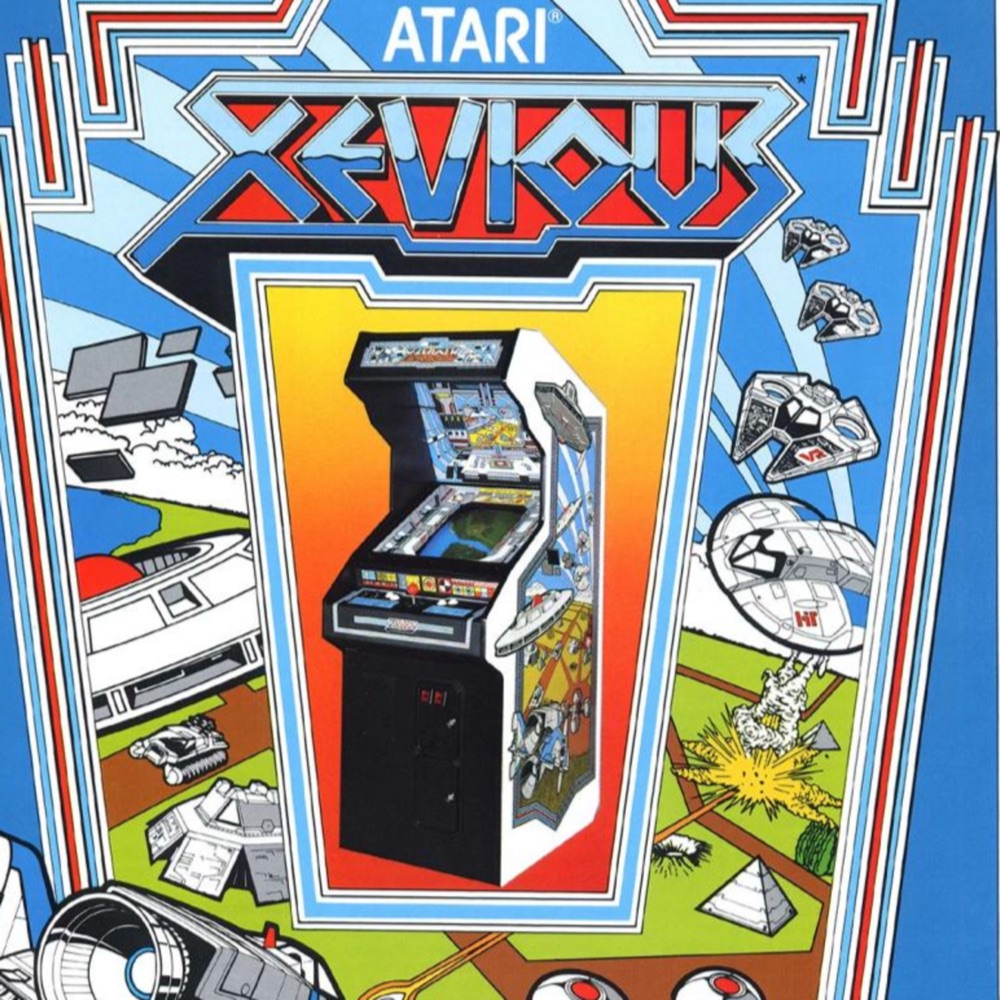
The Xevians are returning to claim the Earth as their own. Only you and your sensational Solvalu super ship can hope to penetrate their defenses and save the planet. Battle your way through air and ground targets, avoid the menacing flying mirrors, and destroy the immense Mother Ship.
SHOW NOTES
Xevious Longplay
Scramble
Super Xevious
Xevious: Fardraut Saga
3 Part Novelization
Xevious 3D/G
Lost Xevious Film
Nintendo Power Sep/Oct 88
Namco made this for Bandai in 1988. It is an early arcade shmup with no real updates for the NES beyond a new subtitle, "The Avenger," and we spent the first few minutes failing to work out who the Avenger is. We found it primitive, and only pleasing if you are playing for nostalgia.
What works
- The bomb reticle. You shoot air enemies and bomb land ones, and a reticle shows where your bombs will land. That is more information than some other shmups give you.
- A few bright spots. Your ship is the only nice sprite work, and Andor Genesis, the manual's name for the big bases, is a cool boss name.
What doesn't
- It looks like Microsoft Paint. It is the cleanest looking game on the system, to a fault: straight lines, solid colors, zero texture. It also looks like an Intellivision game, and that is not a compliment.
- Bullets that find you. Every enemy aims at wherever you are, so you have to keep moving. Sean argued that this is a design decision, not a fault, though it is less fun than learning patterns.
- Walls of tiny bullets. Andor Genesis is the only time the screen stops scrolling, and Joe called it one of the most difficult shmup bosses we've faced, double volcano included. Everything fires the same bullets, with no variety in size, movement or speed, so they pile up into walls with one tiny door to squeeze through.
- Lopsided difficulty. Dense firepower, then three minutes of easy, then incredibly hard again.
- A thin enemy list. There are fewer than a dozen enemy types, and after about three minutes you have seen them all.
Worth knowing
- No stages. The game loops back to the beginning without interruption, and the music is a tiny loop, under a second by our guess.
- The mystery cube. Sometimes a cube comes in front of you, puts things next to your ship, and goes away. At first it looked like a power-up, then it never did anything. Nobody could say what it was for.
- The history. The Famicom version came out in 1984 and sold over 1.26 million copies. We got the same game in 1988, and it did not repeat that success in America. The spinoffs include a three-part novelization, a CG film that is considered lost, and a pachinko machine.
The bottom line
Skip it. Nobody voted it onto the Essential Games List. Sean called it primitive, with not much else to say. Joe, who isn't a shmup fan, put it on the lower end of the shmups we've had and called it a little overly simple. We're not offended that it exists, but we can't see it as full value for an NES game in 1988, let alone now.
Written from our conversation in this episode.
- MISSION: Seek and destroy xevious enemy aircraft and bases
- Introductions
- This is like Galaga
- Early arcade game
- New subtitle
- No real updates
- Overview
- An early arcade shmup that has you pitted against dozens of enemy spaceships. The game take place without interruption and loops back to the beginning after completing a loop
- Gameplay
- The Solvalou
- Shooting vs Bombing
- Did you like the lock on?
- Shooting vs Bombing
- Too basic?
- Graphics
- No Power Ups
- Limited Enemies
- Andor Genesis
- The Solvalou
- Development
- This game was designed to compete with Konami’s successful SCRAMBLE
- The player's ship, the Solvalou, is based on the Nostromo space tug from Alien, while several of the enemies are homages to starships from popular science fiction works, including Star Wars, UFO and Battlestar Galactica.
- Xevious was an unprecedented success for Namco in Japan, said to have sold as many arcade units as Space Invaders in its first few weeks of release. The Famicom version became the console's first killer app with over 1.26 million copies sold.
- The same success did not happen in America
- Sequels and Spinoffs
- Super Xevious - Arcade 84
- An updated version of Xevious made to cater towards veteran players
- Xevious: Fardraut Saga - MSX2 88
- Includes the original Xevious alongside a brand-new game mode, featuring power-ups and new enemy types.
- THERE WAS A 3 PART NOVELIZATION
- Xevious 3D/G
- Same ol Xevious now with low poly backgrounds (still 2D shmup)
- LOST XEVIOUS FILM - CG 2002
- CR Xevious
- Pachinko Machine
- Super Xevious - Arcade 84
- EGL
- Why these games aren’t a good value
- 11:20 phone call on Joe’s file
Auto-generated transcript. Each paragraph starts with its timestamp. Speakers are not identified.
Xevious, the Avenger. Mission, seek and destroy Xevious enemy aircraft and bases.
Inclusive music music
And welcome to NEStalgia, a chronological exploration of every NES game released in North America. I'm Mike. I'm Sean. And I'm Joe. How we feeling today, guys? What's good, what's good?
I feel spectacular, Michael. I mean, how could you not feel great after playing Xevious? I feel like I don't usually just check in with you guys as a general temperature thing. No, I do appreciate it. I do appreciate that you actually think about us beyond just vectors for making a podcast, you know? Right. Well, we've known each other for a long time outside the podcast, but we've never spoken since we started the podcast. Ever since then, it's been strictly business for the three of us. So it's good to hear that you're both well. Anybody have children or anything like that? Nope. Okay. No children yet.
All right. So, you know, this is like that Galaga Demons of Death game that we got earlier. And before you guys tell me why, I'm going to tell you why. It's because this is an early arcade game. They added a new subtitle to it, The Avenger, Xevious the Avenger. I don't know who that is. Is that like a member of Captain America's team? It is Captain America. Xevious is the Avenger, yeah. So Xevious is the Avenger, or did Xevious like take down the Avengers? And just took their name? Well, because Xevious is the enemy aircrafts, right? So like Xevious isn't the Avenger, right? We are the Avengers. I thought Xevious was just like, they're all devious, you know?
Ooh, I like that. I didn't notice the rhyme there. Yeah. So if Xevious is the enemy aircraft, then there's no way to spin it that you're the Avenger. The bad guys are the Avenger. Right. That's what you would have to think. Yeah, I didn't realize. And the reason why I say that, Joe, is just because it's right on the front of the box, is that the mission is to seek and destroy Xevious enemy aircraft and bases. There's no commas, there's no periods that would like make you think that they're separate from each other.
Those Xevious are the enemy aircrafts. Or maybe it's that like they are the Xevious Avenger, like they avenge because of the Xevious. But it says Xevious the Avenger. Okay. Not Xevious Avenger. That's true. You know what? You're right. And also, it could be talking about, it could just be referring to the game. Like, it's just referring to itself. Like, you gotta take out those Xevious enemies. It's like if Mario was like, you gotta take out those Super Mario Goombas.
Right. Whereas, like, with Galaga, they were the demons of death. And that was very clearly communicated to the player. Where I knew right away from just starting up the first level, I was like, those are the demons of death. True. It's true. It's unclear who the Avengers is here. Yeah, it's true. And also, you know, the biggest reason why this is like Galaga is because there are no real updates to this game. Similar to how there were no real updates from the arcade to the NES port of Galaga. You know, this feels like I'm playing an arcade game from the early 80s. Do you guys disagree? Very much so.
So, like, of course, like, we're finally getting back to our bread and butter, which is just shmups. And for a while there, it was like, oh, maybe there's more to the NES than shmups. Like, oh, we got a bunch of game shows now. Like, at least this is different. But, you know, they always seem to find a way to take you back. And, like, Xevious is our unhappy return, I feel.
I was actually surprised that Wheel of Fortune didn't turn out to be a shmup. It probably has a shmup minigame hidden in there somewhere. That's what you would have been doing with the Porsche. It would have been like a Spy Hunter shmup. Exactly. You know, there was a... I'll give an overview of Xevious first, but I feel like we did get an actual updated version of Xevious as a previous NES game. I want to say something like Tiger Heli came close to being, like, what an actual modern Xevious would be. But Xevious is an early arcade shmup that has you pitted against dozens of enemy spaceships. And I don't know what to call them, but the things that take place on land, they're like bases almost. They're like vehicles. Artillery. Yeah.
And the game takes place entirely without interruption. There's no, like, stage one or stage two. It just loops back to the beginning after you complete a loop. Sounds very enthralling. Mm-hmm. Yeah. In fact, the music doesn't even interrupt itself from that one tiny little loop. Yeah, I think it's like a 0.8 second loop. Yeah. It really is, like, almost hypnotic.
And so Tiger Heli was the game I was thinking of, but that one doesn't... You can shoot on the land bases and even things in sea with your ammo. So what's the game I'm thinking of there that, like, lets you attack, like, in the air with land, but... Oh, it was Stinger, right? I think so. I think there were a few. I think there were a couple, haven't there? Yeah. There was a few that do that. Didn't that helicopter one? Well, that's Tiger Heli. Oh, Tiger Heli. Yeah, that's right. Okay. Yes. So Tiger Heli, not essential. Stinger, essential.
Yeah. Got it. Yeah, I don't really know what makes Xevious special as an NES game. Is this just... Do you think this is a thing that, like, this was put on the system because it was a very... And truly, it was a very popular arcade game back in the early 80s. And maybe, like, someone finally now wants it for their home because arcade machines are, like, you know, $2,000 or... I'm making numbers, but, like, you know, they're very expensive and it's, like, finally we can give it to them on the NES, right? Like, is that the logic? That's really all... That's all I can think of as a reason because there are enough of these experiences on the system already, like, as we've notified.
But I guess this specific game hasn't been on here yet. So it's just, yeah, any classic, they have to fill out their catalog. But that's just me as somebody that has never played the arcade game Xevious and not really knowing the full experience. No, I'm telling you, it's this. It's this, Sean. It's just this. I've played it and it is this. Even graphically, it looks very much like this. Wow. Well, that's all I can think of then.
I think that that is exactly what happened. Like, it's just for people who loved it in the arcade, like you said, they want to own it. But I also think another factor that might factor in is just that in 1988, gamers, like, general gamers didn't have, like, the collective knowledge that we have now of every other game that's out.
And, like, you buy a game, you're like, oh, this is a cool game where you fly a ship and you shoot. You're not really, like, aware of, you're not really thinking, like, oh, man, there's been so many of these. I imagine you wouldn't be so aware because you just didn't have access to every game. And you weren't watching videos of the games you didn't own. And you weren't, like, you know, you had the games that you owned and the games that your friends owned. So maybe it was, like, it was a lot more forgivable for there to be so many similar games because you just had less access to them.
I'd say I agree with that. And, you know, we're in a particular time period for video gaming right now with remakes, remasters, and ports, like, the fine line between those three things and what they are. And I think it would just be funny to think about Xevious here. And it's, like, from a purist perspective, is it better that they left this game mostly untouched for fans of Xevious as an NES thing? Like, should they have added a separate mode or, like, should they have modeled it after the other shmups that are on this system and included, like, stages and power-ups? Or was this just, like, this is just for the purists? I think there's two ways of looking at that.
You know, I think you just kind of spelled them out there, too. I think if you want this because you loved it in the arcade and you want to go back and play your favorite game, I don't think you want... You think you want to, like, just play that again? Because, you know, how much access to, like, the arcade version do you have? But then there's also... I think there's a lot of...
I don't know. There could be a lot of desire for, like, an updated version of it. I loved that game back then. How does it age now compared to games that I've played since? I think it's just a preference. When it comes to home ports of arcade games, it's sort of been a crapshoot when it comes to quality and how well it actually remakes the experience. Or, like, how well it ports the experience. And if this is as much of a one-to-one port as you're saying, Mike, I would say that, yeah, if I was a fan of this game in the arcades, I would be more than happy to play it as is at home without spending dollars of quarters just to keep going. So I guess that's one way to look at it.
Yeah, and even from, like, a purist's point of view, you know, going off of what Sean was saying there, even Nintendo can't seem to get their arcade ports exactly right, with Donkey Kong being limited to missing an entire stage of that arcade game. So there's definitely, you know, a thinking here, where I think Joe was touching upon, where people don't know everything that's happened in video games like we do now, you know? And we're kind of obsessive about it. I'm not sure, like, the general gamer knows this stuff either.
But, you know, for some people, they would buy Xevious, not know that there was an arcade game in the early, like, you know, 10 years earlier, and they would enjoy this game. They wouldn't really find many problems with it because they didn't own all the other shmups that were on the NES.
Yeah. I think that because we have the entire catalog in front of us, we can, we make a lot of different judgments that players may not have made back when they were being released. So having played through the game, would you say that if you had spent money on this and knowing what you know, you would feel burned, no? I guess, like, if I didn't have a special relationship with Xevious Arcade, I wouldn't be all that pleased with what I got.
Because this is just, it seems like another bare-bones shmup, like another, like, template shmup that didn't get all of the bells and whistles that the new ones, or the newer ideas usually get. I don't know how you guys felt. Yeah, I agree. I think that the only way that you're pleased, really pleased with this purchase is if you set out, like, for nostalgic reasons, you wanted to play this old game, you know, completely, fully will keep my interest for a long time.
And so let's get into that actual gameplay. You know, there's really, the thing that sets it apart from some other shmups is that thing we talked about where there's shooting and there's bombing.
You bomb the land enemies and you shoot the aerial enemies. There's a weird, like, lock-on system for that where you can see where your bombs are going to land, but you can't move or control that. It's just like, if a land enemy happens to be in that crosshair, that's your perfect time to bomb them? It's basically a reticle. And it's, it, I wouldn't imagine that you could adjust it. Like, if you treat it as, like, the reticle in a first-person shooter nowadays, like, you can't move your crosshair. You just have to put your enemy in the crosshair. So I think that that's totally fine.
And I guess it is unique, at least in that it gives you that information, unlike, I think, maybe Tiger Heli and some of the other shmups. Just, like, you just had to eyeball it. Right. Were those ones, were you actually dropping bombs and they would hit at a certain point? Or would, if an enemy on the ground crossed over the trajectory of your bomb, That's more for games like Gradius and Life Force. Yeah, the side ones. With the missiles, yeah. Right, right. But there were some where you had to bomb directly.
Right. Yeah, it would, like, go over their head if it wasn't that distance away. Gotcha. Yeah, the crosshair didn't bother me too much. Maybe it's just because we're not used to it. It was a little weird. It just, maybe, and also because it's, like, on an NES game,
everything's just so much clunkier than we're used to, that, like, having a crosshair that is, like, the exact, almost the same size of your ship moving at this, it felt like it, like, clutters the screen a little bit. But that's me kind of looking for, like, things wrong with it. Otherwise, like, it didn't, I don't think it was too bad. Well, sort of, on that note, just talking about the visual look of this game,
it is sort of, it's sort of unique in that it's got this, like, pseudo vector thing going on where it is super clean. It's the cleanest looking game that I've seen on this system to a fault, where it's basically just straight lines and solid colors. And I think that any busyness that you would see with, like, this extra reticle is completely countered by the fact that most of this game has zero texture.
Yeah, I'm glad you put it that way, too, because I was trying to find that, like, trying to really, like, articulate my, what was grabbing me about, like, what felt off about this. And it was kind of like what you said, was that the,
it's so, it's so... It's, like, clean. Yeah. Yeah, it's so clean that, like, it's all solid colors that it, at first it looks like, wow, this is, like, really bright and colorful. And, like, there's no, like, weird glitchy textures, which, you know, things that might look kind of crappy on the NES. But then because there's none of that texture stuff, it almost looks like, it looks like something I would have made in, like, Microsoft Paint is what I keep thinking of. Like, it looks really, really, like,
maybe it's because we're just conditioned to remember that kind of stuff from, like, our old computers, but it just looks very, like, like a kid drew it, you know? Yeah, even the enemy, the enemy art, it's mostly just circles with bullet, like, with things that bullets come out of in the center. Right. Yeah, and you don't even see, like, an actual spot for where those bullets might come out. They just come from the center of every single enemy. There's no ship design per se.
And, yeah, really the only, like, nice sprite work is your ship, which makes sense because it's on there the whole time. But I have this weird feeling of, like, looking at the, you know, like, looking at the ground, and it just keeps giving me this idea of, like, baseball fields.
Yeah. I can kind of see that. And there's also this whole thing of, like, I don't know, you guys didn't own an Intellivision or an Atari, right? You guys didn't have those? You don't know me. No. Okay. Well, I had a pretty extensive Intellivision collection for some reason. Wow. This game kind of looks like an Intellivision game, and that's not a compliment. No, I mean, I'm not saying that it's nice. I'm just saying that it looks, yeah, too clean. But, yeah, I know what you're saying.
And, Joe, you had mentioned a long time ago on our Star Force episode, I don't know if you remember that game or not, but Star Force was the shmup with no power-ups. And you said, I could see this as more of, like, for a purist, you know, or somebody who just wants to learn how to be good at shmups.
Does that change at all for you for Xevious? I think for Xevious it does change because this isn't, like, a particularly, in my opinion, as someone who doesn't like shmups in general, this isn't a particularly fun one. I thought I could see Star Force being more, I don't know, it feels like more of a challenge. It still feels like a little more of a traditional shmup. I mean, this feels, you're just moving very slowly. You've got that repetitive music. A lot of the, maybe it's because I'm not good at it, but a lot of the firepower coming at you, to me, felt so much harder to dodge between than in other games we've had. Oh, yeah. Like, it's harder to see. It's really dense.
It just, I don't know, I wasn't getting it from this. Yeah, it's still a very difficult game, so I don't know if, like, that whole Star Force is more of a challenge statement is all that true. But at least, I can't remember Star Force, but I can only imagine it had a little bit more personality than this one. I wouldn't say that I'm trying to say that Star Force was more challenging. I think it's just more that it was challenging in the ways that it was, like, designed to be challenging, and not, like, this one's challenging because it's just, like, crazy stuff's coming at you too much, or, like, it felt like there was a little more intent in what was making Star Force challenging, basing this off of my limited memory of what that was.
But that's how I remember feeling about it by the time. Yeah, did you guys notice that, you know, the way that enemies attack you, it's very, uh, it's kind of poorly designed, I'm going to throw it out there, because it's all OEs in relation to where you currently are. So if you are on, like, the far right corner, and you drag yourself along from right to left,
all of the bullets that come at you from any particular enemy will follow that same curve with you, and yeah, they might eventually catch up with you or something, but I just think it's weird that their only point of target is just wherever you currently are. There's no, like, enemy that shoots this way, that, like, then comes around the other way, you know? Like, we've seen patterns and shmups, and this one just seems to be more guaranteed to be, like, wherever you are, that's where we're coming for. Yeah, I noticed that too, because what stuck out to me was that you have to constantly be moving back and forth, because if you stay in, like, one point,
all of the firepower will just be concentrated on you, and if you wait too long, there's, like, almost no way to get past it, because it's all coming at you. I mean... So I felt like you had to just constantly be moving around and just, like, in, like... You could even move in circles and avoid this stuff, you know? I'm not gonna say that, like, this is a great game in terms of game design, but I will at least say that that is a design decision. Like, for it to be... To make sure that you have to keep moving, I'm not gonna say that that's an intrinsically bad thing about the game. It may not be as enjoyable than learning patterns and then just sort of, like, staying out of that pattern's way,
but I think that it's not a fault of the game that it's, like, sort of tracking you. I think that that is its own kind of game. Sure. Yeah, I see your point there. Yeah, I think that's fair. I was just trying... I was just saying it was an observation more than anything. I definitely think that's a valid point of yours to say that that was a design decision. You have to... It's not a random chance. You have to program them to do so. Yeah. Did anybody notice that... Not to jump ahead to, I guess, what we would... I don't know if you'd even call them boss battles, but those giant things in the ground, I guess they're boss battles. You're talking about Andor Genesis? Excuse me? I suppose.
That's what they're called in the manual. It's the big boss, the big base, if you will. Andor Genesis. And that's the only time your screen stops scrolling is when you have to deal with Andor Genesis, which I think is just such a cool name, so I'm going to keep saying it. Joe, what were your thoughts on it? Well, I was going to say that that is where, I think the culmination of what we're talking about here is where I really noticed it. I thought that was one of the most difficult shmup bosses we've ever faced, including the double volcano from... Double volcano.
Yeah. What about upside down double volcano? Yeah. Let's not go too far. But it was... But again, I mean, I guess to Sean's point, it is not necessarily bad design. It was just so difficult because
it was just like, it felt like constant walls of these tiny little balls of bullets or whatever they are. And there was like almost no room to get through there. And it just felt like there was nowhere to go. Like they were just, everything was honing in on you. And it like didn't give you anything to work with.
Again, maybe that's just because I'm not great at this game, but I feel like that was like difficult in a way that was like... No, it definitely was. I didn't feel like I could come up with like a good strategy. I just had to kind of really just like hope and like dodge as best I can. But... Yeah, I agree that it was very difficult. And I think part of the reason why it's so difficult is because there's no variety in terms of like the shit that's being shot at you. Like everything, whether it's like these floating bowling balls
that dip into and out of space or the giant bosses, they're all shooting these same bullets at you with no variety as to like how big they are, how they move, how fast they are. And when you just pile on and it's just like dozens of bullets in the air all going at you, I think that that's sort of like lazy design and also just it overwhelms the player. I mean, yeah, there are a lot of people that are very good at this game, but I... It just seems broken in that regard where it's like these bosses are... It's just too much. I don't know.
Yeah, and Andor Genesis has me thinking about like the spray of these bullets too because we're used to, in most of our shmup games, but especially in the good ones, we're used to a spray on these bullets that allows you to kind of weave through them. And that's not the case here because as Sean mentioned, the bullets are so small,
the projectiles, whatever you want to call them, they're so small. And there is chance for overlapping and stuff like that that in some ways, they kind of create like a wall that blocks you off from moving in a particular direction. And you have to... There's no dodging. It's more like just, you know, like moving against the grain of the shooting. Mm-hmm. Yeah, and just making sure that you get into that one tiny like door.
Right. And I don't know. Yeah. Yeah, and I also noticed that there were like points that were really difficult, like aside from the boss battles, really difficult because there's dense firepower everywhere. And then there'd be like long periods of time that felt like a rest, which isn't necessarily bad, but just felt like the difficulty was very lopsided where like sometimes it would be like, oh my God, I'll never get past this part. And then like for the next, you know, three minutes, it's like really easy. And then it's incredibly hard again.
It just felt like, and maybe that is partially because it has to do with where you're flying and when things are shooting at you, but it just didn't feel like it was getting progressively more difficult. It just felt like it was like, sometimes it's really hard and sometimes it's not so hard. I think it's just a, like a not so perfect implementation of like the concept quiet time, which exists more in like more modern games and less in arcades because you're paying for like this high adrenaline experience. But I don't think it's a, it's a necessarily bad thing that there are these weird lulls, but the timing and spacing of those lulls is, yeah, erratic at that.
Did you guys happen to notice the way that some of the spaceships are designed? You know, they kind of resemble some other science fiction works, like the X-Wings from Star Wars. Apparently, there's some Battlestar Galactica inspired ships as well. There's the UFOs, which are just, you know, the common saucer things. They, you know, they acknowledge this in their, in their development process. They said that they pretty much use those X-Wings as models and stuff. I don't mind that at all, but I do think it's kind of weird to have like these homages to so many different sci-fi works all in one piece.
Yeah, I, I guess I didn't really notice just because they're so small and moving so fast that you can't, aside from these weird, like, they look like CDs just flying in the air that are, I think it's your first enemy.
I couldn't really tell the difference between them. Aside, yeah, aside from the, the other weird bowling balls that would just like phase in and out of existence. Right. The, the X-Wings you, I would notice at least because, um, that's just something very familiar to me, but also they are the most aggressive. They, they come in from the top and they, they kind of just come at like top speed directly at you. They're the only enemy like that. Most, most enemies come in either from the sides or they stay on screen for a while. The X-Wings just kind of fly by and then that's it.
Huh. What about the, uh, what about the tumbling rectangular gray boards? Yeah. What sci-fi is that? I think that's, uh, like what I want to say, I don't know if it is, but it, they look very much like monoliths. That's what I was going to say from 2001. Space Odyssey, yeah. Oh, gotcha. I didn't expect that there would be an answer to that, but that's a good, that's a good point. Yeah, no, that's what I was thinking too
and that's funny. you know, but there's, but there's limited amounts of enemies too. It's not like, you know, if they wanted to embrace all these different science fiction works, there's, there's countless spaceships they could have designed, but there's really only, you know, I want to say like, we keep saying the word dozen, but I feel like there's less than a dozen different enemy types that you can face. Yeah. Yeah, I'd say so. And I feel like at first, like early in the game, it feels like, wow, they keep introducing new things. But then after like, like after like three minutes, you're like, oh, that's everything. Like they've introduced everything. Like, I feel like things don't really
ramp up too much more than you get from the beginning. And then it's just like, you're just going through more of that. And to be fair, that's, that's something Sean covered. You know, he said that you're paying in the arcade, you're paying for that experience to all happen to you very quickly. You want that rush. You know, they don't want somebody who hangs out for 20 minutes playing the machine. Yeah, that's true. At least on the same quarter. Right. And they especially want to make sure that they get that iconic, Xevious, weird, like, 1990s GPS map to fly over to.
Well, so this game was developed by Namco. It was pretty much their answer to Konami's Scramble, which I don't think we'll ever get an NES port of, but it would be very similar to Xevious right here now, where after we've been spoiled with some good Konami shmups, we don't really want to go back to something like Scramble. At least that's my opinion. I think I can agree with that.
The player's ship in this game is named the Salvalu, and I don't know what that... Yeah, I'm not sure how to pronounce it. Right. I don't know why that's important or anything, but great, there's lore for Xevious now, too. I hope everybody takes that information and does whatever they want with it. I don't want more lore for these smups. I don't understand. Xevious was an unprecedented success for Namco in Japan, and they said that they might have sold as many arcade units as Space Invaders in its first week of release. Wow. The Famicom version became the console's first major seller for third parties with over 1.26 million copies sold. That's insanity. That's like rock star movement.
Right. So, the crazy thing there is that the Famicom version of this, which is the same game, came out in 1984. We're getting the same game now in America in 1988. Yeah, it seems that there's some weird mistimings here, but that always seems to be the case when we get these arcade ports. Yeah. The same success, though, did not happen in America.
This NES game and just the arcade game in general didn't quite take off the same way that Namco would have liked compared to, like, how Space Invaders dominated in both Japan and America. So, you know, if you're a famous arcade game that sold, you know, a million and a quarter copies, like, you're gonna have sequels and spinoffs. Surely you guys expected this, right? Of course. I always expect there to be sequels and spinoffs to games that fail. So, if this was successful,
I can't imagine how many there are. Tell us, Mike. Look at Assassin's Creed. That series just keeps going. This is my favorite part of the podcast. Because it's like a history lesson for you. You don't have to say anything. You just get to react. I just go, wow. All right. So, we're gonna start this thing in 1984. The follow-up arcade game to Xevious, Super Xevious, would come out. It's an updated version of Xevious made to cater towards veteran players. Do you think that's a mistake?
I mean, if there are that many veteran players, then I don't think it's too bad of a move. You think, like, focusing on the hardcore element of it instead of, like, making it more accessible? Like, you know what I'm saying? I guess... Yeah, I mean, veteran gamers would never have fallen for the scam of the Super Nintendo, which is obviously a few to get more money.
I don't know. I guess it's not something that would make sense in, like, a market sense, but it's something that we always sort of hoped that developers would do, so I don't know. Great. Maybe not the best idea. And then on the MSX2 in 1988, same time as Xevious comes to North America on the NES, we have Xevious Fardro Saga. It includes the original Xevious alongside a brand new game mode featuring power-ups and new enemy type.
Finally got to the party. Got to, like, a real shmup, essentially, now. Yeah, it caught up to what people were doing years ago. You know, more importantly, there is a three-part novelization of Xevious the Fardro Saga. Oh my god. So if you really want the deep lore, you can read the three-part novel to understand the Xevious Saga.
Do you think, you know, I think what I have in the show notes here is a link to Amazon or something like that where you can buy them. Do you think you'll be buying them, Sean? No, you're actually going to link an Amazon.com. Like, so we're now just, we're shilling for a book series from the 80s. Okay, well, you know what? I just found this place called
Shuruga-Yah.com and that's definitely not Amazon. So we'll link them instead. That might have viruses, you know? Yep, it could be yours for 244 Hong Kong dollars. So I'd say if you want the three-part novelization, now's the time. Xevious 3D slash G.
I mean, kid you not, Tetsuya Nomura. This is a Kingdom Hearts game. I was going to say, Tetsuya Nomura did not direct this game. It has nothing to do. The naming convention is, it's just basically Xevious 3D slash G is the same old Xevious that we're used to now with low-poly backgrounds on the PlayStation 1. Okay, I guess I can kind of see how that might look considering these are it's like low-texture map backgrounds in the NES. So it's just like FF7 zero texture mapping on these, like just green. Completely. Love it. Except for, sorry, no, something important about Xevious 3DG is that it wouldn't be green. It took place in space. Ah. So there's no ground. Cool. Yeah. Of course. Then we have a lost Xevious film.
It was going to be, it was going to be a CG film in 2002 that I believe what I'll be linking to is from the Lost Media Wiki that has a few screenshots of it for people to check out. But there's also the plot and the production and stuff like that. The crazy part is is that this existed. Like it was made. We just don't have a copy of it anymore. than did it ever exist. Was it, was it, it was made and released? Made and released. And, uh, the only thing we have now are just like a promotional disc that mentions the film.
Uh, someone's got to have it out there. Yeah. Someone's going to have taped it. Send us your tape, listeners. Yeah, this is crazy. Yeah, there's, there's posters for the movie. There's an untranslated overview of the plot. And you're saying, well, just to confirm, you're saying that this movie doesn't exist in any form anymore. It's lost. It is considered lost. And it, uh, it was initially announced in February of 2002.
That's an, that's amazing. Apparently after that, a lost film, right? And after that, it was planned for VHS and DVD release, but never came out. That's because they lost it. Right. I think that's, I think that's crazy. But also, Sean, if you're into this kind of thing, I would just say, check out the lost media wiki in general, because there's way too much lost media out there. Yeah. I've gotten down a couple of rabbit holes on lost media wiki. I've never done that. I'll check it out though. Yeah. You'll have a good time with that. And of course, just like all video games will eventually become
Xevious ends its life cycle at CR Xevious, the pachinko machine. Of course. It's only a matter of time until we get Super Mario, pachinko, if we don't have that already. I'm not familiar with it. I don't think they would want Mario and gambling to be mixed together, but eventually it will happen. Make no mistake. I can't wait. All right. We are done with our sequels and spinoffs section. Sean, I expect in the post-show you'll talk about the novelization, considering you're familiar with it. Of course. Good. Read them all. Then right now, we will get into the Essential Games list.
Okay. Sean, I need your vote for the Essential Games list because we always vote here in America. That's true. You have to exercise your right. So go ahead. So basically, what we've been saying this whole time is that the game is primitive and really,
that's all you could really say about it. There's not much else that is interesting to talk about. Therefore, it is not essential. It will not be on the list. But, you know, I'll have to start reading those books. I think that's like the new tagline is like, yeah, the game sucks, but I gotta start reading those books. Whereas, like, I always said the opposite about the Harry Potter game. So I was like, yeah, those books suck, but I gotta play Chamber of Secrets on GameCube. You know, I really want that RPG to come out. I've never read the books.
Well, I'm sure that RPG, just like the next Batman Arkham game, just like the next Prince of Persia game, just like the next Star Fox game, are all just right around the corner. Yeah, of course. 2020 is gonna be the year, guys. Absolutely. Assuming the murder hornets become developers. Anyway, anyway, Joe, you have a vote too, so please vote. Yeah, I mean, even among the collection of shmups that we've gotten so far, this is on the lower end of it for me,
and that's tough because I'm not a shmup fan anyway, so to be on the low end of the shmups is not a great look. Again, that might just be because of my shmup bias, but that aside, I do think, Sean, you kind of summed it up pretty well. It's just a little overly simple. There's nothing really to it. I gotta say, not essential. Yeah, I think what this really comes down to is that I don't feel like even at the time, this game is offering a good value.
You know, we talked about very early on that this might just be for people who were fans of the arcade game, and I think that's fine. I'm not offended by the game's existence. I just can't see this being a full value NES game in 1988, let alone now. It's a super early arcade game that got a late port on the NES. They added a subtitle on it to trick some people into thinking that they might be getting something new. There's no real updates going on with this game. game. The graphics are very simple. No power-ups, limited amounts of enemies,
and or Genesis is a really cool boss name, and yeah, I like seeing the X-Wing in the game, but that's not going to do it for me. This is not making the essential games list. I do have a quick aside. Please. It's more a question, but sometimes during this game, there would be a weird like cube thing that would come in front of you and sort of
put things next to your ship, and then it would just go away. Do we know what that was? What that was for? I personally have no idea. I remember seeing that now, but I don't remember ever. I don't remember if I knew what the purpose was. For a second, I thought it was an actual power-up, and then it never did anything. So I just thought that was worth mentioning, like at least trying to figure it out. You know what? Yeah, we can solve this together, and the best way to do that is for our listeners to write in and tell us that we completely missed the mark on this, and that, in fact, the game's graphics are great because the borders between the game areas are indicated by forests.
That is something that they're actually told in the manual. You are, and you know, it's more just like the borders of the game area are the edges of your television. Yeah, you know, I looked for you, Sean, here, and I still don't really see, I see a winning strategies section where Xevious troops become increasingly fierce. To defend against them, you must destroy the enemy information system, Solbeck. You know what? I also read the manual, and I thought, since it was in the manual, I might ask my friends, and you are completely
losing me here. Yes, I understand. Well, I feel like anybody, you know, this is a good manual to go to sleep to, so there's really nothing saving the day over here. The audiobook is good to sleep. Yeah, yeah, the audiobook of the manual. That's a great idea. Somebody makes an audiobook of, like, the, you know, 742 NES manuals. If only we knew somebody that made audiobook. Yeah, well, someday. All right, this has been it for this episode, but I've got some bad news for Joe, and probably some bad news for Sean, because our next game, the game we'll be playing next week, which you should all play along to, is 1943, The Battle of Midway, the sequel to, you guessed it, the year 1942.
They always follow sequential. Wow. Yeah, it's gonna be a good time, guys. I like 1943, that's my spoiler alert, but, you know, you'll have to tune into the episode to see if it makes it to the Essential Games list. Well, you just tell us now, Mike. You already wrote
the script, so tell us. I know, right, right, but would we really, like, have that many shmups on the Essential Games list? Of course. This is gonna become shmup-stalgia by the end of this. That's true. All right, one thing to note is that I have, you know, we're at the end of September of 1988 here, and I have the September 1988 Nintendo Power open because, you know, it's their only chance to follow along, but there's just not a lot of interesting stuff happening in here, so we're gonna deal with this in the post-show if anybody wants to come join.
That happens after the song, which is created by Sam Smith, the former resident of Nostalgia, but still friend, and, yeah, that's pretty much it. So we'll see you guys next time. I'm Michael Esposito, you can reach Nostalgia at NostalgiaCast, and you can reach me at Esposito Film. Those are both on Twitter. I'll talk to you soon. Bye. All right, so as I mentioned, you know, for this post-show, we're just gonna talk about Nintendo Power September of 1988. It's also, like, slash October, so there's a bit of, like, a Halloween theme going on here. Castlevania 2 is getting the front cover, and it's way cooler than the
Mario Clay stuff they did on Nintendo Power number one. So I know you guys don't have a copy of this readily available to you. You don't know that. Oh, okay, great. I happen to own a copy of Nintendo Power number one. I think that's worth throwing out there. Yeah, how much is it worth in real money? Where do you live? Yeah, where do you live? What's cool, though, is, I mean, like, you know, this is Nintendo Power, which, you know, you would think is aimed more towards kids, but right on the front cover there, you have Simon
Belmont holding Dracula's head, and it's just, like, an all-red cover. Like, it's just, like, the whole thing is designed to be pretty gritty. I like it. I thought you were gonna tell me that it was Simon Belmont and, like, a Speedo or something. Right, right. A romper. And, you know, that's one thing to open with, like, a really, you know, like, a really cool cover like that, where it's all bloody and gory and, like, oh, it's gonna be an intense Halloween issue or something like that. And then, immediately when you open it, there's a kid with, like,
30 NES games on a surfboard riding a fake tidal wave, and he's got, like, cheap $1 sunglasses on. So, the vibe is all over the place on this issue, but the thing that we're... It's the 90s. Right. Sorry, the 80s. Yeah, it's the 80s, but the early 90s are pretty much the late 80s, right? Yeah, yeah. Yeah. So, the thing that we're gonna get into here is the mailbox section, because I'm gonna read to you guys what people wrote, and rather than telling you what Nintendo said, you guys can respond to them, okay?
Mm-hmm. Okay. Alright. This comes from Justin, Ryan, Cameron, Jeremy, and that's it, and they are in Kansas. They write, my friends and I have been wondering if we could make a game and send our idea to your company. Okay. Do you think Nintendo would allow that? Yeah, I think they just said, okay. I'd be... So, this is what I would say. I would say, I'll have you know that it is much harder to make a video game than what a bunch of Kansas kids can do. Right, right. Specifically kids from Kansas. Yeah.
Anywhere else, you're good. You know, I think it's funny too because they didn't even, maybe they were afraid that someone was going to steal their game or something, but they implied that they were going to make a game and then they said at the end, like, oh, but we'll send an idea. Like, that's not the same thing.
Yeah, they want, it's like they want, we want you to make the game. It's like, we're going to make a game and they just send like a log line. Like, please make this. I would like the idea to just have been like Super Mario Brothers 2. Like, that's, this is my idea. Can you guys make this? I remember when I was in middle school, it was, you know, the Xbox was out and we were playing a lot of mech assault and a couple friends and I were just like drawing like mechs that like we had the idea of. It was just like,
like, oh, this would be a cool mech and it would have this kind of gun and it'd be like this, this interesting to play as. And then one of my friends was like, you think we could send this to Xbox and see if we could get these made? And I mean, I understand that thought that kids may have had. What did Nintendo Power say to these kids? They said, we are always glad that our video games are stimulating the imaginations of our players. Unfortunately, for various legal reasons, we are not allowed to use our proposal, your proposals or send them to our product development people in Japan. Just like humble brag that all of their people are in Japan, too.
You know, Sean, it's funny that you touched upon that like making a game thing, though, because I'm sure that's like things that everybody has gone through, right? Like, Joe, you must have at one point in your childhood designed a video game in your head. I used to like trying to design Pokemon regions. Like, this is what the gym leaders would be. And these are the routes. And, you know, here's the Elite Four. That's cute. I thought that was fun. I mean, I liked, I liked Star Fox 64. But I didn't love it as much as the fact that I designed a whole game that was just basically Star Fox 64 again, but with my characters and my planets in them.
Ooh, who was your character? No, I can't remember anything. I just remember that I would like design the tree. No, I'm serious. I would like design this tree system. I think his name was like his name was like Ray, R-E-Y, like in Star, like the Star Wars character. But I did it, you know, 20 years before them. So you should be getting paid royalty. Right, I have to just find that character. So to be clear, you're taking credit for the Star Wars sequel trilogy. I don't think anybody would proudly do that. I just have to say you're the person, for better or worse, to point the finger at. All right, this next question comes from Michael Hawthorne in Texas.
And he writes, I have heard Icarus from Kid Icarus pronounced many ways. How do you pronounce it? Well, I think we know how you do now, Mike. You do, but how do you pronounce it? How do you do? So in the magazine, did they spell it out phonetically, how he spelled it? Nope, they just wrote it exactly the same way. Well, then I guess they would just say, we pronounce it Icarus.
Like, just the word. That would be honestly like a funny, like, troll move for them to do, just be like, Icarus, and just spell it out. But like, what else could I have thought of? Like, he said he's heard it many ways. The only other way I can think of is Icarus. Yeah. Icarus, Icarus. Icaruga. But he should understand what Icarus is, and it's not something that Nintendo made up. Why didn't he just Google it? Yeah.
Loser. Next one. Texas loser. A little controversial from Brian here. He doesn't list where he lives. He says, do your Nintendo tapes only last five years? Does it matter if you set them on chairs or if you put the controllers on the floor? What the fuck? This is my favorite one. I've often wondered if it matters if I put my tapes on chairs.
Or your controllers on the floor. Like, they have to be on the floor at some time, right? At no point, is he playing the floor as lava with his controllers? Yeah, if they do touch the floor, that means you get seven years of bad luck. Did they answer with, like, you put your tapes on chairs? Like, really, like, frantic? Get them off!
Tapes on chairs. No, they didn't go that crazy. They immediately started off by letting everyone else who's not in the know know that the term tape is a slang term for game cartridges. But they just go on to say that they do not recommend placing a cartridge or any part of the game where it could be sat or stepped on. So, they are advising against chairs. Yeah, I guess that's fair. Evil chairs. Alright, let's see. Do we have one more?
Well, we have this punch-out poem from Paul Woods. Mike Tyson's... Where's he from? He's from Jamesville, Wisconsin. Okay. Okay? Just making sure. This is his punch-out poem. Mike Tyson's great. The man in black. He's got more power than Little Mac. He can really go when he gets in the ring. He starts his move when the bell goes ding. To get in the ring to play the best, first you have to beat the rest. You think Mike Tyson can't be beat, but if you have this strength, you can knock him off his feet. That kid is now a best-selling author
that has made many poetry collections and has read them aloud at many a campus for money. I would agree with that assessment. Joe, do you think he has any future or had a future now that he's significantly older? I just need a moment. Oh, okay. It's okay. It really got me.
It's okay, Joe. You know, and no more questions here, but I think it's important to just go over what was in the fans' minds as their top five games on the NES. And so at this point in time, and this covers every game that's been released, their top five is number one, The Legend of Zelda, still. Number two, Mike Tyson's Punch-Out!! Number three, Metroid. Number four, Super Mario Bros. And still kicking it, with me at least, number five, Kid Icarus. Or Icarus. Or Icaruga. Whatever you say.
So this is their, this is some kids' This is actually, this is a very interesting thing where they take the, they take the players' picks, the pros' picks, and the dealers' picks, and they merge them together.
Okay. I guess that makes sense. And aggregate them, yeah. I still will never understand the Kid Icarus thing, but. Well, you know, it's always telling when you can see what the dealers' picks are, which is on the next page, because they like, show you a breakdown of how the points are totaled. And the dealers' picks, what I love about them, is it's just like, whatever isn't selling that well, like, let's make sure that goes up high. Like, RBI Baseball is their number one NES game.
Wow. I love it. Better than, better than the Legend of Zelda, which falls to number three, but Kid Icarus is number two. Did you guys lose me? Wow, no. No, I just stunned. I have to navigate the same silence. Okay, good. You know what? I think that's actually a great point to end then, just like, but Kid Icarus is still number two. All right, we'll end there. I'm going to stop recording.