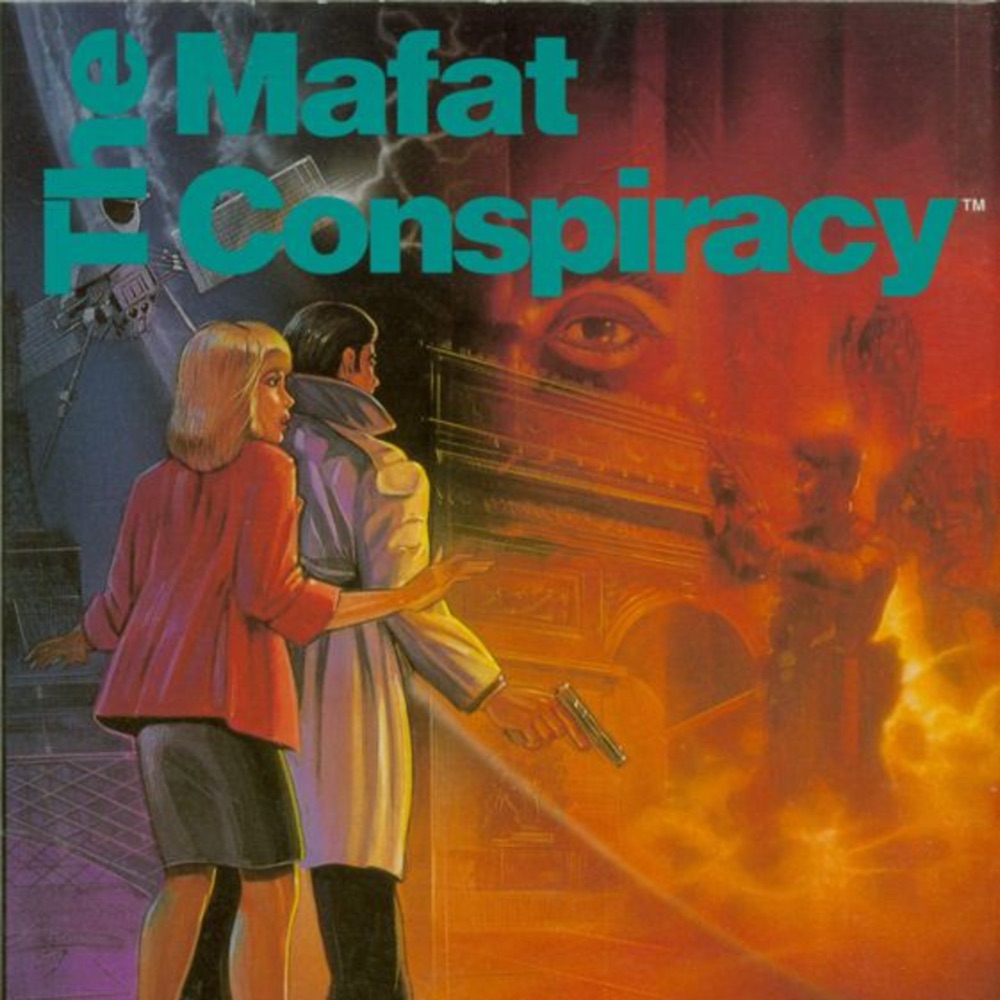
323 · The Mafat Conspiracy
You play as Golgo 13 aka Duke Togo, ace sharpshooter and assassin. Based off a character of various manga comics, Golgo is a down-to-business man at the end of a gun. Stuck in the world of espionage among such groups as the FBI and the CIA, Golgo is constantly in mortal danger, and a lethal weapon in his own right.
The Mafat Conspiracy is the sequel to the NES game Top Secret Episode. In this chapter, Golgo must track down a missing satellite from the SDI laser defense system, as well as rescue a top scientist and stop those who would use the satellite for blackmail and terror on the world's nations.
The back of the box promises "a phantasmagoria of action and interaction," and nowhere does it say Golgo 13. It follows the first Golgo 13, which we played in episode 115 and liked. Mike, Sean and Joe were on this one, and we admire how cinematic it is but missed what made the first fun.
What works
- It tells a story. A stolen "Star Wars" satellite (Reagan's SDI), the KGB and CIA blaming each other, terrorists demanding a nuclear submarine. A purple skeleton gets its head shot off before every chapter, and the game ends on a headshot of a man walking away, papers flying. It's the most graphically violent game since the first Golgo 13, Bionic Commando's exploding Hitler aside.
- Smart small choices. With a gun, the game decides whether to shoot or kick by how close the enemy is. Golgo strolls through gunfights with his hands in his pockets, newspaper readers never attack, and Select skips cutscenes.
- A tidy ending. Sean liked the finale: the woman from earlier turns up at your house dying, a driving stage follows, then a last sniping mission against your former partner. Cringe, he said, but it fits together.
What drags
- Linear, and thinner. The first game was semi open, with people to talk to. Here the side-scrolling stages are walk right and fight, and the plot lives in long cutscenes of talking heads and exposition. The manual calls these "standard action screens," which says nothing with a lot of words.
- The labyrinths. The 3D mazes are huge, multi-story, and easy to get lost in; one stray D-pad tap and you don't know which way you face. We ended up on GameFAQs for a map, then had to backtrack out on a time limit. The manual prints the maps, so why not the game? Sean called them unforgivable.
- Timers everywhere. Stages, mazes and driving all have them, and we asked what the rush is in a story game.
- Controls shift. Jump is A on scrolling stages and up on the pad on the stationary screens, with kick on B and punch on A.
- Driving and sniping. The Rad Racer style driving has a three-gear manual shift we liked, but the time limit needs near-perfect runs. Sniping is one input, accounting for wind, and rare.
Beyond the game
Golgo 13 is a manga running since 1968, and Joe noted the name nods to Golgotha, which explains the skeleton in a crown of thorns. The only Golgo game after this is on the Philips CD-i, which might suit a visual-novel format.
The bottom line
Skip it. We all voted no, as with the first game. The mix of action, mazes and driving gets weaker combined, since no part is a breakthrough. Sean still likes the game, and without the labyrinths it might have been on the fence, but they're most of the frustration. Joe said the first one was a jack-of-all-trades, while this is master of none, and it didn't live up to it.
Written from our conversation in this episode.
- Caution! Opening this box unleashes an awesome adventure
- NES Longplay
- Manual
- The back of the box also refers to the Mafat Conspiracy as a Phantasmagoria of Action and interaction
- DEFINITION - a constantly shifting complex succession of things seen or imagined
- The intro goes hard though. Golgo sniping off a purple skeleton. We’ve transcended the reality of the first game.
- Golgo 13
- Mafat Plot
- A “star wars” satellite has been stolen
- KGB and CIA blame each other
- It’s up to Golgo 13 (AKA DUKE) to recapture the satellite and stop nuclear war…a bit like Metal Gear Solid with FOXHOUND threatening to launch the nukes and the actual actions of the US Government being called into question
- Gameplay
- More linear
- Standard Action Screens
- The lack of any detective sleuthing here. Just get to the end to advance the game
- When you get a gun, it defaults to shooting unless you get close enough and then it knows to kick. Pretty cool intuitive design rather than having to switch out the gun for melee or assigning another button
- Game starts off pretty fair, then the Ninjas show up and it’s a little more bombarding
- 3D Maze Levels
- Oh no!
- No map, no sense of direction. Better grab paper
- OR better use the maps in the manual. I wonder how many Mafat manuals have writing on the maps
- Enemies are quick. You don’t have to aim but you do have to input on d-pad if they aren’t dead center
- 3D Driving Levels
- They took the Mach Rider, Rad Racer approach for 3D driving
- Manual gear shift
- Sniper Levels
- Wind and direction affect aim
- You can skip cutscenes with select
- Pretty modern feature
- Sequels and spinoffs
- The only Golgo 13 game released after this is a game for the Philips CD-I just titled Golgo 13
- EGL
- Next week - Mechanized Attack
- NEStalgia Byte
Auto-generated transcript. Each paragraph starts with its timestamp. Speakers are not identified.
The Moffat Conspiracy. Caution, opening this box unleashes an awesome adventure.
And welcome to NEStalgia, a chronological exploration of every NES game released in North America. I'm Mike. I'm Sean. And I'm Joe. The back of the box, which talks about opening the box, which is nice. I don't know how many times we've ever had that happen on the show. It knows it's a box. It's sentient.
Right. And it knows to warn you too. Like most boxes that are sentient you would think would be like, open me, open me. But this one's like, you got to think about what you're about to get into if you want to deal with me. I don't know. I felt like that was like the most generic back of the box because it can imply that it has nothing to do with the game. Like, and in fact, it's kind of very out of the tone of the game. Oh, couldn't an awesome adventure only apply to the Moffat Conspiracy? Oh, that's true. This is the first awesome adventure we've had. The back of the box. The Soviets. The Soviets are here.
The back of the box also refers to the Moffat Conspiracy as a phantasmagoria of action and interaction. So it really knows how to say nothing with a lot. Is this just because like maybe a year or two prior there was a movie called phantasmagoria? Was there like a time where phantasmagoria as a word was in the cultural zeitgeist? If it wasn't now, when was it? If not now, then when? Because think about it. Phantasmagoria, that might be the only time on the NES that that word is uttered.
So wait, you're telling me there's no phantasmagoria like tie in game we're going to play? Unfortunately, Sean, I was going to talk to you about this offline. But yes, there is no phantasmagoria NES game. But there is a phantasmagoria video game just for whatever that's worth. It's on Steam. It's a point and click adventure. Maybe it was just a video game and never a movie. I'm not really sure. Yeah, it was released by Sierra in 1995. Okay, so it hasn't happened yet. See, I'm getting all my old stuff. It's fine. So this game coined the term. There you go.
Phantasmagoria, of course, a constantly shifting complex succession of things seen or imagined. That, I, I, look, the Moffat conspiracy tells a story similar to how the first Goal Go 13 game, you know, like, had some pretty cool cut scenes and world building and everything. There's no doubt about it. Like, this is more cinematic than most NES games. But a constantly shifting complex succession of things imagined. I'm not sure. Is it saying succession? Yeah. Succession? Yes, that's the word. Okay, good. All right.
You wanted me to say suck out loud? Mark this down for the 400th episode trivia. Yeah. I'm just from, you know, the regional dialect where we don't, two C's don't make a K. Ah, I see. Yep. They make an S.
Well, I mean, so it is a succession of different kinds of way to play a video game. I'll hand them that. And while I might be, you know, knocking it a little bit for using such a big word, maybe that's my own problem. Because the intro goes pretty hard. You know, you got, you have Goal Go sniping a purple skeleton. And that might not be something that ever happens in the game. But already, like, that's like, I'm signing up for what the game's putting down. Yeah, it's pretty, like, graphic. And it made me think, and I don't think this is true, but I was initially, my initial thought was that this must have been a human head, like, in the Japanese version, and we censored it to a skeleton. Because there's no skeletons in this game.
But, uh. Oh, that's interesting. Because usually the Japanese are not cool with any kind of decapitation. I guess that's true. I guess I was just thinking, not so much so specifically, like, what they censor and what they don't. I was just thinking, we normally get censored because there's more nudity or more swearing or more stuff in other, in Japanese games. But yeah. Yeah, it's funny that you don't ever come into contact with a, uh, with a skeleton. Because, uh, it happens before every chapter. Like, the same, the same skeleton gets its head blown off.
And you'd think that if it's going to be that kind of repetition, there'd be a moment like, oh, I'm gonna shoot the skeleton's head off in the game. Yeah, I mean, we can confirm that, I mean, I'm guessing you don't come into contact with a skeleton in the entirety of this game. But I didn't come into contact with a skeleton. Yes, I think, I think it's confirmed that there are no skeleton monsters. Hmm. There are no skeleton monsters. Just KGB agents.
No skeleton monsters in the game. However, I don't know why we would do this at the beginning of the episode, but spoiler alert for the end of the game. Uh, you do, uh, snipe a guy in the back of the head as, as the game, as like the ending of the game. It's brutal. It's the last thing you must do. You must successfully headshot, uh, as he's, he's walking away from you and you have to do it. Yeah. And then the credits roll with his bloody head. Just, I mean, it's like a wide shot too. So like you see the blood, but you also just see that he's clearly dead. Papers are flying everywhere. It's, it's beautiful actually. And it just, again, it shows that there's a little more cinematic storytelling going on here.
And, uh, I mentioned that this is Golgo 13. It's funny that the, you know, the game didn't really want you to know that the game is the box is just says the Moffat conspiracy. Nowhere on the box does it say Golgo 13.
It's only once you get to the manual or the actual, you know, uh, in-game cut scenes that you realize, oh, it's Golgo 13 again. We played that a while ago. Maybe not everybody because back then kids just played whatever was available to them, but we played Golgo 13 and we were pretty high on that. Right guys. Yeah. I think that it's, it's still stands alone in what it did, not in terms of like quality or anything, but it stands alone in how much it paid attention to story and, uh, how mature the themes are. Like this is still the most like raunchy and graphically violent.
I think video game on the NES since Golgo 13. And I don't mean that in like a, like, oh, there's tons of blood and guts and stuff, but like what, what Mike just described, like just sort of like the, uh, the blase nature of like shooting a guy in the head and sort of lingering on that. And so, yeah, it's, it's, it's something.
Yeah. I mean, I'd also say that it stands alone ish in the, in its sense that it like the variety of types of gameplay in the original Golgo 13. Cause if I remember correctly, there's the side scrolling levels. Then there's like the, you're, you have like a three 60, like first person shooter level where you're shooting, you know, kind of like on rails, sort of like you're shooting, shooting people around the city. And then, then there's the 3d maze area. There's a shmup area. There was a missing one too, but there were, there were like stuff. There were like at least five or six different gameplay types in that one game.
Yes. And, uh, just to finish one thought before, uh, we move along, uh, tangent related to what we were talking about, Sean, uh, not the most, uh, violent game since Golgo 13. I think that honor has to go to Bionic Commando, which ended with Hitler's face exploding, which is just a little cooler than anybody else's head exploding. That's true. When Hitler's head explodes. You're right. Uh, but, but to get back on topic, what's interesting is, uh, you know, we liked Golgo 13 a lot. Didn't get onto the essential games list, but we did talk about just like we're talking about now, how cutting edge it was.
Uh, the Moffat conspiracy keeps the idea of like contextual gameplay based on like what the story requires. So sometimes you're driving a car and you're in these like 3d racing scenes. Other times you're, uh, exploring a building and that goes back to the 3d maze levels. And sometimes you're just doing the side scrolling action, uh, stages, which are pretty casually. Yeah. Casual.
Um, but all of this is now presented in like a, okay. A linear fashion, right. Of like first do this stage, then go to the next stage. Golgo 13 was like a almost semi open world game. And so it's, it's interesting that they thought, you know, like to make this more cohesive, we actually have to simplify it. I guess I don't remember having all that much choice in the original, but it has been a while.
Well, I'm being kind to, that's why I said semi open world. Like you, you can go into buildings and stuff like that. Whereas in this game, when you go, when you go into a building, it's at the end of the stage and it, it prompts you into the next section.
If you know, you know what I'm putting down. There are a couple of buildings that you could go into like before the end. I mean, there's nothing in them except for like one guy. Yeah. There's like a guy and like, uh, like some health or some ammo or something. But yeah, every, every level sort of, not every level, but there are at least three big buildings that you have to walk through. And a bunch of little ones that you can, you can walk through. Mm-hmm. Uh, to go over the plot for a second. Uh, this is taken directly from the manual. Uh, this is a, a Star Wars satellite has been stolen. Yes. What is this? What's a Star Wars satellite?
Does it have R2-D2? It's like Reagan's thing. Yeah. It's Reagan's thing. Okay. The, uh, like they, they mentioned SDI. Yes, they do. I don't remember what that. Strategic defense initiative. Yeah. Strategic defense initiative. Um, but like it, it got like the moniker of Star Wars because it was going to be, you know, shooting nuclear missiles out of the sky. That was what it was kind of called. Oh, okay. So this is like a real life thing. Yeah. I thought, I thought, and I, I know this mostly from the movie Kingsman, but I mean, I do remember it a little bit, but I thought it was called the Star Wars initiative.
Like, I thought that was like, well, that's just combining both. Yeah. That's just combining the SDI and Star Wars together. Um, no, that's interesting because, you know, there's a lot of, you know, it's a, it's set in our reality. You have the KGB and the CIA blaming each other for whatever's happening in the game. Turns out that it's actually, um, you know, a group of terrorists that are behind it all. And they're demanding the American government, give them a submarine, uh, that also has nuclear warheads on it.
And I'm going to turn to our Metal Gear expert, uh, Sean here for a second and just ask you, you can say however you want, however much you want, but then there's a bit, I'm not saying they copied. I'm just saying a bit familiar to Metal Gear Solid with Foxhound, like threatening to launch the nukes and the actual actions of the U S government kind of being called into question of like a, you know, why is Snake getting involved and is it a setup? Is it not? Who funded Foxhound kind of thing? Is that what we're getting here with the Moffat conspiracy?
I would say that both Metal Gear, um, and Golgo 13 in general have the same, uh, have the same predecessors that they're drawing from. Okay. And so, yeah, I'd say there's a lot of similarities between like the basic story of both. It wasn't even the, even the original Golgo 13 kind of that premise. I mean, not, not with a satellite, but wasn't it like somebody with like, somebody took out a plane or something, but it was like the only person that, the only person that could have done it was you. Was Golgo. Yeah. They, they, they pin it on him and then.
13, I think is his name. Yes. Uh, well, his actual name is Duke Togo. Yeah. Duke Togo. Or Duke Togo. It's a mercy for him. Yeah. We'll call him Golgo 13. It's like, do you call, see, but you don't call James Bond always 007. James Bond's kind of cool. Duke Togo is like. No, you can do 00. Yeah. Hey, 00. Give me old 00 on the phone. I actually had that when we were kids and you know, you, when you're a kid, you role play every franchise that you're interested in, like Dragon Ball Z and every, you know, Pokemon, whatever. For a while we were into, uh, 007 and we assigned each other like code names. And one of my friends was 006 and I was 00 double. And I thought that that was. 00 double.
Not even like a number, just taking the double part and being like, that's what gets referenced. 00 double. That's great. Uh, yeah. I, I mostly role played, um, like Glenn Gary, Glenn Ross. Uh, that was what I would do with my friends. I mean, I was, I was every, every property that, that I watched was, was role played at some point. Uh, getting back. Yep. No, I'm not done yet. Um, the, uh, no, I'm done. Yeah. Eventually you just role played being John Malkovich.
Yeah, I did do that. Uh, okay. So, uh, to get back to the Metal Gear Solid thing for a second, I did have a point with that. It wasn't just to say like who copied who or who was drawing inspiration from. Um, cause it also kind of lays down in that same fashion, the, the more movie-esque, uh, approach to the video game of like, yeah, you're doing, you're having some fun with the gameplay and everything, but it's mostly short bursts of whatever you're doing, the platforming, the racing. Uh, unfortunately we wish the mazes were short bursts.
They're not, but there's nothing, you know, there's nothing being conveyed while you're playing. And then it's like, here comes the plot and it's actually like, you know, it's, it's heavy stuff. And, and I think Metal Gear Solid is guilty of that as well. And even the Metal Gear games that we've played are, are, are, uh, on the NES are in that vein. So, um, Vic Takai and Golgo 13 and the Moffat conspiracy are all, um, in, in a category of video games that I would put closer to movies than say, um, Super Mario Brothers, which is more in the pure joy category.
You know? And, and I'd say that like, I might've mentioned this in the Golgo episode, the first one. Um, but it, it's just funny how a game can, can, I mean, this is not a, a crazy complex plot or all of that deep of a story, but it's crazy when you go from, oh, you got to stop the Czar Blacksians from blowing up the, the, the galaxy and you're the only one that can do it and yada yada. And it's just a bunch of made up words as proper nouns.
And, and then there's this and it's just funny that even back then there was still that, uh, uh, within the game space, that kind of variety. And it, it's funny. It's just funny. Yeah. I mean, there's, I, I'm the kind of person that, you know, especially growing up, I always love heavy storied video games and I, I, I live for the cut scenes. Like that's what I'm playing for half the time.
You know, I just, um, I'm not sure that some of these cut scenes though, like gave me that, gave me that same feeling. I, I was finding myself after a while being like, okay, like, like, I don't know. It was just a little bit of like of a drone of a story to me. I, I did get kind of, especially because if you compare it to something like Ninja Gaiden, where it's like, yes, it has similar, like beautiful cut scenes and, and like in that
ridiculous aspect ratio that makes it look really cool and stuff. But the Ninja Gaiden, it's all like animated, like a comic book and it's like action. And this is honestly a lot of talking heads back and forth. Uh, a lot of their lips to move, which is awesome. But it's a, it's a lot of exposition on, on a lot of text on screen. Getting into the gameplay, uh, what I was referring to is the side-scrolling action levels.
The manual refers to as the standard action screens. And I find that, again, to just be a way to say, uh, nothing with a lot, uh, like most of the manuals details. Would, would you ever think to call any of these things standard action screens? Like, is that, is that a terminology? Yeah. I think that this is sort of the default way to move around a fake space in a video game right now. Like, you're probably gonna lean, like, overhead-ish, um, like, like a Zelda 1.
Or you're gonna go side-scrolling. And I think more often than not, it's, it's the side-scrolling. And so this is a standard action scene. Yeah, I, I, I think it, I think it holds up. It fits. But, uh, I do think it's funny that as, uh, maybe it's just because, you know, we're, we're living in 2024, but, like, today something new happens and the next day there's a name for it and everybody in the world knows it.
But we're, we're, we're, we're like 25 years into, like, video games here and, like, still nobody has names for any of these things. We're like, they're all making it up every time. Yeah. Today, the standard action scene would be a third person with a camera that you can control and freely move around and just move your character with the left analog stick. And that's, like, what 90% of games are now. So that's the standard action scene.
And a few comments on these standard action screens. You have, uh, basically you're just going left to right. Once you get to the end of the, once you get to the end of the right, once you can go no further, you've completed the stage along the way, there will be enemies in your way, but there is a lack of any, uh, detective sleuthing or, you know, information, you know, you just basically like, this is the most dangerous streets in the world because only people around are people with guns. And I say that specifically because in GoGo 13, you could talk to people in these standard action screens. And so that's kind of what I say about, you know, making it more linear and more straightforward.
These are really just combat, uh, sequences from left to right. And so it's fine that there isn't any, you know, detective work going on. It's all happening in the cut scenes.
Uh, on the positive side though, I did think that it was cool that when you start off, you're just, uh, you know, uh, punching and kicking, but when you get a gun, it defaults to shooting with the bullets unless you get close enough and then it knows to kick. And I think that's pretty cool that rather than having to like go into a menu, um, uh, or assign a different button, it just is like the game just decides for you based on proximity to the enemy, whether you will, uh, use one of your bullets, which, you know, uh, can run out or whether you can kick. Uh, I just thought that that was like, oh yeah, this is a noticeable enhancement from other games where like, once you get the gun, you just shoot people point blank.
Yeah. I guess this is more or less just across the board, whether it's the overall structure of the game or something as minute as the specific button presses for combat. Like it's just streamlining, uh, from Golgo 13, the first one, whichever, whatever subtitle that one had. Yeah. Oh, top secret episode. It did have. Ah, yes. Um, I actually sort of took that for granted. I did notice it, but like, I didn't think that much of it until right now. I'm realizing that that is pretty cool, but we haven't really seen that, uh, that kind of thing yet.
Yeah. And you could see them being like, oh, well, how would we deal with that in a different game? Like A would be to punch and B would be for the gun. And now up to jump, you have to press up on the D pad. Right. And it's like, nobody wants that. Nobody wants up on the D pad for jump. Just saying. Isn't that, isn't it already up on the D pad to jump in this game? Probably. It's been a minute. Is it? I don't think I ever did that then. I thought that. Maybe not. It's the A button to jump.
Okay. Uh, I, but you know, the fact that there's no longer any like non-punnel, combatants in this game, uh, they, they didn't like change how like casual you are in like actually playing, because I think you're walking with like your hand in your pocket and you've got like quite the, uh, uh, quite the graceful step. So I just, I thought that was weird. Yeah. I actually thought that that was super cool. It is cool. You look like such a cool guy. Just walking, hands in your pocket and just kind of like smoothly shooting at your enemies. You're not worried. You're not rattled.
You're what you're walking. Everyone else is running around. You're, you've just got like this like stride, you know? I think, uh, you had a stride. You're hit, man. Yeah. I think you had a stride like that in, um, Dr. Jekyll and Mr. Hyde too. We, we couldn't stop, uh, praising it for that.
Any game with a stride in it. Yeah. And speaking of just walking very coolly, uh, nobody else on the streets cares either. Not that you can talk to them or anything, but there's just like guys reading the newspaper. It's like, whatever, you know, like most people would run away when they hear a bullet, but. It's so funny though, that they have this guy, they have guys reading the newspaper and you think of like all the tropes of spy fiction and they don't jump out and try and fight you. I was waiting for that. Me too. I was like so afraid of all of them. I was like, oh my God, they're going to attack. And like, oh, they're playing the long game. Like they're going to eventually attack and they never did. Good news.
Nobody was wrong when it comes to how you jump in the game. It's both. It's both, but dependent on of course, what kind of screen you're on because the manual breaks down, uh, really strangely. It breaks down like in, in a table where the columns are the button you press and the rows are the kind of screen you're in. And so on the stages we were just talking about, you jump with the aid button, but on the stationary screens, as they refer to them, the ones that don't scroll, the ones where you're like inside a building, but not in the maze, uh, those, uh, now you kick with B punch with a and jump with the up button. Very unfortunate.
Very. Because it just feels like, you know, was, so let's talk about the, those stationary screens for a moment. Was anything enhanced by switching this, the controller that way? Was it confusing? Are we just talking about like boss fights? Is that, because that's the, yeah, essentially. Yeah. All right. I've never been one. Sorry. Go ahead, Joe. No, you go for it. Okay. I've never been one to really hate on being jump because there's only so much, there's only so many buttons and it's, it's intuitive enough.
So, and you know, when I play smash, I press up to jump. So I'm okay with it. I mean, in terms of like, like, I don't, I don't blame every developer for making up jump, but I just don't think it feels as good. Like it doesn't feel as natural or as smooth. Um, even I always remember, and I don't play a ton of smash, but I do always remember playing smash. That would always bother me a little bit. I don't know how you would do it otherwise, but, uh, it just, it just never, maybe it's just, I'm so used to something on like my right hand being the jump. Well, X and Y are also jump on smash, which is crazy that there's three buttons for jump.
Um, I don't know. I know that really threw you off. You weren't expecting to hear that. I'm like, I don't know. I was going to say something before, but I don't remember what it was, but that's okay. And, uh, after that are the, uh, you enter buildings after a certain amount of time and now you're in the 3d maze levels. Oh no. Uh, we hate, we hate these in any game for what it's worth. We're just not into this. I'm sure back then it was kind of cool tech and it was expected in a lot of computer games, but, um, for whatever reason, even especially in these Golgo games, why is there like loading when you're turning around and stuff? Like I didn't know, I didn't know NES games could have that.
I, I think that just might be the amount of time it takes to completely draw a new screen. I believe that is what's happening. But I, uh, I'll never understand what, what people saw in this stuff. Like, yeah, yeah. At first it's cool, but now that we've seen it in so many games and they never, aside from, oh shit, what was that adventure game that we put on the essential games list? Uh, there's a few, um, it's okay. Like point and click one, right? Point and click one. Like that one. I love it too. I can't think of the name.
Uh, Mike, can you just like, uh, say right here in shadow game is shadow. There it is. Okay. All right. So that one, um, was cool because yeah, you're walking around, but it's not just like a repeated texture of no texture. There's like actual things to interact with. Like there's set dressing. Whereas this is just a, a flat labyrinth and it's never going to look different. You're going to see the same doors. You're going to walk past the same enemies. Um, and you're not in a dungeon. You're in a, you're in like an office building. It shouldn't look like this.
Yeah. Well, if, if, but if you were to make it, uh, you know, texture it and, you know, put stuff in it, you wouldn't be able to make it 40,000 screens long. So I thought I could just brute force this stuff. So I was like, all right, I'll just keep going in directions until I get to something. And then I was doing that for too long. And I'm like, fine, I'm going to game FAQs. And I was just flabbergasted by how big these, these labyrinths were and how they have several stories. And I guess, yes, you're supposed to draw maps. Like this isn't a time where half the fun is drawing your own map, but I don't like drawing maps. So I had to read a map to get through it.
Also in, in, in this context, like if you make like, if you make one wrong move on that map draw or like, or you just like accidentally hit a button and you don't remember what you hit. Yeah. You're lost. You don't know which way you're facing anymore. You don't know which way. I guess you have the compass. But like, it's, it's easy to get lost as my, as my point. But, uh, I did the same thing. I tried to brute force it, went to find a map and I was just like, there's no way this is. And then I finally got through it and then like, you know, not to jump too far ahead, but then like later on in that same level, it's like, all right, now go back out. And now there's a time limit. And I'm like, are you kidding me right now?
I got to do all that again on a time limit. But because even with the map, like it was, I did have like satisfaction sometimes. I was like, Oh, this is cool. Like I'm getting through it and everything. But like, it was so tedious. It was so tedious. Even with the map. This proved to me that it's very easy to understand how people get lost in the catacombs or in a desert. Like you will just lose, you know, your sense of place to Joe's point. Even if you just like accidentally press the D pad in a certain direction and don't catch it. Like now you're screwed. Like you don't even know which direction you're facing.
Sean, you mentioned that you could draw a map or look a map up. The Moffat conspiracy manual was a little ahead and was saying, don't worry, we'll make the maps for you. And all the maps. Yeah. All the maps are in the game, including 3D models next to them. But I'm being generous with 3D. It's just like cubes stacked on top of each other to explain. Well, then what's the point of making them?
Right. That's what I'm saying is like, if you can do it in the manual, can't you just do it in the game too? Can't you show us like a map if we like are somewhere and it's like you are here, right? Like you don't have to tell me where I need to go, but at least tell me where I am and where, you know, like where the doors are or something. It's not that hard and it's not that fun as it is. So I think the worst thing is, is that forget that we don't like maze levels. Forget that it's really hard to, it's really easy to get lost and really hard to know where you're supposed to be going.
Because there's no like, you know, in Zelda when you get the compass, now you know where the boss is or whatever. There's nothing like that in this game where it's like, you have to just get this thing and then you know which door you're supposed to head to. Instead, you just have to keep trying to find whatever it is you were looking for. And I guarantee by the time you even find it, you're like, what was I doing? Oh, right. And then on top of that, the enemies inside the building are pretty quick.
Yeah, that was also a pain in the ass. And I don't, it's only there so you can't just stare at the map and press button inputs. Like you always have to keep, keep your eyes open. And I don't know, I just find it more frustrating than challenging combined with everything else we've been saying. And then for a different kind of 3D, we have the 3D, pseudo 3D driving levels. They kind of took that Mach Rider, Rad Racer approach for 3D driving.
But they also have a manual gear shift for the car. That's pretty cool. I think it was pretty cool. I like that. No, yeah. I think it's like, it is just kind of making sure that the game stays hard across different stages, right? Like, knowing that most of us drive automatic here. Not even just the three of us, I'm just talking about in general. Well, it's funny that like, I gotta learn, how'd you learn manual? The Moffat conspiracy on NES.
It's actually how I learned to walk through office buildings too. Yes, yes. It is still like, it is still hard though. Like, not so much, like driving isn't difficult, but you kind of have to be really good and almost perfect to make the time limit. Not that there needs to be a time limit in most of these situations. Well, that's a good point, Sean. There's a time limit in nearly everything we've experienced so far. There's a time limit in the action screens. There's a time limit at the end of the mazes. There's a time limit in these driving things. What's the rush if they're trying to tell us a story? I think it needs to get to the really long cut scenes.
I guess one could argue that everything going on in this game is of great urgency. And so you need to do it fast. But like, what's the difference between, unless you're literally putting the controller down and walking away, I don't think it's really that immersion breaking to get to the end of a driving section in two minutes and 30 seconds, as opposed to two minutes. But that's just me. No, you're right. That is a sensible response. That's one thing that I'm glad that video games have sort of moved away from, is the arbitrary time limit that are on a lot of things. I mean, even Mario games and stuff. I'm already playing the game. Like, you don't need... Everything doesn't need to be a race.
So, like, I was happy that... Or I would be happy, rather, with this game doing away with the time limits altogether. But I also, if I remember correctly, the original GoGo13, I'm not sure if it had a time limit, but, like, your health drained automatically, constantly. At least in the, uh, whatever it's called. The main overall... Oh, isn't... In the deep lore, isn't... Isn't he just, like, bleeding out the whole time? Is that true? I don't know. So, like, all that to say, like, at least... I'm glad they didn't do that this time.
Anything else on the driving, though? I just want to be clear, uh, the manual gear shift isn't, like, you have to spec out... It's not Gran Turismo style, like, you're not upgrading the car and tuning it and setting, um, the transmission yourself. It's just a, a one, two, three, uh, gears that you change around.
That's all it needs to be. Yeah, exactly. That's all it needs to be. I just want to make it clear. It's not as difficult as, like, you know, learning manual, uh, in, say, what I did with Gran Turismo 7, where I was like, oh, you actually have to drive manual if you want to be faster. And then I'm sure that if you ever put me in a real car, I would destroy the car with the manual transmission because I've learned reckless behaviors that I can get away with in a game like Gran Turismo 7.
All right. We're just going to keep moving along to the different kinds of screens you can get to. All the different, all the screens you can see in this game, you better believe we're going to cover them. Next up, the sniper levels. Uh, it's funny calling them a level. It's really just a hit this thing or don't. Uh, there's not, there's not really much more to it. It's not like you have to clear off a bunch of things or, um, use a light gun. One input. You make one input and it's over. Um. Yes. But what's that, what's the twist? What, and it's not the twist really because it was in the first game, but what makes it so hard, Sean?
Because, uh, in this version of our planet, the atmosphere is very, very thick. So any change in wind direction is going to carry your bullet miles from where you meant to put it. So, uh, yeah, there's like, you just have to account for wind and that's it. And unlike our reality, uh, they are not on a flat earth. They, you know, so there's some curvature there and I think that's explaining it. Whereas on ours, obviously the bullet just continues in a straight line. Yeah. Very Euclidean. Oh no, that would be on the curved one. Or an infinite Taurus.
Uh, but, but is it challenging? Like once you kind of, you're going to miss your first shot probably, but like once you learn how to do the sniping, is it one of those things that like, now I'm good at this or is there still always potential room for error and it becomes a source of frustration? I don't, I don't think. Let me ask you, how often do you have to snipe? Exactly. Not often. But I'm actually asking. I think. I'm not making a, is it, when's the first time? I thought it was three for some reason. Maybe it is three. It's two or three. How far into the game is the first time? It's like halfway through the game.
Okay. Cause I didn't snipe anyone. It's after you finished the driving sequence. I believe. Yeah. So. So you couldn't get over the manual shift is what you said. Yeah. Right. I didn't know man, I didn't know how to drive manual. Well, honestly, before the driving sequence, I was already like, I knew that there was a driving section. So I was like, I gotta get to that at least. But, uh, well, the maze alone is seven hours.
So the time that I was, the time that I was ready to like check out was when I got to the center of that first maze or the center, whatever the thing I'm trying to get to on the fourth floor. And then it's like, all right, go back to the time limit. And I was like, okay, I don't even want to play this game anymore, but just because of that part. But so, but yeah, to answer your question and to elaborate on your question, uh, no, you don't, you don't do it very often. And so I don't think there is enough time to get good at it. Or if it's something that like, it's basically you get the one trick and you kind of eyeball it and then you're done.
Another ahead of its time feature. You can press select during cut scenes to skip them. I mean, that's so ahead of its time, right? Like just think about it. There's certain games that still won't let you skip the cut scenes. The speed running community for this game must, must be huge or not. The speed run of this game would be so boring to watch.
Joe, I want to ask you, how did you remember that about GoGo 13? Uh, the first game and the health draining. Did you realize that he was a vampire who kills in order to gain more health? He has to kill enemies. I know it's crazy for me to remember that because I don't, I could, couldn't remember Shadowgate. Right. That's what I'm saying. Or I don't remember anything. Um, but no, I did. I just sort of like revisited some footage of that game, uh, this week, you know, in preparation for this podcast. Watch the tape. Out of the usual for me, uh, out of the ordinary for me.
And it seems like we didn't get far enough along in the game to fully complete it, but it seems like you guys have an understanding. GoGo 13, we're now, uh, two games into his, uh, his world. He has obviously a whole, um... I love that it's still his name is GoGo 13. Right, right. Um, just like, is that a cool character? Is he, is he a cool dude? He is a cool dude. He's a great strut. He's so cool. Like, do you want to see more? This is the second game in a row that he lays down next to a lady, presumably, um, who he works with, which is very unprofessional, but still very cool. Um, I thought they were just sinking into quicksand off screen. They were just like sinking down below the camera. It's totally possible.
Uh, yeah, I think he's very, I think he's, he's a very cool guy. I, I, I, I, for the question of do I want to see more, I would like for them to pretend, I would like for them to, like, all right, take the first game and try to improve on it, expand on it, but, like, go back to the first game and do it again.
Like, forget about this attempt and, like, try again. Because I do think that the first game had me excited, and there were still, there were flaws with it. I'm getting, like, right into my essential vote here, sorry. But, but, uh, the first game had me excited about things, and this game was either more of the same or a lot of it had been taken away or whatnot. So, like, I don't know. I, I, if I'm going to see more of it in the trajectory that they're going right now, maybe not. Maybe, maybe leave me with my hopes from the first game. But, but Joe, did, in the first game, did you, did you get to go to a kind of, uh, a kind of antiquated view of what one might call Afghanistan?
Because. I don't, I, to be honest, I'm thinking what you, what you're looking for is no, but I don't remember is the real answer. Well, you also wouldn't have gotten far enough to get to that level in this one either, so. Right. Yeah. So, Sean, you're saying that's not what Afghanistan looks like?
I, I, I'm, I'd be hard pressed to find footage that looked like, looked like what the Afghanistan, it looks like the old west, but, um, but with eggs everywhere. Eggs? They're like rocks that kind of look like eggs. Oh, okay. That's just the common way that people will talk about rocks. Yeah. They say, yeah, they're eggs. I thought that was going to be like a movie pitch or something. I think it's like the old west with eggs. And, and apparently everybody's a ninja, which is the wrong area of the world. That part you actually could find footage for, I'm certain. Okay, wait. Two things, Joe.
You, uh, you have, you have seemed to take an issue with me referring to him as Golgo 13. Why is that? Well, not, not necessarily issue, but because that's not his name. Is that his title? Isn't that like the organization? Is that like his 007 name? Golgo 13 is his name. That he, he, that's the assassin name. Yeah. And in fact, his true name is, is a mystery. Duke Togo is just one of his like aliases.
Well then I take it back. I thought Golgo 13 was like his IMF or something. Right. Well, yeah, it's, I guess that's what I was saying. It's like, it's his 007. Yeah. Right. But like, that's actually just what people call him. Whereas like, yeah, most, most people, well, I guess most people in MI6 don't call him James Bond. Right. Well, I didn't even mean that. I thought like that would be the equivalent of his MI6.
Right. Got it. Yeah. I, I don't know if we know the organization he works for. I guess I don't know. Cause he's a professional assassin. So do you have an organization then at that point or are you just hired? Are you a hired arm? Support? I mean, maybe he is just a freelancer. I don't know. Yeah. No, I'm just thinking because, okay, here's another thing that's going to explain a lot of mysteries that we've laid down in this episode. So this episode is kind of like an episode of Lost where like first we plant a lot of seeds and then we answer some of the questions.
So Golgo 13 is a reference to the death of Jesus Christ. What? I did see that also. I did see that. And that's why there's a skeleton with a thorn crown on his head. Well, don't scoop the story like that, Joe. Oh, sorry. It was going somewhere. You can edit that out then. No, no, no. It's very funny. It's funny because- You're not joking? I was going to build it up to something bigger than it is. Golgo is short for Golgotha, which is the place of Jesus's crucifixion. And the number 13 is just considered an unlucky number.
No, I thought that was the number of apostles. But I wouldn't know that. I think it's 12. I think it's 12 apostles. Yeah. Yeah, I guess 12 plus Jesus is- I don't know. But I think it's just funnier to say that according to the Golgo 13 lore, it's because 13 is an unlucky number as if that explains the Jesus Christ part of things. But then Golgo 13's logo is a skeleton wearing a crown of thorns, which explains, but also maybe unsettlingly explains the purple skeleton that we keep sniping.
Because that would imply that we are destroying Jesus every time we snipe off that purple skeleton. So is this game actually like, how did this get by Nintendo's approval? This is blowing my mind right now because like- Are you the skeleton? No, like the fact that you started this conversation with like Jesus Christ.
It's funny, I have heard- this is not the first game that I've heard Golgotha referenced. It's like a thing in Resident Evil now too, so that's super weird. Well, this isn't even the second time- this is also not the first time that I've heard Phantasmagoria this week, which I made note of. I was like, huh, that's weird. Like Golgo 13 is blowing my mind. No, I can't use that again. It's bleeding into my reality with the word Phantasmagoria, which is not a word that Golgo 13- The longest running manga in history, by the way, is- Whoa. I'm just going to shadow drop that. It's not something that I would have expected.
No. The oldest running manga is still in publication. I'm sure there are longer mangas, but it seems like- Which, there was a new, like, Golgo 13, like, last month? Yeah, 1968, and it's still running. So, you know that it's- You know it's just good stuff, right? Like, there's never been filler. It's always, like, top-notch political commentary.
209 volumes. So, it doesn't come out that often. It's like a whole bookshelf. Yeah, it's a whole bookshelf. No, no, it means a lot, right? Because volumes are, like, there's, like, how many issues in a volume, right? Oh, I didn't know that it was sort of like cups in a quart or something. I feel like there's, like, four or five issues in a volume, depending on the size. So, then you do that. So, yeah, what is that?
They're up to, like- 500 and something? Sorry, 1,000 something? Yeah. Yeah, 1,000 something, which makes sense. But then also, there's also, like, more than 1,000 of one piece. So, I guess they don't mean longest running in terms of issues, just in terms of longest running in terms of years. Yeah, it's like one issue every decade, you could easily become the longest running.
Yeah. And yet, on the sequels and spinoff side, the only Golgo 13 game released after this is a game for the Philips CD-i, just titled Golgo 13. And if you know anything about the Philips CD-i, thanks to the wonderful, question mark, Mario and Zelda games that were put out there, the Philips CD-i is not known for being a powerhouse of a system or having anything redeeming about it.
I don't think I can get my hands on even a way to play this, but if anybody has played it, definitely let us know, because it does seem to just kind of be, like, an interactive storytelling kind of game. Like a visual novel? Yeah, visual novel. It's not even, like, point and click where you can interact with the screen, but you're just choosing the next part of the adventure.
Oh, okay. To choose your own adventure, Philips CD-i game. Yeah, having only seen footage of the Zelda Philips CD-i games, it feels like maybe Golgo 13 could be, like, the property that might work on the Philips CD-i compared to, like, these other action-based games. Which, granted, this is an action-based game, but it could very easily not be. And while Golgo 13 top-secret episode didn't work for the Essential Games list, maybe the MoFat Conspiracy. See, I wasn't sure if I was supposed to say Golgo 13 there, because it's not on the box. But I think it's weird to say the MoFat Conspiracy solo. So I'm going to say, definitively, in the very next thing after this song, whether Golgo 13, the MoFat Conspiracy, is on the Essential Games list.
And I think I can definitively say no, and even clearer than the first time. I feel like Golgo 13 top-secret episode, being so new, new, of course, but it's, like, you know, 100 episodes in, or what have you, it was, like, fresh. And now it's, like, okay, I've seen it, and they streamlined it, and it didn't... Streamlining things, first off, doesn't mean that it's going to be worse. I'm down to cut down on the fad and give me a more comprehensive, guided experience of a video game. Please, don't send me off into the 150-hour open-world game and just let me do whatever the heck I want. I won't want to do that, so I'll just choose not to play your game entirely. Exactly. Golgo 13, the MoFat Conspiracy, now I'm giving it a whole new title again.
It just... It loses because of what separates the different, like, the standard action screens, the 3D maze levels, the 3D driving levels. None of them, as... None of them standalone are, like, a breakthrough Eureka moment. And so when you put them all together, they actually just get weaker. It's like, oh, I moved from one thing that I wasn't too crazy about to now, like, another thing that also has flaws. So that's my justification for not putting it on the Essential Games list. What about you, Sean? Alright, so... I still... I think I still like this game.
I'm gonna drop a spoiler warning right here because I just want to describe the end of the game here. So, you beat the big bad, you know, you stop them getting a submarine and, like, electromagnetic research or whatever.
And then you're just sort of doing normal stuff, like, you're not trying to save the world. And, like, presumably you're just sort of hanging out at your house. And then, like, your love interest, the girl that you laid... That you sunk in a quicksand with earlier, she, like, drives to your house. And then, like, walks into your house and, like, just sort of, like, says, Hey, I was shot and I'm bleeding to death. Like, you have to avenge me. Please, please avenge me. Like, oh, no. Like, oh, I'm dying. And then he just sort of, like, stares at her. And then it moves you into another, like, driving sequence. And so that's sort of where, like, there's some plot and gameplay. Like, it's actually sort of fitting together.
And then that's when you get to the final sniping mission. And it's the guy that obviously turned evil that you were working with before. And, like, I just... I think, like, for a game this sort of slapdash... Not slapdash. Sort of all over the place. I think they did a good job of tying it up in a way that only makes sense. For this game, much like Lost.
And so, like, I at least appreciated that there was some thought put into that. And while it is, like, a really cringe-inducing sequence, it's also pretty well told as far as that can go. So, I still think that the only... The biggest problem, and it's an unforgivable part of the game, is just how much those labyrinths pad out and make infuriating this game.
And without that, if it was something a little bit cooler, then maybe this would be even on the fence of, like, oh, maybe this is essential. But, no, it does have those things. And it is the majority of your frustration in the game. So, it is not essential. But I really wanted to tell that story.
Joe? Yeah, I already sort of gave away my opinion on this earlier. So, I mean, I will just kind of expand on it a bit. Where, yeah, I don't think it's essential. I think with the first Golgo 13, I was really appreciative of it being kind of like jack-of-all-trades, master-of-none. Like, I liked it trying all these different things. And any segment in that first game alone was not anything to write home about. But, like, as a whole, it was really cool. And none of them, I mean, I shouldn't say none of them. There was still an infuriating, like, 3D maze section. But, like, most of them were at least still manageable and everything.
This game, I feel like, just has the master-of-none trait. It's not even a jack of that many trades. Like, it's only a few things. And one of them is that maze thing, which is, you know, such a giant portion of the game, which is already unforgivable. And the other ones are, like, I don't know. Part of it could be that I already got that, like, wow, this is cool experience from the first game. So now I'm looking, now you've got to make a good game.
But I do think that, granted, not having gotten to the end, and I do appreciate, Sean, what you were saying. I appreciate, like, those story things. But I did also mention earlier that I got kind of bored with the story, at least as far as I got. Not very far. But overall, I just, this game did not meet the expectations set by the first game, which I already voted not essential. So I'm going to also vote this one not essential.
I think it is a little funny that there has been such a gap between the two GoGo13 games. And we've played so many games between them. But I am kind of sad that there won't be another one because of just my own now nostalgia that I've created on the show about, like, how we feel about these games and how the first one kind of broke some ground for us. And now this one, like, I don't know. I think I like GoGo13 as a character.
And just maybe I'll chase that in other media. It seems like he had an anime, a manga. Yeah, exactly. I mean, there's something to be said about, I mean, I forget literally every game that we ever played. But GoGo13 stands out to me very vividly, the first one. Even before I watched the videos this week and everything. Like, this one really stood out to me. So, like, whether it was great or not, it was unique. Right before we played GoGo13, we played Galaga Demons of Death. Do you remember anything from that? I remember the name. Okay, you remember the name because Demons of Death is a crazy thing to put on an arcade shooter.
Yeah, very uncommon. And then after GoGo13, though, we had Jackal. And I think we all remember Jackal being pretty cool. I do remember Jackal. But I was familiar. I was aware of Jackal before we played it. And then after Jackal is Jeopardy, which we just did again. Which one was that again?
The original Jeopardy, of course. But if you don't want clip shows, I got great news for you. Next week, Mechanized Attack. SNK is back with a, I mean, you decide. Is it a light gun game or is it an NES controller game? It's up to you, the player, to find out on our next episode. Do you think there's some, like, unwritten law of physics or the universe that, like, if a GoGo13 game is released, it's gravitationally pulled to be released near a Jeopardy game? Wow. Yeah, that's a great point because it must have to do with how gravity either, I don't know what would be the term here, weighs or lightens the bullets that you shoot out of your sniper in those GoGo games. The same is true of GoGo getting close to Jeopardy.
GoGetProGetProGetProGetProGetProGetProGetProGetProGetProGetProGetProGetProGetProGetProGetProGetProGetProGetProGetProGetProGetProGetProGetProGetProGetProGetProGetProGetProGetProGetProGetProGetProGetProGetProGetProGetProGetProGetProGetProGetProGetProGetProGetProGetProGetProGetProGetProGetProGetProGetProGetProGetProGetProGetProGetProGetProGetProGetProGetProGetProGetProGetProGetProGetProGetProGetProGetProGetProGetProGetProGetProGetProGetProGetProGetProGetProGetProGetProGetProGetProGetProGetProGetProGetProGetProGetProGetProGetProGetProGetProGetProGetProGetProGetProGetProGetProGetProGetProGetProGetProGetProGetProGetProGetProGetProGetProGetProGetProGetProGetPro