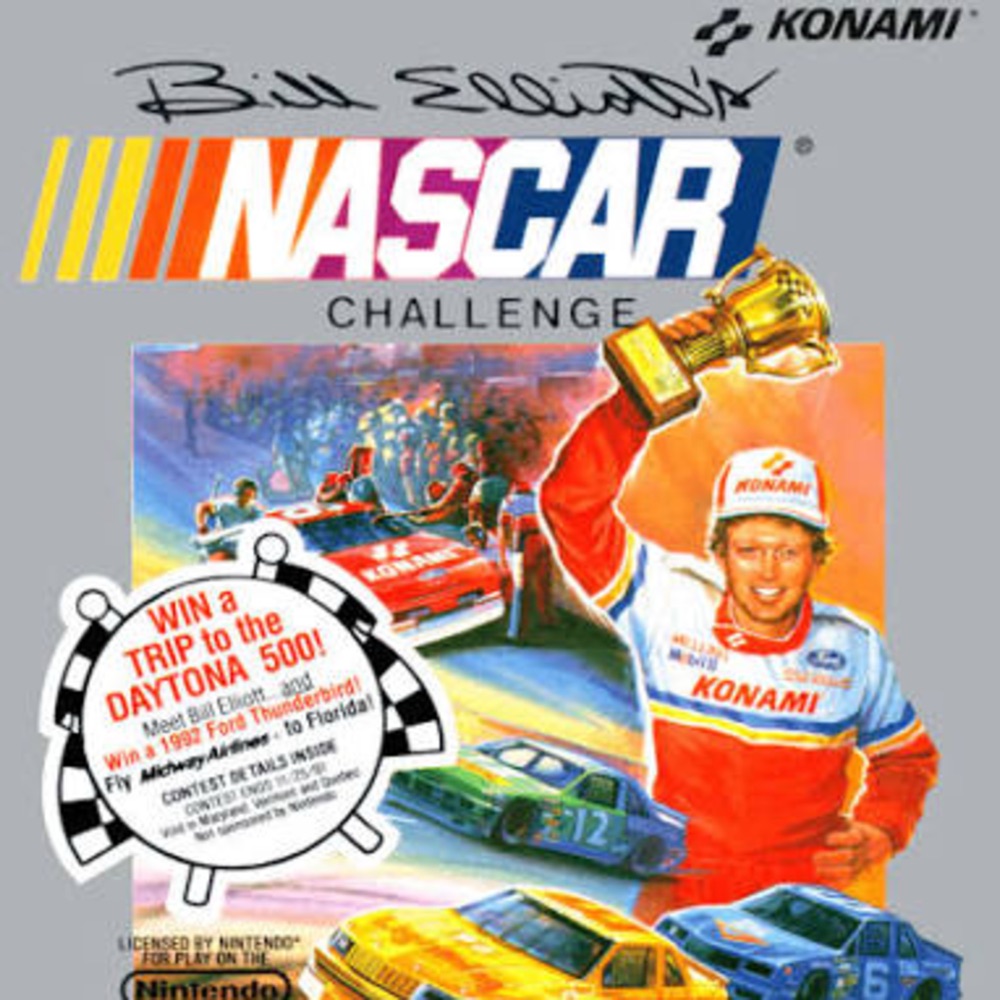
447 · Bill Elliot's NASCAR Challenge
Bill Elliott's NASCAR Challenge is a video game developed by Distinctive Software and published by Konami and was released for MS-DOS, Amiga, Macintosh and Nintendo Entertainment System in 1991.
From Wikipedia: Bill Elliott's NASCAR Challenge (CC BY-SA 4.0)
Bill Elliott's NASCAR Challenge is the first game to carry the NASCAR license, with the logo rebuilt in 8-bit on the title screen. Days of Thunder had the movie but not the license, so this is the first NES racer to try for the real thing. Only Mike and Sean were on this one, and neither is a NASCAR person. It is the most simulation-minded racer we have played on the system, and that is both its pitch and its problem.
What's impressive
- It feels authentic. You tune your own car, and the manual gives a tip from Bill for each setting: spoiler, gearbox ratio, tire stagger. Pick manual and drive it as a manual. It feels better than most racers we have played, with a cockpit view, a rear-view mirror, and temperature and fuel gauges that all work.
- The pit stop. The low-fuel alarm startled us, and after a lap of looking for something odd by the road we found the pit entrance. Then the view switches to top-down, Spy Hunter style, and you have to park in your own stall. Blow past it and you lose places.
- Real detail around it. The credits list Bill Elliott under design and programming. Konami ran a sweepstakes where you mailed in a photo of your championship season score, and the winner got a trip to the 1992 Daytona 500, a meeting with Bill and, supposedly, a Ford Thunderbird. We doubted the car.
What gets in the way
- A cold start. Our first turns were tailspins. It took six or seven races to get a feel for shifting and braking, and Watkins Glen is a bad place to begin. The manual is paragraphs with no diagrams, though a practice mode covers a few skills.
- A thin career. Novice means you cannot crash, and Pro means rivals drive faster, not smarter. Beyond tuning there is little to unlock, nothing like Supercars' upgrade loop, so it plays like a game made to feed that sweepstakes.
- Bill always wins. In every race we were in, he won handily.
Beyond the game
We wanted this engine with a looser, more arcade feel. It also has a Game Boy cousin, Bill Elliott's NASCAR Fast Tracks, which somehow keeps the first-person cockpit and mirror. We asked listeners whether we should cover NES-port Game Boy games on the Patreon show.
The bottom line
Skip it. We both voted it off the Essential Games List. It is a tech demo of what the NES can do, and a nice addition to the library for NASCAR fans, who finally got the real thing. But a simulation with this little content is not a game we would keep going back to, and Rad Racer and RC Pro-Am are still the more fun racers today.
Written from our conversation in this episode.
- EXPERIENCE LIFE IN THE FAST LANE
- Here are the core topics for Bill Elliott's NASCAR Challenge:
- 1. A real license wrapped around a genuine simulation
No arcade fantasy here, this races real tracks under NASCAR's actual name. Developed by Distinctive Software, published by Konami, with the NES version arriving December 1991 after the 1990 MS-DOS original and 1991 Amiga/Macintosh ports. - 2. The industry-first hook
This is believed to be the very first video game to ever secure the NASCAR license, and Bill Elliott is credited as a co-designer, making him the first real NASCAR driver ever featured in a PC game. DAYS OF THUNDER film was NASCAR, but no mention in the game. - 3. Who Bill Elliott was in 1991
Nicknamed "Awesome Bill from Dawsonville," he was a 1988 Winston Cup champion and the first driver ever to win the sport's Winston Million bonus, in 1985. On April 30, 1987, the real Bill Elliott set NASCAR's all-time qualifying speed record at Talladega, 212.809 mph, a mark that still stands. Four days later, Bobby Allison's car went airborne into the catch fence at the same track, a crash serious enough that NASCAR mandated restrictor plates at Daytona and Talladega the following season. - The irony: players in late 1991 could chase 200-plus mph fantasy lap times the same year real NASCAR was already several seasons into slowing itself down for safety.
- 4. Framing it against what listeners expect from NES racing
This is not Rad Racer or R.C. Pro-Am. It's a from-the-driver's-seat simulation about tuning gear ratios and spoiler angles as much as steering, closer in spirit to a flight sim than a typical NES racing cartridge. - 5. High Score Board: Konami sent a real winner to a real Daytona 500
In 1991 Konami ran a contest where players could mail in a photo of their Championship Season score to win a trip to the 1992 Daytona 500 to meet Bill Elliott, plus a real 1992 Ford Thunderbird. To qualify you had to run full race distances, manual transmission, and regular damage settings, so Konami wanted proof someone beat the hard version of the game. - 6. The tuning loop is the real game
Before every race you set transmission type, engine type, spoiler angle, gear ratio, and tire stagger, and the game's own manual is apparently the only place that explains what these settings do. Pit stops shift to a top-down view where you choose fuel, tires, or damage repair while the clock keeps running. - 7. Emergent strategies born from the physics and AI
Drafting and the slingshot technique are real NASCAR moves the game asks you to learn and execute. On Watkins Glen, driving into the outside grass at a turn's entry lets the terrain nudge you through without crashing. Skipping the halfway pit stop and only partially refueling can steal a lead on ovals, an exploit that comes from reading the AI's fixed pit behavior.
I. Setup & Premise
- The pitch: a real NASCAR license wrapped around a first-person driving sim
- No arcade fantasy here, you are racing real tracks under a real sanctioning body's name
- Developed by Distinctive Software and published by Konami, with the NES version arriving in December 1991, after the MS-DOS original from 1990 and Amiga and Macintosh versions that followed in 1991
- The NES version has an identity problem right away
- This is believed to be the very first video game to ever secure the NASCAR license, and Bill Elliott is credited as a co-designer, making him the first real NASCAR driver ever featured in a PC game
- So the NES cartridge is riding on the coattails of a genuine industry first that actually happened on computers, not on Nintendo's console
- Who Bill Elliott actually was in 1991
- Nicknamed "Awesome Bill from Dawsonville," Elliott was the reigning-era face of NASCAR, a 1988 Winston Cup champion and the first driver ever to win the sport's Winston Million bonus, in 1985
- The simplest way to frame it for listeners
- This is not Rad Racer or R.C. Pro-Am
- It is not an arcade racer with a light touch
- It is a from-the-driver's-seat simulation about tuning gear ratios and spoiler angles as much as it is about steering, closer in spirit to a flight sim than to a typical NES racing cartridge
II. What Makes It Stand Out
- A genuinely licensed circuit: Eight real tracks appear across the full series of ports, including Talladega and Watkins Glen, though the NES and Game Boy versions narrow that down to four tracks run twice each for the Championship Season
- Weird detail: Konami sent a real winner to a real Daytona 500
- In 1991 Konami ran an actual contest where players could mail in a 35mm photograph of their final Championship Season score to win a trip to the 1992 Daytona 500 to meet Bill Elliott in person, plus a real 1992 Ford Thunderbird
- To qualify you had to run full race distances, manual transmission, and regular damage settings, meaning Konami wanted proof someone had actually beaten the hard version of this game, not the easy one
- A cockpit dashboard doing a lot of work: The in-car view packs in a lap counter, position tracker, rear-view mirror, speedometer, tachometer, oil pressure and temperature and fuel gauges, a damage light, a fuel warning light, a flag indicator, and a gearbox display all at once, which sounds overwhelming on paper but reads clearly once you know where to look
- Practice mode teaches you the sport, not just the controls: A dedicated Practice mode walks players through drafting, passing, holding a line, and pitting, each with advice text attributed to Bill Elliott himself before you try the technique
- Weird detail: Konami sent a real winner to a real Daytona 500
III. Gameplay Structure
- Basic controls
- D-pad Left and Right: steer
- A: accelerate
- B: brake
- Release A and press Up: upshift (manual transmission)
- Release A and press Down: downshift (manual transmission)
- Setup before you ever hit the track: Players choose a track, a race distance from 10 up to a full 500 miles, and one of three real-world car bodies, a Pontiac Grand Prix, Ford Thunderbird, or Chevrolet Lumina, each with different hidden handling characteristics the game never states outright
- Skill level locks in the danger: Novice mode removes the ability to crash entirely, while Rookie and Pro allow real crashes, and the Championship Season locks you into Pro regardless of what you picked
- The tuning loop is the real game: Before every race you set transmission type, engine type, spoiler angle, gear ratio, and tire stagger, and the game's own manual is apparently the only place that explains what these settings actually do to your car
- Pit stops shift to a top-down view: Crossing the pit lane line switches the perspective, and you must stop in your own numbered pit box, choosing what to prioritize, fuel, tires, or damage repair, while the race clock keeps running around you
- D-pad Left and Right: steer
IV. Unique Gameplay Elements
- Drafting and the slingshot: Following closely behind another car reduces air resistance enough to save speed, which can then be spent all at once to slingshot past the lead car, a real NASCAR technique the game asks you to actually learn and execute
- A password system nobody asked to be this long: The Championship Season save uses a 35 character password including punctuation, which the game at least has the decency to preserve automatically if you reset without power cycling too far
- Track-specific exploits emerge from the physics: On Watkins Glen, driving straight into the outside grass at a turn's entry lets the terrain itself nudge the car through the curve without crashing, trading speed for safety in a way the road course rewards more than the ovals do
- The fuel-strategy trick that actually wins races: Skipping the halfway pit stop that every AI racer takes, then only partially refueling on your own delayed stop, can steal a real lead on oval tracks, an emergent strategy that comes from reading the AI's fixed pit behavior rather than from anything the game explains
V. Reception
- A blogger who dislikes racing games came away respecting it: The Take on the NES Library review is upfront that its author does not like NASCAR, racing, or racing video games generally, and still spent twelve to fifteen hours completing the Championship Season, calling the final product "a good NES game" despite personally disliking the genre
- Specific praise landed on the presentation: The review singles out clean graphics, realistic-feeling physics and handling for NES hardware, and sound design that uses engine and tire noise as genuinely useful gameplay information rather than filler
- Does it matter that a non-fan still respects it? That kind of praise from someone with no stake in the genre is a stronger signal than a racing enthusiast's approval would be, though the same review is clear that the password length and lack of in-race music are real, if minor, annoyances
VI. Sequels and Spinoffs
- A same-year cousin, not a sequel: Bill Elliott's NASCAR Fast Tracks arrived on Game Boy in 1991, built from very similar systems to the NES version rather than as a numbered follow-up
- No true NES sequel: Neither the NES nor Game Boy line continued into a numbered NASCAR Challenge II, so this remained a one-off appearance for the license on Nintendo hardware
- Comparison games
- R.C. Pro-Am: useful as a contrast, arcade-style NES racing built for immediate fun rather than setup screens and tuning menus
- Al Unser Jr.'s Turbo Racing and Nigel Mansell's World Championship Racing: fellow real-driver-licensed NES racing games from the same handful of years, worth setting side by side to see how differently each one balanced simulation against arcade accessibility
VII. Pop Culture
- The real Bill Elliott's most famous moment happened just before this game shipped, and it changed NASCAR forever
- On April 30, 1987, the real Bill Elliott set NASCAR's all-time qualifying speed record at Talladega, 212.809 mph, a mark that still stands today
- Four days later at the same track, Bobby Allison's car went airborne into the catch fence after a tire failure at similarly extreme speed, a crash serious enough that NASCAR mandated restrictor plates at Daytona and Talladega starting the following season specifically to bring speeds back down
- So the fastest, most famous version of Bill Elliott, the one whose name is on this cartridge's box, set a record that NASCAR's own rule changes then made permanently unbreakable in real competition
- A small irony worth pointing out to listeners: Players booting up this NES cartridge in late 1991 could chase 200 plus mph fantasy lap times on Talladega with a fictional car under fictional rules, in the same year that real NASCAR was several seasons deep into restrictor-plate racing specifically because that kind of raw speed had already proven too dangerous to allow
- Where the game itself briefly touched real life: Beyond the Konami contest already covered in section II, a real winner really did travel to meet the real Bill Elliott at the 1992 Daytona 500, one of the more concrete ways a licensed NES sports game ever paid off its own marketing promise
- On April 30, 1987, the real Bill Elliott set NASCAR's all-time qualifying speed record at Talladega, 212.809 mph, a mark that still stands today
VIII. Essential Games List Vote
- Case against Essential
- The learning curve is steep enough that even a dedicated NES completionist needed outside videos and forum posts just to find a competitive car setup
- Setup screens, tuning menus, and a 35 character password system ask a lot of patience before the actual racing even starts
- There is no in-race music, and the genre already has faster, more immediately fun NES representatives in Rad Racer and R.C. Pro-Am
- Case for Essential
- This is a genuine industry first, the debut of the NASCAR license in video games, arriving on NES the same year as its computer counterparts rather than years later
- The learning curve is steep enough that even a dedicated NES completionist needed outside videos and forum posts just to find a competitive car setup
- The commitment to real technique, drafting, slingshotting, tuning gear ratios for a specific track, gives it a design ambition that very few other NES racers even attempt
Found automatically from the transcript and checked, but it can miss things or pick the wrong page. Spot a mistake? Tell us.
Games
- Bill Elliott's NASCAR Challenge mentioned at
The episode's game: Konami's 1991 NASCAR-licensed simulation racer, first-person with tuning and pit stops.
- Days of Thunder mentioned at
The earlier NES game based on the NASCAR movie, but without the NASCAR license.
- Jordan vs Bird: One on One mentioned at
Mentioned when the hosts debate whether the NES ever got a proper NBA game.
- Super Cars mentioned at
The racing game from the previous episode, used to talk about capturing a sense of speed.
- Al Unser Jr.'s Turbo Racing mentioned at
The earlier NES racer Mike calls the closest thing to this game's simulation approach.
- Rad Racer mentioned at
The arcade-style NES racer that a four-year-old can pick up, unlike this one.
- Daytona USA mentioned at
The arcade racer with a third-person view that Mike contrasts with this game's cockpit view.
- Spy Hunter mentioned at
What the top-down pit stop mini-game reminds Sean of.
- Gran Turismo mentioned at
The series where Mike always has to copy someone else's tuning setup.
- Major League Baseball Featuring Ken Griffey Jr. mentioned at
The N64 baseball game whose cheat lets Griffey homer every time, as an example of a toggleable star-player cheat.
- Kobe Bryant in NBA Courtside mentioned at
The other N64 game Sean cites with a star athlete on the cover.
- MLB The Show mentioned at
Used in Sean's analogy for a career mode that starts in high school.
- R.C. Pro-Am mentioned at
Cited with Rad Racer as the arcade racers still fun today.
- Bill Elliott's NASCAR Fast Tracks mentioned at
The Game Boy cousin, released the same year, that keeps the first-person cockpit view.
Hardware
- Game Boy mentioned at
Handheld that got the cockpit-view cousin of this game.
Companies
- NASCAR mentioned at
Racing series whose license this is believed to be the first video game to use.
- Distinctive Software mentioned at
Developer credited on the game's title screen.
- Konami mentioned at
The game's publisher, which ran the contest to win a trip to the 1992 Daytona 500.
People
- Bill Elliott mentioned at
The NASCAR champion who co-designed the game, shows up in the credits, and wins nearly every race in it.
- Bobby Allison mentioned at
His 1987 Talladega crash led NASCAR to mandate restrictor plates.
- Dale Earnhardt mentioned at
Mike's "Raise hell, praise Dale" aside.
- Dwayne Johnson mentioned at
The "can't lose a fight in a movie" contract clause the hosts argue about.
- Vin Diesel mentioned at
The actor the clause is sometimes mixed up with.
Film, TV and music
- Days of Thunder (movie) mentioned at
The Tom Cruise NASCAR movie the earlier NES game was based on.
- Cars (movie) mentioned at
Mike's joke about Lightning McQueen saying "I am speed".
- Lightning McQueen mentioned at
The Cars character behind the "I am speed" line.
- Cars 2 mentioned at
Where Mike guessed "if you ain't first, you're last" came from.
- Talladega Nights mentioned at
The actual source of "if you ain't first, you're last".
- Dodgeball mentioned at
The other movie Mike confused the quote with.
- Fast & Furious mentioned at
The franchise where the Rock and Vin Diesel's feud became public.
Terms and events
- Restrictor plate mentioned at
Why Bill Elliott's 212.809 mph qualifying record can never be broken.
- Daytona 500 mentioned at
The race the contest winner got a trip to in 1992.
Articles, videos and sites
- NEStalgia Bytes mentioned at
The hosts' Patreon show about Famicom games; Mike wonders about an episode on Game Boy ports of NES games.
- NEStalgia Essential Games List mentioned at
Where the hosts' verdicts are collected; this one was a clear no.
Other
- Talladega Superspeedway mentioned at
The track Sean attended a NASCAR race at, and where Bill Elliott set the qualifying speed record.
- Watkins Glen International mentioned at
The road course Sean tried first and found too hard.
- Daytona International Speedway mentioned at
The oval Sean moved to after Watkins Glen.
- Ford Thunderbird mentioned at
The car reportedly given to the contest winner; the real Bill Elliott drove one.
- Chevrolet Lumina mentioned at
The car Sean drove in the game; the hosts joke the NASCAR car is a Malibu.
- Xbox Game Pass mentioned at
Where Mike says the newer NASCAR games have been free to try.
Auto-generated transcript. Each paragraph starts with its timestamp. Speakers are not identified.
Bill Elliott's NASCAR Challenge, experience life in the fast lane.
And welcome to NEStalgia, a chronological exploration of every NES game released in North America. I'm Mike. And I'm Sean. And I'm Bill Elliott. Now, could you imagine? What a guest spot. Is he still around?
I don't know. I didn't look up before the episode, so maybe that was in bad taste. That's okay. He goes fast. We all know it. Yeah. Yeah, he's actually, he is speed. Is that what he said? No, that's, what's his name from Cars? Lightning McQueen?
He's like, I am speed. It's like, I feel like every NASCAR driver should say that if they grew up watching Cars. Because those kids that grew up watching Cars are now driving the Cars. And if he ain't first, you're last. Yeah, that was probably in Cars 2. Well, that's Talladega Nights. Oh, perfect. Yes, of course. I was thinking it was Dodgeball for some reason. Yeah, same thing. Similar vibe. Yeah. Now, we've kind of had a similar vibe to this kind of game before when we played Days of Thunder, the game based on the movie. Yes. And that movie had the NASCAR, had the NASCAR license and obviously all took place in the NASCAR environment.
But the game did not. And so this is now the first time that a racing game, of which we've had many, they don't usually go for the realistic. But here we are with Bill Elliott's NASCAR Challenge, NASCAR in the title on the starting screen. Right. On the starting screen, the NASCAR logo beautifully recreated here in 8-bit. So this is like a big deal because at this point, I feel like every other major sport has been represented, right? Maybe not the NBA, actually. Did we get an NBA game? Well, we got some NBA players. I don't know. I think that counts, right? Yeah. Michael Jordan, if Jordan and Bird are version each other, that's basically the whole NBA at that point anyway. Yeah, exactly. But no, I don't think we actually got an NBA game yet.
Anyway, NASCAR, do you have any history with NASCAR? I don't have any history with NASCAR. I have watched a few races. It is a thing you can do, especially with a drink. Yeah, nobody tells you to not do it. You can just do it.
Yeah, yeah. So I have watched a few. Don't think I understand enough about like, or maybe I do understand enough and that's why I'm out of it. But to me, both F1 and NASCAR have this problem, which is unavoidable. There's really no way around it. They can't drive while the cars are like fucked up on the track. But when that happens, it causes a, you know, a safety car to come out and everybody has to slow down. And, you know, any like sort of lead that was gained is now like, you know, you still keep your position. Yeah. But you now have to drive slowly around. And I've seen NASCAR races where they just end on the safety lap. And that just feels like such bullshit.
Yeah. I just, it's like, that would be like if, you know, in the, well, I guess actually the equivalent, the closest I can think of is in the NFL when they just can have the ability to just run the clock. Like, no, I'm not playing anymore. You can just kneel. You're just going to kneel. Yeah. It's funny. I grew up with NASCAR on in the house, but I don't think anyone really gave a shit. Like even like my, my stepdad who would have it on didn't seem to be reacting in any way to whatever was happening in the race. It was just, he was just on his rocking chair, just staring at the screen.
And I was just like, oh, NASCAR. And he'd be like, yep. And he would just kind of look at it. And that's just sort of the relationship that I developed with it. Like I never really, unless something was actually crashing into another thing.
Um, I wasn't paying too much attention to NASCAR. Now to defend the NASCAR fans out there, I don't want them to think that we think that, uh, we're objectively correct here. We just didn't grow up in the NASCAR landscape. Like there's no NASCAR races coming to Buffalo. Uh, and there were certainly none coming to Long Island. Yeah, but they come to Lockheed Glen. And that's right between both of us.
Okay. But you, but would you go? I would go. I have been to a Talladega race. I, okay. So this is exciting. Cause that's what I was going to ask you next is like, I was going to say that to me, the, the core appeal of a NASCAR race cannot be captured on TV for something that we were talking about in the supercars episode, which is that like, you know, you just can't capture that sense of speed. It's like, it's kind of unbelievable how fast those cars are going, but when they're all going that speed and the cameras tracking them all on TV, it's just not nearly as exciting as just hearing and feeling and being there.
You know? Yeah, exactly. That is, that's like the difference. That's the NASCAR experience. Yeah. So when I went, I was way too young to really fully take advantage of it. Like if I went there in my twenties, it probably would have been like a near religious experience, um, with just how centered, uh, the drinking culture is there. But, um, yeah, it was very fast. Uh, they, they really get back past you. It was very loud. Um, but I'd say after the first 15 or so laps, it does kind of get like hypnotic and like in a bad way, kind of repetitive. And you're sort of waiting, like how long does this go?
Um, but I was too young to fully enjoy the atmosphere. And while this is believed to be the very first video game to ever use the NASCAR license, I thought what was more interesting is that as the, um, after the opening screen with the NASCAR splash, you have, uh, the credits for the game. It has the logo for distinctive software. And in the credits, in the design and program section is Bill Elliott. Like that's the kind of thing that like you usually put as like a special thanks or a featuring. Right. But he's like, I'm supposed to believe he coded the game.
I have to imagine that like, I don't know. There, there's something about now to actually talk about the game. There is something that feels very authentic about this game. I don't know if it's because it actually feels like a bit more realistic than most, whether it's visually or, um, the way that the vehicles handle, but like they, anytime you have to tune a car. Yeah. In a video game. I'm automatically sold that it's more realistic than the ones that just let you hop in and do automatic. Well, I completely like ignored all of the shit I could sort of, uh, mess around with. Cause I didn't know what any of it meant.
Um, I, I, but I made sure to use manual because I'm not a coward. Um, but like, can you, can you say a little more about that, Sean, though? Cause you gave an interesting perspective to me when we were, um, at long Island retro gaming expo, uh, when we were doing the arcade racers. And obviously those have, you know, they have a wheel, they have pedals, they have, um, the gearbox. So you, you said something very interesting about your philosophy behind choosing manual, even though you would not drive a manual car in real life.
I don't entirely remember what I told you. Um, I know, I know we talked about this, but you said, what's the point of, of playing a racing video game? If, if I'm not like, it's like, it's basically like having at that point, why steer too, right?
Like if it's going to do the gears for you and what, what are, you know, I totally agree because for the longest time I was an automatic transition, uh, kid growing up just because I couldn't even understand the concept because we didn't own a manual car. But once I like got into it, I was like, not only does it make you a faster, better driver in these games, but it's also just like, it's more immersive. Yeah. You kind of, you kind of have to, like, even if you do a bad job, it's like you're a bad driver then.
Exactly. And I'm not going to blow a trans, well, you could blow your transmission in this game, but I'm not blowing my transit transmission, uh, and then having to spend thousands of dollars to replace it. I just have to do the race again. Um, so yeah, it's, it's fun. So, I mean, that's all to say that I totally buy that Bill Elliott or one of Bill Elliott's people advised on maybe some like game feel or like systems in this. Cause like, I just don't, it feels way too good compared to a lot of other racers that we've played.
Yeah. I would definitely agree there, especially on the simulation front. I think the closest thing we have is the F1 counterpart, um, Al Unser Jr.'s, uh, turbo racing, I think was the name of the game. Was that F1 or was that Indy?
Oh, right. Maybe that was Indy. Yeah. Sorry. Um, now I can't, or was that the one that you work up to F1? Like is the last car you can get an F1 car? Oh, that's a good question. I do remember that one too. I think that's different.
Maybe I'm merging two games together. Yeah. Anyway, that was, you know, this has never been done with these kinds of cars and this kind of speed behind them and everything. So I do agree with you. Um, and I will just say too, it's like, it's the kind of thing that is intimidating at the same time. Like part of the appeal of having Rad Racer on the NES is that you can just literally be four years old, plug in that game and get the concept of trying to win a race.
Like that, that, that, that comes across easy now with the tuning and you know, the difference between manual and your engine and all that and the different cars. And then like learning the track layouts, doing the qualifying laps, like this is definitely, um, a step above in the polish of a racing game, but it is also an intimidating kind of racing game as a result.
Do you think that this is the kind of thing that, um, you know, that, uh, you can just jump into and play or do you kind of, do you kind of suck at first for a long time before you get good? Well, well, Mike, the first thing that happened when I got into the race was I immediately just tailspinned and I had everybody blow by me because I didn't entirely know how to accelerate slash shift. So the first turn that you take is just going to make you lose complete control. That was what, that was my experience. Um, and then, yeah, it took a few more tries. To even like clear a turn without hitting the wall.
Uh, and then I, then I decided I'm playing on hard mode. I got to get out of Watkins Glen road courses probably shouldn't be the first thing you do. So then I moved to just a typical like oval ish circuit. Like I think I did Daytona first. Um, and there was a little bit easier, but I'm still hitting the wall. I'm still, I'm still wiping out.
Um, but I'd say it took like six or seven races to even get a good, a good feel for the game. Yeah. I spent a lot of time in the qualifying, um, just to kind of even learn, you know, you know, cause it's NASCAR too. It's like, am I, am I breaking? Like, am I just always supposed to be accelerating? Like, how do I do the turns? You know, I know that the, the turns are also very forgiving in these kinds of tracks. It's not like indie racing. So I just was like, I needed to have that kind of, um, cause it's a, it's a first person view through the driver's seat.
So it's maybe a little easier in like a less realistic game, like, um, Daytona USA, where you have this third person POV and you can see the track, your car, how you're turning and everything in, in this cockpit, which is again, super immersive. And you're able to see even like your little rear view, uh, mirror up at the top and you have your, your temperature and how much gas you have left. Like all, all these things are amazing and they all function too.
Yeah. But it's the kind of thing where it's like, I just, I don't know if I know enough yet to like do a race and, and place properly. And I think maybe that's where like the simulator got, like got too into it. Like it needed to have more of like a, we'll get to the really challenging stuff that only skilled people can do. But we also need to make sure that like, if you buy this game, it's not just wasted on you. If you don't understand NASCAR racing.
Yeah. I think the first time I was completely caught off guard with what it expected me to do was when I, like first I wasn't expecting to get the low fuel, uh, notification that quickly or the alarm for that. And then I was like, Hmm, I don't remember seeing a pit stop, but I'll just look for something weird on the side of the road. And then on this next lap, um, then I found it and then I'm like, okay, there's going to be some cut scene. That's my team working on my car and I can just take a breather. And then it brings you to a completely other like game mode that is top down. So you're no longer first person.
It's like you're playing spy hunter now. Um, and you have to like find your pit or your pit crew and stop in like right in a parking spot. And you can just blow right by them. Like if you weren't paying attention or know that this was coming, you would have no idea what to do. I guess we didn't read the manual.
Um, so, uh, that didn't work out quite the way I wanted it to the first time I tried. I was able to kind of get it the next time. Uh, but yeah, uh, then you have to pick what kind of work you want done and then you have to decide when enough's enough and start going. Then it gives you a little bit of like, hey, can you make up some positions if you have other people in the, uh, the pit with you? It's a lot to do that. I just was not prepared for.
Right. And, and, you know, we should specify that there are difficulties to choose from. Uh, there starts on rookie. Easiest. Yeah. It starts on rookie. You can move even down below to novice and novice makes it so that, uh, you cannot crash. Oh. Uh, which I, I guess is a useful feature if you want to play bumper cars against the, the rails and just hit the walls every time on the turns. Uh, an acceptable strategy. Maybe you will obviously lose your speed, uh, by doing that, but that's like, that's Gran Turismo, uh, shit. It's kind of funny that they still don't allow those cars to get beat up or anything. You can't show our car with damage, Mike.
Right. Uh, and then the pro version, um, which is the step up from rookie, uh, is, is basically the same thing except for now the, uh, the AI, it's not necessarily that they're smarter. It's that they drive faster, apparently, according to the, um, to the manual here. So that's an interesting like update is that like, they're both competent drivers at the rookie and pro level, but specifically at the pro level, they just like are no longer like put in their pants. Pinky toe on the gas. Yeah. They're finally going all out.
Um, that to say, of course, I never tried a pro race. I, I wasn't up to the, to the challenge. And if you look at the rest of the manual, I, I, I'm not asking for like diagrams or anything, but it is very text heavy about every single thing that you can do in this game. And I, I just feel like, you know, for a racing game, there's gotta be a better way to like explain, um, you know, drafting and slingshotting and passing all these things that are awesome and can be done in like real NASCAR strategies can be done in this game. Um, but I just feel like sometimes instead of a paragraph, it's like, just show me a diagram of like, yep.
Drafting is when this car is behind this car. It's like, I know that now, but it would have like helped, you know, at the time in the manual. Yeah, I could not actually find, I usually have no problem finding a scan of the, of a manual. I couldn't find one for this. Um, so I was just, I actually ended up finding a, an AI overview of the controls and I'm not proud of it, but I use that. Uh, and because it also like just at the very beginning, it took me a while to learn how to shift correctly. So that, that added to that number of races it took to get to being able to drive through the road.
Um, but yeah, I didn't even actually know that drafting was modeled here. I mean, I kind of, now I feel it like remembering sort of just how it was to like be able to, uh, pass at all. Like, I feel like there had to be something like that going on, but yeah. Yeah. And they do, they do have a practice mode, um, for a few of those strategies, uh, which is also very helpful. They probably could have had more of them, honestly, but, uh, for drafting, passing, following a line and most importantly, pitting, because if the pitting is the one that's going to like, you could be a great driver, but if you can't pit properly and get this stuff out, you're just going to lose places every time.
Also in this manual though, because it is kind of a gold mine, it does have that section that probably, you know, we're not car guys. It would have, it definitely stumps me. It still stumps me in all the Gran Turismo games I play. I usually have to just like look up like insert car name tuning and then like use somebody else's build, uh, and then adjusted a little bit for the track that I'm racing on. But even in this game, you know, there are, you, you have your spoiler, you have, uh, your gearbox ratio, and then you have, um, the tire stagger.
And the manual kind of explains like a basic concept of each one, but more importantly, it has a little like tip from Bill for each section, just about like what you should kind of be adjusting for based on the course. And I feel like that's the biggest thing that this, that this, that, you know, this manual is like kind of required for that reason is unless you kind of design the game, like, like, like a bill Elliot, uh, you wouldn't really know what, what exactly you're looking for here.
And so this stuff was very helpful to get me up to speed. Yeah. I was driving stock each time. So I'm sure that didn't help. I was only ever able to place like ninth tops, um, after like simulating my qualification.
Um, so I was never really doing too great. I, I'm sure some of that would have helped, but I'm also just not a great like race game, make player mechanically. I I'm always way too, way too fast going into turns and into hitting walls usually. So it just takes a lot more self-control for me, but, uh, um, and we're talking about speed here. Uh, the real Bill Elliot set NASCAR's all time qualifying speed record at Talladega. Uh, 212.809 miles per hour. And believe it or not, that mark still stands because NASCAR mandated restrictor plates, uh, following a serious crash with, uh, Bobby Allison's car just four days later. So now that's like that record's just going to stand because it's too dangerous to go that fast. Raise hell, praise Dale, man.
And also you have to kind of like, you know, just going back to what you were saying about the manual, uh, you have to listen to what Bill says, because if you don't win, he's going to win every race, at least every race that I was a part of. I don't know if like, I have to imagine that the rest of these names are made up, but every, every race that I was a part of Bill Elliot, just one handily. I feel like that's just a part of the game. I mean, Sean, to be fair, if you're going to, if you're going to design a game, are you not going to make yourself the best driver? I didn't. Okay. I, he didn't design the game. I'm pretty sure he just sort of like, yeah, he put, he worked in assembly on this.
I think maybe again, like his, his assistant said like, yeah, make sure that the spoiler thing, you can do something with the spoiler. I think they have to be a little more like reserved about it. You can't win every race bill, right? Like it's kind of, sometimes it's like a, a cheat that you can put in depending on. So I know for N64, we had Ken Griffey Jr.'s baseball and we had Kobe Bryant corpse at court side. And in those like, yeah, their stats alone are like pretty good, but they're not going to like single-handedly win you a game.
But there was like a cheat you could put in so that Ken Griffey would just hit a home run every time that he made contact with the ball. And it's like, that's fine because it's like toggleable. I feel like Bill should have had some more restraint to be like, I just want to finish in the top three. Like, I don't need to win every race. Just put me in the top three or whatever. It's kind of like that, you know, the rock has that clause in his contract. That's like, I can't be seen losing a fight in a movie. And it's like, the rock has that clause. It's pretty, it's pretty weak. I thought it was Vin Diesel.
I think, well, I'm pretty sure that you're thinking of that because I think it came out because of like a fast and furious movie or something like that, that the rock was in. And it's like where it got leaked from him and Vin Diesel don't get along. So I don't think either one of them would lose a fight to the other one on purpose. Family, man. Family matters. Family does matter.
I'll tell you something exciting, though, if you are good at this game, unlike me and Sean. And we just haven't had enough time yet, guys. Okay? We're enjoying the systems. Yeah. We'll get there. I'm going to get that visit to the race that you could get. Oh, okay. You know about this. I did see this on the Wikipedias. Yeah. Did we know, did anybody actually win this? Or was it a lie? Yeah. Konami ran the contest. Players had to mail in a photo of their championship season score.
And, you know, I don't know if it was like Tygos or whatever. But yes, the winner of the trip did receive a trip to the 1992 Daytona 500. Got to meet Bill Elliott. And apparently, a real 1992 Ford Thunderbird. That's crazy. That part I'm skeptical of.
Yeah. That's got to be like, and a down payment on a Ford Thunderbird. Or you get a lease for two years of a Ford Thunderbird. Like, were they giving away cars back then? Right. Did they have that kind of money back then? I mean, I guess, you know, I mean, this is Konami.
It is Konami, right? It is Konami. Yeah, yeah. Konami's the publisher. Yes. They're like, yeah, we'll jump on this. This is a quality game. We'll jump on this. And then, you know, obviously, like, further you get into the championship season and everything, you have different cars to race. You got to tune appropriate to the laps and everything. So there is still a gameplay loop here. It is not just like, you know, race on the same track over and over again against the same set of cars until you're ready to drive pro.
That said, you know, outside of like, outside of the strategies for the actual racing and everything, there isn't like, there's not too much in the sense of a career mode here. Yeah. There isn't like a, oh, buy better parts thing like we saw on supercars and stuff like that. It's almost as if Bill Elliott's NASCAR challenge. It's like a game made specifically to facilitate that sweepstakes. Just with the naming.
But yeah, I mean, I guess, you know, this is a simulation racing game. I guess it's like one of those games, like the fun is just the tweaking and the and trying to optimize. I'm not trying to say that that is like an excuse for not having an actual campaign or anything of the like. I would prefer it. I guess it's just what I would assume would be there to their reason why. Right. Well, it's also like it's a it's a NASCAR car. So why should it not be perfect? Right. Like, why should it? Were you riding the Chevy Lumina or were you in the Thunderbird? I was in the Lumina. I mean, because, yeah, because for me, a NASCAR car is a Chevy Malibu.
So I was the closest I could get. But got it. And have you played any of these NASCAR games, even if they were like free on Game Pass for a little bit? Have you tried any of these newer ones? Because I will say they are they are kind of fun, too, because they understand the concept of like nobody wants to drive that many laps. So they kind of like truncate everything. And and you could you could adjust that. Obviously, there are sliders and stuff. But there's also like a real career mode where you kind of just start off in like, you know,
dirt road races and stuff like that and just kind of make your way up through the ranks. And it's kind of like it's almost like too easy in a way that it's like, yeah, of course, I'm going to win these races and eventually move up. But it's like it's also an interesting approach from NASCAR to be like, yeah, you won't be doing any real NASCAR driving for a while in this NASCAR game.
You know, it takes a while to actually like get to Daytona or anything like it. But it's funny that like, you know, NASCAR and I guess just motorsport in general, I have the same relationship with these with this as I do like wrestling. Like I think stories about NASCAR a lot more interesting to me than NASCAR itself. I watched this sort of fumbling history of NASCAR and how like they handle their playoffs or like the fact that there even is a playoffs.
And like it's just very funny that what you're saying about like, yeah, there's going to be a lot of not NASCAR racing in this NASCAR game kind of plays into what I've been seeing of just like how mismanaged the league as it is has been. Or is it a league or is it? I don't know what it is. I think it is a league. I feel like there's got to be a different word for that when it's not like franchise teams, but whatever. It doesn't matter. It's an association. An association of racing gentlemen.
Yes. There you go. I don't know. It's just fun. I find the whole concept fun, even though like I just can't. I can't watch a race. And I guess the equivalent would be like if you were in like MLB the show and you're creative player and you had to start in like high school and still like go to class and shit, but also play like high school baseball. Well, that's basically college football games now, but you still play a lot of football.
For me, it's going to MLB the show and being stuck in double A for multiple seasons and just kind of stick with it. But I see what you're saying. I guess to my analogy, it would have to be like you start off as a three-year-old playing t-ball and like you. So you're not able to do the real MLB experience like technically actually high school though and definitely college. They use metal bats. So that is kind of weird.
Well, actually, I think the better analogy for this would be like you have to first like build and play a few levels as the player's father to see if he will be kind of psychotic enough to force the kid into that kind of like regimen so that he would be good enough to be drafted. It's kind of like what I'm having you do every week when we record the podcast is just kind of like, you know, cheering you on, corralling you and forcing you to record these episodes. I feel like there's some venom there.
But well, it's just like I always corralled the listeners to our final section, the essential games list. Sean. Hey, Mike. Your vote. Oh, yes. Yeah, I we've been we've been pretty generous to this game. It it's you know, it's a simulation racing game. It's it's it's very pretty like it does a very good job of like giving the faux 3D effect. It feels right.
There's a lot of like presentation going on and just like authenticity that I wasn't expecting out of NES game. But I think what we haven't really given too much airplay to is just that like, you know, it's a simulation game with not too much content. There's no way this is ever going to make the essential games list. It's way too niche and I'm not saying that niche games can't make it. We know from what's on the essential games list right now that they can. But yeah, a simulation racing game.
Probably. Yeah, I can't I can't put that on the essential games list. Yeah, I think you're onto something there. It's very one note. And even though it's like technically impressive for an 8-bit video game to be doing this kind of simulation work, there's also like flight simulators on, you know, running on Microsoft basic and shit like that, that are like, you know, wow, it's really impressive that they're able to calculate that, you know, that level of physics and stuff in a flight simulator on a old computer.
But just because it's technically impressive doesn't mean that it's actually like fun to play. And I think of that this in that same regard where it's like, this is technically very, very impressive in terms of the other racing games that we've seen on the on the console. And I'm sure to the NASCAR fans, this is the answer to the kind of racing game they were looking for. I would just argue that in terms of like that video game fun factor that I am looking for when it comes to the essential games list, the kind of games that you would keep going back to decades later, the more arcade racers like Rad Racer and RC Pro-Am are the things that are still fun today.
And this is now just kind of like a tech demo of what's possible on the NES. And we have much newer and better simulator games across every, you know, it happened on 16 bit. It'll probably happen on the PS1, PS2. It just keeps getting better. So there's really no reason to think about including this on the essential games list.
Definitely a fun game for NASCAR fans, though, as they can finally, you know, do it, do it the right way rather than trying to force it into these other racing games. Because it's not, you know, in baseball, on the NES, the Nintendo one, you don't have teams that you can pick, but it doesn't like make it so it's not baseball. It's not like, oh, well, I can't pretend like I'm playing as the Mets and, you know, and those are the Yankees. It's like, you can still do all that shit.
It's just that now, you know, you finally have a game with the licenses. Here, it's like it's actually simulating a different experience than those other racing games. And so I feel like at the very least, this was kind of an important add for the library. It's nice that they included a NASCAR game in the racing lineup. But just another quick note just on like the technical prowess of this game. Like if they just sort of, you know, loosened up the handling a bit or like not like made it a bit tighter so that you could be a bit more loose with it and maybe had a bit more, uh, uh, just a bit more chaos.
I would play the shit out of the arcade version of this game with like whatever this quote, maybe it's an engine or just however they did this stuff. I would play this. I think that would be an amazing racing game. If it would just, if it just felt a bit more arcadey, but otherwise played like this, uh, it looks very cool.
Maybe we should try it's, um, Game Boy cousin, Bill Elliott's NASCAR fast tracks, which, uh, also came out the same year, probably developed at the same time. Uh, I cannot imagine that the Game Boy game, um, gets the simulator part as, as like thoroughly as it's done here, but believe it or not, it is still in the first person cockpit view with the, the fuel gauge and the gearbox and, uh, the steering wheel and all that shit. Even a rear view mirror all on the Game Boy. So that's just again, uh, incredible.
It's wild. But yeah, I guess I don't think too much about these Game Boy versions of these NES games. I don't know if I'd ever make that into an episode of our, um, uh, Patreon, uh, show Nostalgia Bites. I don't think I would ever like be like, Hey, let's just take all the Game Boy games that are NES ports and see how they fare. I feel like for the most part, I feel like you're going to make us do it.
Yeah, I don't know. I don't know. Maybe I will. Maybe I won't. Let, I guess I'm, I'm throwing it to the listeners. Let us know if that's something you'd be interested in hearing and maybe we'll do it in a future episode. Bye.