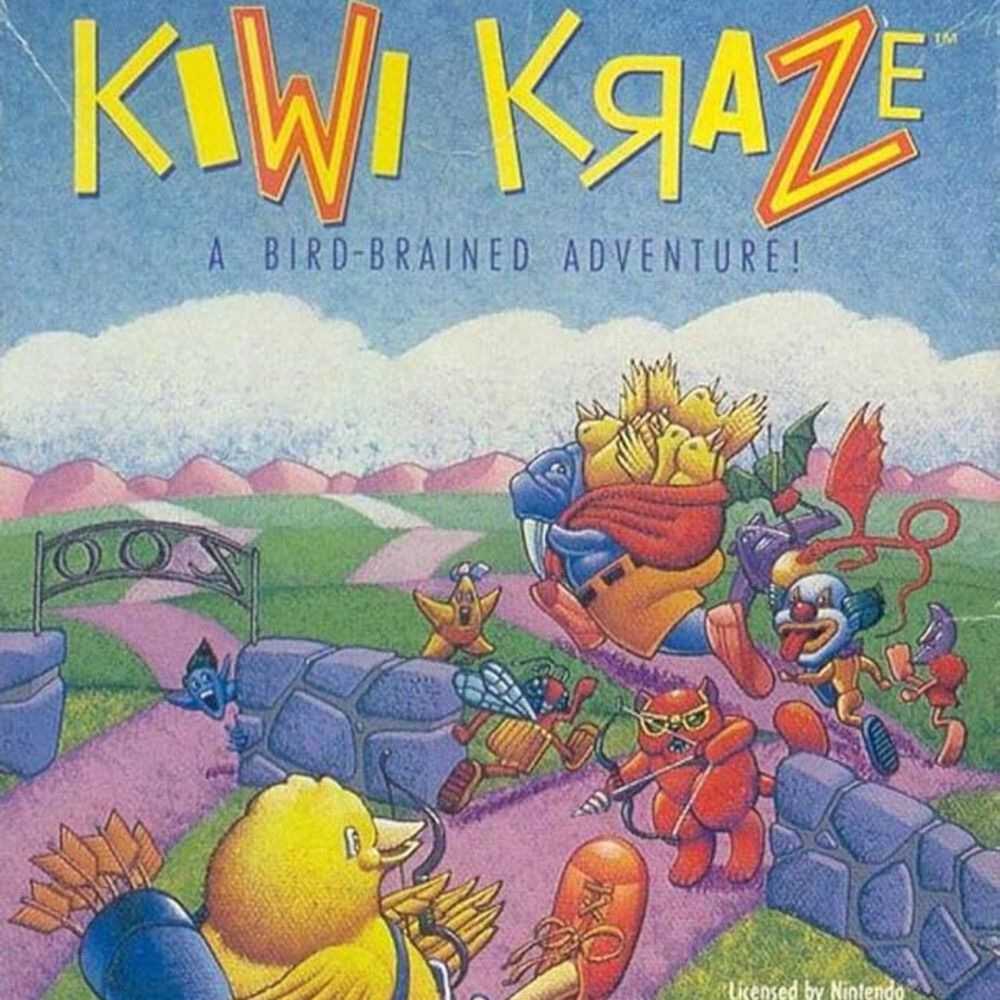
454 · Kiwi Kraze: A Bird-Brained Adventure
The NewZealand Story is a 1988 platform video game developed and published by Taito for arcades. The concept and setting were inspired by a holiday trip in New Zealand by one of the Taito programmers. The player controls Tiki, a kiwi who must save his girlfriend and several of his other kiwi chick friends who have been kidnapped by a large blue leopard seal. While avoiding enemies, the player has to navigate a scrolling maze-like level, at the end of which they release one of Tiki's kiwi chick friends trapped in a cage. It was followed by two remakes.
Software Creations made this NES version in 1991, working from Taito's 1988 arcade game, and Joe was out, so this was just Mike and Sean. Tiki the kiwi is the one who got away when Wally the walrus made off with his friends, and now he has to free them one cage at a time. Everywhere else it is The New Zealand Story. Only here is it Kiwi Kraze, a Bird-Brained Adventure, and we agreed the new name is perfect.
A maze with gravity
- Find the cage. Stages scroll in every direction and the only goal is the caged kiwi. There is no key and no enemy count to hit, and an arrow keeps pointing the way, so you cannot really get lost. Nothing ever branches into a dead end.
- Avoid everything. Enemies only hurt you with their projectiles, apples are a side note, and the game discourages interaction. We described it as an animated maze, and the whole thing feels like how a first-time game designer might design a game.
- So much yellow. Half the visuals are shades of yellow, and Tiki is yellow too. Running water never animates, which makes the stages feel like a drawn maze.
- The balloons. Tiki is a flightless bird who flies about 90 percent of the time on sheep-head balloons, which seemed like a missed joke. The double balloon is very slow, the duck balloon, which looks like a turtle, is twice as fast and runs you into more spikes, and the joystick one lets you steer with the D-pad but lasts at most a stage.
The few good ideas
The first boss is a whale that swallows you, and you fight it from inside while it flickers from damage. It was the first moment that made us think. Tiki also gets a scuba costume in water, the one whimsical thing in the game, though the water levels are slower still. Wally at the end floats around shooting a t-shirt cannon in the exact same arc every time, and you just pop his balloon.
Odds and ends
Taito's idea was a follow-up called Crazy Balloon Part 2. In the arcade version, dying in certain places sent Tiki to a playable heaven, and that did not make it to the NES. The music is a soundtrack of remixed arcade themes, but there is only one song across all 20 levels. Tiki never got a proper follow-up, only cameos in other Taito games, a 2007 DS game that IGN gave a 5.9 and Eurogamer a 6, and a 2026 Steam remake with mixed to negative reviews. The arcade original is $7.99 on Arcade Archives.
The bottom line
Skip it. Nobody voted it onto the Essential Games List, and we agreed it is simply not essential. What it asks you to do just was not interesting to us: no real puzzle, a vehicle that is not fun to control, and a brighter arcade version we would rather watch. The best thing to say is that it reminds us New Zealand exists in a pre Lord of the Rings world of video games.
Written from our conversation in this episode.
- Wally's got himself a kiwi cookbook, and your friends are the main ingredient!
I. Setup & Premise
- The pitch: a flightless bird steals a balloon and commits twenty counts of grand theft aviation
- You are Tiki, a kiwi bird. A large blue sea mammal named Wally has raided the zoo, made off with all of Tiki's friends, and is selling them to other zoos across New Zealand.
- Tiki was the only one who got away. So he goes and gets them back, one cage at a time, across twenty stages.
- His girlfriend, Phee-Phee, is the last one. She is at the end of the game, behind the final boss.
- The identity problem: this game has two names and neither one is quite right
- Everywhere else in the world, the NES cartridge is called The NewZealand Story, published by Ocean.
- In North America, Taito published it as Kiwi Kraze: A Bird-Brained Adventure!
- So an American kid and a British kid could own the identical game and have no idea they were talking about the same thing. Not too uncommon actually STAR FOX vs LYLAT WARS
- It is an arcade port, and a good one, from an unexpected place
- Arcade original: Taito, 1988.
- NES port: developed by Software Creations, a British studio, released March 1991.
- A Japanese arcade game about New Zealand, converted by a British team, sold in America under a name that mentions neither Japan nor New Zealand.
- The simplest way to frame it for listeners
- This is not a run-to-the-right platformer. Do not picture Mario.
- Picture Bubble Bobble's cuteness stretched across huge scrolling mazes, where the exit could be anywhere and you have to go find it.
II. What Makes It Stand Out
- The mazes go in every direction, and that is the whole point
- Stages are not corridors. They scroll all four ways and sprawl outward.
- The goal in every level is the same: find the caged kiwi. The map does not tell you how to get there, only where "there" is.
- The levels are built out of tiny 8x8 tiles rather than the 16x16 tiles most platformers of the era used, so you get dense, fiddly, puzzle-like little structures connected by wide open flying spaces.
- You get around by mugging your enemies for their vehicles
- Most enemies fly around on balloons. Shoot the enemy, jump on the balloon, it is yours now.
- You can also jump onto a balloon while the enemy is still standing on it, which knocks him off
- Most enemies cannot hurt you by touching you
- Enemies are mostly safe to bump into. It is their weapons that kill you.
- That flips the normal platformer instinct. You are not avoiding bodies, you are avoiding projectiles.
- It is much harder than it looks
- Tiki dies in one hit. Spikes, drowning, any projectile.
- The cute pastel art is doing a lot of work to disguise a fairly brutal game.
- High Score Board: nobody can agree what the villain is
- The final boss has a species crisis that spans the entire history of this game.
- Taito's arcade closing credits identify him as a leopard seal. The Japanese material calls him Azarashi, which is just the Japanese word for seal.
- Ocean's home computer packaging called him a walrus.
- And the American NES manual goes all in: he is "Wally Walrus" throughout, complete with a warning that Wally and his nasty pals hate jumping.
- So depending on which box you bought and which continent you were on, the villain of this game is either a leopard seal or a walrus, and Taito apparently never got a memo about it.
III. Gameplay Structure
- Five worlds, four levels each, twenty stages, one caged friend per level
- Reach the cage, free the kiwi, next stage. That is the loop.
- Most worlds end in a boss. World Four ends in a spike-filled ship interior instead of an actual boss fight (GameFAQs).
- Basic controls, on land
- D-pad left and right: move. Up and down do nothing on land (GameFAQs).
- A: jump. Hold longer for a higher jump. Tap A while falling to flap Tiki's wings and slow the descent (Take on the NES Library).
- B: fire your weapon. Default is a bow and arrow with unlimited ammo.
- Start: pause, which also brings up the map overlay showing level size, your position, and the exit (NES manual).
- Select on the title screen: one or two players. It is alternating play, so it is not much of a co-op.
- Basic controls, on a balloon
- Hold A to rise. Let go to sink. The balloon falls under Tiki's weight, so you are constantly feathering it.
- D-pad still moves you horizontally, and you can still shoot while flying.
- Press Down while resting on the ground to dismount (Take on the NES Library).
- Basic controls, underwater
- D-pad moves you in all eight directions. A and B do nothing while submerged.
- Your score display switches to an air meter that drains.
- Surface to breathe. On the surface, B spits water at an upward angle, which both attacks enemies and refills your air faster (Take on the NES Library).
- Long water sections require you to plan around air pockets.
- The weapon and item loop
- Three weapons: bow and arrow (default), bombs that fall on an angle, and the green laser gun.
- The laser is the one to hunt for. It fires straight, fires fast, and shoots through walls, which lets you clear a room you have not entered yet (GameFAQs).
- You keep a weapon until you die or finish the stage.
- Magic items on top of that: a book that wipes the screen, an invincibility pickup, and the joystick, which is the interesting one.
IV. Unique Gameplay Elements
- You can jump up through floors, and this rewires the level design
- Tiki passes upward through solid floors. Take on the NES Library notes this is a Taito habit, since Bubble Bobble works the same way.
- You can even jump up into walls from underneath. You only land if Tiki is not stuck partway inside the geometry.
- Consequence: climbing up is easy, getting back down is hard, and areas that look sealed off are often reachable if you jump at the right spot.
- This is the mechanic that makes the mazes work. It is also the one that makes players think they are stuck when they are not.
- The joystick item, which is a quiet game-changer
- Normally flying means constantly tapping and holding A to fight gravity.
- The joystick powerup gives you direct D-pad control of the balloon in all directions, no A button required.
- There are shortcuts in the game that only open up with the precision this gives you (Take on the NES Library). Losing the balloon loses the powerup.
- Balloons are not interchangeable
- Several types with different behavior. The common sheep-head one is your workhorse.
- There is a tall red one that accelerates upward very slowly but is the only balloon immune to spikes.
- A green ostrich-looking one accelerates fastest. A carriage type is what you respawn in after dying while flying (Take on the NES Library).
- The invisible timer and the Red Devil
- There is no visible clock. Take too long and you get a "Hurry Up" warning.
- Then an invincible red devil spawns and chases you. He passes through walls. You cannot kill him.
- He does move at a steady speed, so you can outrun him if you have room, which is more mercy than most hurry-up enemies offer.
- The GameFAQs writer flags this constantly, once per world, because it genuinely shapes how you play.
- Invisible warps you have to shoot into existence
- Some levels hide warp windows in empty air. Shoot at the spot repeatedly and a black window appears.
- The tell: if your arrows are stopping in mid-air, keep firing (Take on the NES Library).
- Some lead to bonus rooms with apples and extra lives. Some skip you ahead a level or more. The 1-4 warp lets you skip a boss entirely (GameFAQs).
- Nothing in the game tells you these exist. This is pure arcade-era "somebody at school told me" design.
- The one that will make people quit: the World Four rule change
- For the first three worlds, dying puts you back where you died with a moment of invincibility.
- Starting in World Four, that goes away. Death sends you to the beginning of the stage.
- Take on the NES Library beat World Three within a few tries and described everything after that as wading through mud. That is the difficulty curve in one sentence.
- You get three lives and three continues. Then you are back at the title screen.
- Honest gripes
- Hitboxes get strange on a balloon. The balloon becomes the contact point, so you can graze spikes with Tiki's head and be fine, then die instantly to the same contact on foot.
- Some of the tiny spikes do not read clearly against the detailed backgrounds.
- The last stage is on ice, so you have no traction and stop only by hitting a wall, in a level that is already asking for pixel-precise jumps between spikes (GameFAQs).
V. History & Development
- It started as a sequel to a completely different game
- Gaming Hell reports the project began as a follow-up to Taito's much older arcade game Crazy Balloon, under the working title Crazy Balloon Part II.
- They cite the Taito Memories Pocket manual and a Hamster developer stream as confirmation.
- Once you know that, the balloon-stealing mechanic stops looking like a quirk and starts looking like the leftover skeleton of the original concept.
- The setting came from somebody's vacation
- The commonly repeated origin, traced back to a Computer and Video Games piece, is that a Taito programmer went on holiday to New Zealand and wanted to make a game about it.
- Outside the map between stages and place names like Auckland, Rotorua, and Mount Cook, the environments have very little to do with the real country.
- Also, Tiki looks nothing like a real kiwi. He is basically an anime chick in sneakers. HG101 points out the game knows this, because some background posters show a realistic kiwi silhouette right next to him.
- Fresh off Bubble Bobble
- Taito was riding the worldwide success of Bubble Bobble and clearly wanted another cute platformer with a rescue-the-girlfriend plot (Hardcore Gaming 101).
- The DNA shows: EXTEND letters, jumping through floors, an escalating hurry-up enemy.
- The NES port is better than it had any right to be
- What got cut: some enemies, weapons, and vehicles, and the boss sprites are shrunk down.
- What survived: almost all the warps and secret areas, plus the New Zealand map between rounds, which only the NES and Master System ports kept.
- What did not survive: the Heaven stages.
- About those Heaven stages, since they are worth describing on air even though the NES cut them
- In the arcade, if you lost your last life in the middle chunk of the game to a solid projectile, Tiki went to Heaven, and Heaven was a playable level made of clouds where every enemy had a halo.
- Reach the exit and you meet a goddess figure and the game ends, but the message hints there is a way out.
- Find the hidden escape route and you get put back into the game one stage past where you died. One time only (Hardcore Gaming 101).
- NES players never got any of this. It is the single biggest thing the port lost.
- Port trivia worth one line
- The Japanese Mega Drive version was built from the prototype arcade board, so its levels are different from every other release, and it has only thirteen stages instead of twenty.
VI. Music & Presentation
- The Follin brothers did the NES soundtrack
- Tim and Geoff Follin, both at Software Creations, handled the NES music.
- Hardcore Gaming 101 goes further than usual and says their version outclasses the soundtrack of every other version of this game, arcade included.
- Callback for the show: the Follins also did the NES Indiana Jones and the Last Crusade, which we have already covered.
- Important nuance: they were arranging, not composing from scratch
- The underlying compositions came from the Taito arcade team (credited variously to Hisayoshi Ogura, Yasuko Yamada, and Yasuhisa Watanabe depending on the source).
- The Follin tracks are documented as arrangements of the arcade themes (WhoSampled). That does not diminish the work, since the whole Follin reputation is built on wringing sounds out of hardware nobody thought could produce them.
- The catch nobody mentions until they have played it
- There is one in-game song. For all twenty levels.
VII. Pop Culture
- The kiwi is a national symbol carrying a lot of weight
- Te Ara, New Zealand's official encyclopedia, describes the kiwi as an unlikely national emblem: flightless, nocturnal, rarely seen in the wild by the people who put it on their coins and stamps.
- New Zealanders are called Kiwis. The bird is a taonga, a treasure, in Maori culture.
- So this is not a random cute animal mascot. Taito picked the single most loaded animal in the country.
- The timing is genuinely poignant, and this is the best hook in the episode
- The NES version came out in 1991. In that same year, the Bank of New Zealand, the Department of Conservation, and the Royal Forest and Bird Society launched the Kiwi Recovery Programme (Department of Conservation).
- The first formal kiwi recovery plan covered 1991 to 1996.
- So in the exact year an American kid was buying a cartridge about a kiwi rescuing other kiwis from cages, New Zealand was standing up a national program because real kiwi populations were collapsing.
- The cause was different, of course. Real kiwi are killed by introduced stoats, dogs, and ferrets, not by a cartoon walrus running a black market. But the shape of the story is the same: the national bird is in trouble and somebody has to go get it back.
- Kiwi numbers are still declining today, roughly two percent a year in unmanaged areas.
VIII. Sequels, Spinoffs, and Comparison Games
- There is no real sequel, only remakes
- Tiki never got a proper follow-up.
- Cameos: Liquid Kids, Bubble Symphony, Pop'n Pop, and Space Invaders DX.
- New Zealand Story Revolution, Nintendo DS, 2007. Reviews were middling. IGN gave it 5.9, Eurogamer 6 out of 10, both criticizing the touchscreen additions and some spiteful level design.
- The NewZealand Story: Untold Adventure, a Steam remake, released February 2026. Early reception was mixed to negative, with complaints about collision detection and stages missing elements.
- The arcade original is easy to get now: Taito Legends compilations, and Hamster's Arcade Archives release for Switch and PS4 in January 2023.
IX. Essential Games List Vote
- Case for Essential
- Strongest argument: this is the rare NES arcade port that is arguably better than its arcade parent in at least one dimension, and it hides a real design idea (a cute platformer built as an open maze) that almost nothing else on the console attempted.
- Supporting: the Follin soundtrack alone is a piece of NES history.
- Supporting: it is a Taito game with clear Bubble Bobble lineage that most American players have never heard of, which is exactly the kind of gap this list should be filling.
- Case against Essential
- Strongest argument: the difficulty design is unfair in a way that is not interesting, specifically the World Four rule change that strips checkpointing right when the levels get most punishing.
- Supporting: one song for twenty levels is a real endurance problem on a game this long.
- Supporting: the secrets are invisible and undiscoverable without a guide, which was fine in an arcade and is less fine on a cartridge you own.
- Supporting: "essential" should probably mean an American NES player in 1991 could reasonably have encountered it, and almost nobody did.
- Host note
- The honest verdict may be that this is essential to understanding what the NES could do and not essential to the average player's experience of the console. Worth saying out loud either way.
Found automatically from the transcript and checked, but it can miss things or pick the wrong page. Spot a mistake? Tell us.
Games
- Kiwi Kraze: A Bird-Brained Adventure mentioned at
The episode's game: the NES version of Taito's The NewZealand Story, starring Tiki the kiwi.
- Arcade Archives The NewZealand Story mentioned at
The $7.99 Switch release of the arcade original, out January 2023.
- The NewZealand Story: Untold Adventure mentioned at
A 2026 Steam remake by bitobit with mixed to negative reviews.
- New Zealand Story Revolution mentioned at
The 2007 Nintendo DS version, which got middling reviews.
- Crazy Balloon mentioned at
Taito's 1980 arcade game that the game was originally planned as a sequel to.
- Bubble Symphony mentioned at
One of the Taito games where Tiki makes a cameo.
- Balloon Fight mentioned at
Compared to the tap-A balloon flying in this game.
- Grand Theft Auto mentioned at
Joked about as inspired by stealing an enemy's vehicle.
Companies
- Software Creations mentioned at
The British studio that made the NES port.
- Bank of New Zealand mentioned at
One of the three partners in the Kiwi Recovery Programme.
Film, TV and music
- The Red Balloon mentioned at
The French short film compared to the red balloon in Crazy Balloon.
- The Lord of the Rings film series mentioned at
The hosts wondered why a New Zealand game has no references to it.
- Flight of the Conchords mentioned at
The New Zealand comedy duo suggested as a missing reference.
Terms and events
- Harambe mentioned at
The zoo gorilla joked about when discussing not trusting zoos.
Articles, videos and sites
- IGN mentioned at
Gave the DS version a 5.9.
- Eurogamer mentioned at
Gave the DS version a 6.
- Patreon mentioned at
The show's Patreon, joked about as paying for a New Zealand trip.
Other
- Kiwi mentioned at
The flightless, nocturnal bird and national symbol of New Zealand.
- Tweety mentioned at
The yellow caged bird the kiwi friends reminded the hosts of.
- Arcade Archives mentioned at
Hamster's Switch series of arcade releases, discussed again from last episode.
Auto-generated transcript. Each paragraph starts with its timestamp. Speakers are not identified.
Kiwi Craze, a bird-brained adventure. Wally's got himself a kiwi cookbook, and your friends are the main ingredient.
And welcome to NEStalgia, a chronological exploration of every NES game released in North America. I'm Mike. And I'm Sean. Sean, forget about having a kiwi craze. I've got a kiwi crave. For kiwis? For kiwi, yeah, the fruit. The fruit, not the bird. I don't know why, but when I see kiwi, I immediately think of the fruit, never the bird. No, same. Never the people of New Zealand either.
Yeah, no. Oh, that's true. They are called that. There's too many things called kiwi. They're called that because that's like the national bird is a kiwi, and then that happened afterwards. Like, is that the timeline? Well, you're my fellow eagle, so I get that. Right, yeah, I guess that's how it goes, right? What's up? What's up? What's up, eagle? Oh, that's why he was named Soaring Eagle last week. We're just closing that loop.
If you have no idea what I'm talking about, that means you didn't listen to last week's episode, and therefore you should know that you have to listen to... You can't... This week's episode won't make any sense if you don't listen to last week's, guys. You can't just jump in on episode like 453. Oh man, imagine if that's the episode. I never check anymore what that number is. But you can't just jump into episode 453 if you didn't listen to the first 452, guys. It's not how this works. We started serializing, I think, back in 2019.
So you got a lot of catching up to do. Exactly. My computer froze for a second, so that's a good start. Cool. But yeah, the notes... Yeah, I need the notes. Sorry, guys. I hate to tell you. It's not a script, though, at least. It used to be a script, but I do need the notes to have a show here.
And, you know, the kiwi that we're talking about is not a fruit. Much as I would have liked to have played as some kind of fruit mascot, I'm sure that's coming, right? Don't we get the California raisins? Yeah, sure. But I meant like, I guess the raisins aren't really a fruit anyway. They're dried up grapes. Yeah. I mean, it's still like at its core fruit. Yeah, but it's like... How's the computer doing? It's altered. I'm good. I'm back now. So thank you so much, Sean. A kiwi, of course, being the flightless bird that you play as in this game, this flightless bird has to steal balloons and rescue other kiwis.
Yes. I just want to get to the heart of this. I was under the impression that this game was called the New Zealand story, which one, very funny to just have a game just called the story of a nation state. I don't know why that's funny. It's actually pretty normal, I feel like. Were you worried it was going to be like a Koei game where it's like a grand strategy New Zealand game? I kind of did. I have no idea what that would entail. I don't really have a very good grasp of New Zealander history, but I was surprised when it was just sort of like a puzzle platformer.
And even beyond that, though, there's just a lot of surprising elements of this game that just feels weird. It's a weird game, right? I wasn't expecting a I wouldn't even call this a puzzle game, but like I wasn't expecting this like super short repeatable format for a game called the New Zealand story or Kiwi craze. And it's called the New Zealand story literally everywhere else. It's just called Kiwi craze, a bird brained adventure in North America. So it was only Nintendo of America that was like, this is kind of a nonsensical. Yeah, you guys got to make this more playful.
And and, you know, to be to be fair, I don't really I'm not a huge fan of just putting K on crazy and calling it a day like, oh, my God, that's so crazy that they did that. They they added a K. But I I do like a bird brained adventure.
I know you did. Yeah, you always love to see it like that. Yeah, I like I like a good subtitle and that's one of the best. Yeah. But if you wouldn't call this a puzzle platformer, what would you call it? No, I have no idea. I just didn't want to call it a puzzle because it's not hard to solve. No, no, it's just weird. Yeah, exactly. You are. Apparently, this bird has a name. His name is Tiki, which, you know, is strange. Like Tiki, like that's Hawaiian. It's called a kiwi. Yeah. So he's a kiwi bird. And then, as I mentioned on the back of the box, this guy, Wally, he's a walrus and he has made off with all of Tiki's friends. And apparently, according to the manual, it's selling them to other zoos.
Other zoos being other zoos, though, being the concerning part. Like, so they were never free? No, no, no. Like, they were always in zoos? Yes. Huh. They just have a lot of national pride that they're in the New Zealand Zoo. Yeah, I can't trust the zoos ever since Harambe.
Absolutely not. Yeah. And then Tiki, I guess, is like, you know, he's the one who got away. So he's got to be the one to also get them all back one cage at a time. And, you know, the interesting thing there is that, of course, the other zoos aren't, like, next door. They are all throughout New Zealand. So the reason, I guess, why it was ever a New Zealand story is that after you complete a stage, you find out the next, like, you know, city, town, whatever that you're visiting in New Zealand where it's the next zoo. But don't worry, all the zoos look the same, and they're devoid of people or other animals.
Or really color. Right. Color. Yeah, sure. I'm surprised how, like, a game that is this playful in vibe is so monochromatic visually. Like, yes, there are moments when you get to see, like, the sky and you get to see, like, foliage and water. However, but I'd say, like, half of the visuals of this game are just shades of yellow.
Not really sure. It's not even like it's the yellow of sand or whatever. It's just weird texture patterns of yellow. Yeah, it's a lot of yellow. And keep in mind, Tiki is yellow, too. And also, like, I don't love how the levels are laid out because they're both horizontal and vertical, but they're also, like, walled off in a way where a lot of times it is actually just one giant square that you have to, like, maneuver around. It's a maze with gravity. Right, exactly. And, like, that's not a great feeling. I get that they're trying to be like, oh, you see this? Like, you'll get to this part eventually. But, like, that's kind of frustrating in a short stage. Like, just if I can see it now, why do I need to go around it?
That's whatever time, like, you know, when I opened up the newspaper when I was a kid and there were mazes or maybe not a newspaper, but, like, a child's magazine. I was always like, what's the point of going through when I just draw the line, like, straight through all the walls? Yeah, exactly. What's the point? You just look. Why even draw anything? Just look through the maze. Like, solved it. Yep. Done. Now, there are weird, I don't know what they, like, I don't know, sheep's heads that you can sort of float on. I called them balloons. I felt stupid saying that, but I think that's, like, that's what they're doing, right? It's, like, maybe those are the kinds of balloons they're giving out at that zoo.
Oh, these are just New Zealander balloons. This is just what they do there. Yeah, yeah, yeah. They all have sheephead balloons. They actually look like cows to me. Maybe cow. I'm still going to go with sheep, but, yeah, I don't know.
It's just a weird, like, it's a weird vehicle of choice anyway. Always. Like, why have... Half the enemies are on them. But also, like, why not make the gimmick, if he's a flightless bird, that he can't fly? Like, fly another way. Well, that is the thing. Like, he needs this sheep to fly. Right, but, like, no, but, like, the whole thing then being designed around flight is, like, stupid. It's, like, instead, just make it a fun platformer of trying to figure out how to get there. Like, the fact that you can't just fly should be a point of the game, but instead it's just like, oh, no, but he can fly, like, 90% of the time as long as you have this power-up.
Yeah. I'll grant you that. I just think, like, you know, they're going for the fact of... Because a flightless bird is quite a comedic thing, right? Penguins. Penguins are really funny when they march. Penguins are funny. Emus are funny. Name a single flightless bird that isn't funny. I challenge you. Yes. And inside, when you go to rescue these birds that are in the cages, they all, like, give me Tweety Bird vibes right away. Oh, yeah. Yellow bird in a cage. Tweety Bird. Yep. So, where's, like, where are the enemies that want to eat these birds?
Where are they in this stage? I'm going to be honest. I don't really know how to even talk about this game because it is just, it's just so strange. It's kind of, like, how I imagine someone that has never designed a game might design a game. I don't know if you have a lot of developer history or research done, but I do know that this game was inspired by a trip one of the developers took. Yes. That's all you need to know. They captured New Zealand so well, or they went on a company all-expense-paid trip to New Zealand and were like, shit, now I have to make a game. You phoned it in. Yeah, exactly.
Like, what do I even do? Oh, Kiwis. There we go. Stories like this, I can buy. Like, you know, when you hear that story about, like, oh, Zelda is based on, like, oh, when I was a kid, I used to go on these adventures in the woods. And, like, I buy that. I get it. Like, it feels like an adventure in the woods, kind of. I don't get this as, like, I did a road trip of New Zealand, aside from maybe the map is the route he took. Yeah, right? Yeah, yeah, yeah. Maybe this is the, all the different zoos that you go to are his trip.
Or maybe he just went to a lot of zoos. He was like, yeah, there's got to be something I can do around zoos in a video game. But, you know, it's worth mentioning, this started on the arcade in 1988, and it was developed by Taito, so, like, you know, very competent developer, made great arcade games.
Maybe this is fun in, like, a short spurt, put 25 cents in and see how many stages you can complete. But on the NES version of this game, you know, the bosses are probably the most interesting thing about the game. And I was very surprised by the first boss. Yes. Because you have to be swallowed by it in order to even start fighting it. Okay. And I love that. I think that that was like, wow, that made me, that was the first time in this puzzle game that I thought.
I think that the, to just know context, you have to be swallowed by it before anything is very funny. For a little context, you fight a whale, and it kind of throws a bunch of projectiles at you, kind of goes everywhere, and then he sweeps in, he swoops in and eats you. And I thought that that was like, you lost a life, you got to start over. And then you just kind of spawn inside the whale.
And there's, I don't know, there's drips that, for a second, I also thought like, maybe this is just its way of prolonging your death. Because there's so many drip drops that it's kind of... Drip drops look like water, but it should be like acid, right? Like, from his stomach? Yeah, maybe it should have been more, like, obviously something that's digesting you. But then you just start shooting, and the big blown up whale that you are inside of, it starts flickering like it's taking damage. And then eventually you get out. And like, yeah, that was like a, wow, really makes you think moment.
That, once again, is just kind of nonsense in the context of the rest of the game. But I did appreciate that design. But the rest of the game remains kind of this, you know, just long-winded, don't get hurt by any enemies, make it from one end of the stage to the other, and constantly keep riding these floating devices, whether they are balloons or sheep heads, whatever, constantly keep using them to make your way through this maze.
That is the core crux of the game. The original game, obviously, being developed by Taito, the NES port by Software Creations, which is a British studio. So that means that we have a Japanese arcade game about New Zealand, converted by a British team, sold in America under a name that mentions neither Japan nor New Zealand. Remember, we got rid of the New Zealand story part. So now it's just all over the place. I don't know how to explain this one to anyone. And I don't think calling it Kiwi Craze is, like, harmful in any way either. No, that's really the main point of this episode is to defend the name change. Right. The name change is perfect. Perfect. Yeah. It's alliterative. A Kiwi, I think, is a fun word to say.
Really dragging this one out for you. Listen, OK, forget about the title, though. Even just the stages themselves, right? So again, it's not do not picture Mario. This is, you know, this is a maze. And so stages are not corridors. They can scroll in any four directions. You know, the goal is always to find the caged Kiwi. There is really like nothing else in the way. There isn't like a key you need to find. There aren't a certain amount of enemies you need to kill before the gate to the cage will open. There's nothing like that.
And the map does not tell you. Sorry, there is no map, essentially. Like the stage itself does not tell you like where that bird is. You just have to kind of find it. Oh, it tells you like every few seconds you see a new arrow pointing you in a direction. That's what I was going to say is like, you know, even even though you don't know like where it is, it's not like you can get lost. There is never like a branching paths to a dead end, which might have been a novel idea. Instead, it's always just as long as you keep going in a direction different than you were, you're going to eventually just find this bird in the cage. And so it's just, again, it becomes kind of like, well, what was the point? Like the whole game is about avoiding things.
Like avoid playing the game. Which is, again, a funny thing to say. It kind of makes us sound like we just don't understand video games in general. But this game truly is like hard to describe in how kind of like. No, but it's like it's antithetical to most of the games we play because it discourages interaction with anything. It wants you to just get from point A to point B without doing anything fun between them. I guess maybe riding that aircraft is supposed to be fun. But to me, the only whimsical thing in this game is when Kiwi goes into water and suddenly has like a costume change.
I found that to be very funny. That is fine. That he now has like scuba gear. It's like, where's that kind of whimsy or charm in the rest of this game? And it is too bad that once you enter water, the game becomes much more boring. Like even more boring than just. Yeah, they're like, oh, we can make this slower. Don't worry. This game can get a whole lot slower. Don't don't worry about that, guys. You were having too much fun. You were collecting too many apples.
That's the only thing there is, is if you kill enemies. There's the apples. Yeah, you're not. Yeah, you're not encouraged to do so. But if you do, you get some apples. And if you eat those apples, you get some points. And as you know, also get a huge offense on the Nostalgia podcast. We do not care about points. Yeah. They can sometimes turn into ray guns.
Right. Sure. Which I think like just makes your sort of kiwi blast a little bigger. I don't quite remember what the ray gun did, but I did remember picking up the ray gun when I was supposed to pick up an apple. There are other pickups too. Not entirely sure what they do.
The enemies also, they don't hurt you by touching you. Oh, I was avoiding them. Right. You were avoiding them, but it's only their projectile that hurts you. Oh, okay. That makes sense. I knew that. So the only time you're really encouraged to like interact with them at all is if you need, you know, if they have the aircraft instead. It's like, okay, well, I have to go, you know, kill that guy so I can steal his vehicle, which I guess is, you know, this is a direct line of inspiration to Grand Theft Auto.
That I do. Okay. That one I'll grant you. That's a pretty good one. I have a random thing that I didn't like about this game. And that is while there is a lot of water and we were just talking about the water and there's also a lot of running water. At no point is any of it animated. It's just kind of like the wallpaper is water.
I found that to like make it feel even more so that you're just sort of like drawing a maze. Like you're just sort of like this. This is sort of a an alpha version of a game that it's really just a couple of the mechanics that are implemented. The fact that the water running water is not animated anyway felt very like kind of bad to me. Right. Yeah. It's just blue. It just blue. It shows direction, but none of it moves. And for all of the talk about interesting bosses near the beginning of the game and everything. Did you see Wally at the end of the game? No. Tell me about it.
Wally, you know, similar to Kiwi being a flightless bird. Wally is a walrus. He's a walrus. A walrus. Yeah. That would have been interesting. Maybe if the guy would have actually went to New Zealand instead of laundering from the company, he would have known about that. But he, while he is on like a giant red balloon that doesn't have to be like, he's not in the actual stage. It's like very hard to describe. But essentially, he is floating around on the screen. So, he's not withheld to the limits of like Kiwi's reality.
He can go outside the edges of reality and just float around as he pleases. Yes. It doesn't make any fucking sense. He ends up in the background. What's happening? Yes. Right. So, he's on this balloon and he's floating around and he's shooting you with like one of those t-shirt cannons.
And it's just like, it's all in the same exact arc. So, even though he shoots like five of them, they all go in the exact same arc. So, it's like very easy to dodge. And you just have to hit his balloon enough till it like pops. And then that's the end. And it's like, what the hell was that? This is the guy who stole and kidnapped like 20 something birds. You know, I guess like if you describe it like that. If it's really he just stole 20 birds. Like that's not really that big of a feat. I'm sure you could steal 20 birds if you wanted to.
So, I think it tracks. Is this like a cartoon ability or is this just a power for Tiki that like he also has the, he doesn't have to like. Like for platforms, you can just jump through solid floors to land on the next ones.
I was very confused about like which. I thought that like the thin ones were where you could phase through them from below. And the thick ones you couldn't. But then there were definitely points where it didn't seem to adhere to that logic. So, I'm not really sure what was going on there. Yeah. Most of this game. Climbing is easier than getting down. Yes. Like it's easier to go up than it is to go back down.
Indeed. I agree. Yeah. Most of the time. No. Most of the time. Yeah. You were talking about some of the other power ups and I don't remember all of them. But the, there's a joystick power up that is worth talking about. That is the one that, you know, normal flying kind of works. Flying with that aircraft thing, the balloon, whatever. We got to, we got to land on a title to call that thing.
That works like balloon fight where you have to like tap A to go against gravity and stuff like that and create enough momentum. But if you get the joystick power up, now you just use the D pad to control the balloon and you can move it in any direction you want. No A button. It's weird. I don't really think that that's necessary. I think that just kind of balloon fighting your way around is actually more fun than just direct input.
But, you know, I guess you gotta, you gotta get your power up idea somewhere. But also, once you get rid of that particular balloon that you're on, you lose the power up. It's not like this is like a power up you gain and you have it till you die. Huh. So it's very short lived. Very. At most, it's one stage.
What do you think of the enemies themselves? Those bears? There's the bears. There's bats. There are bats. But they all kind of come out of, they're kind of heralded by some kind of either book opening or maybe like a doorway from heaven. Yeah. Right, right. I'm not really sure. I actually didn't question that, but you're right. The doorway thing checks out because it's also like the door looks a little bit like clouds too and stuff. Yeah. Or like some kind of scroll.
So yeah, maybe they're being summoned against their will to come back to Earth to fight a Kiwi. Yeah. I really, again, don't know how to criticize this game. Or like the bears are more tone or rather in line with the design of this game. The bats, kind of scary for this game. Yeah. Especially if you're just in one of those like pure yellow areas. Pure yellow plus bats. I'm not sure where I am, but I guess I never really was sure where I was.
Balloons. Goofy and Pluto. Oh, yes. Because Pluto's a dog. Like, Goofy's a dog, but he stands upright and he participates in society. And Pluto is like, you know, hey, I don't want any of that. I'm good just being a dog. I think it has to be. Right. So I guess that's the bear thing. But then there are some other balloons too. Tell me about them. There's the double balloon. And that balloon is very, very slow. So another way to slow down gameplay. Fantastic. There's the duck balloon, which I refuse to believe that those are ducks on those balloons. They don't look anything like ducks. Are these the ones that just kind of look like pottery?
They're the ones that kind of look like, no, they look like turtles almost because they're green. Oh, yes. Okay. Yeah. And the duck balloon is double the speed. So, you know, great. You can get through the level faster. But, you know, now you also are more likely to bump into all the spikes that they put throughout the stage. And then the pottery one. You got to settle on something. Do you want it fast or do you want it slow? I want it the pace that it's at. Okay. I want it the way that the game had it originally. But you know what, Sean? I really just don't want these floating balloon things at all. Because, again, flightless bird.
It could have been a whole joke there. There shouldn't have even been a jump button. There should have. You should have. You should have just honestly given up. When all your friends were taken to the zoo, you should have just given up. Should have been like, ah, guess I'll just. But, you know, hopefully it doesn't take me as well. Yeah. But your girlfriend was kidnapped too. So, that's important. Oh, yes. He wasn't going to do anything until he found out his girlfriend was kidnapped. Well, I mean, you know, I think that's realistic. That's human nature. Did I mention the girlfriend's name? Is it wiki? Fifi. That was close.
Yeah. I want to even know, where did your guess come from? What's the origin of your guess? A kiwi, but backwards. Oh, shit. That's good. You should have been on the team. You should have went on an all-expense-paid trip to New Zealand. Can? I mean, we have to have some Patreon money saved up. Can I have some of that money? Yeah. We're doing actually a field trip with the patrons. Ooh. We're all going to New Zealand together. And you can sign up where? Yeah. Patreon.com slash Nostalgia New Zealand story. Try that. Try and see what happens. Maybe I'll develop a site for that. I won't. Neither will I.
No. Now, here's the development stuff that you came for. And it has nothing to do with that New Zealand vacation. Okay. This game was going to originally be a project, a follow-up project to one of Taito's much older arcade games, Crazy Balloon. And it was going to be called, get this, Crazy Balloon Part 2. How do you feel about adding the part, you know, to the, like, instead of just being like, oh, this is game number two, it's like part two. I'm not a fan of that. Did Crazy Balloon have a really in-depth, like, story? I guess that's what I'm getting at, too. But I also just feel like part two is never warranted. I don't know. Like, Godfather 2? Does that sound good to you?
Well, I also just, maybe Godfather Part 2 isn't needed either. Like, maybe it could have just had a cool subtitle. Reckoning. Godfather Reckoning. Godfather Reckoning would have been amazing. It feels like that's actually what the hidden subtitle of the third one. Well, no, that's Revengeance. Right, right, right. But here's the thing. Part two implies not only some larger story or whatever, but that, like, there was something
missing in part one that now this is going to fulfill. Yes. And I don't think that they can deliver on that in any game of this iteration. So, did they change anything? Is there more ways to interact with the world? Are there stakes this time?
I don't think you know just how old Crazy Balloon was, Sean. Like, that game doesn't look like games on the NES. Yes. That's, like, that's a real old one. That's, like, 1980, you know, just a bunch of, like, you should look that up. It's, like, a bunch of just, like, different colored stars on a map. Is it Crazy with a K? It's not, actually.
They weren't crazy. They didn't dare enough. Yeah. They didn't know what they, they didn't know they could do things like that yet. But you are, you have this red balloon that you have to, like, maneuver through this, like, you know, everything else is spikes. I see that we're in the MS Paint era right now. Sure, sure. And I guess, you know, for whatever reason, they were like, no, no, we could actually, yeah, maybe that's actually where the trip to New Zealand comes in, right? It's like, they were working on Crazy Balloon 2, and instead they were like, you know, I think these kiwis could be something big.
Like, this is the mascot we've needed all these years. Right. Not a balloon. Mm-hmm. Although the balloon, you know, famously, probably that's the same red balloon from the French movie, The Red Balloon.
La Balloon Rouge. I can't say I've seen that one. Oh, it's great. It's a great, it's only, like, an hour. You should check that one out. Yeah. Yeah, very good. Very good. I'll do that right after this. Thank you. Do it during this. I'll start it right now. You do director commentary on that while I keep talking about this.
Okay. In the arcade version of New Zealand. Oh, I can't believe that she just killed that guy. Yeah, that's what happens in that movie for sure. In the arcade version of the New Zealand story, if you lost your life in a specific portion of the game, Tiki went to heaven. And heaven was a playable level made out of clouds where every enemy was just the same enemy, but now they had halos on their heads.
Is this you describing a part of the game? Like a real part of the game? A real part of the game, but that didn't get brought over to the NES part. Okay. So in the arcade, it was like, you died, you got to go to the heaven level instead, you know? So it was like, don't worry, game's not over, now you're just in heaven. I mean, I feel like that would have made me feel a lot better if I was allowed to have a simulated heaven experience.
And yeah, and you would get to the end of the, if you reach the exit, you would meet this like goddess and, you know, the game, the game would end. She was like, you know, hey, like nice job. He's like, you didn't beat the game, but you, you reached me. And that's, I guess, worthy or whatever. But it, but there was a way to find a, believe it or not, branching path and, and find the hidden escape route that could get you back to the game one stage past where you died.
I kind of would have just preferred that the game were about accepting and just completely abandoning the fear of death. I think that if they just kept that as like the canon path, that this would be a bit more interesting.
Just such a very involved thing to do for like a, like a very random, like not, no, no one's going to experience that. Cause again, specific stages that it happens. So it doesn't guarantee that like, if you, you have to get hit by a specific object and you have to die in a specific stage in order to get this like heaven thing. It just feels like something that like they wanted to be like a playground rumor or like that somebody was just obsessed with this idea and couldn't let it go. So they programmed it into the game, but it really has nothing to do with the rest of the game.
Unless that's where those bears were coming from. We were talking about that earlier, right? They come from heaven. I think that's, yeah, that's actually finally some thematic coherence. And the music on this one notable because it is a Fallen Brothers soundtrack. Oh. Yep. So it does sound good, but here's the interesting thing.
The, you know, like the compositions, they didn't do the arcade version. So the compositions already existed. They already had like music to work off of. So these are the remixes. These are like, yeah, remixes, arrangements, whatever of those arcade themes. So I'm not trying to like diminish their work or whatever, but because it still sounds great, but it's, you know, it's, why not just let them go to town? If you have them anyway, right? Like just fucking go nuts with the soundtrack. You're telling me.
But here's the catch on one. You probably didn't notice because you didn't bother to continue to explore the game when you called it a wrap on this one. There's only one in-game song for all 20 levels. It's the same fucking song. It's like you have these guys, like, would they hire them for an hour? Is that what the budget allowed? Because the rest of the budget was used on this New Zealand field trip?
I think, you know, if I don't know what the budget was, you know, like maybe that's all they could afford. And there's no studio time. There's no studio. But I don't know. It sounds like they really just kind of needed to get something out there. The Kiwi is flightless, nocturnal, and rarely seen in the wild by the people who put it on their coins and stamps. But it is, as we mentioned, the national symbol of New Zealand. New Zealanders are called Kiwis.
So. Why are there not any Lord of the Rings references in this? That's the only other thing you can do with New Zealand. Or Flight of the Conchords. Come on. Sheesh. And now the NES version came out in 1991. In that same year, the Bank of New Zealand, the Department of Conservation, and the Royal Forest and Bird Society, those three, you know, entities together. The Fab Three. They launched the Kiwi Recovery Program.
Like to fight, like, just like what he's doing. He's finding all these birds that were stolen. Think about it. Is this like a stealth psyop? To get people to start thinking like, man, yeah. Is this a Kojima thing? We got to get those Kiwis out of these zoos. And into my belly. So, think about it. The exact year an American kid is buying an NES game about a Kiwi rescuing other Kiwis from cages, New Zealand is starting a national program because the actual Kiwi population was collapsing in front of them. Oh, I thought it was actually like finding specific Kiwi birds. No, no, no, no. Yeah, yeah. It's not like there's no Amber Alert for Kiwis.
So, I'm actually looking at some footage from the New Zealand story. Great. So, I don't know what platform this is. This might be the arcade game, actually. So much more colorful. It's not apples. I think there's actually like Kiwi fruit, maybe. But at least, you know, more tropical fruit.
Like the map is actually kind of like a height map now instead of just lines. This looks so much nicer. And I think that we're missing out here. Yeah, I would agree with that. Just the color palette alone. And also like the fact that the balloon, at least the duck balloon, actually looks like a duck this time and not a turtle. Amazing. Who knew that that kind of technology was possible?
Now, Tiki never gets a proper follow-up, but he did have cameos in many other Taito games. Bubble Symphony, Pop and Pop, Space Invaders DX. But there was another New Zealand story game. And it came out on the Nintendo DS in 2007. New Zealand story revolution. Wow. Yep. Reviews are middling. IGN gives it a 5.9. Eurogamer a 6. So, it was like IGN trying to like prove something by knocking off 0.1. Like, it's the difference. It's the opposite of Price is Right. Not the only New Zealand game, though. There's also the New Zealand story Untold Adventure, a Steam remake released earlier this year, Sean, February 2026. Come on. Yep. What is here?
What is here to do? What is here to? I don't get it. There's money to tap into for very cheap. Nostalgia is a drug, right? That's not nostalgia. We're not a drug. No. We are. We're food. The problem is, if I look at the New Zealand story Untold Adventure Steam page, I would just immediately think that's AI. Like, it's not even like it's good looking. Like, oh, there's no way humans could do that. It's just like, why would any human waste their time doing this? And I don't mean that to be rude to bit to bit. I think you do a little bit. Bit to bit is the developer of this. But like, no, it just feels so unnecessary.
It got mixed to negative reviews on Steam with complaints about collision detection and stages missing elements of the game. Oh, then yeah. That sounds fantastic. Yep. But similar to last week's episode, we talked a lot about the Arcade Archives series. And this series, the New Zealand story, is available on Arcade Archives. So, Sean, you could play it the way you just watched. Is it Arcade Archives 2? No, just the first iteration. Oh, okay. It's cheaper, too, which is nice. So, for just $7.99, you can play the arcade version of the New Zealand story that you just saw on your Switch. It came out in January of 2023. Now, do you have like a, what do you call that? That link?
That affiliate? Do you have an affiliate link? For Arcade Archives. We could be rolling in it, right? We could be. I don't think Nintendo allows affiliate links to the eShop. Damn it. I thought we finally had that money maker. You know what's funny? They won't allow affiliate links to the eShop, but they'll allow hentai games on the eShop. Like, nobody cares. Shots fired. I'm just throwing it out there, guys. Just like I'm also going to throw out the Essential Games list.
Sean. Yeah, this game will hold a special place in my heart as just one of the most baffling. It's really not that weird, but for some reason, it just feels completely alien to me. I mean, it's like it has all of the trappings of a puzzle game, but there's no actual puzzle. But yeah, you're kind of just playing an animated maze.
It's not essential. Very confused. Yeah, I'm going to put this simple. It's just a boring game. It was boring. Forget about that it looks brighter and more cheerful on arcades or whatever. I just feel like what they're asking me to do is not something I'm interested in doing. And that's like, that doesn't take much. Like, I feel like a lot of video games, what they're asking you to do is something, I don't want to say interesting, but just maybe like it's fun.
It's like a unique situation that you can't experience in real life. Like, there's some kind of hook. Here, I wasn't buying into that at all. So I wasn't really even buying into the premise of the game. You add in the fact that the cartoonish nature isn't there. There's barely any like cartoon hijinks or anything to have. The aircraft thing isn't fun to control. It's not fun to be a flightless bird who then also doesn't have like good flight abilities. The fact that this is your hang up is just so funny to me.
You know, Tiki fucking sucks. He does. I'm going to drop the F-bomb on Tiki. Anyway. Yeah. So look, the honest verdict here is that it's not essential. But like, what part, like if you had to say like one part of it that stands out, what is the part that stands out?
That's a good question. Um, is it really just the title of the game? Like we talked about that for a while. Is that the part that's worth discussing like 40 years later? Look, I think that it's just important that, you know, there's representation for New Zealand in the world of video games, uh, in a pre Lord of the Rings world. And the fact that this exists is, I think for the best, it just reminds us that they're there. I don't know how many New Zealand viewers, sorry, listeners that we have, but I just, I think that it's important that they know that we see them. And Taito saw them too.
And I just want to apologize to everybody born in 1991 who just got scared when I called them 40 years old. You still have time. You're near 40, but you are not 40 years old yet. We're all, we're all getting older in the cosmic gardener will come for us all. We're all getting older in the world.