453 · Whomp 'Em
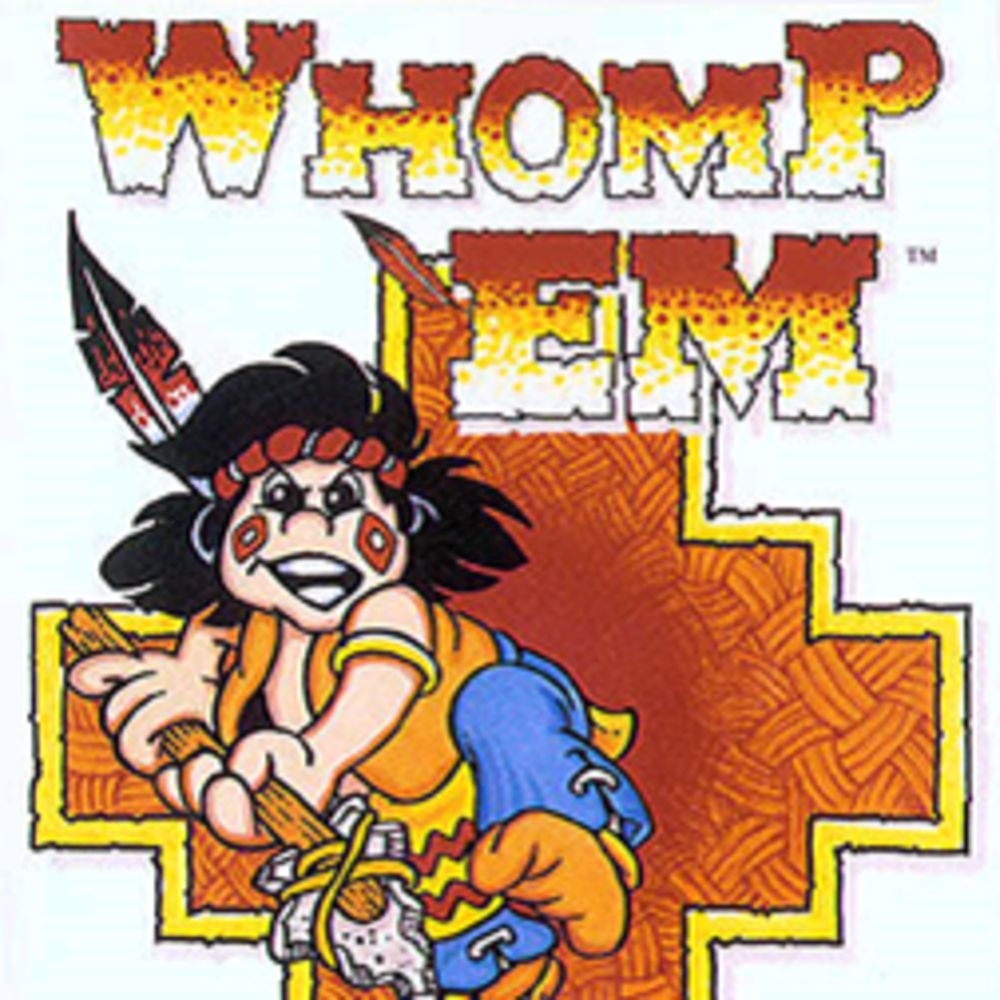
Whomp 'Em, also known in Japan as Saiyūki World 2: Tenjōkai no Majin is a platform game released by Jaleco for the Nintendo Entertainment System in December 1990 in Japan and March 1991 in North America. It is named after Wampum.
From Wikipedia: Whomp 'Em (CC BY-SA 4.0)
Jaleco developed and published this one in March 1991, and Joe was out for it, so this was just Mike and Sean. In Japan it was Saiyuki World 2, starring a Chinese hero. For North America you play Soaring Eagle, a Native American hero dropped into a game still full of East Asian design.
The spear
- Melee, not a blaster. Mega Man with a spear is more melee focused than the usual blaster. You get a spin move that works almost like a fan, thrown spears you can step on, and a cloud you can ride.
- Powers that show restraint. Beat the fire boss and you do not get a fireball. The tip of your spear catches fire, which melts ice blocks in the ice level. Nothing breaks the game, and there is always a plain way through.
- No rock, paper, scissors. Mega Man taught us to match element to boss. Here an ice power used on a boss made of fire did nothing, so we mostly defaulted to the normal spear attack. The trade-off is that there is no energy meter, so you can use the powers freely.
- Enemies that react. Many treat your movement as an input, and with a spear you have to get up in their faces.
Generous, until it is not
Gourds dropped by enemies earn you extra hearts, starting from four. The counts run nine, twelve, twenty-two, then eighty. A magic potion fires on its own when you hit zero health, like the fairies in Zelda, and continuing keeps your hearts. Then you ride the magical elevator to the cloud realm and the difficulty spikes. The last stage is the longest and makes you use every totem. The final boss looks epic and has attacks that hit anywhere on screen, and it opens by summoning some of the more annoying enemies.
Wrong land
There are no cutscenes. The hero's name and his quest for totems for his magic pouch come only from the manual. On a CRT he is a guy in a headband. The localization feels phoned in compared to Power Blade, and most of the East Asian stuff stayed. Wampum is a currency and you never collect any. The composer, Tsukasa Tawada, is credited as Adios Amigo, and the web says that is because it sounds like audio.
Odds and ends
Nintendo Power gave it a 3.1 out of five, and Famitsu gave the Japanese version 23 out of 40. There is no Wampum 2. Last year it came to Switch in a Jaleco collection with Saiyuki World 2, now with an official English translation, plus achievements and a speed run timer. It costs $7.99. It hit shelves the same month Dances with Wolves won seven Academy Awards.
The bottom line
Play it. Both votes were no, so nobody put it on the Essential Games List. The controls are tight and the power-ups are clever, but the spear is less desirable than Mega Man's projectile, and the stage select adds none of the replayability Mega Man has. A Mega Man clone should be more awesome than Mega Man, and this one kept the inferior parts of the trade-off.
Written from our conversation in this episode.
- UNKNOWN PERIL LURKS BEHIND EVERY CORNER
I. Setup & Premise
- The pitch: a kid with a spear collects seven magic totems, and that is the entire story
- You are Soaring Eagle, described in the manual as a young Indian Brave venturing out to gather totems for his magic pouch.
- There is no cutscene, no crawl, no text in the game itself. The premise exists only in the manual.
- The identity problem, and it is a big one
- This is a reskin of a Japanese game called Saiyuki World 2: Tenjokai no Majin, released on Famicom on December 7, 1990.
- In that version you play Sun Wukong, the Monkey King from Journey to the West. Same game, same levels, same bosses.
- Jaleco swapped the monkey for a Native American boy, the staff for a spear, and shipped it in North America in March 1991.
- And it gets weirder going backward: Saiyuki World 2 is a sequel to Saiyuki World, which was itself Jaleco and NMK's heavily altered Famicom version of Sega's Wonder Boy in Monster Land. (Hardcore Gaming 101)
- So the chain is Wonder Boy to Monkey King to Native American, across three companies and two continents.
- The simplest way to frame it for listeners
- This is Mega Man with a spear.
- Intro stage, then six stages in any order, a new power from each boss, then a final gauntlet.
II. What Makes It Stand Out
- The reskin is visible from the first screen, and it never stops being visible
- Soaring Eagle runs through bamboo forests. He fights samurai. He punches out things drawn straight out of East Asian folklore.
- "bamboo forests are not native to the United States, Jaleco," and that is the whole experience.
- The only enemy sprite Jaleco bothered to redraw was a panda midboss, which became a brown bear. In the bamboo forest.
III. Gameplay Structure
- Eight stages, six of them in whatever order you want
- World 1 is a bossless introductory stage. Beat it and a map screen opens up.
- Six selectable stages: Sacred Woods, Magic Forest, Water Test, Secret Cliff, Ice Ritual, Fire Test. (Manual)
- Clear all six and the final secret stage unlocks in the center of the map.
- Basic controls (they're simple, which is part of the charm)
- D-pad: move, duck (hold Down), raise the spear overhead (hold Up).
- A: jump.
- B: thrust the spear forward.
- Up + jump: stab upward. Down + jump: stab downward, and you can land on enemies with it.
- Start: cycle through your collected totems.
- Select: pause, and it also shows how many more gourds you need for your next heart. (GameFAQs, manual)
- The combat loop is stab and reposition
- Enemies take one to four hits depending on type. Gremlins have shields and are only vulnerable while throwing daggers. Snails are invincible in the shell.
- The downstab is your best friend. Vertical sections are built around it.
- Every enemy you kill drops something, so grinding is not a chore, it's the health system.
- The item loop is the gourd economy
- Gourds are the most common drop. Collect enough and your maximum health permanently goes up by one heart.
- You start with four hearts and cap at twelve.
- The gourd requirement scales brutally: 9 gourds for your fifth heart, 12 for the sixth, 22 for the eighth, and 80 for the twelfth. (GameFAQs)
- Crucially, your gourd count and heart maximum carry over even when you continue. That is the real progression system in this game.
- Also in the mix: small hearts (heal one), large hearts (heal all), flint spear head (attack up, four hits), buffalo headdress (defense up, four hits), deerskin shirt (brief invincibility), and a spear pickup that extends your reach for the rest of the stage. (Manual, GameFAQs)
- Magic potions are your lives, and they work automatically
- Hold up to three. Run out of health and one triggers on its own, restoring you mid-fight.
- Lose all potions and all hearts and it's game over, but you get unlimited continues back to the stage select.
- Hidden potions are scattered throughout every level in specific spots, which is a Wonder Boy holdover: jump in the right place and things pop out of thin air. (Hardcore Gaming 101)
IV. Unique Gameplay Elements
- The totems are the Mega Man hook, and most of them are bad
- Spear Whirlwind (Sacred Woods): repels projectiles and breaks rocks. Mostly a key, not a weapon.
- Fire Wand (Fire Test): flame from the spear tip. Melts ice blocks, wrecks the Ice Guardian. Probably the best of the six.
- Cloud (Ice Ritual): summon a cloud and ride it. The GameFAQs writer's complaint is that it takes forever to form, drifts away while you chase it, and then moves slowly.
- Ice Crystal (Water Test): freezes enemies. Useful, but you usually could have just killed them.
- Web (Magic Forest): trap an enemy and throw it at another enemy. Works on very few enemy types. Ranked dead last by the GameFAQs writer.
- Dart (Secret Cliff): throw spears that stick in walls and become platforms. Weak as an attack, genuinely interesting as a traversal tool.
- Be honest here: multiple reviewers independently landed on "the special weapons are almost useless until the final level forces them on you."
- Unlimited use, which is the interesting design divergence from Mega Man
- No weapon energy bar. Once you have a totem, you can spam it forever. (GameFAQs)
- That sounds generous, but it removes the resource-management tension that made Mega Man's weapon swapping feel like a decision.
- It also means the totems have to be good on their own merits, and mostly they aren't.
- The seventh totem
- The manual lists six totems with names and descriptions, then a seventh entry that just reads: "(?) Unknown: You will have to find out the power of this totem on your own!"
- It's the Death Branch, awarded automatically after all six bosses fall. It fires a dragon head that destroys everything in its path.
- The catch: it costs you one full heart of health every time you fire it.
- Which means the best weapon in the game runs on your own life bar, and at max health you get eleven shots before you're down to your last heart.
- The final stage is a different game
- Every enemy in the last level is a miniature version of one of the six bosses, retooled and meaner. That's a genuinely cool idea.
- It's also the longest level, it forces you to use every totem, and there is an anti-gravity section where your only thrust is your spear attack. Multiple writers describe those controls as awful.
- The final boss is where everyone agrees the game breaks. He has an attack that hits you anywhere on screen, which is not communicated at all, and the accepted strategy is to trade hearts with the Death Branch until he dies.
V. History & Development: The Reskin
- The name
- "Whomp 'Em" is a pun on wampum, the shell beads used by Eastern Woodlands nations.
- Reception was quiet
- Nintendo Power: 3.1 out of 5, May 1991 issue 24 (Wikipedia).
- Famitsu: 23 out of 40 for the Japanese version (Wikipedia).
- AllGame: 3.5 out of 5, with Weiss praising the graphics, music, and controls.
- It essentially vanished, then got rehabilitated decades later. 1UP's "Hidden Gems: The Rest of the NES" feature is the citation Wikipedia leans on, and that hidden-gem reputation drove the cart price up. Take on the NES Library noted picking up copies for eight to ten dollars before the market caught on, with loose carts running around thirty-five dollars by 2018. Current listings run higher.
- It finally got a legitimate rerelease in 2025
- City Connection put out a two-in-one JALECOlle package on Switch on August 7, 2025, containing both Whomp 'Em and Saiyuki World 2.
- That release included the first official English translation of Saiyuki World 2, which means for the first time you can play the original and the reskin side by side.
- Bonus features include rewind, quick save, an attack info screen, and a gourd counter, which tells you they knew the gourd math was opaque.
VI. Music & Presentation
- The composer signed the game with a joke name
- Tsukasa Tawada wrote the music. In Whomp 'Em he is credited as "Adios Amigo."
- According to the Video Game Music Preservation Foundation, he picked it because "Adios" sounds like "Audio." He has said nobody made him or the other developers use aliases, they just did it to be funny.
- He also credited himself as "Ludwig Tawada" on another Jaleco game, a Beethoven joke.
- And then he went on to score Pokémon
- Tawada composed Pokémon Colosseum in 2003, then Pokémon XD: Gale of Darkness, Pokémon Trozei, and Pokémon Battle Revolution.
- The man credited as Adios Amigo on a reskinned Famicom platformer wrote one of the most beloved soundtracks in the Pokémon spinoff catalog.
- NEStalgia callback: Tawada also did Moon Crystal, which we covered on our bytes episode
VII. Pop Culture
- The timing is almost too on the nose
- Whomp 'Em hit North America in March 1991. Dances with Wolves won seven Academy Awards including Best Picture on March 25, 1991, the first Western to take Best Picture since 1931.
- Jaleco was localizing this in late 1990 and early 1991, exactly when American mainstream culture was having its biggest Native-American-themed moment in decades.
- "One of the first Native American video game protagonists," with an asterisk
- The Turtle Island Games Archive, a Texas Christian University project cataloging depictions of Indigenous peoples in games, says in one section that Whomp 'Em is the first game with a Native American protagonist, then hedges elsewhere that it's only cited as potentially the first.
- Where the "spirit quest platformer" idea went next
- The 1990s gave us Chief Thunder in Killer Instinct and T. Hawk in Super Street Fighter II, both broad fighting-game archetypes.
- Turok on Nintendo 64 in 1997 is the first Native protagonist with real commercial weight behind him.
- Nearly twenty-five years after Whomp 'Em, Never Alone was built in collaboration with Iñupiaq storytellers, which is the actual answer to what this could have been.
VIII. Sequels, Spinoffs & Comparison Games
- Comparison games
- Mega Man 2: the structural template, right down to stage select and boss powers. The difference is that Mega Man's weapons are decisions and Whomp 'Em's are mostly tools.
- Zelda II: The Adventure of Link: the up-and-down aerial spear thrusts are the direct comparison, and HG101 suspects that's where they came from.
- The Krion Conquest: HG101's own reference point for how far a Mega Man clone can go. Krion is the blatant one, Whomp 'Em just borrows the shape.
- Totally Rad: another Jaleco game that got heavily reworked for America. Good companion piece if you want a "what was Jaleco's localization department doing" segment.
- Bionic Commando: for the gourd system specifically, which works like the bullet collection that upgrades your health bar.
IX. Essential Games List Vote
- Case for Essential
- It is one of the best-playing NES platformers that almost nobody played, and the stage-select structure gives it real replay value that most late-era action games don't have.
- Supporting: the controls are tight, the eight-direction spear work is genuinely good, and the persistent heart upgrades make repeat runs feel productive.
- Supporting: it's a perfect artifact of what the NES library actually was in 1991, which is imported games in American costumes.
- Case against Essential
- The story of this game is more interesting than the game, and an essential list should be about the playing, not the trivia.
- Supporting: six of the seven special weapons are widely agreed to be useless, which guts the Mega Man structure it's borrowing.
- Supporting: the final boss is cheap enough that the accepted strategy is trading health for damage until he dies, which is not a fight, it's arithmetic.
- Supporting: if you want the stage-select action platformer experience on NES, Mega Man 2 through 4 are right there and they are better.
Found automatically from the transcript and checked, but it can miss things or pick the wrong page. Spot a mistake? Tell us.
Games
- Whomp 'Em mentioned at
The episode's game: a Jaleco spear-wielding Mega Man-style platformer starring Soaring Eagle.
- Saiyuki World 2 mentioned at
The Japanese Famicom game that Whomp 'Em was reskinned from, starring a Chinese hero.
- Mega Man mentioned at
The platformer series Whomp 'Em is compared to, with its stage select and boss powers.
- Wonder Boy in Monster Land mentioned at
The Sega game that the first Saiyuki World was altered from.
- Power Blade mentioned at
Last episode's game, another NES game with a heavy North American localization.
- Kid Icarus mentioned at
Mentioned while comparing localizations, along with its hero Pit.
- Pokemon Battle Revolution mentioned at
A Pokemon spinoff Tawada composed for.
- Pokemon Colosseum mentioned at
A Pokemon spinoff Tawada composed for.
- Moon Crystal mentioned at
Famicom game Tawada composed for, covered in a bonus episode without Sean.
- Castlevania mentioned at
Mentioned for its pun-filled credits and for giving you the best whip right away.
- Xevious 3D/G mentioned at
A 1996 arcade game coming to Arcade Archives the day after recording.
- Rock Band mentioned at
Compared for its weekly song drops and points currency.
- Rocksmith mentioned at
The game where your real guitar is the controller.
- Totally Rad mentioned at
Last episode's game, brought up when asking what carried over.
- Super Mario Bros. mentioned at
One of the early essential platformers cited as fun right away.
- Contra mentioned at
An essential game that is fun from the first moment, though you start without a gun.
Companies
- Jaleco mentioned at
The developer and publisher of Whomp 'Em and the Switch collection.
People
- Tsukasa Tawada mentioned at
The game's composer, who is credited as Adios Amigo and later scored Pokemon spinoffs.
Film, TV and music
- Dances with Wolves mentioned at
The film that won seven Academy Awards in March 1991, the month the game released.
- The Last of the Mohicans mentioned at
The Daniel Day-Lewis film mixed up with Dances with Wolves.
Articles, videos and sites
- Nintendo Power mentioned at
The magazine that gave the game a 3.1 out of five.
- Famitsu mentioned at
The Japanese magazine that gave the Japanese version 23 out of 40.
Other
- Journey to the West mentioned at
The classic Chinese novel behind the Monkey King that the Japanese game was based on.
- Arcade Archives mentioned at
Hamster's series of arcade game releases on Switch, discussed as a pricing comparison.
Auto-generated transcript. Each paragraph starts with its timestamp. Speakers are not identified.
Wampum, Unknown Peril, lurks behind every corner.
And welcome to NEStalgia, a chronological exploration of every NES game released in North America. I'm Mike. And I'm Sean. And that's it today. All right, Joe got whomped.
Oh, I guess actually I did say, yeah, that's the title, right? He got whompum. No, no, no. He got whomped is better. Yeah, yeah, yeah. The M with like the, you know, apostrophe and the EM, like instead of them, does that make this game still cool? Um, you know, like whomp them, whompum. I don't think that whomp them would be very playful, nor would it be the same kind of, you know, what are they doing? What do you call it when it sounds like the word, but it's not the word? A pun? The pun! Okay, yeah. I was like, it can't be that easy. You never let me get away with these.
Usually it's some very sophisticated word, but here we go. Stop it with the sophisticated word. And what is, what is wampum a pun of, Sean? Wampum. Right, so it doesn't even sound different. You know, it's just, it's just, you write it out differently. Wamp, because like, I'm sorry, but like, I'm not the guy to do this, but like wampum and wampum, like, you know, it's lost on you if you hear me say them that close together. But it, you know, the wampum is like, what is that the? It's the, you know, it's the equivalent of like, you know, Native American currency, I think in like the Iroquois Confederacy. If I'm not mistaken, I could be wrong.
But that's the wampum. And I guess this guy is a Native American. You know what I was thinking of? So I'm glad I let you take the, take the answer here. I was thinking of a wigwam. Maybe that's wigwam? No, no, what is that? No, no, no, no, you're right. I'm saying wigwam is like the, you know, the, the shelter, the hut. Ah, yes, yes. So I was thinking of that when I heard wampum, but wampum is like a currency.
Yes, I think it's like a, a bead slash currency. Right. So this is a game where you collect wampums and then, I don't think you collect any wampums. Right. You don't collect anything. So they just went for the title and they were like, hey, you know, you play as an indigenous person. And I have to check when this episode is coming out because maybe it's close to not. Unfortunately, indigenous people day had passed by this point, but I hope everyone had a good one.
And no better representation on the NES so far than this game, because this game. And yeah, it's the only one. And it's actually, it was not an indigenous person in the original Japanese game. This was actually a, a game that was part of a series of games called Sayuki World. So this is the second Sayuki World. Say, yeah, it was a Chinese guy. Yeah, exactly. But so everything in that game was like, you know, East Asian, both in like, you know, design and in the enemies and everything.
And for the most part, they left all that stuff in. Yes. So it kind of feels like, you know, like they, they, they're, they're indigenous person here, like wound up in the wrong land or something, because none of these things have any tiebacks to that culture. Yeah, I guess you could kind of just sort of just say like, oh, forests are in America, too.
Um, you could probably change the color. Maybe there were some panda bears that they changed the color of to be more brown. Um, that I'm not, I cannot confirm, but I think it was a pretty slapdash effort to like, we've seen some pretty impressive is the wrong words, but, but like more complete, uh, kind of localizations and how they like completely change. Oh yeah. I mean, we just saw that with power blade, power blade change.
Yeah. Obviously like, what was it? Kit was Kit, Kit Icarus was like that too. Right. Uh, not Kit Icarus, but, um, no, cause those, those in Hindu games are pretty much just straight, but yeah, they're a chubby cherub. Yes. Another cherub. Those are the two games that I always mix up and I'm sure everybody hates me. And then they're both cherubs to be fair. Right. I think, but Kit Icarus, by the way, his name is actually pit. So, you know, he's just Kit. Kit Icarus is pit. Yeah. Uh, but, but yeah, we've seen this done a lot more like, you know, not phoned in. This feels a bit more phoned in.
Um, but I don't know. I haven't even seen. It just almost makes you wonder why bother changing. Is it just for, is this where you have that clever title for the game? I guess, but like, you know, you could have just done journey to the West and you know, maybe we would have been the first that a bunch of kids would have heard of that, but it didn't really need to change anything. Right. I've seen a lot of Eastern vibes on this, on this console. Yeah. Playing as the monkey King sounds pretty cool.
Yeah. Uh, but actually the, the story of the localization of all this gets a little stranger because, um, while that, you know, that first game in the Sayuki world, which has no relation to this one was actually more of like an RPG. And this one's kind of like a, a Mega Man like platformer. Uh, the second game was, um, uh, was like a heavy, was working off of a heavily altered Famicom version of Sega's Wonder Boy in Monster Land.
So that rings a bell. I'm not. Yeah. I mean, famous game, but like kind of weird that like a, a Sega property somehow through like a, a port, an adaptation of a Famicom. Game that then gets retranslated over here to an NES game, uh, featuring, um, you know, indigenous people instead is like, there's just a lot of the, there's a lot of like stuff going on here that is completely lost. Even, even if you look at it, like from the historical lens, like none of it really matters. It's just like a neat trivia thing. It doesn't, it's not represented in the actual gameplay at all.
No. And even the, the character design, it like you could, you know, on a CRT, maybe not even like correlate that it's a native American and it just a guy with a headband. Um, because nothing else really ties into it. So it doesn't matter. He does have a sick name though. What's his name? Well, you would never know in the game. So I don't, don't feel bad, but in the manual, uh, it's revealed that his name is Soaring Eagle. That's a great name. It's a great name. Yeah. Uh, and, uh, Soaring Eagle is venturing out into the world to gather totems for his magic pouch.
There are no cut scenes in the game. There's no explanation. This is all from the manual, but basically the top line is that like, this is Mega Man with a spear and we've seen Mega Man with an X, uh, games before. A lot of times it's literally just another version of a blaster. So this is something different where it's more melee combat focused.
Uh, but the, also the interesting thing is kind of like the, uh, introduction to Mega Man X. The first level is like not a selectable thing. You're not like, you're not starting off in like a choose your boss or whatever. You start in the mountains, do this cool little like introduction thing. And so I wasn't like the Mega Man headline was, wasn't apparent to me. I only realized like, as soon as we got to the stage like screen, I was like, huh, I wonder if we're going to like gain power ups after we defeat enemies, you know? And like, sure enough, you do. And one of them old, yeah. Yeah, exactly.
Like, um, what was that? Uh, shoot. The, it was interesting. I wish I could remember it. Yeah, it's fine. The Cryon Conquest. Oh yeah. Yeah. Uh, that was another nonsense name that, that, for a game that was all right. Nonsense names are the way to get some attention though, right? Like, like, I feel like I'm always going to remember Princess Tomato in the salad kingdom, but Thunder and Lightning. Cryon Conquest was, was a, that was a witch girl, right? Yes. Okay. I, I have some memories. Okay, good. Yeah.
But Thunder and Lightning, come on. You have no idea what that is. That's too, it's too generic. Is that a NASCAR game? Thunder and Lightning is not, that was a like, wasn't that a breakout style clone game? Yeah. Maybe. It tracks. I think so. Or Arkanoid, whatever they mean, you know, like the difference is one has power ups or something like that. Anyway, to, to get back to, uh, Wampum here. Uh, how, how interesting is the take on Mega Man then? Like, let's, let's start there rather than rehashing what it means to be a Mega Man like thing. Just how did they apply it? And did they make good use of, um, you know, the spear as a weapon?
I, I do like the spear. Uh, I think it feels, it feels good. Um, and I also appreciated that the powers were varied. Like a lot of the time that you, that you get these, I feel like they're all just sort of variations on here's a different colored projectile.
Um, whereas this, you know, instead of, uh, poking people, you can kind of do that, like spin move and almost like, it's almost like a fan. Um, that, that's cool. That's cool. There's a couple different almost projectiles there. Then there's the actual projectile, but there's spit on that is that you can then like, you're just throwing spears and you can actually step on those. There's like, uh, there's a cloud you can ride.
It felt like they were at least having fun with the power ups here. Yeah, I agree. I think that there's also like a lot of those things are also complimentary to the platforming, which is nice. It's not just like, okay, cool. We put like a bunch of blocks here and just figure out, you know, which ones to jump to and stuff like that. Like there's a lot of, um, creative solves to, to get across the stages.
And one thing that like the, uh, the first stage doesn't prepare you for is that like, there is some difficult or like well-timed platforming to be had in, in these stages that you choose. And so if you go from like that introductory stage, that's just kind of like, congrats, you proved, you know how to play the game to then going into the actual game. Uh, you're going to take a lot of damage.
Yeah. Um, not only is the, the platforming challenging, but the, the enemy behavior, I think is a lot more reactive to you as a player than in most games that like, you know, they, the enemies might have a pattern and you're supposed to learn that pattern. But a lot of the enemies in this game have a pattern that also has like your movement is an input. Like if you try to avoid it, it will be very responsive to you trying to avoid it. Or are you trying to run up and hit it? It'll be very responsive to that and try and get out of that way. And you, did you, did you feel that at all?
Sure. Yeah. I think also the spear isn't necessarily like, because it's a close combat thing, you have to, you know, you have to fight these enemies. It's not the kind of thing where you can like, uh, hold them off from a distance. You have to get up in there.
No, the one thing about the power ups and the enemies interacting that I thought could have been done a little differently is, um, there, there, there aren't a lot of intuitive ways to like, once you get into the more like exotic, uh, power ups, uh, you know, there's a, there's a spider thing. There's an ice blast thing. It's not very intuitive. Like which enemies are going to react to these. Uh, I don't even know if some of them like work on every, I don't think they do. Like there's a, there's a boss that, you know, if we think about Mega Man logic, uh, and in some upgrades being particularly effective against certain bosses and how that sort of telegraphed,
um, you know, you have an ice power up that if you use it on a boss made of fire, it doesn't, it doesn't do anything. And I don't know if, if you tried that or if, I don't know what order you played these maps in, but I was kind of flabbergasted by that and ended up just most of these, uh, most of these bosses, I just defaulted to the spear normal attack. Cause that was the only thing I could think of. It's a good point because the, um, Mega Man taught you that essentially like, you know, it's a game of rock, paper, scissors.
Yeah. You have to pull out the strong, uh, element against the weak one. And so there's an order you want to play these things in. That does not happen here. The end, the bosses, uh, might have a weakness in the sense of like a certain power up is easier to hit them with than others, but they don't like apply more damage or anything. Sometimes don't do any damage.
Sure. Yeah, exactly. But the trade off there too, being that in Mega Man, uh, you have a energy meter and in this game you don't, you can just, uh, freely use, uh, these attacks. And I think like what power up you get from each of these things is also, um, I get, it does show some restraint by them too, though. Like I was thinking about the fire one and when I, that's the one I went to first. And when I beat the fire boss, I was expecting like, now I'll have like some kind of fire
projectile. But instead all you have is like the edge of your spear now has like a flame on the tip of it. And that comes in handy if you go to the ice level, like it is able to melt ice blocks and stuff like that. Um, I feel like you can also like fan attack those same blocks. Yeah. But like, I guess I, you know, I, I recognize that like, that's an interesting thing that like they could have made this like a lot more op and they chose to like keep, keep everything
to be like the same kind of power across them. There is no like, Oh, this power up is like way more powerful. Like there's the one you have at the very end of the game that obviously is more powerful. But, uh, for the most part, all of these have like a specific use case that will, that will help you, but do not break the game because obviously since you can do them in any order,
it would suck if like there was one that just like created blocks for you to platform over, right? Like that breaks the game. Um, I did appreciate at least the one that allowed you to use enemies as projectiles themselves that, that felt very good to use. Um, but, uh, yeah, that was nothing felt too wild because it only worked on certain enemies. I feel like. Yeah. And there was the one though, um, that like, now you can throw your spear and it creates a platform on the sides. And, and that I thought was like another, uh, another great, interesting one that like, they have to kind of play test a little bit to make sure it doesn't break the game.
Yeah, exactly. But also that like, but that is also not required anywhere. There's no spot where it's like, Hey, if you didn't collect this, like you're out of luck. No, it's usually it's, I think it's sort of in the same vein of as the cloud where you can use the cloud to skip like some platforming sections in the same way that you could probably use the, the throwing spear to skip platforming sections, but there's always a vanilla way through because that could have been the first map that you used or the map map that you attacked or map that you chose.
That's what I'm saying. Yeah. There you go. Yeah. And if all those power ups are acquired by defeating, um, the various bosses at the end of each stage, there is, uh, another like guy, I wouldn't even call it a power up, but just like, uh, you know, worth collecting are, uh, I believe they're gourds, uh, that certain enemies leave behind. Is that what that is? There's, according to the manual they're supposed to be. And, um, if you collect a certain amount of those, you gain a new permanent, uh, heart, uh, kind of like a legend of Zelda style, like, you know, collect hearts across the top of the screen. Is that the more counter?
There's a more counter? When you press select, it says a random number and it says more. Oh, interesting. Yeah. Maybe it is because it scales very weirdly. Um, you, you, you start with, I believe four hearts to get your fifth. You need to collect nine of those, uh, gourds to get your sixth. You have to get 12. So that is keep in mind just three more than the fifth one, right? Like it's not like collect nine. And then when you get three more, you get the six, you'd have to, you know, you've started zero against you to get 12 more, but to get the 12th heart, you have to collect 80 of them. So it's like, the gap is huge. It goes like nine, 12, 22, 80.
I don't know if that's logarithmic, uh, you're rhythmic. I will say this though. It, you know, I, it, you get those extra hearts like kind of early. Um, you know, so like even the, even the four, if you don't collect any of them feels like it would be challenging by the end of the game, but it doesn't feel like a bad amount to have. Cause like, you don't take, uh, you know, a significant chunk of like, it's not like a, an
enemy can deal four hearts worth of damage to begin with. So to, to get these extra lives in a way that isn't like, Oh, find this hidden thing in the stage that reveals the heart that do then collect to get the extra heart. And if you miss those, you're shit out of luck to instead, just have it be a collectible makes it so that, you know, you'll get at least like a, a good amount of these hearts naturally. Just passively.
And then you may not notice them populate, but then, then you're just better prepared for later maps. Uh, I was not super prepared for the, like, once the game starts being more linear after you've done all of the, uh, you've done all of the select the maps. I was very bad after that, but yeah, I was more prepared.
There are also magic potions, um, that you can hold on to. And that's another like amazing consideration for like the, to the difficulty of this game that if you run out of health, you just, it's like, it's like the fairies in legend of Zelda again, where it's like, if you have one, it just, as soon as you're out of health, it triggers by itself and restores you mid fight. So these are very handy to have on you, especially in, at the end of the game.
Always love an auto potion. We talked about the powers you get from the bosses, but we didn't talk about the bosses themselves. It's not like they're, uh, you know, work works of art or anything, but the actual like fights are, are unique. And, and I think very well designed in a way that wasn't just copying Mega Man into being like, you know, this guy, uh, because he gives you the fire spear, he has a, um, a fire punch. And, you know, so it's like something similar enough that you know, you're going to get. It is just like a, Oh, that's a different kind of boss battle. Yeah. I think the, the biggest difference between them is just that they have different, um,
I mean, it, yeah, that's all patterns, but like the, the movement, like where, uh, specifically like one of them will keep going in like, uh, like a zigzag. One of them will kind of hop or a couple of them just hop around in different arcs and it, it makes it more difficult to track. That's the biggest difference between them. All they're all kind of the same size.
Um, some of them have, uh, like phases in which they're invincible, like, but none of them are crazy there, but they're, they're varied enough to feel different. Yeah. And while they might not be like gorgeous sprite work or anything, they are like fun, different enemies that you'll face. Like the, the frog isn't just like, uh, you know, an animal like frog. Like he has like a bit of a, he reminds me almost of the chrono trigger, uh, frog character. Yeah. And who doesn't love frogs? Who doesn't love frogs? What are frogs? Amphibians.
Yeah. Uh, Jeopardy reference, but you'll, you'll, you'll get it one day. Okay. Got it. Yeah. You just don't know Jeopardy references. What the hell is going on anymore? Anytime you say what is, it's always, it's just automatically.
Yeah. Everything is. Yeah. Got it. Uh, okay. And then what was the, there was one other thing I wanted to touch. Oh yeah. So I feel like one thing we've been covering is like the unlimited use of the power ups, the magic drinks that refill you mid fight, the, uh, generous amount of hearts you can receive. The, the game is generous in these ways. And it is also generous after you like run out of, you know, like when you have to hit continue, uh, everything like carries over from your continue, including your hearts and stuff like that. Like you don't lose any actual progress. So the game seems to be very forgiving, but what did you think about it from a, like a difficulty perspective?
Yeah. There was just something about the, the shift to like, once you kind of go up that magical elevator in the center of the map, um, to the, to the cloud realm or whatever. Uh, I, I felt a huge difficulty spike in which I was having trouble getting all that much progress. I, I didn't, I, it definitely feels easier than a Mega Man game, uh, because I'm terrible at Mega Man games and I'm only like slightly, I'm slightly less terrible at this game. Um, so I, I can, I can see it both ways there. Yeah. And that last stage is not only the longest level. Um, but it also is the one that like forces you to use every single one of your totems to kind of prove that you know how to use them and what they're for.
Um, but the final boss is like there. Tell me. Okay. Me neither, but, but I'll tell, I'll tell you this, the final boss is pretty epic looking, but is the, maybe the most like, okay, I'm not quite sure how this ties into, uh, you know, Native Americans, but because it's like truly like one of those like Chinese demigod
things, but you're like, okay, sure. Sure. And, uh, it has some truly awful attacks, uh, that can basically hit you anywhere on the screen. Um, so you basically are just, you know, like accepting that you're going to be taking damage and just basically hoping that you can defeat it before it defeats you. Like you, you, I'm sure someone skilled enough at the game could do a hit list run, but for
the general like person who's playing this game or has been playing this game and thinking like, Oh, this is pretty easy. It's like the final boss is just like, Hey, eat shit. You know, like now, now you have to deal with something that can just hit you no matter where you are. I see that he starts by just sort of summoning enemies, uh, some of the more annoying enemies, uh, to start.
And that's, uh, that's a good appetizer right there. Isn't that funny how like there, especially, uh, you know, I, I think of a lot of, um, more modern RPGs and, um, even the, the souls like games where like, there are some just like normal enemies that are way more frustrating than boss fights. Yeah. Like you just like, I don't want to run into another one of these, like, cause you run into them so often and there, they are kinds of pains in the asses. Like it's funny that there are some enemies that are just harder than the bosses because it's like, I don't want to deal with this again. Like I defeated this thing so many times.
They're more of just an annoyance that it feels harder, you know? And they don't quite get to that distinction though, of being like, um, uh, like a secret boss or, or like, uh, you know, like you do have to, you do have to deal with encountering
them. Um, there are obviously like in a lot of those RPGs, there's like hidden encounters and stuff like that. But this is just like, I'm thinking about enemies that you run into like in the late game that just become random encounters all the time. And you're like, man, fuck this guy. Like, what specifically do you have in your head? Because I feel like you're, you're visualizing one enemy right now. Well, I'm visualizing something from kingdom hearts too.
Um, so even Joe's not here, right? Even when Joe's not here, but I'm saying like, that's because I, I have that, but there was also, that was very much in bloodborne too. Oh yeah. The end. There were plenty of enemies that I was just like, I am so glad that I can just like, you know, uh, not have to, not have to fight you. And then I could just skirt the other way because obviously everybody in that game is, is a tough encounter, but especially some of those more, uh, uh, eldritch horror enemies
really, um, uh, really were just not pleasant to deal with. Yeah. Um, uh, some of the, yeah, no, you're right. There's a ton. Any, any souls, like any from soft game is going to have a ton of those.
Yeah. And I just finished a run of final fantasy five too. And while I don't have any of the enemy names committed to memory or anything, there are a bunch like that in the, in the last, uh, dungeon of that game too, where it's just kind of like, uh, okay, I guess I'm just going to use the same strategy over and over again because I figured out the fastest way to deal with these guys, but it's not necessarily like I'm having a good time. You know, it's like, this is how I have to get through this encounter. Frogs. What are frogs? Did you get that reference?
Now here's the funny thing. Um, this game comes out, uh, it gets like pretty okay reviews. Uh, Nintendo power gave it a 3.1. Uh, that's out of five. We found out, uh, on an episode without you, Sean, we found out that Nintendo power rankings are out of five, but we thought they might've been out of four. I see. Got it. And Famitsu gave it a 23 out of 40. Uh, but that was for the Japanese version, obviously. So I wonder if they would've deducted more points for the, uh, aesthetic choices. Ha ha ha. And then like, if you think about it, right?
Like this whole franchise kind of just dies off, right? No one's thinking about like, Oh, where's Wampum 2? Like we kind of, I feel like you just know you're not going to get Wampum 2, right? I felt that. I mean, I would've been, there's been many a time that I've been surprised in our sequels and spinoff section that there are sequels and spinoffs. Uh, but this is, this is one of them where I would've been surprised. Yes. So, but would you be surprised to hear that this did get a legitimate re-release on the Nintendo Switch in just last year?
Yes. It was a, um, it's a Jaleco, uh, two in one package. Uh, and you get both Wampum and Sayuki World 2. So you can experience both, um, the Famicom and the NES version for the price of one. And they even did a official English translation of Sayuki World 2. So for the first time you can play the original. It's just like, I guess like. Is there any words?
Right. But who was demanding that too? Like, you know, even, even if they, maybe that's why they did it, right? It was like, shit, we just have to translate the, the main menu, you know, do anything else. But like, I guess who was clamoring for this, that they took the time. Cause it has like rewind and quick save and don't get me wrong. Like I'm thankful for this kind of preservation and everything. But usually these things come with like at least $7.99 price tags, if not $11.99 price tags. And I just feel like that's a tough ask for like two ROMs.
It was it that do you, do you know the price? Uh, let's look it up. I'll look it up now. Why not? Yeah. Cause I, I can't, I can't spend that kind of money. Uh, if there hasn't been any kind of work done to it.
Okay. Also, so it's the collection is called Jaleco. Jaleco, which obviously we know Jaleco and they were the developers of the best. They're the best. Jaleco two, like Roman numerals, I, I Jaleco two E. Uh, what, what, what? Yeah. Is that like, is that supposed to Jaleco? Like, it looks like it's supposed to be like Jale, Jaleco collect, you know, like it's missing the C. Ah, like the Jaleco collection. Yeah. It's missing that. It's that it's just Jaleco two E.
Uh, which is like Banjo two E, you know, it's the sequel. Uh, anyway, the, the price is believe it or not, Sean, I guessed it. $7.99. Yeah. Nah, nah, that's, that's steep. That's deep. What if I told you though, that they, um, did put in like achievements and stuff too, though? So they did do the work. You are, you are playing a ROM, but at least they added like, no, they even added like a speed run timer. So you can, uh, reset the clocks and stuff like that.
Like you're adding stuff. Yeah. They have like little, um, things on the UI to like the, cause obviously they kept the four, three aspect ratio. So using the rest of the screen, you can see the current achievements that are locked off for you. You can see the controls. You could see like, there is no bad.
There is no bad. Yeah. Why not? You could even read the manual. How about that? Maybe that's what they translated. The manual. Yes. That makes sense. Yeah. Um, but I don't know. It's like, I'm glad that they're doing this kind of stuff. I do. I do like this more maybe than the, um, uh, who is it? Uh, arcade archives collection, which just gives you the game. Like they're like, yep, we brought this arcade game to your switch. It's like, well, yeah, I've never bought any of those. I had, I mean, I guess.
Yeah, exactly. And anything that's on the switch marketplace is too expensive. So if it's not like a modern game, I'm probably not picking it up because I'm already paying for the Nintendo like battle pass itself. So I'm just going to play the, uh, the ones that are like being pretty honest about the fact that they're just emulation. Right. Now here's the interesting thing too, about arcade archives, since we're talking about all this stuff. And trust me, this is all relevant content to the episode guys.
Um, arcade archives has a release schedule. And it's like, you know, like how, uh, how like rock band did. Do you remember? Or maybe like, sorry, maybe the Wii shop is better, but like, do you remember how like rock band would have like every Tuesday? I think it was like, oh, songs would drop. Yeah. The song drops. Yeah. And you could use your three 60 points. Remember that you had to like buy three 60 points.
Well, I didn't really have a three 60. I had the PlayStation, but okay. But this is an interesting question. All those songs. Yes. Yeah. But like for PS three, was it just in cash? Was it like, Hey, this song costs two 99.
Yeah. Was it like you needed like, actually, you know, Rocksmith, the game in which your right, your real guitar is a, is the, the controller, uh, still did that up through the PS four. So, wow. Okay. I mean, I guess it's just nicer to know the price upfront. I was being fooled by being like, you know, Oh, this song's 400 points. It's like, great. That's nothing. What are points? You know, like I'm getting 400 points.
Yeah. 400 points is one note in rock band, you know, uh, but arcade archives is like literally pumping these things out, uh, every like Friday or Thursday, they're just giving out like a new game. They give them out or they list another game for purchase. A list, another game for purchase. Yes. Uh, but, but I'm saying how kind of them, you know, like, but who's collecting them? Is there somebody who's like every Thursday, like, fuck, I got to throw another seven 99 and get another one of these. Like just for reference, we're recording this episode, um, uh, September 23rd.
So September 24th, uh, arcade archives is getting, um, a release of Xevious 3d slash G sounds really fucking cool. What is that on? Are we playing that? No, we'll never play that. Uh, cause it's in 3d. Oh yeah. It came out in 1996.
And, um, this is one of those ones that like they branded under arcade archives too. Like as if like, it's like next gen, right? Yeah. Like, Oh yeah. Next gen arcade archives. And I guess like, I get it cause they're now doing, um, the 3d games that probably use like, um, uh, the CP three or whatever Capcoms, um, and Sega's like 3d arcade, uh, cabinets instead of their 2d ones from the eighties.
But like, does that, that probably means it's also more expensive. And it adds a 1299. Yeah, sure. But like, here's the, here's the good news. Okay. We don't condone piracy on, uh, on nostalgia. Never pirated a single thing in my life. But think about it like this. Wampum on the switch came with two versions of the game. And for the first time ever, the Japanese one in English for just the mere price of 799. If you wait for a sale, you might be able to pick it up for six, Sean. What do you think? What do you think Wampum is going for in, um, like, Oh, the market at the NES cart? Oh God. Uh, $390.
$62. But I'll tell you one thing. That's only $20, uh, cheaper than Grand Theft Auto six. And I think I know which one I'm picking, you know? So maybe I shouldn't be complaining about a 799 price tag. You're right. That's like in, in, in 2010, that's like, that's just $4. I feel like, you know, cheaper than a cup of coffee. I'm, I'm now pro Wampum by Wampum. What did you think of the music in Wampum? Anything stand out? It was, it was there. Um, I remember it being better than I expected, but I can't conjure any particular melody in my head. Uh, me neither, but I, I call it out because in the, uh, credits of Wampum, uh, the composer who is, uh, Tsukasa Tawada, uh, he didn't put his name in as the composer. He put his name in as Adios Amigo.
I mean, it was cute when like, Castlevania did that. Remember with like, uh, you know, they were doing like, uh, puns on the, uh, various like universal horror monsters and stuff or actors. This is like Adios Amigo. Like, like, was there supposed to be a Mexican version of this game too? Like what, what, what, like what's happening? Like, what reference is that? Yeah. That that's, that that's more of like a native American thing. Yeah. Maybe. Hey, apparently I don't even know if this is true or not. This is just something I'm picking up from someone else on the web. So great journalism here, but they're saying that he chose Adios cause it sounds like audio.
Okay. I, I buy it. So audio Amigo, well just do that. That's funny. You don't even need the Adios part. I don't even, I don't even know what we're doing anymore because I think like if you were to like me knowing that it's because it sounds like that doesn't make me go, ah, I get it now. It's just like, yeah, yeah. It's not even like it does. It doesn't clear up any of the mystery.
Uh, but, but Tawada is not like, um, you know, he, he, he's not like just making Jaleco music on the NES. He, he was a composer for a long time. Wind up composing a lot of stuff for some, uh, not the mainline Pokemon games, but, um, um, the spinoff games like Pokemon battle revolution and Pokemon Coliseum, uh, and get this. Okay. He also did moon crystal, which we just covered as a bites episode. So I wasn't there.
Oh, sorry. Which we meaning me and Joe keep yourself out of this. Okay. Absolutely. Right. Well, I always like to think of we, when I say that, like I'm saying we to the audience as like the three of us to them, you know, like nostalgia is the three of us. Well, I mean, you know, let's just speak for yourself is all. We would like to play. Yeah. But, but, but was it good? Do you remember those commercials? No. They'd come over the, it would be, it was like a reference.
That's not a jeopardy reference. That's a Nintendo reference. Okay. We're on a Nintendo podcast. Why would I be making jeopardy? You sick person. Yeah. Actually I should be making jeopardy references. There's four jeopardy games on the NES. It's basically like Nintendo is more jeopardy than jeopardy is jeopardy. Yeah. They didn't even make four Super Mario brothers on the NES. Losers. They got beat on their own system.
Sean, you wanted to know if Moon Crystal was any good. And to that I'll say, you just have to subscribe to patreon.com slash nostalgia to find out. You can't just leak it to me. I have to pay. Yeah. I can't leak it to you. I can leak it to you off the show. How about that? Okay. Never on the show. Got it. We can never talk about Moon Crystal again on the off chance I might spoil the chance to collect $4.99 from someone who's listening.
Now, Wampum hit North America in March, 1991. Or it Wamped North America. Yeah. It got Wamped. Okay. Now, but I don't know. That doesn't sound good. That's like Wamp Wamp. You know? Sure. Like, how were the sales on Wampum guys? Wamp Wamp. That's our own fault. But here's something that's not Wamp Wamp. And I don't think it's a coincidence. Wampum comes out in March, 1991. Do you know what else happened in March of 1991? Tell me. Dances with Wolves won seven Academy Awards, including Best Picture. Holy shit.
Right? I mean, was there a better time to release a, like, this was like, this was like America's biggest North Native American moment. Wait, is this Daniel Day-Lewis? Is this like, is that him? In Dances with Wolves? In the game. Or you, oh, yeah, is he Soaring Eagle? Yeah. I was like, buddy, I got news for you. Um, yeah, no, maybe. Who knows? This was the performance of a lifetime by Soaring Eagle.
And we did touch on it being, um, the first, you know, Native American, uh, game on the NES, but I think it might just also be like one of the first ever, like across any video game. I think. For a protagonist, you know, obviously they were the antagonist in a lot of video games, which is like, not cool, but to have them as the protagonist, hey, this is pretty, hey, look at, look at the NES being progressive. I just, I just want to make, I just want to throw it out there. I want to be, um, held accountable.
I mixed up, uh, Dances with Wolves with The Last of the Mohicans. So. That's why I was saying I've got news for you when you said Daniel Day-Lewis, because that's Costner. Yes. I knew that. I know that now. People get them mixed up all the time. I get it. They're a year apart. Right. Kevin Costner is giving out Daniel Day-Lewis worthy performances. Apparently. Hey, I like Feel the Dreams. That was Daniel Day-Lewis, right? Yes, it was. He was everybody in that movie.
Uh, let's see. Uh, I don't know. We talked about the references, you know, you got Mega Man in here. You got some Zelda elements. Um, do you have, is there, is there anything to pull from Totally Rad?
Remind me. Oh, you weren't there for that either? I mean, mentally, who knows? Mentally, you weren't there. Yeah. Okay. I think you were there. I, I, it's entirely possible. Um, this is. No, it's, you're probably not. Okay. This has been a roller coaster of emotion. Yeah. This is the, this is the content that's going to get cut from the episode. Actually, if I cut anything from the show, it's going to be the part where we forget who was on last week's episode. I won't forget though, to do the most important part of the show. And that is the essential games list.
Sean. Yeah, this is, this was, this was a fun game. Um, I, I think that the recontextualization and retheming is kind of phoned in and half baked. Uh, but I think this would have been totally fine if they just kept it as it originally was. I would have been none the wiser and wouldn't have been like a confused American consumer being like, why isn't this about things that I know about?
But I think all the, the, the gameplay elements are there. It's fun. It's, it's, it's, it's nice to, it's nice feeling. Uh, I think there's a lot of good stuff with the, uh, with the power ups and not so much the boss design. The boss design is fine, but I don't know. It's a lot of this is just like, yeah, it passes the bar. Um, of did Sean hate doing this to himself when he had this assigned as like, uh, this is the podcast game. Um, Sean did not hate himself playing the podcast game, but I don't think it's like really up there as an essential game, uh, candidate. So I'm going to just say no.
Yeah. And I think the interesting thing here, um, and I'll, I'll just lead off with, it's a no from me, but it's not like a no in a way where I would like, this is a play it. This is a play it game. This is the kind of game that like respectfully, there's a reason why you don't see it on lists of like top NES platformers or whatever, because this, you know, we have so many high, uh, high caliber, uh, platformers already on the essential games list. You look at like the, the mega man's the castlevania's the super Mario brothers.
When, when, when those kinds of games exist, this one, you feel better playing it because you never heard about it. You know, it's a great, it's, it's a great NES platformer that almost nobody played, um, or nobody plays today. Uh, the stage select structure, um, you know, maybe adds some, like, it doesn't, it doesn't add like any new routes or, you know, replayability in the way mega man does.
Um, the, the controls are tight, but the spear is like maybe a little like less desirable than a projectile weapon that you get in mega man. So I just think all these things to, to basically make it a mega man clone, they, they forgot that like, they, they took all, they took all the inferior parts of the trade-off. If you're going to make a mega man clone, the game, the goal should be to be more awesome than mega man, not be like, okay, it's mega man, but he can't do this, this, and this. And I think that's why this isn't on the essential games list. And I think that's something that we're just, I've been thinking about lately, Sean, not just for the NES, not for the essential games list, but just for video games in general is
like, I, a lot of video games just need to be fun from the very beginning. If the goal of the game is like, Hey, this, you know, I, you always hear that meme of like, Oh, don't worry. It gets really good after 10 hours or whatever. Right. That's not even what I'm talking about on like, there are totally games that, uh, 10 hours in all of a sudden you hit that flow state and everything comes together because of all the systems you learned and everything.
But if a game isn't like, if, if it's not fun to control the character, if it's not unique or interesting to, to be that character after having played so many of these now, we're, you know, we're looking at 400 plus games. You pick these things up and it's like, they're so easy to dissect right away that I feel like I know, uh, whether or not I like these pretty fast. And with wampum, I was, I would give soaring Eagle, uh, some kudos for being a tightly controlled character. And that may be just like, as I continued to play his limitations were more like noticeable, uh, than they would have been initially.
Yeah, no, I, I, I, I agree. I think that I have a bit more of a, uh, uh, what would you call it? I have a bit more patience for games that I choose to play of like, is this fun right now? Versus, uh, is this fun 10 hours from now?
Um, I think that again, and we've talked about this before the fact that we have to play these in order and there's no changing the order, uh, makes it a, a lot more, uh, a lot more front and center of like, is this going to be something that hits us in the face? And that's always good when we kind of have to do this, um, or have to play this game right now. Whereas I think that, you know, maybe a more, a more like where the fun is a bit more earned.
If I had like, just sort of decided to play that game, I would be a bit more kind to it. Whereas in this, uh, in this shape, it, it's what, there's always going to be a lot more, uh, like sort of, it's always going to, we're always going to be nicer to a game that kind of like hits us in the face with the fun stuff. Right. Cause I'm looking at, you know, I'll go back to the 85 games here or not just the 85 games, but some of our early essential games.
And if you look at duck hunt, super Mario brothers, balloon fight, Castlevania, legend of Zelda, punch out, contra gun dot smoke. Like you're doing the fun thing right away. As soon as you start playing the game, the thing that makes it essential is happening immediately. It's not like, you know, um, uh, to, for contra, right? It's not like, oh, you need like this super power up to all of a sudden feel like you're, you know, doing a run and gun blitz through, uh, alien levels. It's like, that's just happening right away.
And it feels awesome. Well, the first third of the game, you don't get a gun. Like you're, you have to, you just have to run around and die over and over, you know? Right. Uh, and same thing with like Castlevania. It's like, you have like this really short whip, but before you even enter the castle, you have the maximum whip, you know, it was just showing you like, Hey, this is how you, this is how you could be for you if you don't pay attention to the power ups. But like two minutes, one minute into the game and you're already the best version of Simon. Oh.
Oh. Stay tuned.