101 · CITY CONNECTION
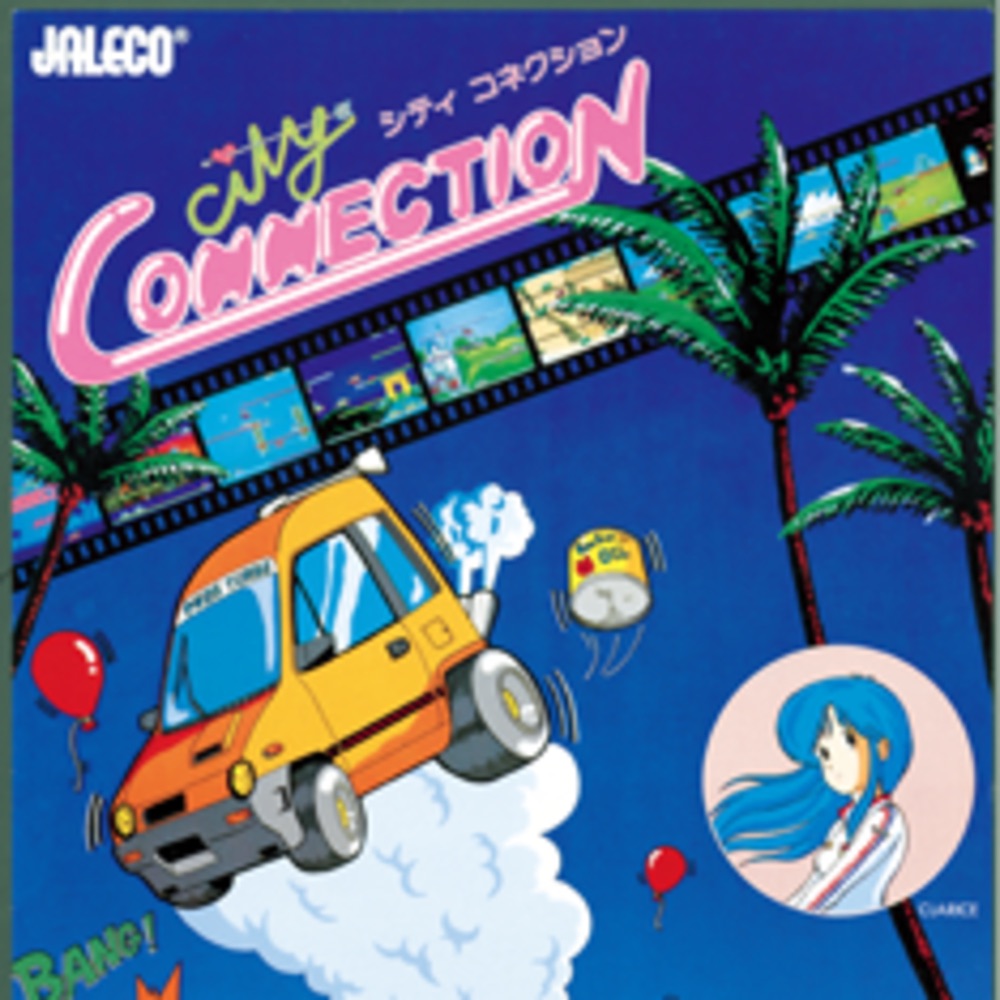
DRIVE FOR YOUR LIFE! Race your speed demon car from New York to Tokyo. Tour city after city on the way and make points. With the cops and the enemy on your tail.
SHOW NOTES
Manual
Flohwalzer
“Highway Star” by Deep Purple.
1985 Honda City Hatchback Auction
City Connection Commercial
Cruisn'
Cruis'n Franchise
City Connection Rocket
Jaleco made and published this, its first NES game and a port of its own arcade game. You drive a car across roads at different heights and paint every road white to clear a city and move on. It felt new and a little satisfying at first, then repetitive, and the NES version feels jank.
What works
- A loop we hadn't done before. Filling in the lines is a little satisfying. We compared it to Pac-Man and, as a joke, to Splatoon.
- Backdrops and music. The backgrounds are nice and detailed, and the police cars change in each city. The music has a remix of Highway Star by Deep Purple, and we doubt Deep Purple signed off on it.
What doesn't
- The handling. Turning around takes so many frames that a nearby police car often tags you. Joe found one upside: you can turn on a dime, right up to the last second. You are also always moving, only left or right, so holding your spot means shuffling over the same two pixels.
- Backtracking. Miss the edge of a platform and you fall off, and getting back up to a higher road is a pain. You spend each level going over parts you already covered.
- The cat. It pops up right where you are headed. Hit it and nothing tells you something bad happened, so three hits in a row is a sudden game over. Not everyone had that problem ("your cat's nicer").
- Jank. Police cars spawn at random, and you can despawn them by turning around and back. The screen draws in line by line instead of scrolling smoothly. Cars flickered invisible until we crashed into them, and we couldn't tell if it was the game or the cartridge.
- No variety. We wanted a puzzle element, not the random dumping of obstacles. Balloons let you skip stages, like a warp zone without any cleverness.
Worth knowing
The manual says you broke into an exclusive paint store in New York City, but nothing says why you cover every road. The cat is named after the song that plays when you hit it, which we were told translates to "I stepped on the cat."
The arcade game came out in December 1985 and was called Cruisin' in the U.S. A 2004 Japanese mobile spinoff turned Clarice into a spy collecting briefcases instead of painting roads. We preferred the touching things.
The bottom line
Skip it. Nobody voted it onto the Essential Games List. It was an interesting, unique concept that got really repetitive really fast. Sean's reason was that there is never an explanation for why you are painting highways. It was also impressive how badly an arcade game from 1985 controls on an NES that can already give you a whole adventure through Hyrule.
Written from our conversation in this episode.
- Back of the Box is downloaded
- Manual
- Introductions
- Jaleco
- Founded in 1974, this is their first game on the NES. They are also known for Bases Loaded and probably more as a Publisher than a Developer
- Possibly developed by Axes Art Amuse. The Arcade developer was the Japanese Company Hect.
- Jaleco mainly worked with TOSE
- Jaleco’s parent company filed for Bankruptcy in 2014 and Jaleco was purchased by City Connection, an indie Japanese studio that specializes in Soundtrack releases.
- Overview
- The player takes control of Clarice, a blue-haired teen in her Honda City hatchback, in her efforts to travel the world in order to find herself the perfect man.
- To clear each stage, the player must paint over all the roads by driving across them, changing the pavement color from white to green.
- Gameplay
- Turning the car
- Shooting the police
- That cat thing
- Miles system
- Music
- The song used when Clarice hits one of the flag-waving cats is “Flohwalzer”, known in Japan as “Neko Funjatta” (lit. “I Stepped on the Cat”). The game is one of the first to use a new music track for each stage rather than reusing a single song. One stage features a remix of the song “Highway Star” by Deep Purple.
- 1985 Honda City Hatchback Auction
- City Connection Commercial
- Sequels and Spinoffs
- Released in December 85 for Arcade as Cruisin’
- City Connection Rocket
- developed by Studio Runba and released for Japanese mobile phones in 2004, available from Jaleco through i-mode.
- The game places Clarice as a spy for a secret organization to capture criminal leaders from around the world. Rather than painting sections of the road, Clarice must now collect briefcases placed in each stage whilst avoiding police cars and other types of enemies
- EGL
Auto-generated transcript. Each paragraph starts with its timestamp. Speakers are not identified.
City Connection, drive for your life.
And welcome to NEStalgia, chronological exploration of every NES game released in North America. I'm Mike. I'm Sean. And I'm Joe. And guys, today we are talking about City Connection. I don't know if the drive for your life thing was as applicable as some of our- It wasn't apparent, I guess. Right. Yeah, yeah. That feels like a very urgent call to action. I wouldn't suggest anybody drive for their life. Yeah, but I mean, honestly, City Connection just sort of sounds like a 60s buddy drama,
like driving through cities. And when I said drive for your life, I meant like, you know, as your career. I wouldn't- Drive for your life. Yeah, you know, a lot of the- Yeah, like that's a long time of just driving the streets of a city. I mean, you know- Especially if the streets are like floating and stuff. And we've all seen taxi drivers, so we know where that goes. Bus drivers. The only leads- Speed. Uber drivers. That movie shows what the dangers of being a bus driver. Yeah. Garbage truck drivers.
Yeah. And so City Connection was made by Jellico. We haven't heard of them yet. Still sounds made up. Okay. Jellico was founded in 1974, Sean. This is their first game on the NES. What did they do before this? No. This is their first game on the NES. They didn't do anything. You never heard of that before. 1974. They were founded in 1974. They didn't make video games. Okay. I was asking what they did instead. You think they make this game in just a couple years? This takes several years to make this game. This was in the making for a long time. They just needed to sign the deal with Honda to use the Honda City hatchback. We'll get to that in a minute. They need to sign the deal with France to use Paris as a city. Right, right. It's copyrighted.
So anyway, yeah. This is their first NES game. They're also known for Bases Loaded, which is, I think, coming up very soon. Yeah, very soon. So we have that to look forward to. Nice. And while they definitely made this game in the arcades and everything like that, I found some conflicting information on maybe a company called Axis Art Amuse might have made the NES port. But this is all hearsay. Who cares, really, at the end of the day, too?
But I guess if maybe this was a very prestigious game, people would want to get to the bottom of it. It's not? But, well, I don't know. When was the last time you ever heard of City Connection? Just now. Great. You just said it. For this playthrough. Cool. And Jaleco mainly worked with Tose or Tose. We still don't know how to say that. I hope we never find out that we can always say Tose or Tose. Right. I think it's just important that we always say both to be respectful of the correct one. Yeah. And just to round out Jaleco here for you, their parent company filed for bankruptcy in 2014.
And so Jaleco was then purchased by City Connection. The game? It sounds like it. The game itself purchased the company? City Connection is an indie Japanese studio that specializes in soundtrack releases and named itself after the game that Jaleco had made all those years prior. Wow. So I guess that's pretty fitting. I wonder if they felt like, oh, well, we have to be bought by these people. It seems like maybe it was like their end goal if they named their company City Connection. Maybe they're always planning on buying. Jaleco. Well, that's like saying, oh, one day we'll own Nintendo because we're on the NES.
I don't think they're getting quite there. We'll see. But it's cool that they specialize in video game and Japanese movie soundtracks. I guess. It's a niche. They don't make video games. No. No, no, no. They own one, though. So just a quick overview on City Connection for everybody. The player takes control of Clarice, a blue-haired teen in her Honda City hatchback.
That's in the arcade version, though, right? But this is what we're going to do. Otherwise, we wouldn't even know that it's Clarice. Okay. Right? We would just think that it's just a car driving itself. We never see Clarice in the... We see some blonde guy on the cover. All right. So this is in an alternate universe. Of course. The NESK is in an alternate universe with a blonde guy driving your car.
Anyway, I guess, like, none of the story is important anyway because the only important part is that it's an arcade-style game where you drive around in a car and to clear each stage, you have to paint over all the roads by driving across these roads. Now, keep in mind, when I say roads, I'm talking about, like, different heights of roads, too. This isn't like a highway system where you have... Like tiers. Yeah. There's tiers of roads.
And you're just changing the pavement color. And once you change the entire thing, once you paint all of the road, you move on to the next city. Mike, I'd really like to apologize for throwing you off with the different universes in which the ports play. I think some people are a little upset that we left out the City Connection cinematic universe, but most people are thankful for you for just saying we don't care. I didn't say that. It was bad enough I made them sit through, like, five minutes of Jaleco information. All I did was talk about the color hair.
Right. So, blue-haired teen in the arcade, blonde... Dude. Yeah. In the NES version. That's because, like, you know, Athena was really... Athena and Samus are, like, the only women representatives on the NES at this point. Poor Athena. So, I mean, like, the objective sounds pretty easy, right? Yeah. It's nonsensical, but, you know, it's very straightforward. But is it a pretty easy game? No. I wouldn't say so. Why not, Joe? It's a little... I mean, it's not... I don't think it's hard in, like, an unfair way.
Yeah. I think it's just hard to... There are... Okay, you're right. There are some times. It's hard to avoid the obstacles, the cop cars, and it is kind of tough to jump from level to level of the road. Well, one thing that Joe hasn't pointed out is that there is a quantum cat that just sort of pops up where you're going to be. It knows where you're going to go, and it shows up right in front of you, and if you hit it, you can't shoot it with anything.
Like, we haven't really gotten into this, but... Yeah, no, this is just you on a rant right now. I like it. I'm really sorry, but... I kind of want you to keep going. There's a cat that you can't get around. You have to turn around again, and then it'll teleport somewhere else away from you, but simultaneously back in front of you.
It's not fair. I actually didn't have that problem with the cat. It never did that to me, like, that close in front of me. All right, well, your cat's nicer. Yeah, my cat's a nicer cat. Yeah, you didn't have Schrodinger's cat. But the problems I did have that I don't know if it was a problem that was just, like,
my game wasn't working correctly or something, but... So the cars would flicker to be invisible. Like, the flicker would be so bad that I wouldn't be able to see the car until I crashed into it. Wow. And I would crash into nothing, and then the car would be there. That's new. That happened to me a few times. You ever try, like, wiggling the cartridge?
Yeah, all the time. Maybe it just was, like, not all there. I'm not sure if, like, maybe it just wasn't, yeah, it wasn't loading right. Anyway, Mike, what did you mean by that? Yeah, so I think, you know, this is one of those games where it's, like, it kind of reminds me of Pac-Man, right? Because in Pac-Man, you have to eat all the dots. So essentially, you're, like, removing things instead of in this one, you're adding on all the colors. But in Pac-Man, you see the entire screen at once, and it's very clear, like, what's going to stop you and what's in your way. And there's only ever four ghosts in your way.
In City Connection, you barely see, like, any of the screen other than, like, what's immediately in front and behind of you. Yeah, it's like a third of the screen at a time. Right. And other than the police car enemies, there is the cat, but they're also, the police car enemies randomly spawn at any given point, too. In fact, if you're good enough, if you see one in, like, the distance, you can turn around and then turn around again, like, immediately.
Despawn them? Despawn them. And it's like, I think that that probably didn't happen in the arcade version, but this is, like, an unacceptable state, I guess, for, like, the arcade gameplay loop of what this is describing. You know? Like, based on the objective, the way that the game is actually playing out on the NES, it actually feels really jank.
Yeah. So we're, like, we've made it completely clear what you're doing in this game, right? You're just painting, like, platforms. It's basically Splatoon. The roads look like, look like sideways, like horizontal ladders. Yes. And then when you drive over them, they fill in white, as if you've spilled paint all over the road. Yeah. I really want to emphasize the comparison to Splatoon. Yeah. It's almost exactly the same as Splatoon. Exactly the same. There's a big e-sports community.
And the hardest part, I guess, about, like, painting the roads themselves, though, is that the mechanics of controlling the car aren't quite refined. So let's talk about the car a little bit. First off, the speed of the car, fine, whatever. It moves at a pace that's very easy to deal with. Turning your car around. I don't know about you guys, but this felt like a huge hassle to me and took so many frames to do a turnaround that a lot of times, if there was a police car nearby, you would just, like, get tagged. You're it by it. You know? I think that it's a very good simulation of paint and its coefficient of friction, maybe.
Otherwise, it's just, you know, really sloppy handling. In a game where there's, like, different tiers of roads, though, that you can jump to, I feel like this was not the spot for, like, realistic turns, you know? I do think that the one thing that makes it a little easier is that you can, I found that you could turn on a dime. If you're one pixel away from an obstacle, you can turn and you will just immediately right then and there turn. You don't drift or anything. I mean, that's what we're complaining about. Right. Yeah, yeah.
But I think that was actually, like, helpful, like, made it easier to avoid an obstacle that I'm coming up on because I have right up until the exact last second to turn, which I was kind of surprised by. You know, it might not be a good gameplay design thing, but it definitely made that a little easier. I mean, turning on a dime, I feel like the way we're describing it, it does not sound like you can turn on a dime because you, there's this massive lag between you moving in one direction and you moving in another and you don't end up, like, exactly where you want to be. But I understand what Joe's saying, you know, that you're not actually having to, like,
lose any, you're staying in your exact spot as you're turning. There are a lot of times where I couldn't get that last tiny segment of a ledge and I would be able to get right to it, turn, and, like, if I missed it, I would just be able to turn right back. I could just, like, basically stationary, like, stay on the same two pixels and just go back and forth until I hit that one little square of the road and then turn around and not fall off the ledge. That brings me to another point. Like, the reason that you have to keep going back and forth to basically remain at a standstill is because you're always moving forward, which with the car as your avatar is really counterintuitive to me.
Like, when you show me, when you give me a car, I imagine I'm always going to be moving in one direction or I have control over whether I'm moving at all or moving forward. So the fact that you, it's just binary left or right and not really standstill, while the game is really predicated on that control scheme, it really makes me feel weird doing it. I don't know if you guys felt the same. No, I can agree with that. I think that overall I just wanted gameplay in the car and maybe just overall to be more, like, I don't want to say sped up, but maybe just more fast-paced. Like, everything should have happened quicker. You should have been able to complete these stages faster.
You shouldn't have, you know, like, you should have to keep track of what you've missed and stuff like that. Like, I think that's probably the most engaging part of the game is like, oh, I have to jump out of the way because of that cop car, so I got to make sure to go back to that section. Like, that's probably the best thing that this game has to offer in terms of difficulty that that's done right. But I think a lot of times I'm just slowed down by being like, okay, and I got to get back up to that tier and make the jump. Nope, jump sucks. So, you know, we're like, oh, every jump button kind of does the same. You can't really, like, jump for too much longer than a maximum hold would anyway.
And yeah, now I got to turn around. Oh, there's the cat, you know, like, got to jump over him. He's on that space, you know. So, it's a lot of, like, you spend a lot of time on each level kind of just going over the parts that you've already gone over. I think that kind of, like, to sum up how I felt about it, you know, in that sense is that when I first turned it on, I was like, okay, this is interesting. It's new. It's something that we've never, like, it's like a gameplay loop that is not like anything we've done before. There's something like, yeah, exactly.
There's something a little satisfying about, like, filling in the lines and everything. And then, like, after a minute, I'm like, okay. Like, come on. Like, where are we going? Like, I'm like... After one minute. Maybe not one minute. But I'm, like, tired of doing this over and over and over again. Like, then, you know, finally, like, get to the next level. And I'm like, oh, I got to do it all again. It's like, it just gets very, very repetitive.
The loop does not keep me interested. Which actually reminded me of another thing, too. That, like, basically, because you only have four different roads of tiers to jump across and stuff like that, there's no, like, there's no puzzle element to this that Pac-Man presents and, like, it's three to four different maze layouts.
Like, yes, the stages are a little different in terms of, like, the boundaries of the platforms themselves. But I would have almost liked some dead ends that you could crash into or, like, some different layers of tiers. Like, this one, you know, requires more precise jumps or this one's just, like, you got to know about it first. You got to pass by it and then know, like, okay, cool. I got to jump up to first, third, and then I'll drop down into, like, this box to get into the second tier, you know?
Yeah. Just some kind of puzzle element to it for variety in the stages. If it was just the same stage over and over again, I almost would have probably accepted that. Like, I would have been like, oh, that's it. And then it's some nice scenery backdrop, and this is a high-score game. But instead, it offers just enough, like, offering of differences that I'm like, well, why not just go even a little further then?
It's just the design philosophy that I was really hoping that we would get rid of for good because we've been moving away from it, and that's just the random dumping of obstacles
with no pattern, no thought to. No design. Yeah, no design. And just saying, like, avoid them. Like, just stop. Yeah. Right. And we've talked about the cat thing, but I think it's worth bringing up that the cat thing, to me, kind of said a lot about just, like, the design philosophy of the game. Because even if you didn't have the problem of it showing up in random places and stuff like that, which definitely happened for me, I think what's weirder is that it doesn't really communicate to you when you hit this cat that, like, something bad has happened. And it looks vulnerable until you lose a life. Yeah, I think it's like punishment for hitting an innocent animal that teleports.
It almost looks like, you know, if you didn't know better, if you didn't look at the manual and know that that was the cat or something, you could think that that's, like, some kind of balloon thing that you've now, like, hit, and it's, like, going around the stage, and it's like, oh, cool, it's gonna, like, anything it touches will, like, fill in, you know, or something like that. But when you restart the stage again, you're like, huh, did I die? You have to check your lives yourself. There's nothing, basically, if you hit the cat three times in a row without ever knowing that, you just get a game over screen all of a sudden. You're like, oh, I was killing a cat.
You had no idea, you know? Like, I thought that was strange, because it just chooses what to communicate to you and basically chooses nothing other than this, like, ridiculous miles system. Yeah, I don't really get the miles. At the top, which is just bizarre.
I feel like it's kind of cool that they included, like, a, look at your car's mileage and stuff like that, and you have this amount of oil. But, like, I don't know, like, it just seems silly to gamify it in that way. Like, just focus on score. It's almost like you have to track your miles and your score. There's no clarity of information what that actually means.
Right. And I think it's like, but it's a nice touch. It's just that also then, where's my speedometer then? And then, like, you know, like, make it a whole car thing that you're going to... Yeah, give me gas. Well, they kind of do, though, right? With the oil, that's what you're shooting. Yeah, but that's, like, ammunition. Yeah, which is very strange, right? We're shooting, like, oil canisters at top cars? While we're painting, like, isn't that going to mix? I don't know. Oh, yeah. That's a good point.
It's worth noting, though, two really cool things about this game. So, even though we don't like that the levels change very lazily between the different places in the world you go to, the backdrops are pretty nice and detailed in terms of, like... They had good backgrounds. Yeah, they had no... Well, we were a fan of Karate Jam's backgrounds, too, and that game sucked.
But also, the cop cars are different in each place you go to. So, like, when you're in New York, they have, like, the NYPD cop cars, and then they have, like, the bus-like looking... They even say, courtesy, respect, professionalism. Really? No, I don't...
I just... You said it so matter-of-factly that I was inclined to believe you. They even changed the colors and things like that. And actually, yeah, you know what? I'm looking at the gameplay now, and that's not a cat. It's a cat. It's, like... It's kind of like... It's a cat with, like, a goat... Like, a Finnish sign. Like, yeah. It doesn't look like a cat to me, though. It almost looks like a baby with a checkered flag or something. And I guess either way, you still wouldn't want to hit it, you know? I guess. But it's a cat. You wouldn't want to run that over. But... One thing I also wanted to mention... And I made a note about this. The music in this game is a little different than the arcade version.
But it features a remix of the song Highway Star by Deep Purple. I did not notice that. Right. I mean, you know, I can't even think of the music. Like, you know, not like an 8-bit remix, essentially. You know, like, nothing crazy or anything. And it definitely wasn't, like, signed off by Deep Purple to be like, yeah, yeah, use our song in this obscure game. But I just thought, like, that's one of the earliest examples I can think of of, like, a license... Copyright infringement? Yeah, yeah, exactly. Like, a popular song. Yeah. Because that song would have been popular around that time. True. I guess. Being used in a video game, you know? Huh. Yeah, I can't think of anything. Yeah, Mario didn't really steal from anybody.
There's another track called, like, Flow Waltzer. Flow Waltzer, yeah. Yeah, and you know about this one? Radiohead, right? Maybe. I don't know. No. No? Okay, cool. I thought that you were just, like, dead serious. I'm sorry. I don't know. Like, I go to, like, the tape sessions or something like that. You know, you're pulling, like, a deep cut on me because apparently it's a, um... That's what the flag-waving cat is, like, known as, is a Flow Waltzer. And that's what happens when you hit one of them.
And so it plays that song. That's why they're, like... This is all, like... This is all there's, like, lore that we never found out. It's not in the manual. It's not... It's, like, made-up lore? Or is there, like, a cultural phenomenon of cats getting in the way of cars? No, the cats in this game are named a Flow Waltzer because the name of the song that plays when you hit them is the Flow Waltzer song.
Okay? Which is, like, literally translates to I stepped on the cat. I see. And that's, like, apparently, like, a very popular, like, Japanese song. Of course it is. Like, not popular, like, pop music, but, like, Japanese folklore. Yeah. Sure. So it has that going for it. Got it. And we talked about this a little bit. We mentioned the Honda City sponsorship and everything like that. I happened to find the 1985 Honda City hatchback that the game is referencing for sale. Comes with a little mini scooter.
And... You don't get to use the scooter in the game. Yeah. You don't get to use the scooter in the game. This is only for the real-life car. It's worth mentioning that the car sold at auction in 2018 for $14,000. So... That's pretty affordable. Yeah. It feels pretty affordable for a car from 1985 that looked pretty brand new. I mean, I'm sure it's not, like, that new. Yeah. No, no. I'm just saying, like, it wasn't like, you know, oh, well, I forgot to tell you that, like, one of the seats is off. You know? Like, everything's there in condition. I actually like this car. I think it was neat that they... It's very aesthetic. Yeah, yeah. But, you know, like...
I just think it's interesting that they actually got, like, in. They were like, okay, was the game first or was the Honda City hatchback first? Yeah. In terms of, like... They made the car based off of the car in this game? Or, like, which part of it was designed first? Did they make the game and then say, like, oh, you know, like, we should see if Honda wants in on this. Right, I hear you. And, like, we'll put their own thing in the game and that'll help them, like, sell a bunch of Honda City hatchbacks. Or was the Honda City hatchback so popular that they just felt like they should make this game and include it? I feel like it's gotta be the second one.
Because I don't know how much, like... Because this was... Back then, video games were really just played by kids. Yeah, I don't... So... That makes it... That makes me think that neither could be true. Yeah, maybe not too, yeah. Because there is zero crossover in these audiences. But I feel like if it was in the arcades, that's a different audience. Yeah, that's a different one. Than, like, the NES and Famicom. And it could also just be for no reason. Maybe just someone who... A developer liked that car and just, like, yeah, I'll put it in there. Without a motive. Yeah, but you still have to pay for the licensing.
Yeah, I don't know. Yeah, that's true. I mean, this game was popular enough in Japan that it also got a commercial. Oh. Which I'm not gonna play here like we usually do, but if you go into the show notes, it'll definitely be there. So check that out if you just, like, really want to get your City Connection cinematic universe, like, locked down and understand the difference between Clarice and the blonde guy. Brett. All right. Any straight thoughts? I do. Yeah, please. One thing that, you know, the backgrounds are good.
The foregrounds convey a certain amount of information. But the fact that... I don't know if you guys had this, but as you're scrolling, as you are going forward and the camera pans with you, it's not smooth. It's populating the scene line by line in a way very, very much unnerving to my belly. Like, it's... Do you guys have this? I think... Yes, definitely. I didn't really think about it too much until you mentioned it, but absolutely it was there.
But I thought you were going to say that also it feels like, and it could be an optical illusion, but it feels like the enemy cars are sort of scrolling with it. Like, they're going faster if I'm driving in the same direction as them. If I turn around, they go slower because they're scrolling backwards. That was another thing that kind of screwed with me. Yeah. There's a perspective issue there, but it almost, for some reason, it goes away, like everything, if you're just focusing on your car. But you should never do that.
You know what I mean? Like, you need to know what's going on with the rest of the screen, but I agree mostly with the sentiment that Joe shared at the end there, that like, when you're going away from the other cop cars, they almost like freeze in time. Yeah. It's very strange. Because like, they're going forward, but you're sort of dragging them backwards because they're like connected to the screen scroll somehow. And it's very clear that you're going faster than the cop cars. Yes. At all times. Like, you're the speed demon and they're like trying to catch up. The only instance in which like there is an objective like point that the cop cars are is when they're like falling from one tier to the other.
There they, you know, they obey the laws of gravity, but any other circumstance, yeah. At like point two speed. Yeah, exactly. Did you ever feel like you were playing Grand Theft Auto while you were playing this game? No. Being chased by the cops and... I didn't feel like they were chasing, but they're just sort of there.
Yeah. They aren't really chasing, are they? Yeah. It's a lot of wrong with this. But if you hit triangle, you do get out of the car, which I know a lot of people probably didn't notice because there was a triangle button on the controller. Now, okay, that's a good question. If you get out of the car, do you get Claris or do you get the blonde guy? That's the only way to know if you're playing the arcade. You get the scooter. Yeah. You get out on the scooter. And it shouldn't be understated that like turning sucks so much because you're going to have to do it a lot because you're missing these things. And it comes down to the point where like you might be missing just the edge of a platform.
I'm going to be there a while. Yeah, you have to like try to just perfectly time your turnaround. And then you fall off. I almost touched it. Oh, almost touched it. Like, but you don't. And it really is a pain to get back onto a higher platform because the gap that you can jump through, it's hard to time it properly. Yeah. And then get the right. I mean, you just have to be holding up when you jump to get the right height to get to the next platform. But a lot of times, like somehow it misses and I'm just doing like a regular. You hit your head on the bottom. Yeah. Did anybody talk about the balloons?
Oh, right. Oh, I didn't. That's a big part. Yeah. The balloons are whatever, though. I mean, like. They let you skip parts of the game. They let you like, yeah. It's like a warp zone kind of thing. But like without any cleverness to it. It's just get three of them and you go to the next stage. I actually at first mistook them for like what you're supposed to do. Before I read the manual, I was like, oh, I get three balloons and I go to the next stage. And I thought I was like going to the next stage. And then I realized it was like a lot of order and everything.
And also like if you're on a level for too long. Oh, the spikes. The spikes start showing up. And that's like, is that though like the world caving in on itself or something? I didn't even realize that that was because I was on a level for too long. I thought it was just like, why is there suddenly a spike now? There's not been a spike for the first 20 minutes. Well, I mean, it's not like too long either before they start showing up, but it's an arcade game. So the idea is to kind of like get through this fast. And that's why I wish that the whole gameplay loop was just faster in general. Because it's like, if it's going to punish me for being on a stage for too long, help me. Yeah. Get through this stage, you know?
Like don't. Do it. Yeah. Don't just randomly have spikes jut out of the ground and stuff. If anything, like, you know, I could see this same game being like, oh, there's going to be more cats now the longer you stay on the screen. You know, like that's the kind of stuff that they punish us with rather than thinking about ways to make it like more fun. They just add more elements to the screen. Maximalist. All right. If nobody has anything else, I'm going to very quickly talk about some sequels and spinoffs. Of course. Because there has to be in the City Connection Cinematic Universe. Released in December of 1985. Okay. That's three years before this game came out on the NES.
City Connection did come to the United States in the arcades, but it was not called City Connection. It was called Cruisin'. Just Cruisin'. Cruisin'. Okay. Apparently pretty rare, but no connection to the Cruisin' in the USA or Cruisin' around the world series. Cruisin' for a bruisin'. Yeah. No connection to any other words that involve Cruisin'. No connection to the city. Because it's also spelled differently, though. Cruisin' in the USA and stuff like that puts the apostrophe where the I is, whereas this one put the apostrophe at the N, after the N. I've only seen it at the N. Nah. Wait. Say that again? Like, so Cruisin', right? This game. Yeah. Has the apostrophe at the N.
You know, so there's no G. Right. As opposed to... Cruisin' in the USA does it like... Um... Like, Cruisin' and then apostrophe NG? Yeah. No. Cruisin' and then apostrophe N. And then that's N. Oh. That's just... That's not correct. That's weird. But it's kind of cool, right? Like, Cruisin'. I guess that is correct, but then there should be an apostrophe on both sides of the N, right? Because you're getting rid of the I and the G. Well, sure. Yeah. You're getting rid of the G. They don't care, essentially. Put quotes around the N. Yeah. This is a long conversation about Cruisin', but I just was thinking that that was interesting that there was a game called Cruisin' before Cruisin' series, you know?
Fun. And then... Oh. So, developed by Studio Runba and released for Japanese mobile phones in 2004, City Connection Rocket came out. Okay? Yeah. It was available from Jaleco through the iMode. It must have been some cell phone or something in 2004. Only Japan, of course. The game places Clarice as a spy for a secret organization to capture criminal leaders from around the world. Rather than painting sections of the road, Clarice must now collect briefcases placed in each stage while avoiding police cars and other types of enemies.
Seems like a step backwards. Yeah, that's... Now you're just collecting objects on the screen instead of, like, touching the entire screen. Yeah. I prefer the touching things. Yeah. At least there's, like, some kind of, like, inherent difficulty of, like, make sure you go to everything. And more importantly, Splatoon. This one's, like, don't do anything. Yeah. Just get the briefcases. Please do not go anywhere else. There's police. There's bad people all over the roads. All right. Well, there might be bad people all over the roads, but let's find out if there will be essential games added to this list. It's time for the essential games list.
Not essential. All right. I guess I can give a little more of that. If you feel the need to. We spoke mostly about all my thoughts on it. I mean, it was an interesting, unique concept. Got really repetitive really fast. Didn't really have anything that stood out to me as, like, this is what makes this... This is what was going to bring me back. Nothing's going to bring me back. This sounds really grim, but long story short, this is not an essential game. All right. And Sean? I'm going to go a little bit more into detail here.
Most games, most arcade games where you're doing some really, like, obtuse thing to make it a game at least has some really bullshit story reason for why you're doing it. And in this game, like, you get the whole, like, who this person is, like Clarice. She has blue hair. You're on the run from the police, sure. But there's never an explanation as to why you're coding highways in paint. I don't understand the core conceit or why I'm doing it. And for that reason alone, it is unessential.
I feel like I wish you didn't say that. Because I think that the reason why she paints the roads is because she's such a world traveler and an aficionado of these cities that she has to see everything there is to see in these cities. And she must, you know, like, go touch every part. She's painting the town white. Right. Exactly. And so... It's a city, not a town. If she was just... But, yeah. But if she was just collecting things, right? She'd be another, like, Instagram, you know, simple person who's just there for the picture with the Statue of Liberty and stuff like that. So she's Banksy. Yeah. She is, like... Yeah. She's a... And that's why the cops are after her. She's vandalizing the city with her propaganda.
It's just... Which is white paint. I thought this was all really clear. There's no propaganda. It's white paint. Yeah. It's funny how the back of the box just kind of says, like, you're... Race your speed demon car from New York to Tokyo in record time.
And then with the cops and the enemy on your tail. But, like, why? Because you're going too fast? Like, stop being a... Like, you're going to get somebody hurt. Like, slow down. We also didn't mention, though, the manual does say that you've broken into an exclusive paint store in New York City. Yes. But I still don't know why I'm using it. Why you need to use it. But that is why you're on the run, at least. You know that. I don't know why we need to cover every inch of the road with paint. Do you think that countries would, like, continue to try to track down someone who stole paint from a local store in New York City? Well, if it's exclusive. Yeah. It's not... This isn't, like, Sherwin-Williams. This is a...
This is an exclusive store. Very good. Yeah. That's true. This is... Yeah. All right. As for me, this game is not essential. I do think it was a cool concept at first, like, as an arcade game. On paper. Right, right. Like, it felt like, oh, yeah, this would have definitely been one of those, like, things that you would see at a bar in an arcade, you know, like, just, like, go play it for a little time waster or whatever. Yeah, yeah. I get that. It was actually kind of impressive how poorly that performed on an NES.
Like, we're at the stage now where, you know, you can go on a complete adventure through Hyrule, but you can't control a car on an arcade game made in 1985. Yeah. So, I'm a little confused, Jalico, but I heard RBI Bases is... RBI Bases. Bases loaded. I was mixing the two games together. I heard Bases loaded is pretty good, so I'll look forward to that one. Yeah. Anyway, that's about all the time we have for this episode of Nostalgia. This was episode 101.
Congrats, guys. Surely Cruella DeVille will be listening to this episode and every episode going forward looking for those Dalmatians. She will get them. I'm Michael Esposito. You can find me on at Esposito Film on Twitter. It was a really bad joke.
They all are. We're doing nothing to help our fan base here. They listen to it. They're listening to it still right now, and they're going to listen next week when we give them another episode. We're talking about Rambo. Rambo, baby. We have our special guest, Sylvester Stallone, in the house. He's going to be here. He won't be speaking, but he'll be here. He'll be speaking. He will be our guest. Yes. He will have three lines that he agreed to say. All right. That is all. And the Raspberry Pi is listening.