313 · Boulder Dash
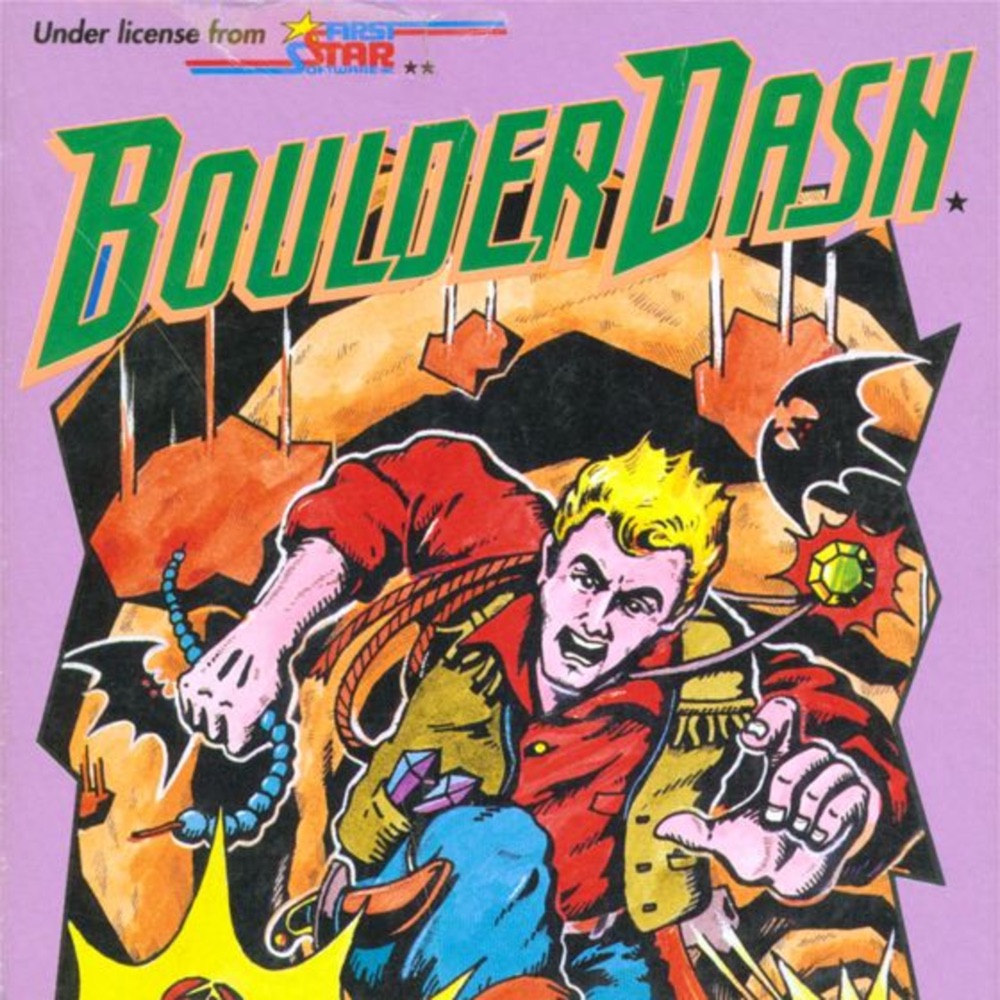
You are Rockford, and you have to dig through monster infested caves in search of diamonds. In each level you must collect a certain number of these diamonds, in order to open a portal to the next stage. Enemies can be squashed by falling boulders, which are released when the ground below them is removed or they are pushed onto empty ground, but be careful because these can also squash you. In later levels, difficulty is increased by many puzzle elements and shorter time limits.
Sean was back for this one, so Mike, Sean and Joe were all here. Boulder Dash began on computers in 1984, made by two people, and the NES version is published by JVC Musical Industries. You play Rockford, whose dying father sends him after the secret jewels of six worlds, a plot that lives in the manual, not the game. In practice you dig through caves, collect enough jewels to open the exit, and leave.
What works
- Real puzzles under a plain surface. Mike expected non-puzzles after a couple of levels, then found stages that felt designed. The cast grows: some enemies roam, some track you like Pac-Man's ghosts, and boulders stack in particular ways before they fall.
- Physics you learn to use. Once it clicks, you build avalanches to fill gaps and drop boulders on enemies to turn them into diamonds.
- Stages that vary. Sometimes the jewels are in view. Sometimes none are, and you have to crush something to reveal them. In one world you trap spreading amoebas with mammoths (that world's boulders) until they fill up and turn into diamonds.
- Short bursts. The stages are brief enough that we kept saying one more, until we got stuck.
- A world map. You can start anywhere, which surprised us in an arcade-style game.
What doesn't
- Two perspectives that disagree. Rockford moves like a top-down digger, yet everything falls as though down is down. It doesn't break the game, but it slowed Joe's grasp of the physics, and a pickaxe animation would have helped.
- Loosed enemies. Releasing one gives you no way to fight back, so you hope it doesn't reach you. We found this the hardest idea, since everything moves fast.
- Little to say. Mike's honest complaint was how little there is to describe: rules, solutions, puzzles. We also doubted the map matters when you have to clear every stage anyway.
- No replay. A solved puzzle stays solved. We wanted a stage editor like the ones in Wrecking Crew and Excitebike.
Beyond the game
The manual spells out what turns into diamonds and has tips on amoebas, which helped, since the game has no tutorial. Joe compared it to Rodent's Revenge, which is Boulder Dash in reverse: you suffocate the enemies. We also learned of 22 sequels and spinoffs, and that Mean Machines called the NES version one of the greatest games ever written.
The bottom line
Skip it. We all voted no. Mike called it unremarkable today and not something he'd remember. Sean said it's playable and fun while it lasts, with real aha moments, but a good game he won't think about again. Joe said it's a satisfying puzzle experience, still adequate now, but nothing to write home about.
Written from our conversation in this episode.
- "My son, you must take up the quest I never completed. Find the Secret Jewels of the Six Worlds, and you will be rich beyond your wildest dreams!"
- NES Longplay
- Manual
- Those were the final words of the father of the player character in this game. Powerful, powerful stuff
- Been a while since we had a game like this on the show
- This game was first released in 1984
- Many computer iterations first
- Developed by just two guys
- Reminiscent of our Lode Runner, Raid on Bungeling Bay, Spelunker Broderbund games
- This was published by JVC Musical Industries
- Gameplay
- Stages take place in caves. In each cave, Rockford has to collect a certain amount of diamonds while dodging obstacles. When enough diamonds have been collected, the exit door opens, and the level is over.
- Controlling Rockford
- Obstacles / How hard is it to collect diamonds
- Similarities to Dig Dug?
- First computer game to be converted to an arcade game
- The game was licensed by Exidy for use with their Max-A-Flex arcade cabinet. Released in 1984, it allows buying 30 seconds of game time.[13] This was the first home computer game to be converted to an arcade console.
- Sequels and Spinoffs
- There are 22 sequels and spinoffs. Give me a number and I’ll tell you a game
- Mean Machines gave the Game Boy port of Boulder Dash a score of 90%, praising it as "one of the finest video games ever written"
- Boulder Dash (1985 – Arcade) – in 1985 another arcade version was released on Data East's "DECO Cassette System", with improved graphics but a reduced display grid on a vertical monitor.[13]
- Boulder Dash II (1985) – published under several different titles; Rockford's Riot on the MSX, Rockford's Revenge on the C64. The second release in Japan was titled Champion Boulder Dash,[13] but it is not a port of the western game.[28]
- Boulder Dash 3 (1986 – Apple II, C64, Spectrum, PC) – monochrome space-themed graphics and poorly designed levels made this a critical failure.[13]
- Boulder Dash Construction Kit (1986 – Apple II, C64, Spectrum, Atari 8-bit computers, Atari ST) – this release included a small number of levels (12 caves and 3 intermission levels),[29] but was titled Boulder Dash IV – The Game for the Spectrum re-release.[13] The title allowed players access to tools which allowed them to design their own levels.
- Super Boulder Dash (1986 – Apple II, C64, PC) – a compilation of Boulder Dash and Boulder Dash II published by Electronic Arts.[30]
- Rockford (1988 – Arcade, Amiga, Atari 8-bit, Atari ST, Arcade, Spectrum,[31] Amstrad, C64)[13] - Rockford was originally a licensed arcade game produced by Arcadia Systems, and later converted to various home computer formats.
- Boulder Dash Part 2 (1990 – Arcade)[13]
- Boulder Dash (1990 - Game Boy)[13]
- Boulder Dash (1990 - NES)[13]
- Boulder Dash EX (2002 – Game Boy Advance) - this one has a new "EX mode" and "Classic mode" which is a direct port of the 1984 PC version.[13]
- Boulder Dash Xmas 2002 Edition (2002 – PC)[13]
- GemJam Gold (2003 – PC) – the game's credits claim this is based on Boulder Dash, and is licensed by First Star.[13]
- Boulder Dash – Treasure Pleasure (2003 – PC)[13]
- Boulder Dash: Rocks! (2007 – DS, iOS)[13]
- Boulder Dash Vol 1 (2009 – iOS)[13]
- Boulder Dash-XL (2011 - Xbox Live Arcade, PC, iOS, 3DS)[32]
- Boulder Dash - The Collection! (2011 – Android)[33]
- Boulder Dash (2011 – Atari 2600) - limited edition of 250 copies.[34]
- Boulder Dash 30th Anniversary (2014 – iOS, Android, Switch, PC, Mac) - co-published by TapStar Interactive and First Star Software, Inc., with a world designed by the original creator Peter Liepa as well as another world by TapStar CEO, Chris Gray. This sequel was developed in collaboration by TapStar Interactive, First Star Software, SoMa Play Inc. and Katsu Entertainment LLC (2014 - Android, iOS) as both a premium (paid) and a freemium game.[35]
- Boulder Dash (2015 – Intellivision) – co-published by First Star Software, Inc. and Classic Game Publishers, Inc./Elektronite[36]
- Boulder Dash Deluxe (2021 – Switch, Xbox, Atari VCS, Steam (PC and Mac), Windows Store and Mac Store) – developed and published by BBG Entertainment with a world designed by the original creator Peter Liepa and a Retro world with the 20 original levels from 1984.[37][38]
- Boulder Dash Ultimate Collection (2022 – Switch)
- EGL
- NEXT WEEK - Cabal
- Next weeks game is a big secret…a CABAL
Auto-generated transcript. Each paragraph starts with its timestamp. Speakers are not identified.
Boulder Dash, my son, you must take up the quest I never completed. Find the secret jewels of the six worlds, and you will be rich beyond your wildest dreams.
And welcome to NEStalgia, a chronological exploration of every NES game released in North America. I'm Mike. I'm Sean. And I'm Joe. Good to have you back, Sean. We'll get to that in a second because I don't want to stray too far from the back of the box that I just read, which are the final- It's okay. I love it. I love that I'm back. I really appreciate the warm welcome. Those are the final words of the father of the player character in this game.
Powerful stuff, guys. Very emotional. I was just going to say that immediately I am floored that there is so much plot that I had no idea about. From like your first sentence there, I was like, wow, this is, maybe I should have read the manual of this game. I feel like I've been saying that a lot lately. That was your dad? That was your dad.
Oh, that was my dad. He works for Nintendo. It was not anybody on the show's dad, yeah. It was Boulder Dash's dad? Like, does the character have a name or is he just Boulder Dash? I guess I did just think it was me because I get to choose the color. No, the kid has a name. His name is Rockford. Do we like that? Is that a good name for a guy who- No, it is not a good name. It's pretty lame. Sorry to any Rockford listeners that we have. His father's name was Stoneford. Much better name.
So what will his son be? Like, you can't get more specific. Pebbleford. Oh, Pebble. Oh, yeah, you're getting smaller. No, his father was Stone and he's Rock, so his grandfather must have been Pebbleford. Oh. He could be Boulderford. Boulderford, yeah. There's so many different names left. Yeah, you're working up to like Mountain and Planet. If he finds all the secret jewels, he can be Jewel Ford. Jewel Verne. Or just Jewel, and you could record music into that name. Rockford's son is Harrison Ford. Oh, that's right. That does make sense. Yeah, this is part of the American Graffiti Cinematic Universe.
Okay, this is way too silly. We need to start talking about the game. And, you know, I just wanted to point out before we actually start into the game, just to lay some, like, I guess, developer talk or whatever. It's been a while since we've had this kind of game on the show. And not like a game where you dig through rocks to find jewels or anything, but just a game that was first released in 1984,
only, like, for computers or whatever, developed by just two guys. You know, we saw a lot of these in, like, 87, I want to say, and 86, where it was, like, you know, one guy or a small group of guys just, like, said, yeah, screw it, I'll make video games. And I'm thinking of, like, Lode Runner, Raid on Bungeling Bay, Spelunker, all of those, like, Broderbund releases.
This was published by JVC Musical Industries, which is different than Broderbund. It doesn't sound like they're even interested in video games based on the musical industries. But, you know, just wanted to throw that out there, that this is maybe got to be judged with a different lens when you realize only two guys made it instead of, like, a team at Namco. Well, even that whole publisher thing, where it's like, wait, so you're saying that Lean Cuisine released this video game? Like, that whole concept of, like, they don't traditionally do this? Like, I feel like we saw a lot of that in, like, the 88, like, the 87, 88, like you were saying.
So, yeah, I noticed that. Sean, I gotta ask you, because, you know, that joke, you know, it's a good joke, but Lean Cuisine is probably the last words I could have expected that you would say there in that joke. Where did that come from?
Um, I don't know. I haven't eaten Lean Cuisine in three years. Well, you know what? You could have been channeling it, and I'm not speaking for you here, but I know that, like, the Kid Cuisine used to, like, occasionally come with, like, a CD-ROM disc if you bought it. No, it didn't. Yeah, it did. There was all sorts of things. The cereal boxes used to come with, like, CD-ROM video games. I had, like, a Cocoa Puffs video game on my computer. It was like any other red-blooded American, but I didn't know that Kid's Cuisine did that. You know, the guy with the penguin?
The funny thing is, when you said Lean Cuisine, I was thinking Kid Cuisine. So it's even crazier to me that Kid's Cuisine actually did do that, because that's the one I thought was the most random.
We're still on topic, right? Yeah. I think we're doing really good. In fact, you know what? Apparently, this is just a joke, of course, but there is a mock-up. If you type in Kid Cuisine video game, there's a mock-up for a Kid Cuisine goes to Washington Sega CD game that does not exist, but is very funny, and it's Kid Cuisine saying lobby for flavor, lobby for fun, lobby for kids, and I like that they chose the Sega CD as the platform of choice. And lobbying as, like, what you do. Well, that's very reminiscent of, like, you know, Yoshi commits tax evasion or whatever, or tax fraud. As one does.
Back onto Boulder Dash, you know, because I know we've already talked so much about this game and covered so much of it, but just to, you know, maybe refresh everybody's memory, Boulder Dash is, like, in, I guess it's like an arcade-style game, very reminiscent of Dig Dug, where stages take place in caves.
In each cave, you're kind of just... You're walking through them, but theoretically, if, you know, if a little animation was on the screen, it's not. But if a little animation was on screen, you might see, like, a pickaxe or something as you chip away at the cave and reveal new areas. And inside this top-down view of this cave, there are sometimes enemies, sometimes boulders, sometimes animals, and mostly jewels. That is the object of choice, the object to collect.
Once you collect the amount of jewels required, it's in the top left of the screen, a door will appear for you to exit. Now, you're free to collect more jewels or just, you know, continue to clean the cave if you're into that kind of thing. But that's all you have to do. Collect all the jewels that are required of you, leave the stage, move on to the next stage. And surprisingly, it goes a little step beyond what we're used to in arcade-style games by actually having a world map that you can select the level, and you don't have to necessarily go right to the stage 1-1 at the start of the game. I didn't end on a thought there, so do you want me to give you a thought? Like, do you want to react to that?
No, okay, so it's funny that you call this an arcade-style game, and I guess by classic definitions it is, but this seems much more methodical than most arcade games. Like, this is a puzzle game. Would we consider, like, Lode Runner an arcade game? Yeah, it's a good point. You're right. Puzzle game, I guess I struggle with just because there is some puzzling, I suppose, but, you know, it's really more like try not to softlock yourself.
Oh, I'm surprised you say that, because I... I mean, that's 100% a... This is 100% a puzzle game. Yeah, I was actually... I went through, like, a weird kind of rollercoaster when I started this. I was like... I saw the world map, and I was like, this is going to be, like... There's going to be a lot of love put in this game. It's going to be, like, a really cool... I think I had an idea that it was a puzzle game. I think I saw footage of it or something. So, like, a really cool puzzle game.
Then I started the first couple levels, and I was like, oh, okay. It's one of those things that's, like... They're, like, non-puzzles. They're just, like... It's just, like, collect all the stuff, and you're done. And then I kept playing, and I was like, oh, there actually are some very interestingly designed puzzle elements in it. Not that they get too complicated, but they did feel above and beyond what we're used to in this style of game. And I felt like there were... I didn't beat the game, but in the ones that I got through, there were some... Some that I considered fun, interesting puzzles.
Yeah, like, each of these... Like, the cast of, I guess, blocks sort of expands as you play. Okay? Just starting with boulders and the aforementioned jewels that you're trying to collect. And then there's, like, other moving obstacles. And then there's ones that interact slightly differently. That, like, this one jumps around, and this one just goes in a circle. And, like, whenever... This one, if you let it go, it will...
It will sort of very aggressively track you down. And this one will just sort of loll around for a bit. Like, the difference between the ghosts and Pac-Man. And this sort of block will... Like, the game has its own weird physics. And this sort of block will stack this way before, like... Before falling over. And this sort of block will have a little bit more structure. So, there's a lot going on here with a pretty simple method of interaction. Yeah, and it encourages you to learn those physics. Which I'm sure we'll get into later. I have something that clicked in my head that made me suddenly, like... Very intuitively understand the physics. Whereas, originally, it was very difficult to understand.
But once you learn those physics, it makes you kind of use them to your advantage. To, like, make things fall into certain places. Or, like, some areas, like... Oh, you have to fill in this area with boulders. So, you gotta, like, kind of use the game's physics to make an avalanche. So, these boulders will all land here. And in that sense, there's a lot of interesting thought processes that have to happen. Joe, you mentioned the physics. But I'm curious, just from a... You know, and it's possible to understand it as you're playing the game.
But, graphically, there is something going on here, at least in my head, about, like, how gravity works in these caves. Yes. Because it would appear that either one of two things is happening. Either the cave is on, like, a 45-degree slant. Or, like, you're... When you're going north on the screen, you're climbing up the slant and things are falling down as you move them. Or, it's like, who really cares? And, you know, Rockford is climbing around a cave that otherwise is just, like, you're viewing the side of the cave from this top-down perspective.
It's just very confusing. This, along with just even some visuals, like I was talking about, it'd be nice if there was just, like, a little pickaxe animation every time he went through these rocks. It just feels like it's missing a little context into what he's doing inside these caves. And from a gameplay perspective, it's not screwing anything up. But, you know, it's a little strange.
Yeah, that kind of perspective issue you mentioned was the biggest reason that it took me a while to understand what was going on with the physics. It's like Dig Dug, right? Like, it's sort of in the same vein as that. Yeah, but Dig Dug, if I remember correctly, it's clear that you're going up and down, right? Yes, you're going down from the ground, you know, so you're digging into the ground. Right. Based on the way this sprite actually moves, to me, looked like, okay, I'm going north, south, east, and west. But then everything else moves as if down is down. So I had to just eventually, like, be like, okay, I'm, even though the sprite looks funky, I'm moving up and down somehow.
Yeah, you gotta have to. I'm climbing, I'm rappelling, or whatever. But I mean, like, okay. Okay. I wouldn't say that it broke my brain trying to visualize that. It's pretty intuitive, like, in terms of just the whole gravity situation. I guess where the physics start to be, like, you gotta think about it more, is how things sort of stack on top of each other, and how stable those stacks are. Right, exactly. Exactly. And I think we agree with you on that, Sean. We were saying that, you know, you're able to play the game without having to think about that, but if you really think about how gravity works in these caves, it doesn't make any sense.
Well, if you think about how pipes work in Mario, like, what is this place? Is it just, like, a place with magic plumbing? No, I read the April issue of Nintendo Power 2001, where they explained how warped pipes work. So, you know, I'm very familiar with that. Yeah, it also is, I mean, even if it's not, yeah, it's not super, super confusing, you get it right away. It's a little jarring at first to be like, I'm walking this way, but think, because it's not immediately clear that, like, you walk through something and everything's going to fall. So it is a little, like, I do think it's an oversight on their part, even if it's, even if it, you know, you can figure it out. Like, it's just, they have two different perspectives that don't match up.
So how hard is it to complete the goal of the stage, in which case collect diamonds, right? Don't focus on whether that's interesting or not, but just how challenging do these stages get, given that the diamonds aren't always obviously shown on screen, right? Like, the first stage, you're given the idea that, oh, I'll always know where the diamonds are, and I just have to figure out how to get to them. Other times, it's like, no, I have to create some new circumstance that reveals the diamonds, or I have to kill a certain enemy to spawn some diamonds. It's not always the same in each stage.
Yeah, I mean, it depends on how it decides to present itself to you, because, yeah, that first level where there are no diamonds on the screen, it's just those little squares where you kind of have to crush the, whatever they are. It's also, what exactly the enemies are is sort of unclear at times, too. But I think it was, it only took me a few minutes to realize that that's what the game wanted me to do.
So, I mean, the difficulty definitely fluctuates, but it's never like, well, how are they supposed to, how was I supposed to know that, you know? Yeah, I think that there's, like, a variety of, like, of, like, ways that you need to figure it out. Like, there's that one that you're describing where it's like, okay, you can kind of figure out, like, okay, you kill this thing, and it'll leave a diamond behind, or whatever, a grid of diamonds behind.
Then there are some where it's like, you really have to look at the level for a long time and, like, experiment a little bit. There's one early on, well, maybe it's in, like, the second world or the third world. No, it's the second world, where there's all these, like, amoebas at the bottom of the screen. And, like, you just, there's just nothing else for you to do, so eventually you just figure, like, oh, let me try stopping these amoebas from spreading, because every couple seconds they spread. And once you, like, have them fully trapped by mammoths, which just sounds silly, because we haven't described the mammoths yet, but, like, once you have them fully trapped by mammoths, which in this world are just your version of the boulders,
then once they can't spread any further and they've filled up all the space, they'll just turn into diamonds. Yeah, or the one where they, like, you have to, like, create a field that, like, boulders will pass through, and on the other side of this field, now they're diamonds. Right, yeah. Like, it is kind of stuff that's, like, well, how was I supposed to know that? But it's also stuff that, like, it feels like they're, it's intentionally designed that, like, yeah, you're not supposed to know it, but you can figure it out by experimenting.
And then on the last thing, there are also puzzles that it's, like, I know what I have to do, but it's really hard to not get trapped. Like, you have to really stop and think about, like, how can I get over there? How can I get over here? And that's just the ones that I played. Maybe they'll get even further, but I did appreciate that it changed it up a little bit, level to level. Yeah, it's great that it's not just, okay, here's nine diamonds, and they're across the map, and you just have to figure out how to dig towards them, and that they give you other, I think that keeps the game fresh.
It's funny, because I do think that the hardest one for me was, like, crushing enemies with rocks. It required the most kind of thought, because if you let them loose, right, they're usually in, like, square boxes, or at least roaming in an area that you haven't touched yet. Once you let them loose, now it's like, you know, you don't have any way to defend yourself. There's no, like, press the B button to throw a rock at them or something. Like, you just have to hope that they don't touch you. So you really got to make sure that your placement of the rocks or the mammoths or the skulls, it changes in each world, essentially. I think eventually it's Moai heads, too. So it's just another example of an NES game with Moai heads.
All of these things, I think, like, that was, to me, the most challenging one. And I think what makes it even more challenging, but wouldn't have been challenging, along with a lot of the stuff that we've been covering so far in this episode, is that if you just read the manual, a lot of this stuff is covered, you know, without difficulty.
It's just very matter-of-fact about things, about, like, which enemies turn into diamonds and what each, like, type of stage objective would be and a little bit of, like, pro tips on the amoebas and stuff that you might not necessarily, like, think of unless, you know, like Joe was saying, you just kind of have this moment of, like, well, I should stop them from growing, but, like, the manual just spells all that out for you. All that to say, I think, like, it's a clearly defined game without any sort of tutorials. You know, like, the stages itself, like, they just throw you into them, but you immediately kind of get the objective. Even the one that Sean was talking about, stage 1-4, I think,
which is the first stage I went to because I was like, oh, this is neat, it lets you skip around in the world map. I didn't have any idea what I was doing because there were no diamonds present on that screen, but eventually, either, you know, through looking at the manual or just through some, you know, trial and error by the player, you'll figure out, like, yeah, maybe I should try to drop one of these boulders on one of these enemies and then they'll give you the diamonds.
Yeah, and just to second what you were saying there about the, I feel like, I feel like anything that involves enemies or whether there's enemies running around the stage, you are just, on top of this, like, minor puzzle solving, you're in constant danger. Like, it's very hard to predict the enemies. Granted, like, they all have a set pattern and you can stop before you let them out and, like, try and figure out where they're going to go, but everything's happening so fast. I feel it's very dangerous.
I am glad to hear that the manual does sort of clearly define this stuff because, I mean, it is fine and it is acceptable if this is all stuff you have to figure out on your own, but the fact that it's clearly defined, the rules are easy to follow, I appreciate that it wasn't just, like, a kid would have to figure that out, too. We are people that are well-versed in puzzle games and we figured it out, but maybe Jimmy won't be able to.
It reminds me of the Windows game Rodent's Revenge. I don't know if you guys ever played that one. That's the one where you're the mouse and you move around green blocks to try to trap cats that are free. It looks exactly like Boulder Dash in the sense that there is a, it's like a cave-like looking structure and instead of clearing the blocks, you're actually pushing the blocks to kind of create these areas where the cats can no longer roam free.
And so you're doing the opposite, you know. Instead of unleashing the enemies like you do in Boulder Dash, in that game you would try to do what you do to the amoebas and kind of suffocate the enemies in order to move on to each stage. And so I'm sure Boulder Dash came first, and so now I've never thought of it this way before, but Rodent's Revenge is a reverse Boulder Dash game. Cute. So without giving your Essential Games list vote,
you know, how replayable is Boulder Dash in the sense of like, how satisfying is it to collect these jewels? Is it a soothing experience to kind of complete a stage and say like, oh, that was nice, what's one more stage? Like, does it have that one more play factor to it? I don't know. I mean, a lot of, most puzzle games aren't really replayable. Like, even the gold standard in the modern era of like Portal or Portal 2, like, you probably have to give yourself a few years before you can, before you can even replay it for the story. Because, you know, once you've figured out a puzzle, and the puzzle is well designed, it's probably going to be pretty memorable.
It's hard to feel engaged while you're replaying that, at least in my opinion. So I don't know how replayable any of this stuff is. Yeah, I mean, I guess if, yeah, if that's what you mean by replayable, then like, I totally agree. But then you were asking a little bit about like, how much does it make you want to move on to the next stage?
And I found, you know, it didn't not do that. It wasn't like, I wasn't like I was always itching to get to the next stage. But I was always like, oh, I could do one more like that. I guess I was, I was a little surprised at how satisfied I was with a lot of these stages based on like my initial impression when I first booted it up. I would agree with you, Joe. I think there's short enough bursts that it did kind of trick you that like,
once you were able to solve it, and it just brings you to the next stage, you're like, sure, like, you know, let me try this one. And I kept playing until I got stuck and then was just like, well, I'm done with that. So I also agree with Sean that like, there is a point where you're not going to go back to the ones you solved, like you solve them. Now, you know, the solution, or I guess some some of the earlier stages that aren't,
you know, that are a little more open to interpretation of how you would solve them or super easy to solve are don't run into that problem. All that to say, you know, yes, the question was two different questions. But I think that, you know, when you look at Wrecking Crew and Excitebike, two like, you know, NES launch games that had stage editors in them, it's a little weird that like no other game has really no other puzzle game has quite done that yet. And that this kind of game would benefit from from that kind of thing, especially for someone like Joe, who would go on and make their own puzzles.
You know, just just some kind of, you know, way to not build your own stages necessarily, but to continue to generate these kinds of stages. It's just a it's a very short lived game without it. Yeah, I don't think this is the kind of game that there really is that much like there isn't a lot of like approach this from a different angle. Like this isn't an immersive sim.
This is not a Deus Ex where all of the problems can be like, oh, you could take this kind of route or you could you could go like guns blazing or you can just really find some other third option. Like it's not that these are puzzles with solutions and maybe the exact way that you solve them can change. Maybe there's some wiggle room in order of operations, but it's not like it's not essentially different. Possibly why I referred to this as an arcade game is because allegedly it is the very first computer game to be converted to an arcade game. It was licensed by Exity for use with their Max of Flex arcade cabinet. And it was released in 1984.
You put in a quarter. It gets you, I think, 30 seconds of game time. And then I suppose no, but I suppose like then in game you do like the jewels or something like earn you more time. But, you know, you're essentially like racing against a clock. I guess that makes sense since it's not really like it's either you solve the puzzle or you don't. And so, you know, you're running out of time, not necessarily like you could just sit there and stall and think about how you want to take on the enemies before they ever like attack you. So I could imagine that like from an arcade owner's POV, like how do I get people to put in quarters? It's like, well, make it time based instead. And I'm sure it's not the only game to do that. Yes. Yeah, it does.
I'm sure that there's other examples of that, though, where like your your quarters buying like minutes of time instead of, you know, three lives. I can't think of anything off the top of my head, but that seems pretty logical in terms of how to extract money from you. It's funny because I never thought of like what it's like to from the arcade owners POV of like quarters per hour or something per cabinet or whatever. And they're like, this one's not bringing in the money anymore. So unplug it and, you know, like send it back to the distributor or whatever. Like, I don't know how that stuff works. It'd be interesting to hear from somebody. But it's like DPS, but instead it's like ROI.
Whoa. Well, even even so, though, it's like, you know, there's some there's some arcade games that obviously like eight quarters like crazy. And yeah, I mean, like they're difficult by today's video game standards, but they weren't even at the time considered like unfair. Like think about Pac-Man Space Invaders, right? It was like those things ate a ton of quarters, but they didn't like rush you for your time and you didn't like just get 45 seconds. Like Sean, what was that game we played at Barcade recently where like, I don't know, we gave like a dollar 50 and we played for like two minutes. Oh, God. I, I can see it, but I don't remember what it was. Yeah, it was. It was a shooter game. I can't remember. We definitely were holding guns.
Fake ones, of course. Yeah. It was like gun games. I don't remember. But they definitely have difficulty settings that can make it unfair. Yeah. The difficulty settings. I'm glad you brought that up. I don't know how this became an arcade episode, but yeah, that's definitely a thing. Even with like Pac-Man, you'll notice that a lot of Pac-Man machines are just set to be the fastest speed from the beginning. And you're like, this is not how I remember my Pac-Man. Like, did he always move this fast? Did the ghost always be this out to get you?
In this arcade? In this arcade, yes. On the sequels and spinoffs side, we have had games where we're pretty into them. And, you know, we're like, oh, the sequels and spinoffs. And it's like, no, there are none. And then there are games where, you know, it's like, oh, the first time I'm ever hearing of this franchise. And it turns out that there's a few sequels and spinoffs. Is this the first time you guys are hearing of Boulder Dash? Yes. Yeah, I think so.
There are 22 sequels and spinoffs. That's officially too many. So give me a number and I'll tell you about the game. Eight. Okay. Eight is Boulder Dash 1990 for the Game Boy, which the only anecdote I have here is that the magazine Mean Machines gave the Game Boy port of Boulder Dash a score of 90%, praising it as one of the finest video games ever written. And ever written makes me wonder, like, is there a plot in that one? Or are they talking about, like, from a code POV? You know? I mean, that is...
So that's what I read on the Wikipedia for this one. Um, but I guess it was just... Maybe it was a page for the series as a whole. And I do remember that whole written thing being weird. Um, I would imagine they mean the code. And this was... This is more akin to, like, a... Like, oh, you have to write a game. You don't just... You don't design games. That's... That's not really in common parlance yet. Probably not. I'm just... I'm just guessing.
Unless the Game Boy version of Boulder Dash is just, like... Is just, like, our generation's greatest story that we're all missing out on. Sean, what you read actually was different on the Wikipedia page. So some other guy is saying that it's one of the best games ever written? Mean Machines said that the Game Boy port of Boulder Dash is one of the finest video games ever written. But for the NES version, Mean Machines said that it is one of the greatest games ever written. So not just the finest.
Mean Machines just doesn't have that wide of a vocabulary. Yeah. Well, you know, I mean, greatest and finest. I don't think anybody refers to video games as fine anymore or finest. We don't have the finest awards, do we? This is the essential fine list. The fine game list. I think a better thing would have been to say that, like, Boulder Dash is a jewel of a game.
A gem. A gem, if you will. A hidden gem. Hidden under all the boulders. Well, it's not too late for nostalgia to say that in one of our Essential Games list votes, if we feel that way. Joe, that was your number. Sean, give me a number. 20.
Boulder Dash 2015 for the Intellivision. What? Yeah. So I'm not sure. You know, like, how legit this is. But it is a version of Boulder Dash that runs on the Intellivision. So it's like a dude. Like, this isn't a hobbyist thing. And not, like, officially released. That, it's included, you know. And I will say that I saw a YouTube video of it. And it runs on Intellivision hardware. And it looks great and everything.
And it has, they even, like, gave it, like, a whole new release, like, with a box and everything. So maybe that's all it takes to, like, get on the Wikipedia. So that just means that they released the game again. They released the game. And, but it even has, like, okay, so the Intellivision had these little, like, cards that you put in the controller. Because the controllers look like phones with the 0 through 9.
You know what I'm talking about, right? Yeah. Those kinds of systems. But you put the card through. And then it would tell you, like, what each button did. So you needed these cards for every single game. And so they really did go the whole, you know, the whole way with this. Yeah. Nine yards, if you will. Is it nine yards? Why is it only nine? It is the whole nine yards. I don't know why. Shouldn't there be ten? No. For the first down? Because it wasn't about football. Oh, okay. It was about war? Yeah. I think it has to do with Bruce Willis.
So we're not going to cover them all. But just some names. We don't even have to talk about these. Is, let's see. Boulder Dash EX. I like the idea of an EX mode. Because what would that be? What would that be like? Think about it. Envision it for yourself. I'm not going to say here. Boulder Dash Christmas 2002 edition. Because it wasn't enough to be the Christmas edition. It needed to be the 2002 Christmas edition. What a great Christmas that was. Boulder Dash 30th Anniversary. Which came out in 2014.
Boulder Dash Deluxe. Which came out for the Switch. And the Xbox One. But also the Atari VCS. So anything can happen these days. And last but not least. Gem Jam Gold. Gem Jam? Which is just. Which is not a sequel. But is a spin off. And in the game's credits. They say. That it's based on Boulder Dash. So they're just saying. Like you know. Yeah. We ripped this idea. From a game that you might like. So does it play like Boulder Dash? Gem Jam Gold? Yeah. I don't have. An eye on it right now. Because it was like a PC game. So like. Who knows. Like it's probably Abandonware. At this point. Yeah.
But. Let's see. Okay. This is interesting. That like they just put it in the credits. But like. Does anything else imply. That it's a spin off. Or they just said it was a spin off. Oh yeah. This is a Boulder Dash clone. Like all the way. Yeah. You play as. You play as a snake though. With a safari hat. And I feel like that's not the first. But that's not like the first time. I've seen a snake wear a safari hat. Right. Like. Is it a snake? Maybe that's a dragon.
Oh. Isn't that weird. When you can't tell the difference. If it's a snake or a dragon. What does that say about the game's graphics? And what does it say about this show. That we keep avoiding the actual game. And we should probably get to our verdict. On the actual game. In the Essential Games List.
And I would say mostly. Why I avoided talking about the game. For the most part. This episode. Isn't because it would give away. My Essential Games List vote. It's because. You know. This isn't a podcast. Where we describe. How a video game is played. And that's really all there is. To this game. Is that there are. You know. There's rules. And there's solutions. And there's puzzles. And you have to. Somehow. Use the rules. To solve the puzzles. Get it? That's what this game is. It's very simple. And you'll. Understand it or not. On your own playthrough.
And so. When thinking about. Well. What else is there. For the game. It's like. Yeah. There was a world map. But it's just kind of. There. Technically. I think. This is one of the. Weird examples. Where I would say. Like. No. Just move me to the next stage. It doesn't matter. I have to complete. All the stages anyway. So why do I care about. Which order I solve them in. And then. Yeah. There's like. The plot in the manual. But that never shows up. In the game. So again.
Thank you for that. But it's not something. I can talk about here. So really. It's just that. There wasn't a lot. To talk about. On this game. And that's because. It's kind of a. Unremarkable game. Today. Uh. That's not to say. That it's a bad game. It's just certainly. Not something. That I'm going. To think about. Like how Sean. Forgets every single game. We play. The episode. After we record them. I'm probably. Going to forget this one. So no. It's not on the. Essential games list. Sean. Yeah. I mean. The game is perfectly. Playable. Um.
It. It's fun. While you're playing it. Uh. There's some. Brain teasers in there. And you do get the. Aha moments. That we talked about. In previous puzzle games. Um. I. I have seen. That this is a very. Well. Liked. Uh. Game. At least. Uh. If Wikipedia. Is anything to go by. That Wikipedia. Article. That we have been. Referencing. Um. I. But like. Yeah. It's sort of. Just a good game. That I won't. Think about. Again. Uh. And I'm sorry.
Joe. Yeah. Certainly. A satisfying. Puzzle. Puzzle solving. Experience. Uh. It's. It's fun overall. Is it a must play? No. Uh. Which. You know. That tells you right there. That I. I'm not considering. An essential game. But. You know. It's. I think that you could pick it up today. And still have. Like. It's still function. It's still very adequate. In what it's trying to do. But yeah. Nothing to write home about. So. Also. Not essential.
Okay. That's three no's. Three kind of like. Uh. Worrying. If we'll even remember this game. And so that makes me wonder. How many games. Like. You would be able to remember. Off the top of your head. Not just about nostalgia. Right. Because. We've played so many. But just in general. Like. You know. Do you. Are you able to even recall. The games that you played last year. Sean. I'm. I'm worried about your memory skills.
No. Okay. And that's the definitive answer on that. Uh. If you wanted to hear more. Q&A with nostalgia. You might be inclined to know. That. On our Patreon account. Uh. Patreon.com slash nostalgia. We are doing a. Um. Patreon mailbag. Where people who subscribe to the show. Can actually ask us. Any question. The most ridiculous. The better. And. Um. If you ever wanted to hear any of those. The only way to hear our answers to those questions. Is on the Patreon. But that's not all the Patreons for. It also gives you access to the Discord. Gives you access to our Nostalgia Bites podcast. Where we play Famicom games. And maybe some other systems from time to time.
Uh. All that to say that. Uh. Yeah. Join the Patreon. Or. Uh. Continue to mooch off the free podcast. You know. You do you buddy. I wouldn't call you a mooch. If you didn't want. To. Give to our Patreon. Like that's. I think that's. Manipulative behavior. Yeah. It's probably fair to say that. The three of us aren't paying for the Patreon. Right. So. We're kind of mooching. You guys aren't patrons? Yeah. Oh. Joe. Uh. Sorry. You were supposed to. Yeah. That was just supposed to be a one time thing. The three. Thank you.