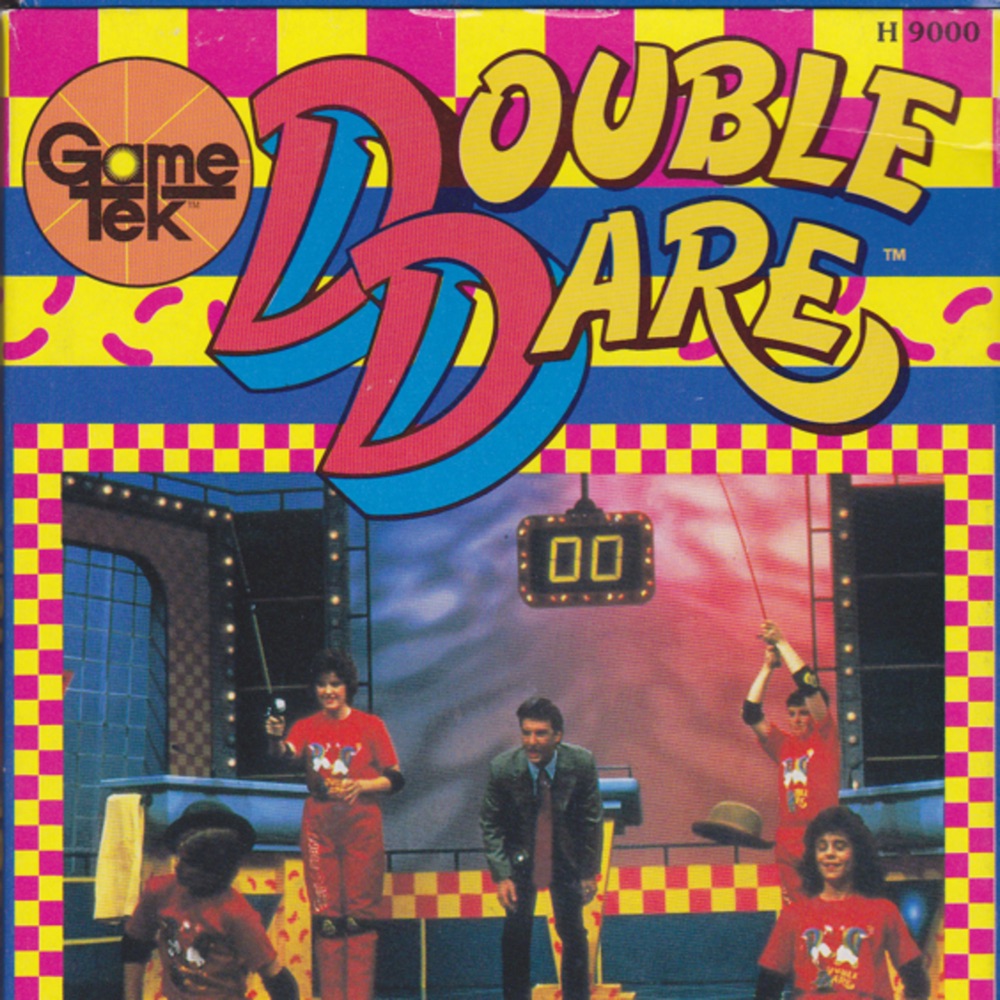
295 · Double Dare
Like the TV show, the game is basically a trivia game with the added enhancement of being able to answer the question, or take a dare. Dares consist of the Toss-up Challenge, the Physical Challenge, and in the last round, the Obstacle Course. Questions are varied, and in large enough number to avoid excessive repetition even over several games worth of play.
Rare made this for GameTek, and it keeps every rule of the Nickelodeon show: answer the question, dare the other team, or take the physical challenge. The format is smarter than we remembered as kids. The game manages to leave out the fun part, which is the mess.
The question round
- The dare is the best idea. You can answer and risk losing, dare the other team and hand them double, or get dared back for four times the money. That is real gamesmanship, and it only works because it can't work halfway.
- Hard to reach the messy part. Questions are mostly easy, the computer almost always answers when dared, and it rarely double dared back. Across two full games, a physical challenge came up about twice.
- A small pool. There are 130 questions and 20 in a game, so repeats show up fast. Five or six repeats turned up in a second game.
- Lexington, Kentucky. One question says it is illegal to carry an ice cream cone in your pocket there. We checked, and it isn't. We want our $20 back.
Throw, catch, repeat
Almost every challenge, including the toss-up that decides who goes first, is the same speed and angle bar with a new coat of paint. Hit the D-pad to start the bar, again to lock speed, then A for angle, with no do-over. Clowns eat pies, monkeys get bananas, kangaroos land in your pocket, and the controls never change. The ones that aren't throwing are catching, by following shadows. What half speed or the middle of the angle meant was never clear, so it came down to trial and error.
The obstacle course
The winner gets sixty seconds on an obstacle course, and it plays like Track and Field: mash left and right to run. Then the buttons change per obstacle, such as up and down to climb a mountain that looks short and takes forever, and you slide back down if you think you've finished early. You also have to jump at exactly the right spot to grab flags in your team's color. There are eight obstacles in a random order and no progress bar, only "Hurry!" Fall short and you get a screen of fake prizes anyway, and one game froze before the course could start.
Odds and ends
- Casting agent. To start, you cycle through kids and answer "Would you like a new character?" Saying no is how you continue.
- Difficulty. It only changes the computer's skill and how long you get to answer, not the questions.
- Rare phoned it in. It feels like the same team that made Jeopardy and Wheel of Fortune, and Rare could have made real platformer or shmup minigames, WarioWare style.
The bottom line
Skip it. Nobody voted it onto the Essential Games List. The question format is a good game show idea and Rare knew how to do much better, but this is a thin pile of easy trivia and one throwing minigame. It did make us want to watch old episodes of the show instead.
Written from our conversation in this episode.
- Draw your own pictures like the Hit TV Game Show
- NES Longplay
- Manual
- Would you like to do the episode or the physical challenge?
- The Show and it’s iterations
- Double Dare
- Super Sloppy Double Dare
- Family Double Dare
- Double Dare 2000
- Double Dare reboot
- Overview
- Compete against a friend or the computer through two rounds of 10-question trivia with the winner moving onto theobstacle course. The rules and scoring from the game show all apply. You can dare the opponents to answer the question, doubling its value; in response, the opponents can double dare for quadruple the original value. When the team in control is challenged to a double dare, they have to either answer or compete in a physical challenge. An incorrect answer, or not responding within approximately five seconds on a dare or double dare, awards both control and the appropriate amount of money to the team that issues it. The second round plays the same as the first, with question values doubled
- The format of the show for a second. Trivia where not knowing the answer isn’t bad, it leads to fun
- Pick your kid
- Would you like a new character “NO” to proceed
- The game can also be set for one of three levels of difficulty with higher levels offering less time to answer questions and a more accurate computer.
- Toss Up Challenge to determine who answers questions first
- Toss-up challenges determine which team gets initial control of the trivia round. To complete a toss-up, each player determines the precise speed and angle of whatever object they are throwing to hit a target. Physical challenges are played the same way. Each player uses the up or down arrows on the controller to choose answers for trivia questions. The player with the most money at the end of round two proceeds to the obstacle course.
- Hungry Clowns - Our Double Dare clowns are hungry….sounds li
- The Trivia Questions
- Hard to get to the physical challenges
- What is it illegal to carry in lexington kentucky
- An ice cream cone in your pocket
- The Physical Challenges
- MOST are speed/angle and require timing that isn’t allowed when you start speed/angle
- The Obstacle Course
- Why would you change HOW you run depending on context?
- Should they have put the controls needed on the screen?
- Virtual prizes for beating the obstacle course include a BMX bicycle, television set, an NES console, and several other gifts, ending with an exotic vacation received for completing the last obstacle.
- Sequels and Spinoffs
- Hi Tech Expressions released two editions of the DOS version of the game in 1988, as well as a "Junior" version,
- A "plug-and-play" console version was released by Senario in 2005; unlike the earlier computer and console adaptations, this one allowed players to actually draw the subjects, using an electronic pen, for their teammates to guess.
- EGL
- Next week -
- NEStalgia Byte -
Auto-generated transcript. Each paragraph starts with its timestamp. Speakers are not identified.
Double Dare. Do you dare? Can you handle the pressure? Do you know the answer? Should you dare the other team? Can you beat the odds? Do you dare to take the physical challenge? Double Dare is double action.
Is that really the back of the box? That is not the entirety of the back of the box either. Are you just bullying us? Yeah, that's not even the entirety of it, which is crazy. Welcome to Nostalgia. What? Oh, sorry. I thought we skipped that. No, no, no, no.
And welcome to NEStalgia, a chronological exploration of every NES game released in North America. I'm Mike. I'm Sean. And I'm Joe. Guys, would you like to do the episode or take the physical challenge?
Mmm. I'd like you guys to do the episode instead of me. But we get extra, we get double the credit. Yeah, it's all breaking down. Yeah, Joe actually has to make up some points for missing a couple episodes.
That's true. Oh, Joe, while you're here, because now you're back on the show, we forgot to tell you, we put a shmup on the Essential Games list while you were gone, and there's nothing... No, you didn't. Oh, yeah. Sorry about that. Uh, no, you didn't. Yeah, Terra Cresta is... You put Zelda 2 on the Essential Games list. No, no, no. It's called Terra Cresta, and you should check it out. I put it. That's where I was. That's where I was. I was doing my own podcast where I'm the only vote putting Zelda 2. Oh, yeah, we didn't even bring this up last week. We just acted like you've been here. Last week? Wasn't last week win, lose, or draw? Yeah, win, lose, or draw, but we didn't tell you then is what Sean's saying.
Oh, I see. Yeah, yeah. And, of course, I asked if you guys would rather do the episode of Take the Physical Challenge, because that is something that happens in Double Dare. Essentially, it's a game show where a trivia question is asked, and the kid contestants can either choose to answer the question and potentially be wrong, or, if they really don't know it, dare the other team to answer it.
The points that are doubled, and that team can double dare back to the other kids for now double the points of the double, so quadrupling the amount of money that the trivia question is worth. But if the kids still don't feel like answering for all that additional money, they'll have to take the physical challenge, which is usually some fun hijinks thing of, like, catch some, you know, eggs in your burlap sack or something, or, you know, mop the floor, but with your knees.
It's all fun stuff. Yeah, there's a lot of egg-based stuff going on here. A lot of food instead of, like, normal objects. That seems to be the running theme. Yeah, and essentially, it's been a running theme on Double Dare since the beginning, too. The show and its many iterations of Double Dare, Super Sloppy Double Dare, Family Double Dare, Double Dare 2000, and the Double Dare reboot in 2018, I think. All of these are essentially the same exact format of trivia and physical challenges.
And I guess that leads my question to, is Double Dare a show you think fondly of, whether it's because of your childhood or just because you like the format? Yeah, I have vague memories of Double Dare. I haven't watched it any time in the recent past. But when I did watch it, I didn't have a fully developed brain, so I'm not really sure I remembered all of the rules, or even that there were rules.
Just that there was a boring part where they asked kids questions, and then a fun part where they threw pies at each other and stuff. Yeah, I mean, similarly, I do remember watching it as a kid. I remember enjoying it. It was not my favorite show or anything, but I remember when it was on, I would give it a watch.
But it wasn't until I was older, specifically, really, when I played this game, because I haven't thought about Double Dare in a while, that I kind of realized that the actual, the question part, while it's not the fun part, is a pretty genius little formula. Where it's like, yeah, you can answer it and maybe lose. You can dare the other team, but maybe give them more points. And then if it gets dared back to you, it's like, well, I didn't know it the first time, but maybe I'll risk it for double the points, or triple the points, or accidentally give it to them. Like, there's a lot to think about in that one simple mechanic.
So I think that I didn't, that was kind of lost on me as a kid. I, like you, Sean, was just like, I just want to see them, you know, run through, like, a giant cream pie, or whatever, and like, look for a thing. Was that Double Dare? Yep, that was Double Dare. Yeah, they would have them search through things to find flags. I think that was Pictionary.
Yeah. But no, I agree, because it doesn't, there's gamesmanship here, and it definitely did not cross my mind when I was actually watching it as a kid. But it also, it only works because it can't work halfway. If you only could just, like, dare someone, then you would just guess, because there's no, there's only ways to lose in that scenario. I'd rather get $0, and then mostly get $0, than get $0, and then maybe getting $20.
If you're confident they don't know it, then they will give you, like, if they get it wrong, you get the points. You get double the double the points. No, no, but not even if they, not even if they double their back to you, like, if you only had. Oh, yes. Yeah, like, it still could be like, well, I know they don't know it. But I'm sure that'd be a rare circumstance, but, like, then if they get it wrong, you still get their points. Just thinking about the format of the show for a second, forget about the video game version, which has all the same rules.
You know, from a development standpoint, it is a really interesting decision to do the whole physical challenge thing, because it creates an environment where, yeah, it's trivia, and that part, I think all three of us are saying, is pretty boring when you're a kid. You don't really care to learn things when you're watching these shows. You just want to get on with the funny stuff.
The fact that they made the trivia a thing where not knowing the answer isn't bad, it leads to the fun, right? Like, just pass it off and hope to get the physical challenge. I think eventually, I don't know if the original iteration of Double Dare was like that, but by Double Dare 2000, there was a, like, everything was basically, yeah, let's just take the physical challenge. Like, let's get the money. Like, it just got down to that point where, yeah, everybody was watching for that anyway, and I'm surprised to find out, I don't know if the game show ever, like, took this long. But there's 10 questions in a round?
Like, that's a lot of questions to also add in the physical challenges on top of that. You know, it's a great decision, though, for a Nickelodeon-style kids game show to have that physical challenge component, because otherwise, this really isn't anything special. And I'm not even saying it's the best Nickelodeon game show. I would actually give that honor to Finders Keepers, a game that didn't really get much airtime, but did get some airtime on Nick Gas, a show that, like, a channel that Sean referenced pretty recently.
Can't remember why you referenced it. Accidentally, yes. Yeah, accidentally. But Finders Keepers was, like, in 1987 or 88 or something like that, and it hit a bunch of stuff inside of a model home that kids then got to, like, ransack the entire house looking for this stuff. And it was unbelievable that they had the, like, I think about the poor set designers who had to carefully design these houses filled with so many knickknacks and other things, and then just let kids destroy it in seconds.
And then be like, all right, set it back up again. Okay, we're going a little out in the left field here, but can you tell me what show would then give kids a shopping cart in an actual toy store and tell them they had, like, two minutes to grab whatever they wanted and they would absolutely destroy the toy store? That actually wasn't a game show. That was just something they did, right?
That was just a commercial? Yeah, it was, like, a commercial. They would just, no, no, no. Yeah, like, we would see it in the commercial. I don't know why. It was someone won, right? Yeah, it was, like, they won a sweepstake through Nickelodeon. Oh, okay.
Good to know. That was a lot of fun. I actually almost said figure it out, but figure it out didn't have that. But it felt like it was. Figure it out with Summer Sanders? Yes. Figure it out instead, like, you won, like, trips and bicycles and stuff and video game consoles. And you weren't even really the contestant on figure it out. It was, like, the Knicks stars were guessing what you just hoped they lost.
Yeah, but you had to answer. Well, you're watching the show. Yeah, you were, like, a celebrity. Oh, you had to answer questions, yeah. But you're answering, yeah. And figure it out you had a talent. That was the whole thing. Right. It wasn't, like, you know, there was something specific about you. So it was kind of, like, the kids' version of that show.
Hollywood Squares? No, no, no. It was, like, from way long ago, like, in the 50s. I can't remember what it was called. But they would bring on, like, famous people. And they would hide their faces. And the celebrities would have to, like, ask them questions. And it would be, like, I was the guy who was in the room when Abraham Lincoln was assassinated. It's, like, that's how old this TV show was. But that's a real example. You can look up that clip on YouTube. Or maybe I'll throw it in the show notes if I can remember.
Anyway, back to the Double Dare. We've gone over the format of the show. And so now, forget everything you know about how much fun it was to watch on TV. Or how much you wished you were a contestant on it. Now we have to talk about the video game. And there's really no better way to talk about the Double Dare video game than just the setting up portion of it. Where you have to pick your kid.
It's really strange that you pick the look of your kid where you cycle through kids. But then even the wording of the kid is, would you like a new character? And you have to say no to basically mean, yes, like, I would like to go on with the game. Like, no is what you have to say to proceed. It's not, do you like your character? And you say yes to move on. You say a negative to go forward. That is weird. I don't think I've ever seen that before. Yeah, that stood out to me.
It didn't, I didn't think of it as all that, like, profound, though. Where I think that you saying it that way makes it feel very out of the ordinary. Whereas when I was just seeing it, I was just like, well, that's a weird way to do it. Yeah, like, are you working in the casting department? And you're like, no, this kid's no good.
Like, he won't test well on TV. That's where, that's the actual player character is the casting agent. Yeah, this whole time. Yeah, you're the casting agent. You're the cameraman. Like, you're the host. You're all the other things other than the kid. And the game can be set to one of three levels of difficulty. But the only difficulty change obviously comes with the skill of the computer. But also the time it takes, the time it allows you to answer questions. Which, to be fair, I guess, like, yeah, they do give you a lot of time on the easy ones. So it's, the questions are really like, you either know it or you don't, right? Yeah, this isn't the kind of difficulty I want, though. Like, I wanted it to be difficulty of the questions.
Because they're really, I mean, there's some, like, just more timely questions that I don't know the answer to. But most of these questions are pretty easy. And if you've forgotten or maybe never knew the actual rules of Double Dare in which you would just try and answer all the questions correctly until you sort of figured it out yourself. This is just a boring game where you, like, win $10 at a time.
But even then, like, you then would say, like, okay, I don't know to an answer that you do know the answer to. Just to hope that the computer rolls the die not to know it. And then, yeah, and they might know it. And so I think what you're getting at, Sean, very astutely in my notes, I have the same observation, is it's kind of hard to get to the fun part, the physical challenges of the game. Which, as I mentioned on the TV show version, is something that happened pretty often. Because, yeah, there are probably harder questions, too.
Yeah, and I tried for a while. So I played two games of this. My first game, after a while, I realized, like, wow, I'm not doing any physical challenges. So I was, like, trying to constantly throw it back to the other team to try and get, like, physical challenge. I would dare them and hope they'd double dare me. And they either never, they would never double dare me. And if they dared me and I double dared them back, they would always just answer the question.
Like, there was never an opportunity for a physical challenge. It happened, like, twice to me in playing through both games. Well, I guess the only thing less fun than seeing the computer get a question right and take your money is watching a computer do a physical challenge that you don't have any input on. So I kind of get why that was the case. Yeah, but I wasn't sure. I mean, I assume that the computer doesn't do a physical challenge.
That's what I assume. But I don't have enough, I don't have a big enough sample size to confirm that. Yeah, me neither. Before you even get to the physical challenges, though, or the trivia, the way that they determine who goes first is basically through a physical challenge, but something they call the toss-up challenge. And the toss-up challenge, as I mentioned, determines which team gets control over the trivia round, which, since the questions are so easy, could be very crucial. Unless, of course, the computer makes a mistake and then you get to dominate from there on out. But the toss-up challenge has this speed angle meter where it's all on one bar, but essentially speed is on the left side of the bar and angle is on the right side of the bar.
And you're supposed to figure out that it works a little bit like how we think all the golf games work on NES. Yes. Except for the inputs are very strange for how to start, stop, and control your speed and angle. So the way it works is you hit the D-pad to start the bar moving to the speed section. Then you press the D-pad again to lock in the speed. In the opposite direction. Right, in the opposite direction to push the bar the other way. The speed at which you want to throw the item.
And then it moves over into the angle portion, and you have to stop by pressing the A button. And now you've locked in the angle of the shot. And let's forget for a second that speed and angle are, especially in your very first time playing this game, arbitrary measures. Like, what does half speed mean? Like, am I throwing at half speed? How far can this kid throw, right? And angle. It's like, is the midpoint of angle, like, straight? Or is it still going to be on an angle?
And, like, you know, throwing from no angle whatsoever, like, all the way to the left side of the angle. Would that be throwing to the left or throwing with no angle? Like, you'll figure these things out, obviously. But it's very confusing. Yeah. And there's no precision the way that NES golf works, where you're hitting, like, the A button to start, lock in your speed. Like, there's no, like, reset. It's like, once you've started it, now you're just screwed on that throw if you don't get it right from there on out. And here's the thing.
This wouldn't be an issue if it were, if the sort of physical challenges slash, like, beginning and halftime games weren't basically all the same game. Like, if this were more of a Mario Party thing where every little minigame had different mechanics and different control schemes, that'd be fine. But, like, 80% of the ones that you're doing here are just variations of power and angle. You get a couple where it's a bit more freeform, but not really.
The fact that all of them are like this just makes that even more annoying. I do want to hear what Joe has to say. But I would mention that, yeah, there is at least one other version that I encountered, but it's basically the same thing again of use the directional pad to move around the screen and try to, like, follow the shadows to catch something that was thrown at you. So you're either throwing or catching. That's the entirety of what they've come up with for physical challenges in this game. Yeah. And as far as the speed angle versions of the toss challenges being, like, very similar or, like, slightly reworked, I would even go as far to say is they're kind of just re-skinned.
Or it's like, you're really doing the same game, but it's like, throw the, whatever, throw the egg into the clown's mouth or throw the banana into the monkey's hand. And it's like, well, it's kind of the same game. Right. Catch the rings on your hat or catch the kangaroos in your pocket.
Like, it's like, yeah, I guess those are silly things. But the problem is they're not translating silly enough to video game form. Like, in video game form, catching a baby kangaroo would be more exciting if it was on the loose or something, right? Like, if you had to chase it down or whatever. But in reality, like, if that happened on the show, I don't know what standards and practices team would allow that. But if they allowed them to throw a baby kangaroo and you had to catch it, that would be exciting to watch on TV, not play in a video game.
Yeah. And, like, just, I think that, so I don't remember if I played any of the catching games. I only played the, um, they'd always ended up being a throwing game for me. But, like, I don't know why it felt the need to make me feel like I'm doing, like, geometry or something in order to figure out which way I'm throwing. Like, why couldn't it have been just as simple as, like, the target's moving and you move. And wherever you move, you throw in that direction.
Like, and that's it. It could be, you could be, you could take, you could take four steps left to right. And it's like, that's how you aim. And the target moves a little bit too, so you gotta just line it up right. And, you know, this is like, I, eventually I would get, like, the feel for it. But in, in the sense that I'm kind of, like, memorizing what's working.
But it never, I never really understood what the correlation, like, the speed and angle thing. Like, I guess angle is, like, which direction you're sort of throwing it. But, like, it never was clear to me, like, okay, this is if I want to throw it here. And if I want to throw it there, I gotta go this way. It was all trial and error to me.
But it's, like, it's a video game. Why isn't the, why aren't the physical challenges something where it's like, yeah, now you're doing the platformer level, right? Like, we don't need to be doing physical activities. It doesn't have to just be this one thing. Yeah, like, transport me to, like, a, you know, still my character. But in a Super Mario Bros. style environment where I just have to complete, like, a quick 15 second level.
So there is a different, there is a different mode. And it's after the game. And I think I remember in the show, I don't know in the actual show what the trigger was. Maybe it was always just the last three minutes. You got the obstacle course. Yes, the obstacle course. That is for the winner, of course. The person who has the most money at the end of the round gets to try to do the obstacle course. And take it away, Sean. What do you do in the obstacle course? Well, you're playing track and field on a controller.
And so basically, you're just moving, like, you're pressing left, right, left, right, left, right to run. And then you run into an obstacle segment in this hundred-yard-long studio with thousands of people in the audience. And you have one minute to get from one end to the other. You never really know how far away you are until the end unless you were paying very close attention to the preview that happened a little bit earlier.
And then I don't know what happens. Because I never was able to finish it. If you don't finish the obstacle course, it shows you a bunch of things like a la Wheel of Fortune or Jeopardy of all of these fake prizes that you won and the equivalent dollar amount. And then the game ends. A couple things. First off, it's always eight obstacles.
So you at least know that, which is helpful in a 60-second thing. Because I agree. There is no tracker progress meter thing. Where there could have been a progress meter. Instead, it puts, like, inspirational things. Like, you can do it. Hurry, hurry. Would have been great to just have a progress bar there instead. But essentially, you're supposed to focus on the... There's a number in the top left that says, like, you're currently on number four. And you're supposed to know there's eight or whatever.
Ah, I see. More importantly than just the tediousness of pressing left and right to run, the input of running, climbing, going in certain directions always changes. And you're just expected to know what that change is as you're doing it. So, for instance, one of the obstacles is a mountain.
You got to switch to up, down, up, down. Right. And it doesn't even look that high. But it takes freaking forever for these kids to climb up. Well, you think it's the aggro crag or something, the way that they're taking their time to go up this thing. And even then, like, the pixel... I don't know if, like, the art is just wrong or something or the boundaries are wrong. But you look like you're done and now you're trying to switch back. Because keep in mind, as soon as you're done climbing and you're at the top of the mountain, to move any amount, you have to now switch back to the left, right, left, right for the, I guess, horizontal running. So, there's horizontal running of left, right and climbing of up and down.
But even if it looks like you're done, you might not be. And then you'll slide all the way back down to the bottom. Oh, yeah. All the while, through each obstacle thing, you have to collect these flags of your team's colors. So, if you're with a red team, red flag, blue team, blue flag, you have to collect these flags. You have to jump. And it's not about, like... At the precise place. Exactly. You have to jump right where they want you to jump.
And for some of these obstacles, that can be crushing to figure out. And then keep in mind that the obstacles are not always in the same order. They are randomized. This isn't even something you could, like, practice with skill and memorization or whatever. You might just get a bad order or something and just not be, you know, like, constant. You have to constantly switch your inputs to the point where I'm not certain it's possible to beat this in 60 seconds.
Okay, yeah. So, I was going to ask if you were ever able to. But I don't even know how... I mean, maybe I wasn't because I wasn't paying attention to the number in the corner. I don't even know how far I got and how much I think I could have improved that number. I'm sure I could have improved. But I was mashing those buttons pretty quickly. That was basically answered my question anyways. Because I was going to ask how, you know, how functionally it controlled. And how, like, how doable it felt. Because, I'll be honest, the first game I ended up losing because, like I said, I was trying to get...
I kept trying to get them to get me to the physical challenge. And then I had to keep giving up points for that. So, I was like, okay, I'm going to play again and I'm going to win. And I did. And I won. And I got to the point where it's like, oh, you're going to have to run a physical challenge. And then the game froze. The game froze? The game froze. And I was like, I'm not doing that again. Because it takes a long time. Like you said, there's 20 questions. It takes a long time to get to that point. So, I was like, you know what? I'm just going to watch a video of it. So, yeah, I didn't get to experience that. Wow. I'm really sorry. I've never heard of that.
Yeah. You've never heard of an NES game for a reason, though? That's like my whole childhood. Well, I mean, I guess if you've got some dust, you're right. It depends on how you're playing it.
It's more fun when you're like touching the cartridge while the game is on and you start doing some like data moshing stuff to your screen and really screwing around with it. That's like before Game Genie, people were just playing around with the cartridge in there to see if they could screw up the game to boundary break or give themselves infinite lives. Because, Sean, you mentioned the prizes and stuff and what happens if you win or whatever.
I think the big prize at the end for winning like the entire thing is that you get like a vacation or something like that. Ah, the vacation. But you do win for each thing, if that makes sense. Like for each obstacle of the eight. Yes. If you did six of them, you do win six prizes. And that's true to the show as well. That is true to the show. Okay. I appreciate that. They give the kids the BMX bike. Like, yes, the BMX bike and the NES console. So you won something you already have.
Wow. Yeah. Well, it's an NES console inside the game. So it's like you can now play like you can now play like super NES games. No, you could play Super Mario Brothers in Double Dare. You can emulate Super Mario Brothers inside Double Dare. There's also a whole life simulator after the show where you grow up and like your only story as you become like a teenager and young adult, like your only story is that you were once a contestant on Double Dare.
And then there's this whole like section about like the, you know, substance abuse you end up going through. And then you end up like okay at the end, but you have to make the right decisions. Sean, every video game is a life simulator. We just can't access those other parts of those people's lives. We just haven't figured out. Like in the debug mode. Right. Exactly. Technically. Yeah. Every single game works like Animal Crossing. If you guys didn't know this. It's just, we're not able to get to those parts.
Two things I wanted to mention. One related to the physical challenge and one related to the trivia questions. I got the Hungry Clowns Toss-Up Challenge. It was called Hungry Clowns. And you have to- I think I had Hungry Clowns, yeah. You throw these pies at them or whatever into their mouths. And that's cute because usually you pie a clown and now you're feeding it a pie. But the text description was a little like, I don't know. It was a little scary. To me, maybe unsavory would be a better word for this food related bit. But it says, our Double Dare Clowns are hungry. And first off, they're called Double Dare Clowns. Like they're not just clowns. They're Double Dare Clowns. Like is everything, were those Double Dare Kangaroos?
I found that there's been like a weird thing. Maybe this is just a thing that the host at the time said. But there was just like, you know, at Double Dare, we really like golf. But we ran out of golf balls. We got eggs. They're like, oh, you know, here at Double Dare, we really like bowling. But we don't have any bowling balls. We got cantaloupe. Right. Is Double Dare a village? Is that just the way he talks? Yeah. Is Double Dare a village? And these are like clown citizens of Double Dare, town Double Dare?
See, I think that those were not like, yeah, those weren't, those weren't like, they were never intended to be fun, messy kid things. It was like, they always wanted to do a serious game. And they were always like, oh my God, we forgot the golf balls again. Like, go get the eggs. And then someone would get fired every time.
Ugh. And then as for my trivia question thing, it's like, yeah, we established that most of the trivia questions are pretty easy and you'd have to want to get them wrong or anything. But there was one that led me to actually, it made me want to find out if it was even true or like I was just flabbergasted that they asked this question. And that was, where, what is it illegal to carry in Lexington, Kentucky? And I thought that was interesting because it went Lexington, Kentucky, not just the state of Kentucky, but what is it illegal to carry in Lexington, Kentucky? And all three choices were some of the silliest things. It wasn't even like there was a common sense answer or whatever. And the answer was an ice cream cone in your pocket.
That can't be real. And so I looked it up and there was an article posted on April 16th of 2020 that says, no, that is not true. There are a lot of internet memes and listicles about weird laws in various places. And one that is commonly found online is that it's illegal to carry an ice cream cone in your pocket in Kentucky.
Sometimes the city of Lexington is also specified. And then they explain why it's not illegal. Not that obviously like they, nobody would have arrested you either way, but like it's not in their laws. And so I think I'm upset with double dare here for two reasons. One, that means somebody clearly didn't do their homework before they just jotted down. Yeah, they jotted down these questions. But also that I was, you know, I dared the opponent because I didn't know. And they selected the ice cream cone in your pocket. So the computer and the double dare team are colluding against me for this erroneous answer. And I want my $20 back.
Yeah, you should write to them and trying, you know, you got, you earned that vacation. I'm not buying the new postal. So I suggested going, uh, going back to the physical challenge thing. I suggested making it more video game like, and doing like a platformer stage and a shmup stage and stuff like that. And they could have just been short burst things too. Almost like WarioWare. I'm saying it's double dare, but it's also WarioWare.
Uh, other than the obvious, like, I feel like that's something we all could have came to. Is there anything else you guys thought could have improved the double dare video game version? Because I do feel like the game show is great, but on TV, but it's like the same as if there was a legends of the hidden temple video game and they just made it mostly about the trivia part. And then at the end, there was just some vague obstacle course of exploring the temple.
Like you would expect the legend of the temple video game to be more about exploring the jungles and the temple and less about the game show format. Should double dare have not leaned into the game show so much? It would be like if the legends of the hidden temple movie came out and it was all just questions. It was all just trivia. Right. And not an exploration on the world of legends of the temple.
Well, that, okay. But that's completely different. Go ahead. Yeah. Well, I mean, yeah, I mean, I'm just joking, but to your, to your actual question, the, um, the one thing that I could think they could have done better is a bigger pool of questions because like I said, I only played two matches and on the second match, I already, I got like five or six repeat questions, which is a lot when, you know, there's, you know, 20 or so questions total.
So like, I feel like you play this a couple of times and then you just know all the answers to the questions, which is such a, so much the meat of this game that it's like now it's even harder to ever get to a physical challenge. Wow. Okay. Yeah. I, I, that, that make, that's crazy. That's crazy that you ran to six repeats. I didn't, but, um, I also changed. Okay. The difficulty has nothing to do with it. It has nothing to do with it either. So, uh, I didn't run into that. That that's some weird RNG.
I imagine. Yeah. I mean, I'm estimating, but it was, it was rough. It was, you know, at least even if it's three, something like that. Yeah. That, that, that's like unacceptable. Um, in my, my answer is I don't really know how you can improve something like this. Cause I don't think that this, this would stand up as a game in any respect, unless like it's something like a, uh, like a Jack box, which, which only works because they are hyper focused and what they're about. Whereas this game is trying to both be an action game to some extent and a trivia game, but it has to be trivia geared towards kids because that's the people that are on the show. Um, I don't really know how, what you can do with that to improve it.
That's aside from making like the ridiculous aside from what you were suggesting, Mike, uh, which is actually giving these physical challenges, real gameplay. Yeah. I think that that's, you know, yeah. Besides that, cause I think it could work. It's just either the physical challenge, like the controls just have to be better. And like, like, like this concept works in my opinion, if you have Mario party games with questions like that, like, like conceptually it works. It's just that the gameplay, the actual thing that's considered gameplay needs to be better, not answering questions, but the actual like, yeah. Joe, uh, you mentioned repeat questions. And so I just did some quick math while you and Sean were talking.
There are only 130 questions in this entire game. And you know that there are 10 in each round. So you have experienced 20 questions out of the 130 in the first time you play the game. Wait, is it only 10? Is it 10 questions in each? I think you meant each round, like before the half.
It's 10 in 10. So 20 total. Yeah. 20 total. Right. So I was actually a statistical anomaly by not running into any repeats because I feel like the odds are not in your favor. If you go through 40, you're bound to, yeah. You've experienced 15% of the entire question pool after what? 20 minutes of playing the game? Yeah. That's crazy. And you cannot say you've experienced 100% of this episode unless you listen to the final segment, the Essential Games List.
It's going to be a resounding no for me. And I know my job is on the line, but I'm going to still say no regardless because here's the issue I have with Double Dare. Double Dare, it actually, believe it or not, saved Nickelodeon early on. This was a huge show in 1988 where it just basically established the next iteration of you can't do that on television. That was Double Dare for Nickelodeon. And so I really wouldn't have a job without Double Dare in some ways. All that to say, the game did not save anybody's ass.
Nickelodeon did not do great because of this game. Double Dare was made by Rare, which they didn't do great because they didn't do themselves any favors here. They basically phoned it in like they did with Jeopardy and with Wheel of Fortune and their other game show iterations, which leads me to believe that it's just a different team at Rare that's doing all this work.
Because certainly my suggestion of video gamifying it is something that Rare would have been more than capable to handle of small little platform, even if it was only platforming, right? But like the challenges were a little different or whatever, or the enemies were different. I feel like I can't stop thinking about that idea and what a better game that would have been that I just know that this one's not essential.
Sean? I just, I can't really extrapolate anymore. Like it's not a good game. It's not essential. But I will say that these past, like this past month or so where we've been playing a lot of game show games, I feel like I'm just going to start like putting game shows on the background as just like some background noise. Like when I was playing through like last week watching Win, Lose, or Draw, like I just find the whole concept so ridiculous that like you can't not just be bemused watching it. And I think I have to just boot up some old Double Dare footage because I think that would be just as goofy.
So I think this is a reawakened something in me. Joe? Yeah, the Double Dare on the NES has simultaneously let me appreciate the game theory involved in the Double Dare game show. will also make me realize how much of a disservice to that game show this NES game does. Because I really do think that like, I would like to throw on a couple episodes too because it's just a, it's a, it's a cool, it's a cool idea that I'd kind of forgotten about. And if you, if, if you showed someone this NES game who's never played, who's never watched the show, I feel like you'd kind of be like, well, this is, it's, it's boring. So I'm going to say no. And the game shows will continue next week when we play Dino Wars Destruction of Spondylas.
Everybody remembers that daytime game show hosted by Wayne Brady. Wow. Did we really make every joke from last week again into this week's episode? We had so many callbacks. This is why you have to listen to every episode. Sean, I wasn't sure if you were aware that the, the one callback you made was actually from last episode. Oh no, that, I knew that was last week. That was deliberate. Okay.
Yep. And everything we said on this episode was true. Joe, we really did put Terrorcrest on the essential games list. So please check it out. And maybe give it a try. Yeah. I was gonna say maybe in one of our, not no pressure for next week, but maybe eventually you'll give us your thoughts. Cause we both did say that we felt bad that we took the opportunity for the episode that you weren't on to put a shmup on the essential.
Well, I mean, if you both were going to vote it while I was on there. That would have made it anyway. It still would have gone out. Right, right, right. But you had, you would have had a chance to talk Sean out of it because you're very good at that. Yeah, that's true. That's true. I do, um. I am very impressionable. Yeah, that's true. I have voted shmups on before. Which one? Uh, Gradius. Okay. And then you tried to take it off.
Yeah, cause what was I thinking? Gundot Smoke maybe? I think of- Gundot Smoke we all agreed on, yeah. That's- I don't think that's a, that's not a shmup though. Yeah, that's just a prequel to Red Dead Redemption. I don't think that's a prequel to Red Dead Redemption.