163 · Q*Bert
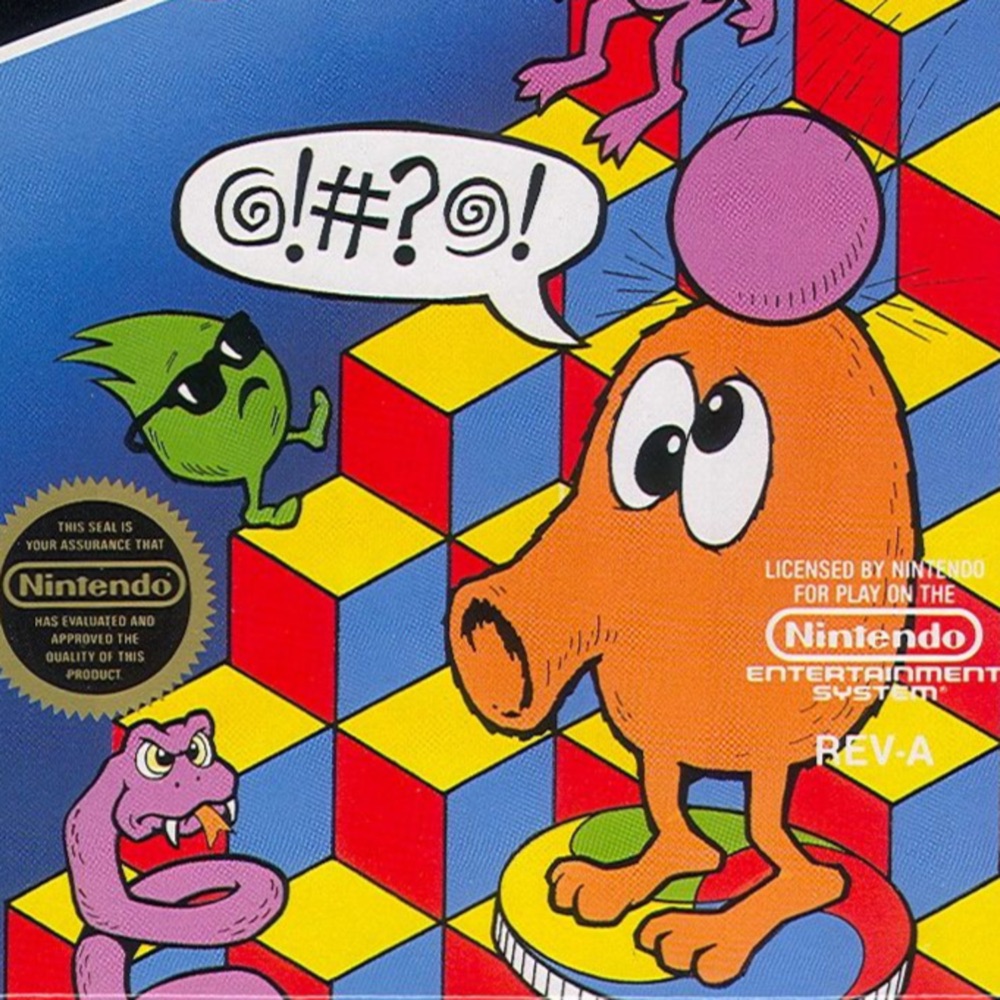
No one ever said it was going to be easy hopping the irresistible Q*bert from cube to cube and staying out of harm's way. Especially when he's trying to avoid creeps like Coily and Ugg.
SHOW NOTES
NES Longplay
Arcade Version
Q*Bert's Qubes
Q*Bert 3 (which really should be called Q*Bert Qubed)
Q*Bert PSX
Q*Bert Rebooted
Q*Bert TV Show (yes, really)
Q*Bert Bedsheets for only $225
The Making of Q*Bert
- This game is so mind boggling - it will knock you out!
- Introductions
- The *
- What is a QBERT?!
- Why is not QWERT
- Overview
- Gameplay
- Is it satisfying?
- The challenge is the isometric nature right?
- Described as an axonometric third-person perspective to convey a three-dimensional look
- Development
- Warren Davis, asked if he could use them to practice programming randomness and gravity as game mechanics.
- Davis also believed games with complex control schemes were frustrating and wanted something that could be played with one hand. To accomplish this, Davis removed the shooting and changed the objective of saving the protagonist from danger.
- The original title was @!#?@!
- Davis expressed regret for the asterisk, because it prevented the name from becoming a common crossword term
- Qbert Quazy
- In 1983, Q*bert was adapted into an animated cartoon as part of Saturday Supercade on CBS
- Over 125 licensed QBert Merch. Frisbees, sleeping bags, bedsheets. They made it
- The video game crash of 1983 depressed the market, and the game's popularity began to decline by 1984.
- Q*bert characters appear in Disney's Wreck-It Ralph and Pixels.
- Sequels and Spinoffs
- Q*Bert's Qubes
- mSimilar gameplay, but is now in three dimensions...except not really? It’s just like cubes are more spaced out.
- QBert 3 - SNES
- This game better be called QBert CUBED
- Where is 2?
- And it’s really just Qbert 1 with some new layouts.
- Qbert - Sega Dreamcast
- 3D puzzle adventure
- Qbert Rebooted (2014)
- The Rebooted 3D game mode changes the tiles from squares to hexagons, offering six points of directions to move instead of the classic four.
- EGL
- Qbert is fun, but I can’t recommend anything here other than some insight into platforming arcade games.
- Next week - Tecmo Bowl!
Auto-generated transcript. Each paragraph starts with its timestamp. Speakers are not identified.
Q-Bert, this game is so mind-boggling, it will knock you out.
And welcome to NEStalgia, a chronological exploration of every NES game released in North America. I'm Mike. And I'm Sean. And that's it. It's another one of the Fireside Chats, mostly always about arcade games. I don't know what that is, Sean, but sometimes the other guys just don't want to join us. It's totally, I'm sure it's totally a coincidence that it's about the games that they've all played a million times before. It's fine. And Q-Bert could be one of those games that some people have played a million times before. Remind me, what's your level of familiarity with our little orange friend?
Going to those bar-arcade combination places. I played them there. And at an arcade called Kahunaville in a mall. That's where I played Q-Bert. I first played Q-Bert online, actually, back in like 2001 or 2002. I guess somebody found a way to like emulate those games online, like just with Java or something like that. So I'm not certain if it was even the real arcade version or what have you.
But I don't know. It was fun. It was like just simple enough that you wanted to keep playing. Not as complicated as some of the other arcade games that were hosted on that website. So it was one that I frequently went back to. But it's also not something that we hear much about today. I don't think anyone's screaming for Q-Bert's revival. Yeah. I think for me, it was always like it had a unique enough look because of the unique angle that it presents it at.
And again, like you said, it was simple enough that I was easily drawn to it. And then when I would eventually just fail, I was just like, OK, I'm just not good at that. And then I'd walk away and play something else. You know, people in 1983, though, when this game came out, they were what I would say Q-Bert crazy for Q-Bert. You know, they were crazy for Q-Bert. God, stop it.
And I say that not even just because the arcade game was a hit, but because we're talking about over 125 licensed merchandise based on Q-Bert's likeliness. Everything from Frisbees to sleeping bags to bedsheets. I mean, you name it, they made it for Q-Bert. For Q-Bert. Wow. That's some really uncontrolled consumerism. I like where you're going with this. Thank you for following along.
You know, Q-Bert also even got an animated cartoon as part of Saturday Supercade on CBS. So I don't know if you managed to like find stumble of this on like YouTube or something, but the episodes are up there. And I just think it's hysterical, you know, that you could flesh out something like Q-Bert who kind of lives in a void in space, you know, like just on a floating pyramid. Yeah. So I guess then you'd be qualified because I imagine you watched the entire show.
So maybe you're qualified to answer this question because I know that you're really into baseball. But my question is, is Q-Bert just the Philly fanatic? You know, best I can tell, Q-Bert, you know, the Q-Bert that we know in the video games is not the same Q-Bert that they put into this television show. So in the television show, right, because like in the television show, he's like, it's almost like it's 1950 or something. Like there's just, there's something off about Q-Bert's world. And he's got a girlfriend, by the way, named QT. Oh, wow. You know, so he also has a brother, Q-Bit. You know, I could just, you know, everybody just Q something.
And they basically deal with, you know, the same people that you deal with in the game, like Coy Lee and Ugg and Wrong Way, which is funny to think that like that's the name of the enemies. But, you know, they're basically just dealing with them, but in more like social settings. Like those guys are bullies to the townspeople. And Q-Bert's kind of like, you know, that's not cool. Yeah. I mean, you kind of ignored my question now.
No. Oh, yeah. So about the Philly Fanatic thing. No, he's, I guess like what I'm saying is like I would imagine he is if you go off of the arcade game. But I just don't buy that the same Q-Bert that's on this TV show, you know, who talks. First off, that's like the weirdest thing. Yeah. Like they should have not have said a word. But no, he seems to be pretty level-headed and, you know, supposed to be our hero. I'd say that like anything like that, this Q-Bert show is more just Q-Bert Gaiden than anything. I don't think this is true deep lore in the TV show. Whereas like the Philly Fanatic, he's like a foil. He's a court jester, if you will.
So much more like a Q-Bert video game. Yes, exactly. Exactly. If I had it my way, and I think both Wreck-It Ralph and that other movie Pixels with Adam Sandler, both of them have Q-Bert and he doesn't say a damn word in either one. And that's how I would choose to portray Q-Bert as well. It's just kind of like this goofy, otherworldly thing that like you recognize, but you're like, oh, that's pretty strange that, you know, he's forced to be alive.
Against his will. Right, right. I brought all this up in the front though, just to say that like, you know, Q-Bert was a big deal. And then like the video game crash happened, you know, like the same exact year. So the popularity of the character pretty much declined in 1984.
But, you know, that doesn't necessarily explain a lot of things because like Pac-Man and Donkey Kong, Donkey Kong is still popular because he got like attached to the Mario series. But like Pac-Man, still very popular. Why isn't Q-Bert like something that, you know, like we're not looking for more of that? I guess we're going to have to start some petitions. Well, I'll start with, you know, just some observations of my own. You know, I'm nitpicky about this stuff. The title, Q-Bert, I don't know, it bothers me because we haven't been saying it properly. It's like, it's Q asterisk Bert.
Yeah, I mean, would you, like if it was hyphenated, would you think that you have to say it any differently? No, but I think that's like the point of the hyphen, right, is to let me know that it's like, it's Q-Bert is like one word. Whereas like the asterisk doesn't tell me much about anything. Is the Q silent by the asterisk? Like, is that like a footnote that you have to read further down? Oh, God. Yeah, you're right. You're right. I think it's supposed to be Q to the power of Bert. That would also, that would work for me a little bit better. You know, like that would be fun to say every time. Q to the power. Also, just general musings here.
Because Q-Bert, when he, you know, like when he gets hit by something, he kind of like curses in random symbols, right? He has like the at sign and the exclamation mark and maybe a few other, maybe the ampersand shows up. He has like these curses that he does. So that made me think of like, you know, why isn't it Q-Wert?
Like the first, you know, four letters on an actual keyboard, like a QWERTY keyboard, like Q-Wert. And it's like when he dies, he's just like rage quitting and spamming a bunch of symbols on the keyboard. You know, that like Q-Wert makes sense to me. Q-Bert? I'm like, I don't really know this guy. Maybe the idea was that it would be like, again, we're going into territory where nobody's an expert on anything. But I would say that maybe that was the original idea. But to make it sound more namey, they made it Q-Bert. And that you're supposed to just understand that it's based on the keyboard, you know?
Or it could be nothing. And we're just, we're reading into things that you don't need to. Warren Davis, who is the creator of Q-Bert, did express regret for using the atterisk because it prevented the name from being a common crossword term. Oh, that's, wow. Okay, that's the sort of things he's thinking about.
It could have lived on for a hundred years. He just removed the asterisk. He's actually responsible. The whole thing that we were asking earlier about, why did Q-Bert die? Why is no one asking for Q-Bert? It's because there's this uncertainty around the asterisk that like no lawyer in America could answer. So they won't dare license the property. Wow. Yeah, I'm looking. I've never noticed it before. But like just in like YouTube videos and just general Google results, nothing is, like everything has the asterisk. I thought it was just like one of those stylizations that aren't always respected.
But here we are. Yeah, and I think like, you know, there's Q-Bert and then there's Q-Bert. So that's why the asterisk has to be there. You know, that's the emphasis on the Q, if you will.
So, Sean, what are we playing here? What is a Q-Bert?
A Q-Bert? I'm confident that a Q-Bert is a game that we're about to talk about, the game itself and not the weird alien creature. It's sort of like, I forgot what game we were talking about. Oh, no, we were talking about Pac-Man just a few episodes ago. We were discussing the feeling of playing Pac-Man. And one of you said that it was like mowing the grass. And this is sort of just mowing the grass on a very cube-y hill, if that's a good enough way to describe it. Yeah, it's like a bunch of actual cubes stacked on top of each other in the shape of a pyramid, I guess, is like the best way to describe that thing. And you have to touch the top layer of each cube to change its color. And this is all done in an isometric viewpoint.
So, you know, the cubes do look 3D. And Q-Bert even has a little bit of like 3D sense to him, right, in the way that a 2D video game could. He's got some shading. Yeah. So, you know, there's supposed to be this added challenge of it's not just like hopscotch. You know, it's like you actually have to – your inputs kind of are the important thing because you have to know where you are in space, you know, like at any given time. Because if you hit to go right, well, what does right mean contextually when you're at the edge of the pyramid? Whereas if you're in the middle of the pyramid, you know, so those things kind of change.
And that's really like – that's the challenge, right? The isometric nature of the game is the challenging part of the game. It was so challenging, in fact, that the – two things happen here. The manual suggests that to make the game easier, you should play with the controller at a 45-degree angle. And when I read that, I had no idea what they meant. I mean, I knew that the directions were not going to be just up, down, left, right because of this like faux 3D effect. But I didn't think they'd go so far as to like just pretend that your controller is these inputs instead.
And then when you actually get into the game, it doesn't start off with the game itself, but you actually like customize your controls with a little helper dude. So I found those very interesting, both of those things going on here. The helper dude especially though, I know that's not like the – it's a menu screen. But like there is supposed – they show you a controller. They have a guy there.
Like there's something – Yeah, there's something great about that though. Like this could have just been – put in an options menu. Yeah. And just like asked you which way – you know, like it would just say up and then it would say, you know, up on the D-pad as well. Like it would be weird if there wasn't all of this extra visual aid to show you exactly what they were talking about. They actually have it broken down for you so that you can see like Hubert is on this square and he's going to jump to this square.
What D-pad button do you think he should press? And, you know, you kind of have to cycle through them and do some work. But I think it's funny that the game lets you customize as far as like just even making it opposite. Like you could say like, oh, Hubert's jumping upright. Well, I'm going to hit the left button on the D-pad for that. You know, like you could totally screw with yourself too. But I like that it allows full customization of how you control Hubert. And not just like a mode A, mode B of how they might think people would use it.
I appreciate that too. Yeah, and this is made by Ultra Games as well who were the same people that brought us Gyrus last episode. So that's interesting to think that like first they had the control A, control B option. And then in this one they're like, you know, just give them full customization. And full customization is important because it's not just choose your direction on the D-pad. They did the thing I was kind of hoping they would do. And my preferred method of playing this game on a D-pad controller instead of a joystick is they let you say up and to the right. Like to have to press down both buttons. Oh, you can do that?
Yeah. Oh, man. You can actually say like, yeah, for each thing, each corner I actually want to press up and to the right or right and down or right down and left. You know, you can actually put that in there. So this way you have to confirm both buttons. But it actually makes it make a little more sense because you can picture. Yeah, so it's more one-to-one instead of pretending that you're playing at an angle. Right, right. You can picture which cube you're going to jump on by that little like square hole that's left on the D-pad. Yeah. Huh. That's really – that's like the first accessibility consideration I think we've seen.
Even though it's not like – it's not in the same sense as how you might think. But I appreciated it. Yeah, and even the – yeah, the 45-degree angle thing, though. Like I'm holding my NES controller right now and I'm thinking about that and I'm like, okay, maybe. Like I don't – I have to actually play the game. But that seems a little more confusing. It didn't work. Than just choosing whatever feels comfortable. Because I did – playing the game, I did have perspective issues that I'll go into further when we get into it. But I did try to play it at that 45-degree angle that they were talking about. And I guess my brain just doesn't work that way. I just felt like I was holding the controller weird. So, yeah, that was a weird suggestion for them.
Now, Sean, you mentioned about the mowing the lawn thing and Pac-Man. That all happened because we started talking about the term like is it satisfying? Yes. Arcade games are satisfying, right? That's what makes those short loops worth it and why you keep putting quarters in.
There's no grand prize at the end. It's all about just the reward of playing the game itself. And so I have to ask you here. Since Q-Bert is kind of like a version of the floor is lava, is that satisfying to you of like touch the tiles and watch the colors change? And you have to avoid some enemies. But for the most part, you're just trying to change all of the colors of the tiles from like blue to yellow, yellow to green, green to red. Like what did you think? I'd say that at the most basic. So level one, round one. I found it satisfying in that very basic way of like I'm just going to turn all these blue. And that did feel good. But the enemies in this game end up turning it for me mostly into like an exercise in frustration and kind of futility.
Especially the – I forgot their names but the ones that will just come and undo your progress. That was just a little – that was like a bridge too far for me. Maybe if they just didn't have the enemies that undid your progress, I could enjoy this a bit more. But unlike Pac-Man where there's no – like none of the ghosts are going to add more stuff for you to have to get rid of or like lay traps for you aside from them just existing.
I'd say that this wasn't as – this wasn't as enjoyable. First, I just want to comment that I hope that the developers of Pac-Man are listening to this episode because that is absolutely something that needs to be added into the next iteration of Pac-Man. Ghosts should be able to add traps and other crazy things. Like they should have their own power-ups too. I hope that that exists on some kind of level because that's a great idea.
You're right though. It's a bit much here in Q-Bert at the very start. I don't know about you. Level one was harder than level two. And that shouldn't necessarily be how any game is run. Like I can't think of another example. Usually level one, you're like all powered out or you're supposed to just like learn the ropes. And this is just my own experience. But I found that stage one took me so many tries to actually like not die on. And, you know, lives are a precious thing. So you can't – you know, you can't really accept too many deaths on stage one and think you're going to get very far. So I would just reset a lot.
But when I finally got to stage two, maybe I just got better at the game as a consequence of stage one being so hard. But I found stage two to be a little more manageable. I don't think it was the right call to say here's most of the game right off the bat in stage one. And we're going to litter the screen with these guys too. Like Snake Boy is coming directly for you. And the bouncing balls is like somebody was juggling and dropped all of them at once. Yeah, that's another thing.
Like the bouncing balls. Like I don't consider them an enemy. I consider them an obstacle. And when it comes to obstacles, I feel like there's an unspoken rule that they should be predictable. Like you can kind of – I mean a lot of great games break the rule. Like in Donkey Kong, you'll – it's kind of random where the barrels will fall. But you can still kind of tell what they're going to do. You can guess more times than not.
But with the bouncing balls, I had no idea if they're going to fall down to the left, down to the right. And I feel like – I think they might be following you. And they might just be a – like actually just an enemy.
So that kind of pissed me off. The fact that an obstacle was behaving like an enemy. And it just – there's just so much going on, especially with the snakes. And now I'm just – now I'm just ranting. So please stop me.
Well, you're having a post-war flashback is what you're having. Because I think you can watch somebody play this game and say to yourself like, oh, seems pretty straightforward. And it is. Seems pretty simple. It kind of is. And it seems fun, which it is. But then you play it yourself and it feels like everyone is out to get you in this game. Like you're talking about the balls being random.
But I kind of feel like there are certain opportunities on this map where your only choice is just to kind of like tempt fate and say, all right, well, I'm not going to move. And if the ball comes at me, that's just bad luck. You know, like I've got a – I don't have any many other choices because sometimes where you are on the pyramid, especially when you're higher up, it's hard to like quickly get around these things because there's more than three on the screen.
You're running out of available squares to you. And a lot of times you just get cut off. And I feel like that was just a lack of enemy programming where – I'm not saying that the game needed to be planned of where balls dropped and where the snakes appear. But there should have been some more rules about how enemies navigate the stage in a way that you're not necessarily cut off all the time. You know, like a lot of times you're just stuck to a zone and you're repeatedly touching the squares that you've already turned. You're just touching them again and again to avoid obstacles.
And that's where things get unsatisfying because the fun part of this game is watching the colors change from yellow to green. As crazy as that sounds, that is the fun part of this game. And if I'm not doing that, if I'm only changing my direction and hoping that I don't forget how I control my D-pad, that's not a very fun game. That's just me playing like 3D Frogger with Q-Bert.
Yeah. One other thing that I'll say about this, just to compare it to Pac-Man again, is like – okay, so Pac-Man, there's four ghosts. I don't know if there's ever more than four enemies on a screen of Q-Bert. But it always feels like there's more. And I think it's because in Pac-Man, you – it's a very minimal – like just even in like color space, it's a very minimal look. It's always a black background and all of the enemies are bright. Whereas in Q-Bert, everything is different colors. Like every level has some new bright color.
And your enemies just sort of blend in. So like whereas with – when you're playing Pac-Man, you can just use your peripheral vision to sort of do your own bit of like crowd control and just to get an idea of everything. Whereas I just lose the enemies in the noise of the screen in this game coupled with other things that, again, I'll get into visually.
But it's just – it's very – it's very hard to make heads or tails of what's happening, I think, for me. Because you also need to – you know, we can get into the visual thing I feel like because that's going to open up a lot of conversation. But you need to always keep track of just like what you're doing. You know, like this isn't as simple as a shmup where it's like you know kind of how you're controlling your spaceship and you're focusing more on all of the other enemies and working on dodging them. Because you're all on the same space. You know, like it's just – if you imagine graph paper, like you could lay that over and see that all.
Q-Bert changes this like established way of looking at video games and instead you're focused more on like am I about to jump on the right space? You know? Am I about to do the right thing? I don't care where the enemies are and then it's like all right, cool. You did that thing but now surprise like you bumped into an enemy and you're dead. Yeah. I mean I do like the idea of like having to think through your actions but I think everything else sort of that's acting against that experience. I do like the idea in theory. It just doesn't seem to gel. And I think the number one thing, at least for me, that isn't exactly like the programming or just the game design itself is – and let me know if you felt this too.
I was getting some weird optical illusions where – because if you look at any board of Q-Bert, it's really just your brain telling you like, yes, this is a corner of a pyramid or something. And that's just like the orientation that you see. But I would keep getting like this effect where the whole thing would just sort of invert and now I'm looking up at a corner of a pyramid and Q-Bert looks really weird.
And do you know what I'm talking about or am I just sort of saying words right now? I could totally understand. Like you did paint a good picture there that like the perspective changed. It did not for me. It didn't. Okay. It didn't. But no, but I know exactly how Q-Bert looks. And I think if you suffer from something like that, right, or even just suffering from like losing the plane that you're on, right? Like there's that one enemy that comes from the sides.
Yeah. That also throws you off. Yeah. That's part of it. It throws you off because now you're like, okay, wait a minute. Like am I, you know, like which tile am I on? And I think that's probably not to the fault of the game, right? Like I think that's like player dependent, similar to how like, no, just similar to like how some people can't play, you know, games with flashing images because they'll have a seizure, right? Yeah, yeah. Some people just can't handle the perspective shift. I get very dizzy playing VR games where I have to walk, you know, like I actually feel like I'm going to throw up if I have to actually walk. So I like games that warp you from place to place.
This is definitely a thing that happens. I don't know how you solve it, but I could see that would make the game so much more difficult if you constantly lose your, you know, your place value. Yeah, if it just had any amount of parallax, I think it would be fine. But because it's at this nominally isometric angle where like the only clues of what your perspective is, is just like what you like, you just sort of trained to think of it that way.
Yeah, it can, I don't know, I didn't feel sick, but I did get very disoriented. I imagine a level of Qbert where the cubes actually like shift up and down, you know, so like in the middle of your playing, you have to be cautious of the moving cubes as they go from like a top heavy pyramid to like a V shape, you know. Now, that would be something that would definitely trip up me, but would also be worth checking out as an idea as well, like kind of a, you know, a Tetris effect version of Qbert. Yeah, that'd be interesting. So did you use those rainbow disc elevators at the sides of the levels or did those just taunt you as like, you know, you totally can use us, but you won't?
I know, I feel like you're playing on hard mode if you don't. But I did get tricked a lot, again, via perspective of, and I know the rules of the game, this is all my fault, but I would jump in the wrong direction and just jump off the screen when I tried to get to it. I'd say like once every six times I tried to use it, I would just kill myself. So they were always like just the siren singing you to the rocks, but I did my best.
I like that they're there, don't get me wrong. I just think it's funny how it's something that to me is like an obvious, like, yes, like get out of jail free card, right? Like I just need to get on the elevator and then I'll be back up at the top and I'll be away from all these enemies. But it felt like whenever I was heading towards them, I was going to be bumped into some enemies or to something, some kind of trap. I did ride the elevator successfully a few times, so it felt nice. And it's definitely nice that they have them.
I think the one-time use thing is an interesting decision. Pac-Man didn't like close the gates if you go from the left side to the right side, you know, if you like warp around. Right. You know, like it probably didn't need to be a one-time use thing, but they did choose that. They did choose that and I don't know what the correct answer is there. Obviously, I'm not great at this game. I played it a bunch though because I really do enjoy the concept. Yeah. I just think – I think something about the NES mode, I don't know if it's just harder or something like that, but it was hard. Yeah, I don't know because I can't fully remember my experience playing on a machine. It cannot be that different.
I know one thing that gets people tripped up in this game and you kind of get used to it is just that input delay because you do have to watch the hop, which is always like – it always takes the same amount of time. But I think to some people it could feel sticky. Maybe the game feel on the arcade version feels a little different than on the NES. But no, I also found this game very hard to control between the perspective and the density of enemies and everything that we've mentioned so far.
To get back to the delay though, that is an interesting observation and was something that I liked about the game that not all the enemies and you moved on like a synchronized clock from space to space. It wasn't like a board game in that respect where everybody moves at the same times and obviously that's true. Like you could just stand on a particular space and everybody else still moves along. But there were weird moments where like you could just narrowly dodge an enemy that's technically like on the same platform as you but if you jump off like a beat early or like leave a beat later.
There's leeway there and that was – that afforded me a lot more gameplay time than it cost me because there's kind of like an advantage to the brain there than to have that leeway where you don't have to be this like frame perfect of like, all right, well, if he's going up, I'm going down. Oh, wait, there's this other guy on the left. He's going to hit me this way.
It would be interesting to see a – you know, we're just creating so many Q-Bert games tonight. Are you talking about like a necrodancer Q-Bert right now? Yeah, yeah. It would be interesting to see that now that I think about it.
Yeah. But like I'm glad that this game had some looseness to the hitbox so that you could kind of escape some narrow moments. Yeah, I did appreciate that and I could tell that it was a – it was something that they were thinking about because I feel like the default would just be like once that sprite has decided to move, it is – like the game now considers it in that box and you're just automatically dead. But I did appreciate that they would actually give you that leeway. You do move slightly faster, I think. Like if you're like trying to outrun the snake from getting to the – from the bottom of the screen to the top, you could easily beat him there and maybe give yourself some room to maneuver. But I think that there were enough instances where you were just painted into a corner that it didn't always help that much.
And I talked about Q-Bert cursing at the start of this episode. But that's like a – that's a funny thing, right? Like there's actually – there's something interesting and unique about that that caught my attention even like back in 2002 when I was playing this game as a kid. And I think, you know, it's not edgy or anything like that. But it's just like – it's just a playful thing to have like a – you know, he could not be cursing for all we know. He could just – that could be the Q-Bertian language.
I'm sure that that's what the designers would say. But I think that – I think he's actually saying like every four-letter word we can think of. I like to think of him that way. Sure. But like I don't know. Did you feel like – for me that was like a significant addition to the character, you know? Like actually like a small little thing that went like a long way. Yeah. He's actually a flawed being of some sort that gets frustrated with himself and I guess is just more somewhat annoyed with his enemies than actually thinking them as enemies. I think he could read into it and maybe everyone will have a different interpretation of Q-Bert's psyche, you know? Yeah. It's just every time he dies, he's having a gamer moment.
An epic gamer moment. Exactly. Sean, would you be shocked if I told you that the original title for this game was at symbol, exclamation mark, hashtag, question mark, at symbol, exclamation mark? Mark? I would say that that's a really weird thing to make up. So I would be inclined to believe you. And I am telling the truth.
But I just think, you know, the most interesting thing is like this was like an actual title. Like it never shipped, I think. I don't think it ever shipped with that title. But they built it into the arcade cabinets first. And it got like all the way to like the president of the company, which, you know, this is Godaleb. So they were like, I don't know if I'm saying that right, by the way, but they're a pinball company, not a video game developer. But like it got all the way up to the president and he was like, I kind of like it. That's so weird. How would you even, what would you even refer to it as? Like static noise?
Yeah, you would say that game with the symbols, you know, like I think. Also, I think it's Gottlieb. Oh, okay. That's why they changed it though, right? Like there was just no marketable, you know, there's not marketable to call it that. But I think it is really funny to think that like, you know, even back then people were kind of testing the limits of what people would put up with. You know, like the original title being just a string of symbols, you know, feels like something that we would now see on Adult Swim. Yeah, for sure.
I'd say so. And Qbert was supposed to shoot, I guess, like a black ball out of his, you know, if you notice his orange round body has another like, you know, a part of it. An orifice. Yeah, it's a, I guess a mouth, right? Let's call it a mouth. But it is really more like a freaking cannon if you ask me. So I think he was going to shoot cannonballs out of these things as another way to take out the enemies. But Warren Davis, who was the creator of the game, he wanted to, you know, like remove as many complexities as possible and make it so that you could play the game with just one hand.
So remove the ability to shoot, just made the game about stepping on the spaces, nothing more. Do you think you went in the right direction? Do you think shooting might have been another way to make this game a little more fun? No, I think the charm of it is, again, the simplicity that we're talking about. I mean, it does turn into a very anxious simplicity.
But in terms of that decision, I agree that that was the way to go. I don't think I would – it would add anything if I was – it was like even how would that work? Like you're going to just throw them – like it would be another obstacle, but it might hit the other dudes. I guess. I like it the way it is in comparison to that. I also like Q-Bert being a harmless guy in the wrong space. You know, like he's innocent and you care for him and you don't want him to get hurt. And then when he does get hurt, he curses and it's cute, you know. If he's shooting a gun and killing snakes, then when he curses, now he's like a badass. You know, it's like, oh, this guy is like Bart Simpson.
Is Bart Simpson a badass? Well, no, I just – I guess like I was trying to think of like what would be the Q-Bertian version of a – you know, forget it. It's not important. Also, Q-Bert predates Bart Simpson by six years. True. So I just think, you know, not the badass part, but maybe just like the, you know, kid with attitude. Yeah, he's got Q-Bertitude. Yeah, he's actually Q-Bart. Whoa. I said it. Anything else you want to talk about?
I don't – I really don't know. I feel like you have some other stuff. I do. I have some sequels and spinoffs stuff because you know Q-Bert – the Q-Bert craze. The Q-Bert quays was real. The Q-Bert quays. And they did release a sequel game in the arcade called Q-Bert's Cubes. Now, I don't know if that was the right title for a sequel. You know, I don't think – I don't think Q-Bert 2 would have been any better, but it wouldn't have been any worse.
Q-Bert's Cubes. What do you think? Is that a good title? I think that it's just like because Q-Bert – like the Q part of Q-Bert is trying to make reference to cubes because you're hopping on cubes. And I think just to add cubes again to the end is just adding redundancies. But if you want to be as flexible with the pronunciation of the Q as we have been, then maybe Q-Bert's Q-Bert's Q-Bert would have been better.
Maybe that's actually how they intended people to – and you think about it, right? If it was a bunch of symbols, would the second game have just been more symbols? Would it have been like at sign, exclamation mark, hashtag, question mark, at sign, exclamation mark, parentheses? I think it would be in parentheses. But yeah, we're on the same page.
Oh, okay. Yeah, that's actually good. I like that. So anyway, similar gameplay, Q-Bert's Cubes to Q-Bert. But now it's in three dimensions. Now, they describe it that way. I thought the first game was in three dimensions. I don't see how this is really any different. In fact, I would argue this one is less in three dimensions because the cubes are just kind of more spaced out now. Like you can tell that they're all boxes and everything, but they're not actually like touching each other.
It seems very strange. I don't think – maybe I'm not looking at this the right way and maybe there was supposed to be played with some 3D glasses or something that made it that kind of 3D. But something about this just – it just seems wrong to me and I can understand why I've never heard about this game before today.
Yeah, I'm watching it right now and yeah, it's just – they've just separated the surfaces and I guess changed the way – oh, I see how it is. So I get it. So basically it's as if you jumping on to the surfaces didn't just change the face color, but you actually had to rotate the entire cube so that the correct face was on top. Oh, it's a Rubik's Cube now. So if every Rubik's Cube had like just one color on each side and you couldn't change all of the little – basically, yeah. Okay, but also a Rubik's Cube with only one color, that's my kind of Rubik's Cube.
All right. Yeah. Now the next game that I'm going to talk about, I'm sure there are other ports of Q-Bert and it got on every Atari console, 2,600, 5,200, 7,600. They're all on there. So I'm not going to talk about ports, but I have Q-Bert 3, which this game better be actually called Q-Bert Cubed.
Okay, because like that is a mistake. If the 3 isn't supposed to be like for Cubed, I think that they really botched this game. It is not in the correct place. It's just Q-Bert 3. I can't believe that they would opt for Q-Bert 3 when Q-Bert Cubed is in front of them. Like it's literally staring at them. They just had to move the 3 up a little bit more. Incredible. Instead we get Q-Bert 3. Where was Q-Bert 2? I know it was Q-Bert Cubes, but I can't think of a series that goes like the game with a subtitle and then the game 3. Like I just can't think of that.
Man, I'm sure there's something I could think of because I know that that still happens. But I'm looking at footage now of Q-Bert 3 and it's even more just busy. Like I don't know how anyone can focus playing this game. Well, this is Q-Bert with new layouts and new patterns.
So for instance, you can – you know, like the boxes are now American flags. Yeah. No, I see that. But like you've got this psychedelic background that keeps changing and I think this is the game that's going to give – like forget about modern video games. Like this game with the flashing psychedelic imagery in the background, that's what's going to give you a seizure. Yeah. And you know, it's really interesting because I did play what I'm going to officially call Q-Bert Cubed and own the rights to.
When I played this game, before you die, but as you're about to die, like let's say you're jumping off the – you know, and they know that you're not going to land on another platform. Like you're jumping off into space, right? Yeah. Before you even get close to dying, just by the fact that you press the input, everything else on the screen stops. And that just feels weird to me. You know, like that – there's something both glitchy and uncomfortable about like every enemy just like halting in space.
You know, like everything just freezing up because you've pressed a button that is eventually going to kill you. But the second you press it, everything is off limits. It's like you cannot undo this decision. Now you need to watch what you've done. I think it's more a comment on the fact that in this universe – like this entire universe is just a projection of Q-Bert's body. Like it's a solipsistic game where the only real thing is Q-Bert. And now that Q-Bert is dead, everything else ceases to be. I see. I thought of it more like a stage play. You know, like everyone is just acting. And then when Q-Bert jumps off stage and kills himself, all the other actors are like, oh, shit. Like is that supposed to happen? Like it wasn't in the script.
Okay. That's not like a stage play then. That's more like a stage play gone wrong. Right, right, right. Sorry. I didn't know I needed the extra subtitle. I'll be sure to make that the second game will be called that. And then the third game will just be called stage play three.
Anyway, Q-Bert for Sega Dreamcast is up next. Okay. It also came to like PlayStation 1 and stuff. So I don't know why I singled that out. I just think it's funny when like, you know, consoles that people don't like. I don't know. I never thought there was a Q-Bert game on Sega Dreamcast. But I'm sure like people who collect Sega Dreamcast own this copy of Q-Bert. They don't give it a subtitle or anything. It's just Q-Bert all over again. And cute, it's actually like, it's like Donkey Kong 94 in the sense that you start off playing the normal Q-Bert arcade game like with the old graphics and everything. And then you move into the 3D puzzle adventure game that Q-Bert on Sega Dreamcast is. Whoa. Okay. I like that. I'm not seeing it right now.
Because I am, again, I'm watching it. It's just like, it looks like an N64 game. I don't know. Oh, yeah, yeah, yeah. Make no mistake about it. It ain't pretty. But they, I think that this game was always going to come too late. Like even on N64, it was going to be, it was going to be weird that it was there. Yeah. Just untextured. Yeah. He was already 3D. It was already a 3D arcade game in 1983. Now when you embrace the actual bad graphics of like an N64, like that's not progress. That's actually a step backwards. I think about this with Teenage Mutant Ninja Turtles.
The arcade games look awesome for their sprite work and everything. And then they like remastered some of those games. Like they did Turtles in Time HD on Xbox 360. And it was just like crappy 3D models, but the same exact game recreated. And it's like, who were the fans of the beautiful sprite work arcade game that said, just give me the exact same thing again, but with Xbox 360 graphics. Like I don't think any of them said that. It's like the, like the Final Fantasy 6 or 3, whatever you want to say for the phones and how they just have like chibi 3D stuff now. And I, I didn't want that.
Nobody wants that. So I hear you. And they did that for every Final Fantasy game that was part of the older lines, right? Like I think even you play Final Fantasy 2 and 3, which were Japan exclusives. You can play them on mobile, but you have to play them with the chibi version. Like you can't just say, give me the, give me the NES art. Demand satisfaction.
Yep. Last on my list is Qbert rebooted. I don't know. Felt like there could have been another cube thing there, like Qbert re, re cubed or Qbert re, re cubed. No, re cubed. Re cubed. Yeah. I like it. Re cubed. Well, it looks like here he's actually not jumping on cubes all the time anymore. Like they can be like hexagonal. Yeah. They're hexagons this time. So now you have six points of direction and this is a mobile game. So I imagine it's like swiping on your phone. Oh yeah. That makes sense. In those directions or something. I couldn't play this one because, you know, I mean, maybe we have the technology, but I don't know how to emulate mobile games. Well, it says it's on PS4.
PS4? Yeah. Qbert rebooted. PS4. A game that looks like that. Yeah. Went to the PS4. Absolutely. Wow. Okay. I mean, why not? Why not? But it's, so then it had to have also just been like, you know, using, uh, you know, an analog stick. Yeah. Right. Yeah. Uh, but the six points of direction instead of the classic four, I'm for that. I think that that out of all the pitches tonight is the one that makes sense that it was greenlit. You know, we pitched a lot of different Qbert games, but I think when you say, well, what if we just take the same game? What if Polygon, but more?
Right. Exactly. I feel like this is the one executives would be like, of course. And so obviously it was made back in 2014 though. So for PS4 though, so maybe go spend, I know it's not 60 bucks, but I'm going to make the joke. Go spend 60 bucks on Qbert rebooted. Yeah. Nintendo would do it. They would charge you 60 bucks for that game. Oh, they would. On Switch.
But we don't charge, uh, anything for, um, the most important part of our show, Sean. Uh, we don't, we don't like ad support the essential games list, which is the part I'm talking about here. No, it's the Nabisco essential games list. Right, right, right. This is, this is free to the listeners, power to the players.
This is something we do every episode. And somehow we've been talking about Qbert for a really long time, but we also need to, we need to wrap up our time. We need to come to a decision and we're going to make that decision on the essential games list. I would say that on the inaugural, uh, Nestle essential games list, I would say that Qbert is not essential just, it, just because like it, every other arcade game that like nothing's really changed from the arcade. Uh, I, I can't put a game like that on the essential games list and, uh, I can hardly put Qbert on any surface without dying.
So that's me. I like that. I like that ending. That was very nice. And, um, you know, shout out to Nabisco. What can I say? I'm, I'm full, I'm all in on it now. I believe in them. That's how sponsorships work. If you just say them enough, they sponsor you. They're like, oh, you know, these guys are talking about us an awful lot.
Um, you know, here's where I fall with Qbert, uh, because I fall off the stage all the time with Qbert. There's something about like a game like this being fun for someone like me, who's awful at it. Like that, that, that takes a lot to make a game that you can still enjoy no matter how bad you are at it. Right. How many games do you know like that? So Qbert does have something going for it, but I really think that's all it has going for it. It's kind of understandable to me why the Qbert Quays died in 1983 with the video game crash.
I came up with a lot of ideas for how to make Qbert a little better, but even those ideas aren't going to get it very far. Um, into like, you know, my, my like, oh, now I should play that game. Like, I don't even think I would, I think I'd skip them all.
So Qbert is one of those games that you find in a barcade or, you know, on a trip and you're just like, oh, this guy has a Qbert in his deli. Okay, cool. Let's play it. Like those things will happen to you in life because they sold a lot of Qbert cabinets. Yeah. And that's when you play Qbert. You don't play Qbert when you're looking through a list of essential games that were released on the Nintendo Entertainment System. In fact, I'd go as far as to say you don't actively seek out a Qbert arcade cabinet. Qbert will find you.
Yeah. You know what I'm saying? Like you don't, you don't like when you're building a arcade for your downstairs basement, right? Which like, I'm definitely not. So this is not, nobody's showing off here. If you're one of those people, you're only buying the Qbert arcade cabinet if you like were there in 1983. No one is saying I need to include Qbert in my list of arcade cabinets that I want to buy when the prices are like $600.
You know, like no one's doing that. So that's how Qbert fleshes out here. It's not as tough a decision for me as some of our other classic arcade games because those are just great games that happen to also, you know, be on the NES and probably be slightly inferior. Qbert doesn't have that problem. Qbert is just, it's always been an inferior arcade game to the greats. Oh man, that's the, that was rough. Yeah, I think you could say that I just spiked Qbert there. And the reason I use the word spiked is because we will be playing Tecmo Bowl next week. Hell yeah. Next week, Tecmo Bowl, everybody must play as the Bills.
I don't know if the Bills are in this one, are they? I feel like the Tecmo Bowl has the NFL license. I think they do, but I don't think that they have all the teams. Oh, got it. Okay, interesting. Well, that stinks. I think the Bills are, I'm pretty confident they're in Tecmo Super Bowl. They are. They're very much in Tecmo Super Bowl, but I'm looking forward to it. Lose four times in a row, I suppose. I swear to God, Mike. It doesn't matter. We're all fans here of nostalgia and the Bills.
The two must always go together. Exactly. Tecmo Bowl is a game that a lot of people hold dear to them, though, Sean, so I feel like there's a lot of pressure on us to give it its due diligence. I'm the one that usually, that's all for the sports. So if it bears any essentialness, it's probably going to come from me. All right, so next week we'll be playing Tecmo Bowl. Next week we'll probably have a bigger cast. Maybe. Yeah, maybe. I said probably. I think probably and maybe are the same kind of words, Sean. Don't correct me like that. I was just adding also. Oh, got it. All right, sorry. I'm sorry to offend you. No, no, no. It's totally fine.
Just remember this is a show where we're supposed to be just four best friends recording a podcast. I get it. I'm fired. I don't want to break appearances on the show. I get it. Okay. All right. Whatever. Next week, yeah, next week we may or may not have Sean, but we will have Tecmo Bowl, and that'll be next Friday. You can find Nostalgia at NostalgiaCast on Twitter. You can find me, Michael Esposito, at EspositoFilm on Twitter. And I, Nostalgia, and yes, Sean, will also be talking to you very soon.
Thank you.