306 · Wrath of the Black Manta
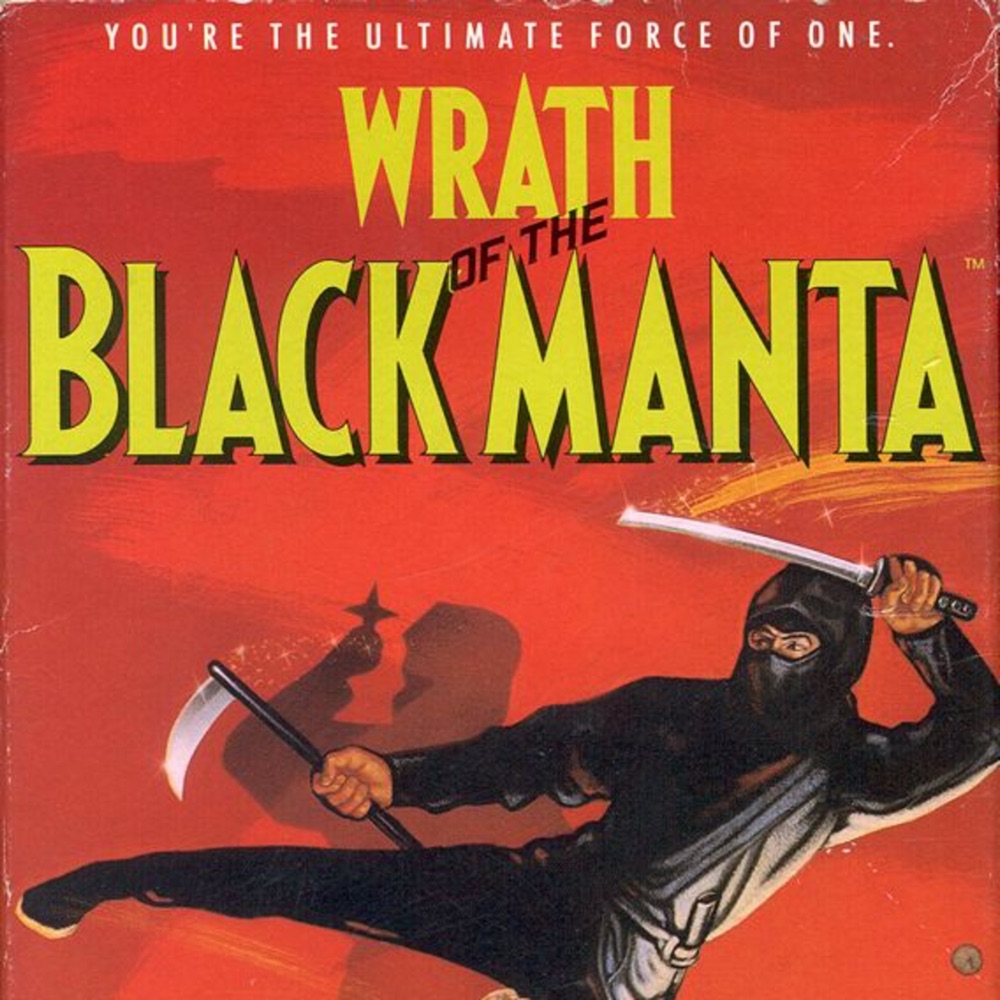
New York is being overrun with crime, and the city's children are mysteriously disappearing. It is up to the Black Manta to rescue the children and stop whomever is behind this. In addition to his ninja skills, Black Manta will be able to acquire additional powers (including invisibility and teleportation) to help him out against the numerous and well-armed villains.
Wrath of the Black Manta opens with "for every crime there is punishment, for every vice there is vengeance," and what follows is basically a playable DARE assembly. You are a ninja going after DRAT, the Drug Runners and Terrorist Association, because kids in New York are being kidnapped, including one of your sensei's students. Mike, Sean and Joe played it, and we were harsher on it during the episode than we felt afterward.
What works
- One button that thinks. Attack is context-based: slash when an enemy is adjacent, throw a star when none is. Hold the button and press a direction to fire a ninja art. We called that forward-thinking for 1990, and we liked that you learn new arts as you go.
- Movement that does the job. It's nowhere near Ryu in Ninja Gaiden, and the Manta never feels especially ninja-like, but it beat most of the NES platformers we'd played. It's also an easy game, so it stays friendly.
- The strange parts. Kids you rescue look like grandmas. The man in red, whom you grab in a chokehold, claims the drug trade is a cult out to convert the world. The first boss, Tiny, is a huge sprite and the one fight that really stands out. There's a kite stage, and a finale with a spaceship that turns into an alien.
- Ham-fisted, and we enjoyed it. Sean called it the clearest picture of mid-1990 he has ever gotten.
What doesn't
- The ninja arts barely matter. There's no meter, but most enemies die in one hit, so throwing a star is simpler. We mostly saved them for bosses.
- Rock, paper, scissors. Enemies stand or crouch, so you jump or duck, again and again. Only the teleporting enemy breaks the pattern.
- Doors, doors, doors. Half of each level is entering rooms that are almost carbon copies, off the main path. Clearing them heals you, but we all got to know every one by heart.
- Secrets that hide. The man in red tells you where the hidden walls are, which is better than saying nothing. But you need to shoot a wall several times plus one, and we only worked that out by guessing or from a long play.
- A boss rush. At the end you choose one of four doors, each holding an old boss. Assume you must beat all four and it is enough to make you quit.
Beyond the game
The Japanese version is called Ninja Cop. It has no drug references, and its cutscenes are cute anime style, with a blue-haired kid, instead of our more serious look. We preferred ours.
The bottom line
Play it. We all left it off the Essential Games List. It's a competent game that would have impressed in 1990, but it doesn't blow you away now. We compared it to Horizon Zero Dawn arriving the same year as Mario Odyssey and Breath of the Wild. If you're working through the NES library, it's worth your time for the cheesy story and goofy art.
Written from our conversation in this episode.
- FOR EVERY CRIME, THERE IS PUNISHMENT
- FOR EVERY VICE, THERE IS VENGEANCE
- NES Longplay
- Manual
- Ninjas
- STORY
- Children in New York are being kidnapped. Your sensei’s students is one of them. This persuades Black Manta to stop it. Is this really a job for a Ninja?
- The “children” you save
- Children in New York are being kidnapped. Your sensei’s students is one of them. This persuades Black Manta to stop it. Is this really a job for a Ninja?
- Control of your Ninja
- The limited options of gameplay outcomes
- Enemies attack either straight on or in a crouched position.
- The limited options of gameplay outcomes
- Exploration in the levels
- ninja arts
- The convoluted method to use these Ninja Arts
- Usefulness and Uniqueness
- Hidden Walls
- You gotta hit it like 20 times
- TINY
- GO TO JAPAN
- The Kite Flying levels
- SHMUP like stages
- Random Over the shoulder Ninja Star level in the final level
- The confusing sprite of the final boss
- Looks like two kids with one on top of the other
- A guy with a huge head using a kid as a shield
- The anti-drug reference
- Version Differences
- The graphics in these scenes are less in the style of anime or manga and more realistic in the U.S. and European versions.
- The Japanese version also has him shoot a projectile from his fists
- The Rio de Janeiro stage on the Japanese game has a boss creature made of electricity, where in Black Manta the boss is replaced with the Voodoo warrior.
- the sprites used for jumping upward are different in both versions.
- There are six stages in Ninja Cop Saizou where Wrath of the Black Manta only has five
- In Ninja Cop, the players must take on all of the bosses from the previous levels, where in Black Manta, they only have to take on BLANK
- The final boss is also completely different in both games. In Black Manta, the player only has to fight a character named El Toro using four of the ninja arts. In Ninja Cop, the player has to take on a space ship which drops a variety of enemies from the game. After that, the game's final boss transforms into an alien, which the player must fight normally, unlike having to use ninja arts like in Black Manta.
- both games have completely different soundtracks
- EGL
- Next week - XEXYZ
- NEStalgia Byte -
Auto-generated transcript. Each paragraph starts with its timestamp. Speakers are not identified.
Wrath of the Black Manta, for every crime there is punishment, for every vice there is vengeance.
And welcome to NEStalgia, a chronological exploration of every NES game released in North America. I'm Mike. I'm Sean. And I'm Joe. Is that true? For every vice there is vengeance? Do you agree with that statement? Yeah. What do they mean by vice? I mean, there could be vices that aren't like criminal. Well, I think what it means by that is like this is basically a playable like dare PSA. And the vice is anything to do with recreational drug. Yeah, because in the game you are trying to take down DRAT, I believe it, the D-R-A-T, DRAT, DRUG RUNNERS AND TERRORIST ASSOCIATION. Yeah. And there's a lot of drugs in this game.
Yeah. Specific drugs, too. I mean, surprisingly, they like, yeah, they call out specific, like dope. I feel like normally if it's like a kid's PSA thing, they would just say drugs. Yeah, it does feel like the terrorist thing is just like an additional like scary word, right? And I don't really recall too many terrorists in the game.
Definitely a lot of would-be child kidnappers, though, because that's another story plot point, is that children in New York specifically, hyper-localized to New York, are being kidnapped. And your sensei, you're the black manta, your sensei alerts you about this situation because one of his students has also been kidnapped. And that's what persuades the black manta to stop all these kidnappings. And I have two questions about that. Is this really a job for a ninja?
And if it is, why didn't he always just do this, right? And if he always had the capability to stop children from being kidnapped, shouldn't he have just agreed anyway? Oh, no, Taro wasn't in trouble. Okay, here's the thing. So, first of all, he didn't know until he was called by his sensei. Before his sensei called him, he was just sitting in a dark room in full ninja garb, which I imagine he spends most nights doing. So, you know, if Batman doesn't know about a crime, how is he going to stop it? And secondly, since it seems that this organization of terrorists and drug runners is primarily
staffed by ninjas or other martial artists, then one would assume that there are other ninjas that, you know, maybe free agents. Hmm. Well, so what he should have done is when the sensei said kids are being kidnapped, but before he said Taro has also been kidnapped, the Black Manta should have said, stop right there. I'm going to go right now. I don't care who else has been kidnapped. If one person's been kidnapped, I'm going. You cannot interrupt your sensei. Oh, I forgot. I forgot the sensei-sensei relationship. And Black Manta's kind of like a ninja with attitude, right? Like, what's up with that main menu where he's posing for his rap album cover?
It's funny that you say that because anytime, like, there's a cut scene and it shows, like, closer to the Black Manta's face, like, I just can't not visualize sort of, like, a pudgy dad. Like, a pudgy blonde dad wearing this ninja costume. Like, there's something in his eyes that just shows him that, like, he's past his prime or maybe he's still not really in shape enough to do this. But, I don't know. That's sort of the vibe I was getting. I mean, is that the, like, because of the, like, don't do drugs kids, like, after school kind of message here that you associate that with that kind of person? It might be. I, it could be something completely, uh, pathological.
I don't know. Yeah, the Black Manta's the dad and the sensei is the grandfather and Taro's just getting one really expensive lesson on why you don't do drugs. Like, everyone else is in on it. That's why you always leave a note. Right, exactly. Thank you, Sean. You got it. A lot of notes. Uh, yeah. And also, while we're on the subject of plot, I swear we'll talk about the game at one point. Um, the children you save. Can we talk about these so-called children?
Yeah. Yeah, this is definitely, um, at some point not intended to be children and then was rewritten to be children because these sprites do not look like children. Yeah, there's, there's like a whole, a very diverse array of, of ages and races and genders. Like, at one point, I, um, I, I picked up, you know, I, I rescued somebody and they're like, hey, my friend's next door. Can you, can you go rescue them?
And we're like, yep, sure. Say no more. I'll go get them. Um, and then you go next door and you rescue the same exact person. Um, and, and, an old lady and your character is just like, yeah, your buddy, he, he said you were in here. So I came and gotcha. And, and I just feel like, you know, everything was written before they actually, you know, created the art assets for this game.
See, I, yeah, I almost feel like it's gotta be the opposite. They created the art assets and then they were like, oh, we should have made them kids. And we can just say they're kids.
Yeah. And what good is a, any kind of ninja video game if it's not, uh, you know, full of awesome ninja arts and cool moves and, uh, you know, like a ninja who feels really in control of his platforming. How is the Black Manta, you know, just his movement, his weapon options, his melee combat,
you know, compare it for me to Ryu from Ninja Gaiden, if you will. If I'm thinking of Ryu, I mean, the movement here is worse, but like, it's totally, it's weird because the whole time, like, this is totally, like, I, I didn't have a hard time with it. It wasn't frustrating or anything. I think that I just have that feeling from Ninja Gaiden in my head when I'm playing a game like this. So like, it is noticeable that it, that it's not at that level, but it's, I will say, I think the movement is better than like 75% of platformers we've played on, on the NES,
but it just doesn't, it doesn't stand out as like, as top, you know, like, like there's plenty of room for improvement. Yeah. I'd say that this is a, the, the people that designed movement and controls for this game, I'd say that they were kind of forward thinking because there, there's like one attack button, um, and it's completely context based. Like if you're right next to a guy, you're going to slash at them. And if there isn't a guy right in front of you, you're just going to shoot your star.
And then you have the like holding down to charge of your special, special attacks. That is, is still kind of, uh, is kind of like a new concept right now. Um, with that, I thought that was pretty satisfying, but it seems to be in the movement itself, while like the difference in like the heights of, of jumping to the side or like somersaulting or just jumping straight up can be kind of weird to, uh, to modulate.
Um, it seemed to be thinking about the quality of life of the player more than the average game, which is more like, fuck you. The button is the button. Yeah. And, and, and it's adding onto the, uh, that holding down the button for your power up move, just holding down the button plus one direction on the directional D pad, giving you a different move than like another direction. That's, you know, that's very like super smash brothers. Like it's cool because it, that gives you a lot more options.
Really getting all of the, uh, getting the most out of that two button controller. Yeah. I, I think that overall though, like circling back to your question, Mike, what, what I think could have been better about the movement is even though it's like, it's totally fine, totally passable. I don't feel like a ninja, you know? Yes. I feel like I'm controlling a good game, but I don't feel like, don't get that feeling that Ninja Gaiden gave me where I'm like, oh, the, the motion makes me feel like a swift ninja. Right.
And I don't know if that's just because he doesn't like when he jumps in the air, he grabs his knees and starts doing like a, you know, flip in the air each time he jumps or something. Like, I don't know if it's an animation thing, but yes, it does feel more like he is in a beat them up than he is in, in a platformer or action kind of game. I think it's mostly just the speed of movement in general. Like you, cause that is the pace in which he walks. If you were playing double dragon and not so much Ninja Gaiden, which is much faster and like, he's not doing like a ninja run. He's just sort of plotting towards the dudes.
So, I mean, I, I said that like, oh, it's kind of forward, forward thinking in terms of design. It's just not forward thinking in terms of like what the game should be going for. Yeah. But I do think you touched on something that not a lot of people while playing would recognize, Sean. Um, and that is the, the situational context, contextual, uh, attack scheme. And then Joe, you touched upon the Ninja arts being assigned to, uh, the B button plus specific directions. And that is, that is great. And the Ninja arts themselves are, are interesting and you learn new ones as you go on, which is great for progression. Two things about the Ninja arts.
The first being the convoluted method to use those Ninja arts. And I don't mean in the actual level to level thing. I mean, understanding that you're choosing them while you're doing it in the menus. That was a little like tough for me to understand. And I'm not sure if you guys agree with that or not, but I wasn't understanding that I was assigning Ninja arts to buttons, uh, in that little screen before the stage. The only reason that I did know is because this was one of the rare instances in which I did read the manual.
I, I realized what was, what it wanted me to do. And it did take me a second to like figure out how to like get into switching them up. Like at first I thought it was just telling me, okay, this button does this, this button does that. But then eventually I realized that you can like go in and swap things out and maybe I didn't, maybe you have to, I can't remember. You have to, you have to earn a new one before you're able to swap anything or do you already have the option to swap early on?
I, I actually didn't even realize that I could swap mid-level until very late. So I don't know. Oh, you can swap mid-level? I didn't know that until right now. Yes, you can. Oh, okay. Well, I had no idea. But at the beginning of the level, um, I didn't realize that you could, that you could do that. But once I figured, once I like just figured it out, once I got used to it, I thought it was a very good method.
Granted, maybe it was more convoluted than I thought because I had no idea you could swap mid-level. I thought I was locked into my choices at the beginning of the level. Well, after each level, you're, you unlock a couple and then that would be at least for the first couple levels, your only real reason to do that is because you unlocked one. So I can understand where you'd get that vibe. Oh yeah. Yeah. But how do you do it in the middle of a level? Cause pausing doesn't, I think it just select.
Really? I tried select just to see what, if it would do anything and it didn't, nothing happened. Yeah. If you press the select button during gameplay, it will show you the Ninja art screen. The more, you know, anyway, go, my other thing about the Ninja arts is they're a little like, uh, you know, not overpowered or whatever, but there isn't necessarily a limit to them or a magic meter or anything. And so you kind of just like should always be using them, right?
Yeah. I guess the only limitation is just the time it takes to actually pull it off. And there are times where there are, I mean, not really. This is actually a pretty slow moving game. You never really get overwhelmed. There's only like one or two or three enemies on the screen at a time. So you, you'll kind of always have time to pull one off. So I'm a sort of arguing against my argument, but I guess that would be the trade-off if this were a harder game.
Well, I, I do agree that like a lot of these are powerful and interesting, but I don't know why, but like in the moment to moment gameplay, I really never found them particularly useful except for some certain scenarios. You know, there's not a lot of times where you run, where you run into enemies that take more than one hit. It's really towards like the later levels. Once in a while you run into those like goblin looking people or like you run into those guys that are like flying on like kites and like they take a couple of hits. But for the most part, they all just look like Deadpool to me.
Yeah. For the most part, you're, you're just fighting like regular people that take one hit to kill. And I just always, almost always found it just easier to just throw a star or whatever it is you're shooting at them or whatever, uh, rather than charge up a power up. I use the power us mostly on bosses.
Um, and even then I think that I, it was kind of sparing. Like I, I wish that there, I had more of a reason to use them. And maybe that was because of like the charge up. Like I just felt like it was easier to shoot and then jump away from an enemy rather than like try and charge up. Granted, you don't have to charge it up all the way to fire it, but just something about
it. I didn't feel the need to use the power ups that often. Like I would test them at the beginning of the level and then just not really use them the rest of the time. Joe, your comment about not feeling the need to use the ninja arts kind of leads to something that, uh, I wrote down in my notes and I just don't have an elegant way of saying it, but I wrote down the limited option, the limited option of gameplay outcomes.
And what I meant by that is really that for the most part, every enemy you encounter in the game is shooting at you or punching at you. And they're either in a standing position that's at your level or a crouched position, uh, that you will then have to like jump over that. And I, and I don't know why I felt it in this game more than in other games where like, think about there's not that many outcomes in super Mario brothers, right? There's not as many projectile enemies and most enemies are just walking towards you. You have to jump over them. But in this game, it just felt like maybe because there's only two planes of battle, but it felt like each time I've encountered two new enemies or however many enemies at a time, it was just,
I'm not actually able to think about like tactfully how I should take on these enemies. And instead it's just, uh, are they shooting on this plane? Then I should duck. Oh, are they ducking? I should jump. And you just like continually do that for a while. And it starts to, you start to feel it. And so I started using the Ninja Arch just to rejuvenate some of the gameplay and try something different, but yeah, they aren't really like, they're not needed and they're not like enhancing the gameplay in another way. Whereas, you know, just to go to the other Ninja game, Ninja Gaiden, like I do feel like,
yeah, there's a lot of unfair enemies in that game, but you feel like you're more in control of your outcomes where in this game you really are just seeing where the enemy is positioning themselves and then just doing the opposite. You're kind of just doing like a game of rock, paper, scissors, but it's just you're always rock and they're always scissors. I think that what might have made you feel that way is because they have one enemy that behaves differently than the others. Like aside from the flying, which is just the flying version of regular dudes standing on the ground. There's like the enemy that will sort of teleport in front of you and behind you. And like, that's the only enemy that kind of behaves differently.
And I think that because we were given a taste of some enemy variety, but they stopped right there. Maybe it feels more like they could have done more, more so than if they just had dudes standing. I don't know.
I'm kind of psychologizing. I hear what you're saying because I personally didn't, didn't, I mean, I, I, when everything you're saying, Mike, as you're saying, I'm like, yeah, that's definitely true for this game. I didn't notice it as a, as something that bothered me, but I did notice that same problem on a more like macro scale where like half the game is kind of going in these doors where
you fight a little series of enemies. Most of these are literally the exact same scenario copied and pasted over and over again to the point where I go in a door and I, I muscle memory my way through the encounter. Like I could do it with my eyes closed because it's the only thing you do where in, and that, you know, one thing I like about it is when you, when you defeat one of these like indoor
enemy encounters, you get some health back. So it like gives you a reason to do it. But then I kind of lose all stakes because I know it's almost always going to be exactly the same thing. And I know exactly what I got to do and when I got to do it to just not get hit and defeat the three enemies. And there are a couple instances like that where it's like, it just gets a little samey. You know, you're, you're always chasing this guy in red and you always have to run up to him and grab him and he gives you no information and then, and then he disappears and you got to find him again. Gives you no information.
And like this, that's just like a, that's like a cherry on top sort of thing. Like that, that's not necessary in this game. So it is like a nice addition, but I, I don't know. I feel like I'm complaining cause there's not more variety, but I'm complaining about something that they didn't have to include at all. And like, it is nice that they included it, but yeah, it just, you got to know what to expect pretty quickly.
And in each level, uh, there is a sort of exploration and definitely not open world, definitely not like RPG mechanics, but exploration in the sense of there are rooms and buildings you can enter and, uh, find out that information or track down these red guys that Joe was mentioning that you grab and, and, uh, try to get some, uh, force some information out of them. But what is the exploration actually like? Are these doors and, and buildings that you go into requirements? Uh, do they lead to interesting encounters? Do they switch up the gameplay? Of course I know the answers, but, um, for the listeners who maybe didn't play the game, what is the exploration like?
Yeah. So, I mean, when I first saw this, I thought it was pretty cool. Like, Oh, you can actually go in that door and like see what's behind it. Like, Oh, I'm going to kill these enemies that were just hiding back here. Like I felt like I, uh, I found something and then you do it over and over and over and over again. And like Joe said, like they're pretty much carbon copies of each other or like there's like two or three variations and it doesn't matter which actual level you're on. They all kind of look exactly the same.
Um, and like the fact that it's all just these little, they're like, they're not branching paths. It's just little nubs off the critical path and then you have to go back and then keep moving to the right afterwards. It was pretty disappointing. Um, once that very quickly, uh, was apparent.
Um, but yeah, I mean, it's still a cool concept. And in this exploration, uh, you might find rooms with notes in them or through interrogation get, get a piece of information. Believe it or not, it can happen. Nine times out of 10, the guy in red will just be another, um, cog in the machine. But, uh, eventually you'll get the guy who actually knows something.
And what they reveal to you is kind of inconsequential. Like, yes, there are a few times where they'll reveal to you where a, um, hostage might be. Uh, that is a kidnapped child, if you will, uh, where they might be. But for the most part, it's also just revealing things like, hey, if you just like jump up to the next level and go through this door, like there's a hidden blah, blah, blah here. And it's like, okay, like, sure. Thanks for telling me where the secret stuff is. And I just feel like, yes, games, other games do that too.
And I don't think I'm, now I'm like becoming critical of all games that do this. Like you're revealing to me where the hidden stuff is. Like, shouldn't I be able to find this out in a cool way, like through the design of your level that I stumbled across this stuff. But speaking of the hidden walls, do they really exist?
Well, okay. Do you guys ever go into one of these? Yeah, I went into all of them. So, okay. First, I just want to unpack the man in red because we just sort of spoke about it as a matter of course. And it's a really weird concept. It's an enemy. It's a normal enemy, but it's red. And instead of killing him, you walk up to him and you put him into a chokehold and have a really weird dialogue where he either says he does nothing. He explains how drugs are a cult that he's converting the world to. Or he tells you where a, yeah, where like a kid is or something. And that's just weird on its own. But yes, these walls.
I thought that I was just finding the wrong wall over and over because I kept shooting at them and nothing was happening. I even shot at them several times in a row and nothing would happen. But what you actually have to do is shoot at the wall several times in a row plus one. And then you'll get teleported to this secret area.
And I only learned that from watching a long play after playing the game. It was, it's very strange. The only reason, the reason that they tell you exactly where to go and what to do is because you have to shoot the wall so often that you would never find it on your own.
Yeah. I mean, so I liked that they had, that they were telling you their secrets on one hand because we've complained so many times about there being secrets that like you would never find. I don't think that this is the best way to do it. It's just like put a secret that is not implemented in good game design and then tell you about it. But I think it's better than putting a secret that's not implemented by good game design and not telling you about it.
If you know, if that makes any sense. So yes, the better way to do it would be to like make it more like you could cohesively figure it out because of the gameplay. But if they're not going to do that, I'm glad that they, that they had, that they told me about it. Because like you're not going to figure anything out. It's not like they're, they're.
Yeah. There's no clue. Yeah. There's, it's not like this is a puzzle or that it's like you have to do something interesting or that there's something interesting on the other side. It's either going to be another note, another hostage or like a life power up. Like nothing really interesting is happening in these things. Yeah. But I, I did. I mean, so I just, when the first person told me about the secret door, whichever one it was, I just shot a bunch of times. Then I ducked and shot a bunch of times. And it seemed like when I would duck and shoot a bunch of times at the wall they're talking about, it would work on the fifth shot.
So yeah, I just did that every other time. And I'm pretty sure, yeah, you have to shoot low. It doesn't make that clear, but, but yeah. I just wouldn't have even shot five times. Like, oh, this is the wrong wall.
Yeah. I was just kind of just guessing, I guess. But, but also to backtrack back to the man in red, first of all, I'm, I was under the impression that when you, each level, every time you grab the man in red and then he gets away or whatever, the next time you grab him, it's the same man. Oh yeah. It's the same dude. And then the next level, it's a new guy. So the thing that bothers me about this a little bit is like, clearly they are, you know, it's not like RNG or something like the, the guy shows up when they want him to, they've designed it to, they, they write. It is dialogue. If you're going to write the dialogue for it, make it unique for each guy.
You know, like sometimes, sometimes like they have unique stuff, but a lot of times they're just saying the same thing. Sometimes like twice in a row, you catch them again, they say the same thing and it'll be like, all right, all right. I'll tell you everything I know. And then you'd be like, what do you know? Like, I don't know anything. And then it's like, it does that three times. And I'm just like, just give them some interesting dialogue. If you have the capability, it just feels like, like they wrote the dialogue and then they're like, oh, he's not in there enough. Let's add them three more times and we'll just copy and paste more dialogue or something.
I don't know. Just, just a nitpick. But it was just like, if you're going to have to, to manually create this each time anyways, just make him say something different. There were even times where he said the same thing in, with like, in like slightly different words, like literally like added one more word to it, but it's the same sentence. I'm like, okay, so you went in and changed it. Why didn't you just make it different? I don't know. It bothered me. It's like, make these guys different characters. It was my favorite part of the game.
I don't know if it's just because I fought a bunch of guys who all wear the same blue uniform, but I didn't assume that the red guy, I'm not saying you're wrong. I'm saying I just didn't assume that. And I, that's why I thought that they repeated because you're just finding a new guy who's just saying the same old story as the, as the other guys, you know? There's also context of like, he seems to be carrying over the conversation from meeting to meeting at certain points. Like there's almost some continuity there that made, and, and these, um, and, and these sort of mugshots of, of the dude you're talking to are so unique, at least to me that it just felt like the same dude.
Yeah, because it'll show, yeah, it'll show as you talk to him, it shows a big, a large sprite of their head while they're talking. And in the first level, it's always the same sprite. And then at the end of the level, you see that sprite of that guy's head report to the big bad and tell him what you've been up to. Then in the next level, there's a new guy. And every time you talk to him, it's that guy's sprite. So I'm just like, okay, these are the characters. They're like his henchmen or whatever.
Going through the very first stage, um, when you, uh, speaking of like building on story and, uh, getting some clues, uh, there's a note about Tiny, uh, who is implied to be the boss of the, uh, first stage. We have played a few other games where this is a joke, usually in the opposite direction. A guy is considered, you know, like watch out for big Bob or something. And then he's just a midget or something. But here with Tiny, uh, this is like an overly, uh, gigantic sprite, uh, a very impressive, uh, boss sprite, if you will. Well, but not the kind of, I don't know, I just feel, I feel like for whatever reason, the, the, this boss fight with Tiny, like really stands out as both a interesting, uh,
centerpiece early on, right? A discussion point, uh, you got to talk about Tiny in your episode. Like that was wild, but also just completely unlike the rest of the game. Yeah. I mean, first of all, uh, my Tiny is from Crash Bandicoot. Um, and he's, he's a very large, I don't know, tiger or something. I don't remember. You, you had my respect and you lost it.
It's been a while. Um, so that's not new to me, but you're right. Like if, if you just go by level one and everything that level one was doing, including this wild, uh, boss fight, if, if it just sort of had that kind of variation, if it continued to surprise throughout, then I'd have a much different opinion of this game, but it just seemed to stick to that formula and never really outshined Tiny, you know? Uh, I'm trying to think. So who, who else did we have? And we had, later on, we had the robots. The voodoo guy, the robots.
Oh yeah, the voodoo thing. Um. There's one more in between there. And then I'm after Tiny. Cause, cause I, I'm just thinking of this because I don't remember having that feeling that like Tiny, I mean, yes, obviously Tiny aesthetically stands out, but I didn't like think that boss fight stood out to me as, as like more so than the other ones. I mean, the boss fight was super simple and it, but like the actual, the actual boss itself, like the, the art of it was definitely stood out. Oh yeah, the other one was like this totem pole thing. That was the, the second one.
Yeah, that was dumb. Now, are they ninjas that turn into totem poles? That seems to be the implication. Yeah, there are three ninjas like standing on top of each other and then they just immediately transform into this totem pole thing. So it's like, why did they ever need to be ninjas? Like why couldn't it have just been some haunted totem pole or something? Is it a magic trick? Like, you know, like they're sawing the bodies in half. Yeah. They also don't really have like a health bar. You just, you just hit each one once and they're dead.
Yeah. And then after you defeat Tiny, I just thought this was an interesting anecdote from the main boss of the game, El Toro. He's like, oh my gosh, he beat Tiny? Well then we should go to Japan. Ninjas are there. And I'm like, is that supposed to be funny? Does he not know that Black Manta's a ninja? Ninja? Or do ninjas hate other ninjas? No, he doesn't know it's Black Manta until later in the game, Mike. That's true. Right, right. That's true. I do know that.
Okay. So then like, I guess it is just a, maybe a funny thing though, right? Like he's just completely incompetent and sends him to probably like the area where a ninja would excel best. I mean, do you think a ninja would excel best against other ninjas? That's what they were trained in, right? Don't you train with other ninjas? I would prefer ninjas to be protecting me from another ninja than a bunch of dudes with handguns. Well, you know, in 80s action movie logic.
And then are we implying that you like took a plane to Japan and got there or was it the kite that you flew in that shmup-like stage? Did you fly on the kite to Japan? I just want to say that that was the first place where I got stuck. I had no idea you were supposed to hijack a kite.
I never aimed for the high guy because I was just like, I don't feel like tying my shot to kill him. And like, oh, this is going to take a couple of shots. So I actually had to stop the game and see what was going on and realize that you had to hijack the bed sheet. All I have to say, the shmup thing, you know, it's interesting, right? Sean, you were talking about how like the boss fight feels a little different. And then you go into the shmup thing and then you and I keep calling it a shmup thing. It's not really. It's just a side scrolling shooter like level. Then you're just back to the same old game for a while.
So it really did kind of like show you everything that the game has to offer and then say, now let's just repeat it, which is not a try. No, I know, I know, I know. Yeah. Like each level I did find like, oh, something new.
Yeah, there's that. Even at the very end there, you like have that over the shoulder, throw your ninja stars. Yeah. And I say over the shoulder, but it's the same thing I was trying to describe with Contra. It's the first person thing I think you do. Yeah. It was like the first Contra game. Yeah, exactly. It's like a pseudo 3D, not quite there. All nice touches. And don't get me wrong. I mean, like at some point, right, the game just can't continue to be new things. It has to, it has to, you know, like think about it. It laid down a lot of stuff in the very first level, including the kite stage that gets you to the next area.
I don't have a thought either way on like, does it get stale or not? That's up to whether you're enjoying the gameplay experience up to that point. Right? I don't, I think that they've introduced enough. It's not the kind of game in the past I've asked questions of like, and that's the gameplay loop. And that's usually because the gameplay loop occurred in two minutes. Yeah. I think why we're kind of double standarding this is because they keep introducing, they were introducing new things.
It's just a clip early on that you would think that they would continue. Um, but the game is like each level is so short that then it just going back to like the, the sort of meat and potatoes that I don't know. It just feels like there isn't enough going on. There isn't enough content here after that fact. Yeah. I have like a weird kind of relationship with this because I agree. I, I, it, it, it does feel samey between all of those like little, little points of interest,
but I wasn't getting bored of it really for, for a while. Like I would a lot of other, um, games like this, like maybe part of it was the accessibility of it. Like this isn't a very hard game and that makes it like, I don't know, more accessible, obviously, you know? And I, and I feel like, okay, I can keep going and I'm, and I'm having a, a moderately, like fun time with the, you know, with, with the gameplay. But for me, what did it, what made me think like, okay, I don't want to do this anymore was in the final, I'm assuming the final stage, uh, the boss rush. You get into, you, you fight, you have to fight all the same bosses and I, you know, maybe just to fight the one, right?
Maybe just to fight tiny and then you go to. No, there's four doors. One of each of the old bosses. Oh. Unless you only have to pick one of them. But as soon as I went in and I was like, okay, each of the bosses are here. You just take on the one. Oh, but you have to pick one? Because mine, when I went in, it was the robots, not tiny. Uh, yeah, I think you just get to pick one. Oh, I didn't realize that. I thought I was gonna have to fight all four. And I was like, you know what? I don't really set up doing this.
Well, regardless, I think your point stands. Yeah. It's just like, I don't feel like doing this. Like, now the game, not only is it same, it's like asking me to redo the same thing. Which, it's funny because I don't always think that a boss rush of refighting bosses is a bad thing. I mean, I think it works in Mega Man and, you know, I don't know why. Maybe it was because I wasn't so interested in the boss battles themselves that, like, I just didn't feel like doing them again.
And I feel like I was just like, okay, I get it now enough. And I, you know, but granted, if I had known that I was only going to have to do one of them, because there are four doors. So if I had known I only have to do one of them, I probably would have kept going. But I was like, okay, I think I'm, I mean, I knew I was going to probably lose all my lives anyways, so.
My, uh, my equivalent for that, because I had a similar feel at a certain point during the game. I don't know exactly where, but it was a point, it was at a point at which you kind of already understand what doors are going to be. Like, you go to a door, you go to the room, you fight a few dudes, or you, there's nothing there. And, and you get to this part of the level, and you just see door after door after door after door, and like, I don't want to go through all these, it's the same thing over and over. So, I get what you mean. Yeah, yeah. I know exactly what you're talking about.
Yeah. We mentioned at the top of the episode that the game might be a little heavy on the whole, like, don't do drugs, kids. Um, and obviously, like, you know, at the time, video games were mostly marketed and advertised towards kids. And, uh, you know, I guess I'm wondering, did you think maybe that there was an agenda here? Not just, like, a fun little tie-in, but that maybe there is some, some tie-in with an actual organization, uh, like Dare or another one to be like, hey, let's, uh, let's try to Americanize this and put in anti-drug mentions in this game? It definitely felt like it.
I mean, as again, when I made the joke about the drug cult and that they're trying to brainwash the kids into joining it, I wasn't making that up. Like, that is something that one of the men in red say is their, like, end goal. They're trying to take over each country's drug operation and they're kidnapping these seven, these 70-year-old grandma children, um, to be their mind-erased drug mules.
Um, and yeah, it's kind of crazy that, that they're this ham-fisted about it. So you have to, you have to imagine that some federal agency had some hand in this. Well, and what I think is interesting, though, is that if it is, like, yeah, like a Dare-like program that is, like, behind this video game, this is the highest quality Dare.
Or, like, or, like, whatever, like, don't do drug kids after school special related video game that there's ever been. It's gotta be. Because, like, usually something like that would be, like, really just, like, poorly done on the video game side, at least in my experience. So, like, kudos to them getting both of those things to fit together in one package and to, like, work. Granted, I do think it is very funny that the, uh, evil organization's goal is to take over all major drug organizations in the world.
Meaning that, assuming you take down this organization, like, they have just done the work for you of consolidating all drug problems of the world for you to just take out this one guy and, like, now are there no drug organizations left? And it's funny because, like, you know, you never live to see the consequences of disrupting this centralized drug operation and seeing the power vacuum that you've created. And maybe there'd be many more lives lost because of power struggles. They never let you see that. Yeah. The heck. Propaganda at its finest.
Would it shock you to find out that the Japanese version of this game doesn't have any of these, uh, drug references in it? It would not. I, I, I read that you... In a lot of it felt very translation-y. Yeah. I read that you fight a spaceship at a certain point, too. Yeah, yes, that, that is true.
Uh, the game is called Ninja Cop, um, and believe it or not, the, you know, there's a lot of changes and it's all detailed on Wikipedia, so I'm not really gonna, uh, go into it here to pretend like I did the research. I just wanna point out the most interesting thing, and guys, I'm gonna share it with you here on the Discord, um, is that the animation style of the cutscenes is a dramatic change. It's, it, it, it basically implies a completely different game, because in our version, we got these kind of, like, you know, a serious-looking ninja and, um, you know, more detailed and everything. Yeah. There's just more detail in everything. In the Japanese version, they went for, like, uh, you know, a cute anime-style look for everybody.
And, uh, it's kinda wild that, like, I guess in, in, if you're gonna change the whole story, you might as well also change the graphics, but that's not the case. That's, this is the outlier. Usually, you just change the localization, right? Like, you just change what, what people are saying, not how the game actually looks.
Yeah, it's funny, because the, the, the localization, I mean, based on just this one screenshot, I mean, the localization that we played looks a lot cooler to me. Yeah, I prefer, I prefer this, but I also think that the change in, uh, content theme also, like, maybe the, the marketers were savvy enough to realize that, like, watching, um, these, this, this kid with blue hair and this goofy-looking old man talk about, uh, disrupting the drug trade is kinda silly. But, I mean, this game is already silly, just in, in, in a way that it, you know, they are not in on the joke.
Um, I just think that they would have, even they would know that that art style might make it hard to take seriously. And then, Joe, they did use your idea, um, of having to take on a boss rush before you get to the final boss, uh, which, which is the spaceship. Um, um, which is just wild, but this, so just to be clear, two things. So, yes, you have to go through all those doors and defeat all the old bosses in order to take on the spaceship. But then, also, the spaceship is just kinda the beginning of the boss fight. So, first, the spaceship drops a variety of different enemies that you have to take down. And then, uh, after that, the, um, either the spaceship or, uh, one of the enemies transforms into an alien.
Uh, which you have to fight without, um, I think the use of your ninja arts. Cute twist. So cute. And that's pretty much Wrath of the Black Manta. Um, you know, a, um, a very competent, uh, ninja NES game. And not the first. So that's pretty surprising. Is that surprising? I don't know. Ninja games. Ninjas are, like, up there with dinosaurs, right? Yeah, I would have thought there'd be more ninjas.
Right, we had this conversation on the Dino Wars episode, though, right? That dinosaurs were really cool in the 90s. Ninjas were also cool. The Ninja Turtles were having a great time. Was Ninja Turtles the Jurassic Park for ninjas? That's a good question. There were also a couple enemies in this game that, like, just kinda looked like knockoff Ninja Turtles. Just wanna throw that out there. What's like, well, the Karate Kid, right, is also, like, not ninjas directly, but, like, the idea of- Karate, martial arts. Yeah, martial arts and everything, like, martial arts is hype. If you say ninjas and karate, I'm thinking of the same things. So, yeah. If you ask for me who's the most popular ninja in the world, I'd say Ralph Macchio.
And the sensei is kind of, right? Isn't Mr. Miyagi his sensei? I guess. I'd say so. Think about it, right? Sean, aren't you a ninja? And am I not just your sensei? I wouldn't say that's the dynamic between us. Interesting. Uh, alright, well, there might not be a dynamic between me and Sean, but there is a dynamic in every episode of Nostalgia, and it kinda has, like, a rhythm to it, and one of the most important beats in that song is the Essential Games list.
I have no doubt in my mind that Wrath of the Black Manta was a great game in 1990 and was received positively and people were not disappointed when playing it. But it's just kinda like one of those things that's best in 1990. And what I mean by that is Wrath of the Black Manta is the Horizon Zero Dawn of 1990, where it's a great game, it gets great reviews, everybody's satisfied with it, but it happened to come out around the same time as Super Mario Odyssey, Breath of the Wild, Persona 5, Mario Kart 8 Deluxe,
Hollow Knight. Like, no one's remembering Horizon Zero Dawn against those games, or talking about it in the same way, and we'll see how that ages, because remember, you have to wait that amount of time to tell me I was wrong, so you have to wait about 30 years. But, all that to say, you know, Wrath of the Black Manta is a enjoyable NES game.
I just feel like it's not the whole package nowadays. This feels like what it would have been a great game, you know, when it came out, but now when you're looking at it with everything you know going forward, it is kinda like, you're looking for something more in a game that offers you enough, if that makes sense. So, my complaint is more to do with just how it aged than how it controls, or the length, or the difficulty, or anything.
The totally competent NES game, just not one that's gonna get me to push it onto the Essential Games list. Joe? I completely agree. I mean, I think this game is good. I think it's definitely a play it. Even today, if you wanna go back to some retro games, I think you'll probably have a pretty good time with this one. But it's just a little generic or something. Like, I don't know if that's even the right word, because it's definitely got its unique
aspects. But, like, it just doesn't blow me away. It's definitely not up on that level. Sometimes I get, like, I, like, trick myself, because we have a lot of bad games that we play on this podcast, and when I see one that's not a bad game, I'm like... Sorry. When I see one that's not a bad game, I'm like, well, that's Essential. And, no, this is definitely not Essential. It's just not a bad game.
So, not to ramble, but... I think that play it if you're interested in, like, trying a bunch of NES games. But if you're, like, just... If you just want the Essentials, this isn't one of them. Sean? Yeah, we were definitely harsher on this game in the episode than I actually feel about it. Because, again, I do think that playing the game feels relatively good. It just doesn't really blow you away in any context. I would definitely recommend you play it, especially if you want to experience just some really cheesy story and dialogue and some goofy art.
And I just think it's such a time capsule of the vibe back then when I wasn't born yet. And I know that that's the vibe because of this game. Like, this is... We are archaeologists. We're cultural archaeologists. And I think that Wrath of the Black Manta is the clearest picture of mid-1990 that I've ever gotten. Yeah, it's kind of funny to think of watch, you know, listening to 300-plus episodes of Nostalgia and still just kind of sitting on the sidelines, you know? Like, no, you're playing these games, right? If you're in it for the long haul with us, like, we're telling you play Wrath of the Black Manta if you're the one... If you're the kind of person who listens to all 300-something episodes.
The Essential Games list at this point is more just, like, something people discover on the web of, like, oh, these three people have an opinion on the Essential Games? Like, let me write an email to them and tell them how wrong they are. But if you're actually listening to the podcast over and over again, you know, you know that by now the play-its are basically worth playing.
They're not just like, oh, you know, like, that doesn't sound like it's for me. So if you haven't played Wrath of the Black Manta because you either never got around to it on its original run-through or whatever, I think we're all saying that it's worth the listener's time. But if this is your very first episode of Nostalgia, maybe check out some of the ones on the Essential Games list first before you think that we're just... No, no, check this out. It's very cool.
We're just throwing everything out there. But, you know, who knows? Because we've been told that the Essential Games list isn't perfect, and I'm shocked to hear that. That just shocks me. Whenever we throw something essential, we should mention that we mean it'll be essential in 30 more years. So then everybody has to wait 30 years to tell us we're wrong about that, too. That's always the disclaimer, right?
Right. I do. I like my Horizon Zero Dawn argument, and I'm going to listen to what the fans have to say about that. So if you think Horizon Zero Dawn is better than the other games I listed, keep in mind, that's kind of a tough competition. All right? It's not every day you get Mario Odyssey and Breath of the Wild in the same year. Unless you get Tears of the Kingdom and Super Mario Wonder in the same year. How do they keep doing this at Nintendo? Wild stuff. We're going to keep doing this, too. Next week, we have a game called Zexies. I think that's how you say it. Did you just call me Zexy? Yeah, I think I did. Thank you.